
Recent from talks
Adams–Onís Treaty
Knowledge base stats:
Talk channels stats:
Members stats:
Adams–Onís Treaty
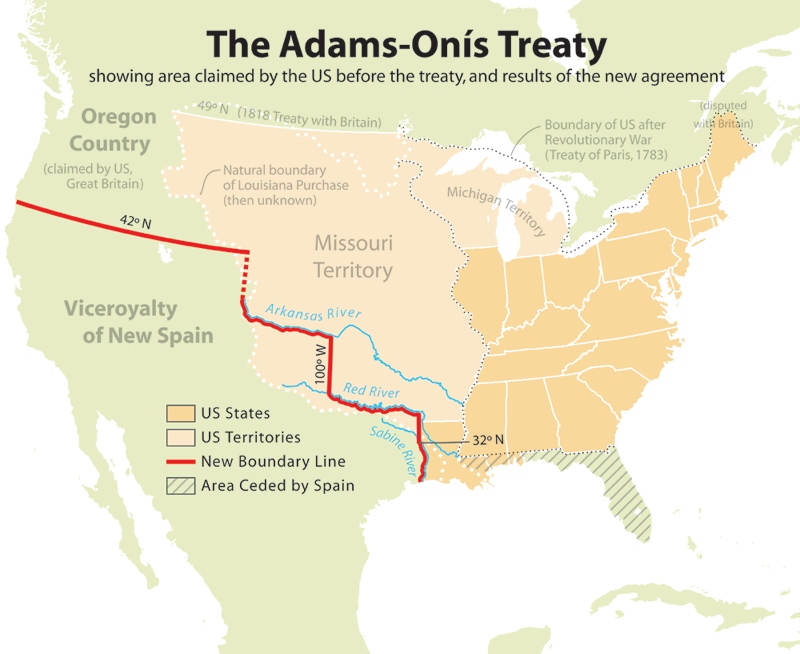
The Adams–Onís Treaty (Spanish: Tratado de Adams-Onís) of 1819, also known as the Transcontinental Treaty, the Spanish Cession, the Florida Purchase Treaty, or the Florida Treaty, was a treaty between the United States and Spain in 1819 by which Spain ceded Florida to the United States; in return, the United States renounced its claims to Texas, fixing the boundary along the Sabine River.
Florida had become a burden to Spain, which could not afford to send settlers or staff garrisons, so Madrid decided to cede the territory to the United States in exchange for settling the boundary dispute along the Sabine River in Spanish Texas. The treaty, named for signatories John Quincy Adams and Luis de Onís, established the boundary of U.S. territory and claims through the Rocky Mountains and west to the Pacific Ocean, in exchange for Washington paying residents' claims against the Spanish government up to a total of 5 million Spanish dollars (purchasing power equivalent to US$102,700,000 in 2024) and relinquishing the U.S. claims of Spanish Texas west of the Sabine River and other Spanish areas, under the terms of the Louisiana Purchase.
The treaty remained in full effect for only 183 days: from February 22, 1821, to August 24, 1821, when Spanish military officials signed the Treaty of Córdoba acknowledging the independence of Mexico. The Treaty of Limits between Mexico and the United States, signed in 1828 and effective in 1832, recognized the border defined by the Adams–Onís Treaty as the boundary between the two nations.
The Adams–Onís Treaty was negotiated by John Quincy Adams, the Secretary of State under U.S. President James Monroe, and the Spanish minister plenipotentiary (diplomatic envoy) Luis de Onís y González-Vara, during the reign of King Ferdinand VII.
Spain had long rejected repeated American efforts to purchase Florida. But by 1818, Spain was facing a troubling colonial situation in which the cession of Florida made sense. Spain had been exhausted by the Peninsular War (1807–1814) against Napoleon in Europe and needed to rebuild its credibility and presence in its colonies. Revolutionaries in Central America and South America had been waging wars of independence since 1810. Spain was unwilling to invest further in Florida, encroached on by American settlers, and it worried about the border between New Spain (a large area including today's Mexico, Central America, and much of the current U.S. western states) and the United States. With minor military presence in Florida, Spain was not able to restrain the Seminole warriors who routinely crossed the border and raided American villages and farms, as well as protected southern slave refugees from slave owners and traders of the southern United States.
The United States from 1810 to 1813 annexed and then invaded most of West Florida (already independent as the Republic of West Florida west of the Pearl River) up to the Perdido River (modern border river between the states of Alabama and Florida), claiming that the Louisiana Purchase covered West Florida also. General James Wilkinson invaded and occupied Mobile during the War of 1812 and the Spanish never returned to West Florida west of the Perdido River.
The State of Muskogee (1799–1803) demonstrated Spain's inability to control the interior of East Florida, at least de facto; the Spanish presence had been reduced to the capital (San Agustín) and other coastal cities, while the interior belonged to the Seminole nation.[citation needed]
While fighting escaped African-American slaves, outlaws, and Native Americans in U.S.-controlled Georgia during the First Seminole War, American General Andrew Jackson had pursued them into Spanish Florida. He built Fort Scott, at the southern border of Georgia (i.e., the U.S.), and used it to destroy the Negro Fort in northwest Florida, whose existence was perceived as an intolerably disruptive risk by Georgia plantation owners.
Hub AI
Adams–Onís Treaty AI simulator
(@Adams–Onís Treaty_simulator)
Adams–Onís Treaty
The Adams–Onís Treaty (Spanish: Tratado de Adams-Onís) of 1819, also known as the Transcontinental Treaty, the Spanish Cession, the Florida Purchase Treaty, or the Florida Treaty, was a treaty between the United States and Spain in 1819 by which Spain ceded Florida to the United States; in return, the United States renounced its claims to Texas, fixing the boundary along the Sabine River.
Florida had become a burden to Spain, which could not afford to send settlers or staff garrisons, so Madrid decided to cede the territory to the United States in exchange for settling the boundary dispute along the Sabine River in Spanish Texas. The treaty, named for signatories John Quincy Adams and Luis de Onís, established the boundary of U.S. territory and claims through the Rocky Mountains and west to the Pacific Ocean, in exchange for Washington paying residents' claims against the Spanish government up to a total of 5 million Spanish dollars (purchasing power equivalent to US$102,700,000 in 2024) and relinquishing the U.S. claims of Spanish Texas west of the Sabine River and other Spanish areas, under the terms of the Louisiana Purchase.
The treaty remained in full effect for only 183 days: from February 22, 1821, to August 24, 1821, when Spanish military officials signed the Treaty of Córdoba acknowledging the independence of Mexico. The Treaty of Limits between Mexico and the United States, signed in 1828 and effective in 1832, recognized the border defined by the Adams–Onís Treaty as the boundary between the two nations.
The Adams–Onís Treaty was negotiated by John Quincy Adams, the Secretary of State under U.S. President James Monroe, and the Spanish minister plenipotentiary (diplomatic envoy) Luis de Onís y González-Vara, during the reign of King Ferdinand VII.
Spain had long rejected repeated American efforts to purchase Florida. But by 1818, Spain was facing a troubling colonial situation in which the cession of Florida made sense. Spain had been exhausted by the Peninsular War (1807–1814) against Napoleon in Europe and needed to rebuild its credibility and presence in its colonies. Revolutionaries in Central America and South America had been waging wars of independence since 1810. Spain was unwilling to invest further in Florida, encroached on by American settlers, and it worried about the border between New Spain (a large area including today's Mexico, Central America, and much of the current U.S. western states) and the United States. With minor military presence in Florida, Spain was not able to restrain the Seminole warriors who routinely crossed the border and raided American villages and farms, as well as protected southern slave refugees from slave owners and traders of the southern United States.
The United States from 1810 to 1813 annexed and then invaded most of West Florida (already independent as the Republic of West Florida west of the Pearl River) up to the Perdido River (modern border river between the states of Alabama and Florida), claiming that the Louisiana Purchase covered West Florida also. General James Wilkinson invaded and occupied Mobile during the War of 1812 and the Spanish never returned to West Florida west of the Perdido River.
The State of Muskogee (1799–1803) demonstrated Spain's inability to control the interior of East Florida, at least de facto; the Spanish presence had been reduced to the capital (San Agustín) and other coastal cities, while the interior belonged to the Seminole nation.[citation needed]
While fighting escaped African-American slaves, outlaws, and Native Americans in U.S.-controlled Georgia during the First Seminole War, American General Andrew Jackson had pursued them into Spanish Florida. He built Fort Scott, at the southern border of Georgia (i.e., the U.S.), and used it to destroy the Negro Fort in northwest Florida, whose existence was perceived as an intolerably disruptive risk by Georgia plantation owners.
Recent media