



Community hub
Recent from talks
Knowledge base stats:
Talk channels stats:
Members stats:
Adi-Buddha
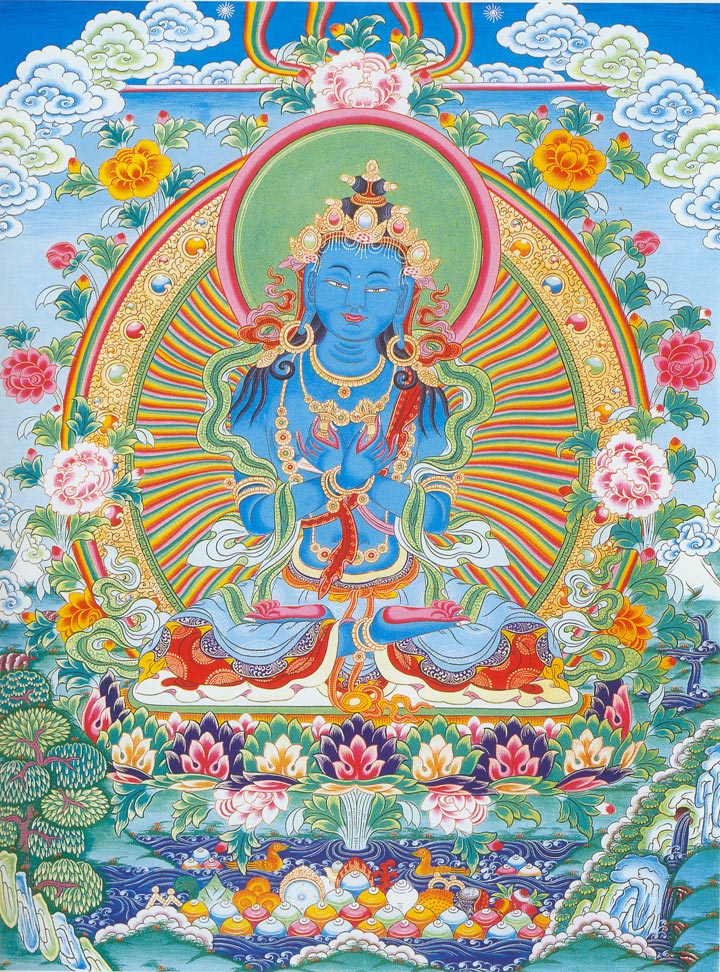
The Ādi-Buddha (Tibetan: དང་པོའི་སངས་རྒྱས།, Wylie: dang po'i sangs rgyas, THL: Dangpö Sanggyé, Ch: 本佛, Jp: honbutsu, First Buddha, Original Buddha, or Primordial Buddha) is a Mahayana Buddhist concept referring to the most fundamental, supreme, or ancient Buddha in the cosmos. Another common term for this figure is Dharmakāya Buddha.
The term emerges in tantric Buddhist literature, most prominently in the Kalachakra. "Ādi" means "first", such that the Ādibuddha was the first to attain Buddhahood. "Ādi" can also mean "primordial", not referring to a person but to an innate wisdom that is present in all sentient beings.
In East Asian Buddhism, the term 本佛 (běn fó, original Buddha, root Buddha) also appears in the works of Tiantai and Tendai school, referring to the original Buddha of the Lotus Sutra which was also later identified with the cosmic Buddha Mahavairocana. It and similar terms were also used in the traditions of Chinese Esoteric Buddhism and Shingon to refer to the cosmic Buddha Mahavairocana.
According to D.T. Suzuki, the Laṅkāvatāra Sūtra uses various terms for the dharmakāya, including Dharma-buddha, Dharmatā-buddha, Mūlatathāgata, and the Tathatājñāna-buddha. This is one of the earliest pre-tantric discussions of a "root Buddha" (Mūlatathāgata) or Dharmakāya Buddha, a Buddha which corresponds to the Dharmakāya, the ultimate Buddha body.
Various Indian Buddhist tantric works refer to an Ādibuddha, such as the Kalachakra Tantra, where it refers to the ultimate Buddha-nature and Buddha-wisdom or awakened gnosis (buddha-jñana). In the Guhyasamāja Tantra, the Buddha Vajradhāra (the "Vajra holder") is referred to as:
the Teacher, who is bowed to by all the Buddhas, best of the three vajras, best of the great best, supreme lord of the three vajras.
Vesna Wallace describes the concept of Ādibuddha in the Kalachakra tradition as follows:
when the Kalacakra tradition speaks of the Ādibuddha in the sense of a beginningless and endless Buddha, it is referring to the innate gnosis that pervades the minds of all sentient beings and stands as the basis of both samsara and nirvana. Whereas, when it speaks of the Ādibuddha as the one who first attained perfect enlightenment by means of imperishable bliss, and when it asserts the necessity of acquiring merit and knowledge in order to attain perfect Buddhahood, it is referring to the actual realization of one's own innate gnosis. Thus, one could say that in the Kalacakra tradition, Ādibuddha refers to the ultimate nature of one's own mind and to the one who has realized the innate nature of one's own mind by means of purificatory practices.
Hub AI
Adi-Buddha AI simulator
(@Adi-Buddha_simulator)
Adi-Buddha
The Ādi-Buddha (Tibetan: དང་པོའི་སངས་རྒྱས།, Wylie: dang po'i sangs rgyas, THL: Dangpö Sanggyé, Ch: 本佛, Jp: honbutsu, First Buddha, Original Buddha, or Primordial Buddha) is a Mahayana Buddhist concept referring to the most fundamental, supreme, or ancient Buddha in the cosmos. Another common term for this figure is Dharmakāya Buddha.
The term emerges in tantric Buddhist literature, most prominently in the Kalachakra. "Ādi" means "first", such that the Ādibuddha was the first to attain Buddhahood. "Ādi" can also mean "primordial", not referring to a person but to an innate wisdom that is present in all sentient beings.
In East Asian Buddhism, the term 本佛 (běn fó, original Buddha, root Buddha) also appears in the works of Tiantai and Tendai school, referring to the original Buddha of the Lotus Sutra which was also later identified with the cosmic Buddha Mahavairocana. It and similar terms were also used in the traditions of Chinese Esoteric Buddhism and Shingon to refer to the cosmic Buddha Mahavairocana.
According to D.T. Suzuki, the Laṅkāvatāra Sūtra uses various terms for the dharmakāya, including Dharma-buddha, Dharmatā-buddha, Mūlatathāgata, and the Tathatājñāna-buddha. This is one of the earliest pre-tantric discussions of a "root Buddha" (Mūlatathāgata) or Dharmakāya Buddha, a Buddha which corresponds to the Dharmakāya, the ultimate Buddha body.
Various Indian Buddhist tantric works refer to an Ādibuddha, such as the Kalachakra Tantra, where it refers to the ultimate Buddha-nature and Buddha-wisdom or awakened gnosis (buddha-jñana). In the Guhyasamāja Tantra, the Buddha Vajradhāra (the "Vajra holder") is referred to as:
the Teacher, who is bowed to by all the Buddhas, best of the three vajras, best of the great best, supreme lord of the three vajras.
Vesna Wallace describes the concept of Ādibuddha in the Kalachakra tradition as follows:
when the Kalacakra tradition speaks of the Ādibuddha in the sense of a beginningless and endless Buddha, it is referring to the innate gnosis that pervades the minds of all sentient beings and stands as the basis of both samsara and nirvana. Whereas, when it speaks of the Ādibuddha as the one who first attained perfect enlightenment by means of imperishable bliss, and when it asserts the necessity of acquiring merit and knowledge in order to attain perfect Buddhahood, it is referring to the actual realization of one's own innate gnosis. Thus, one could say that in the Kalacakra tradition, Ādibuddha refers to the ultimate nature of one's own mind and to the one who has realized the innate nature of one's own mind by means of purificatory practices.