Hubbry Logo
MahayanaMahayanaMain
Open search
Mahayana
Community hub
Mahayana
logo
8 pages, 0 posts
0 subscribers
Be the first to start a discussion here.
Contribute something
Mahayana
Mahayana
from Wikipedia
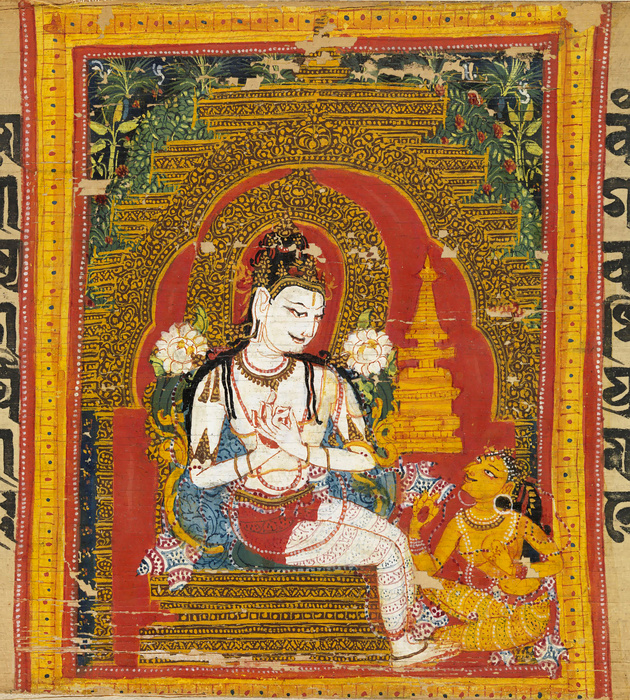
An illustration in a manuscript of the Aṣṭasāhasrikā Prajñāpāramitā Sūtra from Nalanda, depicting the bodhisattva Maitreya, an important figure in Mahāyāna

Mahayana[a] is a major branch of Buddhism, along with Theravada. It is a broad group of Buddhist traditions, texts, philosophies, and practices developed in ancient India (c. 1st century BCE onwards). Mahāyāna accepts the main scriptures and teachings of early Buddhism but also recognizes various doctrines and texts that are not accepted by Theravada Buddhism as original. These include the Mahāyāna sūtras and their emphasis on the bodhisattva path and Prajñāpāramitā.[1] Vajrayana or Mantra traditions are a subset of Mahāyāna which makes use of numerous Tantric methods Vajrayānists consider to help achieve Buddhahood.[2]

Mahāyāna also refers to the path of the bodhisattva striving to become a fully awakened Buddha for the benefit of all sentient beings, and is thus also called the "Bodhisattva Vehicle" (Bodhisattvayāna).[3][note 1] Mahāyāna Buddhism generally sees the goal of becoming a Buddha through the bodhisattva path as being available to all and sees the state of the arhat as incomplete.[4] Mahāyāna also includes numerous Buddhas and bodhisattvas that are not found in Theravada (such as Amitābha and Vairocana).[5] Mahāyāna Buddhist philosophy also promotes unique theories, such as the Madhyamaka theory of emptiness (śūnyatā), the Vijñānavāda ("the doctrine of consciousness" also called "mind-only"), and the Buddha-nature teaching.

While initially a small movement in India, Mahāyāna eventually grew to become an influential force in Indian Buddhism.[6] Large scholastic centers associated with Mahāyāna such as Nalanda and Vikramashila thrived between the 7th and 12th centuries.[6] In the course of its history, Mahāyāna Buddhism spread from South Asia to East Asia, Southeast Asia and the Himalayan regions. Various Mahāyāna traditions are the predominant forms of Buddhism found in China, Korea, Japan, Taiwan, Singapore, Vietnam, Philippines, Malaysia and Indonesia.[7] Since Vajrayana is a tantric form of Mahāyāna, Mahāyāna Buddhism is also dominant in Tibet, Mongolia, Bhutan, and other Himalayan regions. It has also been traditionally present elsewhere in Asia as a minority among Buddhist communities in Nepal, Malaysia, Indonesia and regions with Asian diaspora communities.

As of 2010, the Mahāyāna tradition was the largest major tradition of Buddhism, with 53% of Buddhists belonging to East Asian Mahāyāna and 6% to Vajrayana, compared to 36% to Theravada.[8]

Etymology

[edit]

Original Sanskrit

[edit]
The Five Tathāgatas in Shishoin Temple (Tokyo). A unique feature of Mahāyāna is the belief that there are multiple Buddhas which are currently teaching the Dharma.
Mahāyāna Buddhist triad, including Bodhisattva Maitreya, the Buddha, and Bodhisattva Avalokiteśvara. 2nd–3rd century CE, Gandhāra

According to Jan Nattier, the term Mahāyāna ("Great Vehicle") was originally an honorary synonym for Bodhisattvayāna ("Bodhisattva Vehicle"),[9] the vehicle of a bodhisattva seeking buddhahood for the benefit of all sentient beings.[3] The term Mahāyāna (which had earlier been used simply as an epithet for Buddhism itself) was therefore adopted at an early date as a synonym for the path and the teachings of the bodhisattvas. Since it was simply an honorary term for Bodhisattvayāna, the adoption of the term Mahāyāna and its application to Bodhisattvayāna did not represent a significant turning point in the development of a Mahāyāna tradition.[9]

The earliest Mahāyāna texts, such as the Lotus Sūtra, often use the term Mahāyāna as a synonym for Bodhisattvayāna, but the term Hīnayāna is comparatively rare in the earliest sources. The presumed dichotomy between Mahāyāna and Hīnayāna can be deceptive, as the two terms were not actually formed in relation to one another in the same era.[10]

Among the earliest and most important references to Mahāyāna are those that occur in the Lotus Sūtra (Skt. Saddharma Puṇḍarīka Sūtra) dating between the 1st century BCE and the 1st century CE.[11] Seishi Karashima has suggested that the term first used in an earlier Gandhāri Prakrit version of the Lotus Sūtra was not the term mahāyāna but the Prakrit word mahājāna in the sense of mahājñāna (great knowing).[12][13] At a later stage when the early Prakrit word was converted into Sanskrit, this mahājāna, being phonetically ambivalent, may have been converted into mahāyāna, possibly because of what may have been a double meaning in the famous Parable of the Burning House, which talks of three vehicles or carts (Skt: yāna).[note 2][12][14]

Chinese translation

[edit]

In Chinese, Mahāyāna is called 大乘 (dàshèng, or dàchéng), which is a calque of maha (great ) yana (vehicle ). There is also the transliteration 摩诃衍那.[15][16] The term appeared in some of the earliest Mahāyāna texts, including Emperor Ling of Han's translation of the Lotus Sutra.[17] It also appears in the Chinese Āgamas, though scholars like Yin Shun argue that this is a later addition.[18][19][20] Some Chinese scholars also argue that the meaning of the term in these earlier texts is different from later ideas of Mahāyāna Buddhism.[21]

History

[edit]
Seated Avalokiteshvara bodhisattva. Gandharan, from Loriyan Tangai. Kushan period, 1st – 3rd century CE. Indian Museum, Calcutta
Cave complex associated with the Mahāsāṃghika sect. Karla Caves, Mahārāṣtra, India

Origin

[edit]

The origins of Mahāyāna are still not completely understood and there are numerous competing theories.[22] The earliest Western views of Mahāyāna assumed that it existed as a separate school in competition with the so-called "Hīnayāna" schools. Some of the major theories about the origins of Mahāyāna include the following:

The lay origins theory was first proposed by Jean Przyluski and then defended by Étienne Lamotte and Akira Hirakawa. This view states that laypersons were particularly important in the development of Mahāyāna and is partly based on some texts like the Vimalakirti Sūtra, which praise lay figures at the expense of monastics.[23] This theory is no longer widely accepted since numerous early Mahāyāna works promote monasticism and asceticism.[24][25]

The Mahāsāṃghika origin theory, which argues that Mahāyāna developed within the Mahāsāṃghika tradition.[24] This is defended by scholars such as Hendrik Kern, A.K. Warder and Paul Williams who argue that at least some Mahāyāna elements developed among Mahāsāṃghika communities (from the 1st century BCE onwards), possibly in the area along the Kṛṣṇa River in the Āndhra region of southern India.[26][27][28][29] The Mahāsāṃghika doctrine of the supramundane (lokottara) nature of the Buddha is sometimes seen as a precursor to Mahāyāna views of the Buddha.[5] Some scholars also see Mahāyāna figures like Nāgārjuna, Dignaga, Candrakīrti, Āryadeva, and Bhāviveka as having ties to the Mahāsāṃghika tradition of Āndhra.[30] However, other scholars have also pointed to different regions as being important, such as Gandhara and northwest India.[31][note 3][32]

The Mahāsāṃghika origins theory has also slowly been shown to be problematic by scholarship that revealed how certain Mahāyāna sutras show traces of having developed among other nikāyas or monastic orders (such as the Dharmaguptaka).[33] Because of such evidence, scholars like Paul Harrison and Paul Williams argue that the movement was not sectarian and was possibly pan-buddhist.[24][34] There is no evidence that Mahāyāna ever referred to a separate formal school or sect of Buddhism, but rather that it existed as a certain set of ideals, and later doctrines, for aspiring bodhisattvas.[17]

The "forest hypothesis" meanwhile states that Mahāyāna arose mainly among "hard-core ascetics, members of the forest dwelling (aranyavasin) wing of the Buddhist Order", who were attempting to imitate the Buddha's forest living.[35] This has been defended by Paul Harrison, Jan Nattier and Reginald Ray. This theory is based on certain sutras like the Ugraparipṛcchā Sūtra and the Mahāyāna Rāṣṭrapālapaṛiprcchā which promote ascetic practice in the wilderness as a superior and elite path. These texts criticize monks who live in cities and denigrate the forest life.[17][36]

Jan Nattier's study of the Ugraparipṛcchā Sūtra, A few good men (2003) argues that this sutra represents the earliest form of Mahāyāna, which presents the bodhisattva path as a 'supremely difficult enterprise' of elite monastic forest asceticism.[24] Boucher's study on the Rāṣṭrapālaparipṛcchā-sūtra (2008) is another recent work on this subject.[37]

The cult of the book theory, defended by Gregory Schopen, states that Mahāyāna arose among a number of loosely connected book worshiping groups of monastics, who studied, memorized, copied and revered particular Mahāyāna sūtras. Schopen thinks they were inspired by cult shrines where Mahāyāna sutras were kept.[24] Schopen also argued that these groups mostly rejected stupa worship, or worshiping holy relics.

David Drewes has recently argued against all of the major theories outlined above. He points out that there is no actual evidence for the existence of book shrines, that the practice of sutra veneration was pan-Buddhist and not distinctly Mahāyāna. Furthermore, Drewes argues that "Mahāyāna sutras advocate mnemic/oral/aural practices more frequently than they do written ones."[24] Regarding the forest hypothesis, he points out that only a few Mahāyāna sutras directly advocate forest dwelling, while the others either do not mention it or see it as unhelpful, promoting easier practices such as "merely listening to the sutra, or thinking of particular Buddhas, that they claim can enable one to be reborn in special, luxurious 'pure lands' where one will be able to make easy and rapid progress on the bodhisattva path and attain Buddhahood after as little as one lifetime."[24]

Drewes states that the evidence merely shows that "Mahāyāna was primarily a textual movement, focused on the revelation, preaching, and dissemination of Mahāyāna sutras, that developed within, and never really departed from, traditional Buddhist social and institutional structures."[38] Drewes points out the importance of dharmabhāṇakas (preachers, reciters of these sutras) in the early Mahāyāna sutras. This figure is widely praised as someone who should be respected, obeyed ('as a slave serves his lord'), and donated to, and it is thus possible these people were the primary agents of the Mahāyāna movement.[38]

Early Mahayana came directly from "early Buddhist schools" and was a successor to them.[39][40]

Early Mahāyāna

[edit]
Earliest Mahayana inscription
Inscribed pedestal with the first known occurrence of the name of "Amitabha Buddha" in the "year 26 of Huvishka" (153 CE)[41] In Brahmi script in the inscription:

"Bu-ddha-sya A-mi-tā-bha-sya"
"Of the Buddha Amitabha"[42]

The earliest textual evidence of "Mahāyāna" comes from sūtras ("discourses", scriptures) originating around the beginning of the common era. Jan Nattier has noted that some of the earliest Mahāyāna texts, such as the Ugraparipṛccha Sūtra use the term "Mahāyāna", yet there is no doctrinal difference between Mahāyāna in this context and the early schools. Instead, Nattier writes that in the earliest sources, "Mahāyāna" referred to the rigorous emulation of Gautama Buddha's path to Buddhahood.[17]

Some important evidence for early Mahāyāna Buddhism comes from the texts translated by the Indoscythian monk Lokakṣema in the 2nd century CE, who came to China from the kingdom of Gandhāra. These are some of the earliest known Mahāyāna texts.[43][44][note 4] Study of these texts by Paul Harrison and others show that they strongly promote monasticism (contra the lay origin theory), acknowledge the legitimacy of arhatship, and do not show any attempt to establish a new sect or order.[24] A few of these texts often emphasize ascetic practices, forest dwelling, and deep states of meditative concentration (samadhi).[45]

Indian Mahāyāna never had nor ever attempted to have a separate Vinaya or ordination lineage from the early schools of Buddhism, and therefore each bhikṣu or bhikṣuṇī adhering to the Mahāyāna formally belonged to one of the early Buddhist schools. Membership in these nikāyas, or monastic orders, continues today, with the Dharmaguptaka nikāya being used in East Asia, and the Mūlasarvāstivāda nikāya being used in Tibetan Buddhism. Therefore, Mahāyāna was never a separate monastic sect outside of the early schools.[46]

Painting from the Mogao Caves (Cave 217), Dunhuang, illustrating Sukhavati, the buddhafield of Amitabha Buddha
Photograph of three bodhisattva statues found at Jamal Garhi (Khyber Pakhtunkhwa, Pakistan).

Paul Harrison clarifies that while monastic Mahāyānists belonged to a nikāya, not all members of a nikāya were Mahāyānists.[47] From Chinese monks visiting India, we now know that both Mahāyāna and non-Mahāyāna monks in India often lived in the same monasteries side by side.[48] It is also possible that, formally, Mahāyāna would have been understood as a group of monks or nuns within a larger monastery taking a vow together (known as a "kriyākarma") to memorize and study a Mahāyāna text or texts.[49]

The earliest stone inscription containing a recognizably Mahāyāna formulation and a mention of the Buddha Amitābha (an important Mahāyāna figure) was found in the Indian subcontinent in Mathura, and dated to around 180 CE. Remains of a statue of a Buddha bear the Brāhmī inscription: "Made in the year 28 of the reign of King Huviṣka, ... for the Blessed One, the Buddha Amitābha."[42] There is also some evidence that the Kushan Emperor Huviṣka himself was a follower of Mahāyāna. A Sanskrit manuscript fragment in the Schøyen Collection describes Huviṣka as having "set forth in the Mahāyāna."[50] Evidence of the name "Mahāyāna" in Indian inscriptions in the period before the 5th century is very limited in comparison to the multiplicity of Mahāyāna writings transmitted from Central Asia to China at that time.[note 5][note 6][note 7]

Based on archeological evidence, Gregory Schopen argues that Indian Mahāyāna remained "an extremely limited minority movement – if it remained at all – that attracted absolutely no documented public or popular support for at least two more centuries."[24] Likewise, Joseph Walser speaks of Mahāyāna's "virtual invisibility in the archaeological record until the fifth century".[51] Schopen also sees this movement as being in tension with other Buddhists, "struggling for recognition and acceptance".[52] Their "embattled mentality" may have led to certain elements found in Mahāyāna texts like Lotus sutra, such as a concern with preserving texts.[52]

Schopen, Harrison and Nattier also argue that these communities were probably not a single unified movement, but scattered groups based on different practices and sutras.[24] One reason for this view is that Mahāyāna sources are extremely diverse, advocating many different, often conflicting doctrines and positions, as Jan Nattier writes:[53]

Thus we find one scripture (the Aksobhya-vyuha) that advocates both srávaka and bodhisattva practices, propounds the possibility of rebirth in a pure land, and enthusiastically recommends the cult of the book, yet seems to know nothing of emptiness theory, the ten bhumis, or the trikaya, while another (the P'u-sa pen-yeh ching) propounds the ten bhumis and focuses exclusively on the path of the bodhisattva, but never discusses the paramitas. A Madhyamika treatise (Nagarjuna's Mulamadhyamika-karikas) may enthusiastically deploy the rhetoric of emptiness without ever mentioning the bodhisattva path, while a Yogacara treatise (Vasubandhu's Madhyanta-vibhaga-bhasya) may delve into the particulars of the trikaya doctrine while eschewing the doctrine of ekayana. We must be prepared, in other words, to encounter a multiplicity of Mahayanas flourishing even in India, not to mention those that developed in East Asia and Tibet.

In spite of being a minority in India, Indian Mahāyāna was an intellectually vibrant movement, which developed various schools of thought during what Jan Westerhoff has been called "The Golden Age of Indian Buddhist Philosophy" (from the beginning of the first millennium CE up to the 7th century).[54] Some major Mahāyāna traditions are Prajñāpāramitā, Mādhyamaka, Yogācāra, Buddha-nature (Tathāgatagarbha), and the school of Dignaga and Dharmakirti as the last and most recent.[55] Major early figures include Nagarjuna, Āryadeva, Aśvaghoṣa, Asanga, Vasubandhu, and Dignaga. Mahāyāna Buddhists seem to have been active in the Kushan Empire (30–375 CE), a period that saw great missionary and literary activities by Buddhists. This is supported by the works of the historian Taranatha.[56]

Growth

[edit]
Ruins of the Nalanda Mahavihara (Great Monastery) in Bihar, a major center for the study of Mahāyāna Buddhism from the fifth century CE to c. 1200 CE
Buddhist expansion in Asia, from Buddhist heartland in northern India (dark orange) starting 5th century BCE, to Buddhist majority realm (orange) with the exception of China, and historical extent of Buddhism influences (yellow). Mahāyāna (red arrow), Theravāda (green arrow), and Tantric-Vajrayāna (blue arrow). The overland and maritime "Silk Roads" were interlinked and complementary, forming what scholars have called the "great circle of Buddhism".[40]

The Mahāyāna movement (or movements) remained quite small until it experienced much growth in the fifth century. Very few manuscripts have been found before the fifth century (the exceptions are from Bamiyan). According to Walser, "the fifth and sixth centuries appear to have been a watershed for the production of Mahāyāna manuscripts."[57] Likewise it is only in the 4th and 5th centuries CE that epigraphic evidence shows some kind of popular support for Mahāyāna, including some possible royal support at the kingdom of Shan shan as well as in Bamiyan and Mathura.[58]

Still, even after the 5th century, the epigraphic evidence which uses the term Mahāyāna is still quite small and is notably mainly monastic, not lay.[58] By this time, Chinese pilgrims, such as Faxian (337–422 CE), Xuanzang (602–664), Yijing (635–713 CE) were traveling to India, and their writings do describe monasteries which they label 'Mahāyāna' as well as monasteries where both Mahāyāna monks and non-Mahāyāna monks lived together.[59]

After the fifth century, Mahāyāna Buddhism and its institutions slowly grew in influence. Some of the most influential institutions became massive monastic university complexes such as Nalanda (established by the 5th-century CE Gupta emperor, Kumaragupta I) and Vikramashila (established under Dharmapala c. 783 to 820) which were centers of various branches of scholarship, including Mahāyāna philosophy. The Nalanda complex eventually became the largest and most influential Buddhist center in India for centuries.[60] Even so, as noted by Paul Williams, "it seems that fewer than 50 percent of the monks encountered by Xuanzang (Hsüan-tsang; c. 600–664) on his visit to India actually were Mahāyānists."[61]

Expansion outside of India

[edit]
Recreation of a cave mural from the Mogao Caves depicting the Buddha surrounded by bodhisattvas

Over time Indian Mahāyāna texts and philosophy reached Central Asia and China through trade routes like the Silk Road, later spreading throughout East Asia.[39] Over time, Central Asian Buddhism became heavily influenced by Mahāyāna and it was a major source for Chinese Buddhism. Mahāyāna works have also been found in Gandhāra, indicating the importance of this region for the spread of Mahāyāna. Central Asian Mahāyāna scholars were very important in the Silk Road Transmission of Buddhism.[62] They include translators like Lokakṣema (c. 167–186), Dharmarakṣa (c. 265–313), Kumārajīva (c. 401), and Dharmakṣema (385–433). The site of Dunhuang seems to have been a particularly important place for the study of Mahāyāna Buddhism.[56]

Mahāyāna spread from China to Korea, Vietnam, and Taiwan, which (along with Korea) would later spread it to Japan.[39][40] Mahāyāna also spread from India to Myanmar, and then Sumatra and Malaysia.[39][40] Mahāyāna spread from Sumatra to other Indonesian islands, including Java and Borneo, the Philippines, Cambodia, and eventually, Indonesian Mahāyāna traditions made it to China.[39][40]

By the fourth century, Chinese monks like Faxian (c. 337–422 CE) had also begun to travel to India (now dominated by the Guptas) to bring back Buddhist teachings, especially Mahāyāna works.[63] These figures also wrote about their experiences in India and their work remains invaluable for understanding Indian Buddhism. In some cases Indian Mahāyāna traditions were directly transplanted, as with the case of the East Asian Madhymaka (by Kumārajīva) and East Asian Yogacara (especially by Xuanzang). Later, new developments in Chinese Mahāyāna led to new Chinese Buddhist traditions like Tiantai, Huayen, Pure Land and Chan Buddhism (Zen). These traditions would then spread to Korea, Vietnam and Japan.

Forms of Mahāyāna Buddhism which are mainly based on the doctrines of Indian Mahāyāna sutras are still popular in East Asian Buddhism, which is mostly dominated by various branches of Mahāyāna Buddhism. Paul Williams has noted that in this tradition in the Far East, primacy has always been given to the study of the Mahāyāna sūtras.[64]

Later developments

[edit]
The use of mandalas was one new feature of Tantric Buddhism, which also adopted new deities such as Chakrasamvara (pictured)

Beginning during the Gupta (c. 3rd century CE–575 CE) period a new movement began to develop which drew on previous Mahāyāna doctrine as well as new Pan-Indian tantric ideas. This came to be known by various names such as Vajrayāna (Tibetan: rdo rje theg pa), Mantrayāna, and Esoteric Buddhism or "Secret Mantra" (Guhyamantra). This new movement continued into the Pala era (8th century–12th century CE), during which it grew to dominate Indian Buddhism.[65] Possibly led by groups of wandering tantric yogis named mahasiddhas, this movement developed new tantric spiritual practices and also promoted new texts called the Buddhist Tantras.[66]

Philosophically, Vajrayāna Buddhist thought remained grounded in the Mahāyāna Buddhist ideas of Madhyamaka, Yogacara and Buddha-nature.[67][68] Tantric Buddhism generally deals with new forms of meditation and ritual which often makes use of the visualization of Buddhist deities (including Buddhas, bodhisattvas, dakinis, and fierce deities) and the use of mantras. Most of these practices are esoteric and require ritual initiation or introduction by a tantric master (vajracarya) or guru.[69]

The source and early origins of Vajrayāna remain a subject of debate among scholars. Some scholars like Alexis Sanderson argue that Vajrayāna derives its tantric content from Shaivism and that it developed as a result of royal courts sponsoring both Buddhism and Saivism. Sanderson argues that Vajrayāna works like the Samvara and Guhyasamaja texts show direct borrowing from Shaiva tantric literature.[70][71] However, other scholars such as Ronald M. Davidson question the idea that Indian tantrism developed in Shaivism first and that it was then adopted into Buddhism. Davidson points to the difficulties of establishing a chronology for the Shaiva tantric literature and argues that both traditions developed side by side, drawing on each other as well as on local Indian tribal religion.[72]

Whatever the case, this new tantric form of Mahāyāna Buddhism became extremely influential in India, especially in Kashmir and in the lands of the Pala Empire. It eventually also spread north into Central Asia, the Tibetan plateau and to East Asia. Vajrayāna remains the dominant form of Buddhism in Tibet, in surrounding regions like Bhutan and in Mongolia. Esoteric elements are also an important part of East Asian Buddhism where it is referred to by various terms. These include: Zhēnyán (Chinese: 真言, literally "true word", referring to mantra), Mìjiao (Chinese: 密教; Esoteric Teaching), Mìzōng (密宗; "Esoteric Tradition") or Tángmì (唐密; "Tang (Dynasty) Esoterica") in Chinese and Shingon, Tomitsu, Mikkyo, and Taimitsu in Japanese.

Worldview

[edit]
A Ming bronze of the Buddha Mahāvairocana which depicts his body as being composed of numerous other Buddhas
The female bodhisattva Prajñaparamita Devi

Few things can be said with certainty about Mahāyāna Buddhism in general other than that the Buddhism practiced in China, Indonesia, Vietnam, Korea, Tibet, Mongolia and Japan is Mahāyāna Buddhism.[note 8] Mahāyāna can be described as a loosely bound collection of many teachings and practices (some of which are seemingly contradictory).[note 9] Mahāyāna constitutes an inclusive and broad set of traditions characterized by plurality and the adoption of a vast number of new sutras, ideas and philosophical treatises in addition to the earlier Buddhist texts.

Broadly speaking, Mahāyāna Buddhists accept the classic Buddhist doctrines found in early Buddhism (i.e. the Nikāya and Āgamas), such as the Middle Way, Dependent origination, the Four Noble Truths, the Noble Eightfold Path, the Three Jewels, the Three marks of existence and the bodhipakṣadharmas (aids to awakening).[73] Mahāyāna Buddhism further accepts some of the ideas found in Buddhist Abhidharma thought. However, Mahāyāna also adds numerous Mahāyāna texts and doctrines, which are seen as definitive and in some cases superior teachings.[74][75] D.T. Suzuki described the broad range and doctrinal liberality of Mahāyāna as "a vast ocean where all kinds of living beings are allowed to thrive in a most generous manner, almost verging on a chaos".[76]

Paul Williams refers to the main impulse behind Mahāyāna as the vision which sees the motivation to achieve Buddhahood for sake of other beings as being the supreme religious motivation. This is the way that Atisha defines Mahāyāna in his Bodhipathapradipa.[77] As such, according to Williams, "Mahāyāna is not as such an institutional identity. Rather, it is inner motivation and vision, and this inner vision can be found in anyone regardless of their institutional position."[78] Thus, instead of a specific school or sect, Mahāyāna is a "family term" or a religious tendency, which is united by "a vision of the ultimate goal of attaining full Buddhahood for the benefit of all sentient beings (the 'bodhisattva ideal') and also (or eventually) a belief that Buddhas are still around and can be contacted (hence the possibility of an ongoing revelation)."[79]

The Buddhas

[edit]
Tibetan depiction of Buddha Amitāyus in his Pure Land of Sukhavati
The monumental sculpture of the Longmen Buddha Grottoes contains a giant statue of Vairocana Buddha

Buddhas and bodhisattvas (beings on their way to Buddhahood) are central elements of Mahāyāna. Mahāyāna has a vastly expanded cosmology and theology, with various Buddhas and powerful bodhisattvas residing in different worlds and buddha-fields (buddha kshetra).[5] Buddhas unique to Mahāyāna include the Buddhas Amitābha ("Infinite Light"), Akṣobhya ("the Imperturbable"), Bhaiṣajyaguru ("Medicine guru") and Vairocana ("the Illuminator"). In Mahāyāna, a Buddha is seen as a being that has achieved the highest kind of awakening due to his superior compassion and wish to help all beings.[80]

An important feature of Mahāyāna is the way that it understands the nature of a Buddha, which differs from non-Mahāyāna understandings. Mahāyāna texts not only often depict numerous Buddhas besides Sakyamuni, but see them as transcendental or supramundane (lokuttara) beings with great powers and huge lifetimes. The White Lotus Sutra famously describes the lifespan of the Buddha as immeasurable and states that he actually achieved Buddhahood countless of eons (kalpas) ago and has been teaching the Dharma through his numerous avatars for an unimaginable period of time.[81][82][83]

Furthermore, Buddhas are active in the world, constantly devising ways to teach and help all sentient beings. According to Paul Williams, in Mahāyāna, a Buddha is often seen as "a spiritual king, relating to and caring for the world", rather than simply a teacher who after his death "has completely 'gone beyond' the world and its cares".[84] Buddha Sakyamuni's life and death on earth are then usually understood docetically as a "mere appearance", his death is a show, while in actuality he remains out of compassion to help all sentient beings.[84] Similarly, Guang Xing describes the Buddha in Mahāyāna as an omnipotent and almighty divinity "endowed with numerous supernatural attributes and qualities".[85] Mahayana Buddhologies have often been compared to various types of theism (including pantheism) by different scholars, though there is disagreement among scholars regarding this issue as well on the general relationship between Buddhism and Theism.[86]

The idea that Buddhas remain accessible is extremely influential in Mahāyāna and also allows for the possibility of having a reciprocal relationship with a Buddha through prayer, visions, devotion and revelations.[87] Through the use of various practices, a Mahāyāna devotee can aspire to be reborn in a Buddha's pure land or buddha field (buddhakṣetra), where they can strive towards Buddhahood in the best possible conditions. Depending on the sect, liberation into a buddha-field can be obtained by faith, meditation, or sometimes even by the repetition of Buddha's name. Faith-based devotional practices focused on rebirth in pure lands are common in East Asia Pure Land Buddhism.[88]

The influential Mahāyāna concept of the three bodies (trikāya) of a Buddha developed to make sense of the transcendental nature of the Buddha. This doctrine holds that the "bodies of magical transformation" (nirmāṇakāyas) and the "enjoyment bodies" (saṃbhogakāya) are emanations from the ultimate Buddha body, the Dharmakaya, which is none other than the ultimate reality itself, i.e. emptiness or Thusness.[89]

The Bodhisattvas

[edit]
Avalokiteśvara, the bodhisattva of compassion. Ajaṇṭā Caves, Maharashtra, India

The Mahāyāna bodhisattva path (mārga) or vehicle (yāna) is seen as being the superior spiritual path by Mahāyānists, over and above the paths of those who seek arhatship or "solitary buddhahood" for their own sake (Śrāvakayāna and Pratyekabuddhayāna).[90] Mahāyāna Buddhists generally hold that pursuing only the personal release from suffering i.e. nirvāṇa is a smaller or inferior aspiration (called "hinayana"), because it lacks the wish and resolve to liberate all other sentient beings from saṃsāra (the round of rebirth) by becoming a Buddha.[91][92][93]

This wish to help others by entering the Mahāyāna path is called bodhicitta and someone who engages in this path to complete buddhahood is a bodhisattva. High level bodhisattvas (with eons of practice) are seen as extremely powerful supramundane beings. They are objects of devotion and prayer throughout the Mahāyāna world.[94] Popular bodhisattvas which are revered across Mahāyāna include Avalokiteshvara, Manjushri, Tara and Maitreya. Bodhisattvas could reach the personal nirvana of the arhats, but they reject this goal and remain in saṃsāra to help others out of compassion.[95][96][94]

According to eighth-century Mahāyāna philosopher Haribhadra, the term "bodhisattva" can technically refer to those who follow any of the three vehicles, since all are working towards bodhi (awakening) and hence the technical term for a Mahāyāna bodhisattva is a mahāsattva (great being) bodhisattva.[97] According to Paul Williams, a Mahāyāna bodhisattva is best defined as:

that being who has taken the vow to be reborn, no matter how many times this may be necessary, in order to attain the highest possible goal, that of Complete and Perfect Buddhahood. This is for the benefit of all sentient beings.[97]

There are two models for the nature of the bodhisattvas, which are seen in the various Mahāyāna texts. One is the idea that a bodhisattva must postpone their awakening until full Buddhahood is attained. This could take eons and in the meantime, they will help countless beings. After reaching Buddhahood, they do pass on to nirvāṇa (after which they do not return). The second model is the idea that there are two kinds of nirvāṇa, the nirvāṇa of an arhat and a superior type of nirvāṇa called apratiṣṭhita (non-abiding, not-established) that allows a Buddha to remain forever engaged in the world. As noted by Paul Williams, the idea of apratiṣṭhita nirvāṇa may have taken some time to develop and is not obvious in some of the early Mahāyāna literature.[96]

Illustrated Korean manuscript of the Lotus Sutra, Goryeo Dynasty, c. 1340. The three carts at the top which are symbolic of the three vehicles
Guanyin (Avalokiteśvara) with multiple arms symbolizing upaya and great compassion, Leshan, China
The Lotus, especially the puṇḍarīka (white lotus), is used in Mahāyāna to symbolize the nature of bodhisattvas. The lotus is rooted in the earthly mud and yet flowers above the water in the open air. Similarly, the bodhisattva lives in the world but remains unstained by it[98]

The Bodhisattva Path

[edit]

In most classic Mahāyāna sources (as well as in non-Mahāyāna sources on the topic), the bodhisattva path is said to take three or four asaṃkheyyas ("incalculable eons"), requiring a huge number of lifetimes of practice to complete.[99][100] However, certain practices are sometimes held to provide shortcuts to Buddhahood (these vary widely by tradition). According to the Bodhipathapradīpa (A Lamp for the Path to Awakening) by the Indian master Atiśa, the central defining feature of a bodhisattva's path is the universal aspiration to end suffering for themselves and all other beings, i.e. bodhicitta.[101]

The bodhisattva's spiritual path is traditionally held to begin with the revolutionary event called the "arising of the Awakening Mind" (bodhicittotpāda), which is the wish to become a Buddha in order to help all beings.[100] This is achieved in different ways, such as the meditation taught by the Indian master Shantideva in his Bodhicaryavatara called "equalising self and others and exchanging self and others". Other Indian masters like Atisha and Kamalashila also teach a meditation in which we contemplate how all beings have been our close relatives or friends in past lives. This contemplation leads to the arising of deep love (maitrī) and compassion (karuṇā) for others, and thus bodhicitta is generated.[102] According to the Indian philosopher Shantideva, when great compassion and bodhicitta arises in a person's heart, they cease to be an ordinary person and become a "son or daughter of the Buddhas".[101]

The idea of the bodhisattva is not unique to Mahāyāna Buddhism and it is found in Theravada and other early Buddhist schools. However, these schools held that becoming a bodhisattva required a prediction of one's future Buddhahood in the presence of a living Buddha.[103] In Mahāyāna, the term bodhisattva is applicable to any person from the moment they intend to become a Buddha (i.e. the moment in which bodhicitta arises in their mind) and without the requirement of a living Buddha being present.[103] Some Mahāyāna sūtras like the Lotus Sutra promote the bodhisattva path as being universal and open to everyone. Other texts disagree with this and state that only some beings have the capacity for Buddhahood.[104]

The generation of bodhicitta may then be followed by the taking of the bodhisattva vows (praṇidhāna) to "lead to Nirvana the whole immeasurable world of beings" as the Prajñaparamita sutras state. This compassionate commitment to help others is the central characteristic of the Mahāyāna bodhisattva.[105] These vows may be accompanied by certain ethical guidelines called bodhisattva precepts. Numerous sutras also state that a key part of the bodhisattva path is the practice of a set of virtues called pāramitās (transcendent or supreme virtues). Sometimes six are outlined: giving, ethical discipline, patient endurance, diligence, meditation and transcendent wisdom.[106][5]

Other sutras (like the Daśabhūmika) give a list of ten, with the addition of upāya (skillful means), praṇidhāna (vow, resolution), Bala (spiritual power) and Jñāna (knowledge).[107] Prajñā (transcendent knowledge or wisdom) is arguably the most important virtue of the bodhisattva. This refers to an understanding of the emptiness of all phenomena, arising from study, deep consideration and meditation.[105]

Bodhisattva levels

[edit]
Amitābha Descending with Twenty-five Bodhisattvas (13th century), National Treasure, Chion-in, Kyoto, is regarded as a representative work of early Pure Land Buddhist art in Japan. In Japanese Buddhism, one of the Ten realms in which sentient beings aspire to be reborn is the Pure Land of Ultimate Bliss of Amitābha.

Various Mahāyāna Buddhist scriptures associate the beginning of the bodhisattva practice with what is called the "path of accumulation" or equipment (saṃbhāra-mārga), which is the first path of the classic five paths schema.[108]

The Daśabhūmika Sūtra as well as other texts also outline a series of bodhisattva levels or spiritual stages (bhūmis ) on the path to Buddhahood. The various texts disagree on the number of stages however, the Daśabhūmika giving ten for example (and mapping each one to the ten paramitas), the Bodhisattvabhūmi giving seven and thirteen and the Avatamsaka outlining 40 stages.[107]

In later Mahāyāna scholasticism, such as in the work of Kamalashila and Atiśa, the five paths and ten bhūmi systems are merged and this is the progressive path model that is used in Tibetan Buddhism. According to Paul Williams, in these systems, the first bhūmi is reached once one attains "direct, nonconceptual and nondual insight into emptiness in meditative absorption", which is associated with the path of seeing (darśana-mārga).[108] At this point, a bodhisattva is considered an ārya (a noble being).[109]

Skillful means and the One Vehicle

[edit]

Skillful means or Expedient techniques (Skt. upāya) is another important virtue and doctrine in Mahāyāna Buddhism.[110] The idea is most famously expounded in the White Lotus Sutra, and refers to any effective method or technique that is conducive to spiritual growth and leads beings to awakening and nirvana. This doctrine states that, out of compassion, the Buddha adapts his teaching to whomever he is teaching. Because of this, it is possible that the Buddha may teach seemingly contradictory things to different people. This idea is also used to explain the vast textual corpus found in Mahāyāna.[111]

A closely related teaching is the doctrine of the One Vehicle (ekayāna). This teaching states that even though the Buddha is said to have taught three vehicles (the disciples' vehicle, the vehicle of solitary Buddhas and the bodhisattva vehicle, which are accepted by all early Buddhist schools), these actually are all skillful means which lead to the same place: Buddhahood. Therefore, there really are not three vehicles in an ultimate sense, but one vehicle, the supreme vehicle of the Buddhas, which is taught in different ways depending on the faculties of individuals. Even those beings who think they have finished the path (i.e. the arhats) are actually not done, and they will eventually reach Buddhahood.[111]

This doctrine was not accepted in full by all Mahāyāna traditions. The Yogācāra school famously defended an alternative theory that held that not all beings could become Buddhas. This became a subject of much debate throughout Mahāyāna Buddhist history.[112]

Prajñāpāramitā (Transcendent Knowledge)

[edit]
Prajñāpāramitā is often personified by a female deity in Buddhist art

Some of the key Mahāyāna teachings are found in the Prajñāpāramitā ("Transcendent Knowledge" or "Perfection of Wisdom") texts, which are some of the earliest Mahāyāna works.[113] Prajñāpāramitā is a deep knowledge of reality which Buddhas and bodhisattvas attain. It is a transcendent, non-conceptual and non-dual kind of knowledge into the true nature of things.[114] This wisdom is also associated with insight into the emptiness (śūnyatā) of dharmas (phenomena) and their illusory nature (māyā).[115] This amounts to the idea that all phenomena (dharmas) without exception have "no essential unchanging core" (i.e. they lack svabhāva, an essence or inherent nature), and therefore have "no fundamentally real existence".[116] These empty phenomena are also said to be conceptual constructions.[117]

Because of this, all dharmas (things, phenomena), even the Buddha's Teaching, the Buddha himself, Nirvāṇa and all living beings, are like "illusions" or "magic" (māyā) and "dreams" (svapna).[118][117] This emptiness or lack of real existence applies even to the apparent arising and ceasing of phenomena. Because of this, all phenomena are also described as unarisen (anutpāda), unborn (ajata), "beyond coming and going" in the Prajñāpāramitā literature.[119][120] Most famously, the Heart Sutra states that "all phenomena are empty, that is, without characteristic, unproduced, unceased, stainless, not stainless, undiminished, unfilled".[121] The Prajñāpāramitā texts also use various metaphors to describe the nature of things, for example, the Diamond Sutra compares phenomena to: "A shooting star, a clouding of the sight, a lamp, an illusion, a drop of dew, a bubble, a dream, a lightning's flash, a thunder cloud."[citation needed]

Prajñāpāramitā is also associated with not grasping, not taking a stand on or "not taking up" (aparigṛhīta) anything in the world. The Aṣṭasāhasrikā Prajñāpāramitā Sūtra explains it as "not grasping at form, not grasping at sensation, perception, volitions and cognition".[122] This includes not grasping or taking up even correct Buddhist ideas or mental signs (such as "not-self", "emptiness", bodhicitta, vows), since these things are ultimately all empty concepts as well.[123][117]

Attaining a state of fearless receptivity (ksanti) through the insight into the true nature of reality (Dharmatā) in an intuitive, non-conceptual manner is said to be the prajñāpāramitā, the highest spiritual wisdom. According to Edward Conze, the "patient acceptance of the non-arising of dharmas" (anutpattika-dharmakshanti) is "one of the most distinctive virtues of the Mahāyānistic saint."[124] The Prajñāpāramitā texts also claim that this training is not just for Mahāyānists, but for all Buddhists following any of the three vehicles.[125]

Madhyamaka (Centrism)

[edit]
A statue of the Mahāyāna philosopher Nagarjuna, founder of the Madhyamaka school. Considered by some to be an Arya (noble) bodhisattva or even the "second Buddha"[126]

The Mahāyāna philosophical school termed Madhyamaka (Middle theory or Centrism, also known as śūnyavāda, 'the emptiness theory') was founded by the second-century figure of Nagarjuna. This philosophical tradition focuses on refuting all theories which posit any kind of substance, inherent existence or intrinsic nature (svabhāva).[127]

In his writings, Nagarjuna attempts to show that any theory of intrinsic nature is contradicted by the Buddha's theory of dependent origination, since anything that has an independent existence cannot be dependently originated. The śūnyavāda philosophers were adamant that their denial of svabhāva is not a kind of nihilism (against protestations to the contrary by their opponents).[128]

Using the two truths theory, Madhyamaka claims that while one can speak of things existing in a conventional, relative sense, they do not exist inherently in an ultimate sense. Madhyamaka also argues that emptiness itself is also "empty", it does not have an absolute inherent existence of its own. It is also not to be understood as a transcendental absolute reality. Instead, the emptiness theory is merely a useful concept that should not be clung to. In fact, for Madhyamaka, since everything is empty of true existence, all things are just conceptualizations (prajñapti-matra), including the theory of emptiness, and all concepts must ultimately be abandoned in order to truly understand the nature of things.[128]

Vijñānavāda (The Consciousness doctrine)

[edit]

Vijñānavāda ("the doctrine of consciousness", a.k.a. vijñapti-mātra, "perceptions only" and citta-mātra "mind only") is another important doctrine promoted by some Mahāyāna sutras which later became the central theory of a major philosophical movement which arose during the Gupta period called Yogācāra. The primary sutra associated with this school of thought is the Saṃdhinirmocana Sūtra, which claims that śūnyavāda is not the final definitive teaching (nītārtha) of the Buddha. Instead, the ultimate truth (paramārtha-satya) is said to be the view that all things (dharmas) are only mind (citta), consciousness (vijñāna) or perceptions (vijñapti) and that seemingly "external" objects (or "internal" subjects) do not really exist apart from the dependently originated flow of mental experiences.[129]

When this flow of mentality is seen as being empty of the subject-object duality we impose upon it, one reaches the non-dual cognition of "Thusness" (tathatā), which is nirvana. This doctrine is developed through various theories, the most important being the eight consciousnesses and the three natures.[130] The Saṃdhinirmocana calls its doctrine the 'third turning of the dharma wheel'. The Pratyutpanna sutra also mentions this doctrine, stating: "whatever belongs to this triple world is nothing but thought [citta-mātra]. Why is that? It is because however I imagine things, that is how they appear".[130]

The most influential thinkers in this tradition were the Indian brothers Asanga and Vasubandhu. Yogācāra philosophers developed their own interpretation of the doctrine of emptiness which also criticized Madhyamaka, in effect claiming it fell into nihilism.[131]

Buddha-nature

[edit]
A Kamakura period reliquary topped with a cintamani (wish fulfilling jewel). Buddha nature texts often use the metaphor of a jewel (i.e. buddha-nature) which all beings have but are unaware of

The doctrine of Tathāgata embryo or Tathāgata womb (Tathāgatagarbha), also known as Buddha-nature, matrix or principle (Skt: Buddha-dhātu) is important in all modern Mahāyāna traditions, though it is interpreted in many different ways. Broadly speaking, Buddha-nature is concerned with explaining what allows sentient beings to become Buddhas.[132] The earliest sources for this idea may include the Tathāgatagarbha Sūtra and the Mahāyāna Mahāparinirvāṇa Sūtra.[133][132] The Mahāyāna Mahāparinirvāṇa refers to "a sacred nature that is the basis for [beings] becoming buddhas",[134] and it also describes it as the 'Self' (atman).[135]

David Seyfort Ruegg explains this concept as the base or support for the practice of the path, and thus it is the "cause" (hetu) for the fruit of Buddhahood.[132] The Tathāgatagarbha Sūtra states that within the defilements is found "the tathagata's wisdom, the tathagata's vision, and the tathagata's body...eternally unsullied, and...replete with virtues no different from my own...the tathagatagarbhas of all beings are eternal and unchanging".[136]

The ideas found in the Buddha-nature literature are a source of much debate and disagreement among Mahāyāna Buddhist philosophers as well as modern academics.[137] Some scholars have seen this as an influence from Brahmanic Hinduism, and some of these sutras admit that the use of the term 'Self' is partly done in order to win over non-Buddhist ascetics (in other words, it is a skillful means).[138][139] According to some scholars, the Buddha-nature discussed in some Mahāyāna sūtras does not represent a substantial self (ātman) which the Buddha critiqued; rather, it is a positive expression of emptiness (śūnyatā) and represents the potentiality to realize Buddhahood through Buddhist practices.[140] Similarly, Williams thinks that this doctrine was not originally dealing with ontological issues, but with "religious issues of realising one's spiritual potential, exhortation, and encouragement."[136]

The Buddha-nature genre of sūtras can be seen as an attempt to state Buddhist teachings using positive language while also maintaining the middle way, to prevent people from being turned away from Buddhism by a false impression of nihilism.[141] This is the position taken by the Laṅkāvatāra Sūtra, which states that the Buddhas teach the doctrine of tathāgatagarbha (which sounds similar to an atman) in order to help those beings who are attached to the idea of anatman. However, the sutra goes on to say that the tathāgatagarbha is empty and is not actually a substantial self.[142][143]

A different view is defended by various modern scholars like Michael Zimmermann. This view is the idea that Buddha-nature sutras such as the Mahāparinirvāṇa and the Tathāgatagarbha Sūtra teach an affirmative vision of an eternal, indestructible Buddhic Self.[135] Shenpen Hookham, a western scholar and lama sees Buddha-nature as a True Self that is real and permanent.[144] Similarly, C. D. Sebastian understands the Ratnagotravibhāga's view of this topic as a transcendental self that is "the unique essence of the universe".[145]

Arguments for authenticity

[edit]

Indian Mahāyāna Buddhists faced various criticisms from non-Mahāyānists regarding the authenticity of their teachings. The main critique they faced was that Mahāyāna teachings had not been taught by the Buddha, but were invented by later figures.[146][147] Numerous Mahāyāna texts discuss this issue and attempt to defend the truth and authenticity of Mahāyāna in various ways.[148]

One idea that Mahāyāna texts put forth is that Mahāyāna teachings were taught later because most people were unable to understand the Mahāyāna sūtras at the time of the Buddha and that people were ready to hear the Mahāyāna only in later times.[149] Certain traditional accounts state that Mahāyāna sutras were hidden away or kept safe by divine beings like Nagas or bodhisattvas until the time came for their dissemination.[150][151]

Similarly, some sources also state that Mahāyāna teachings were revealed by other Buddhas, bodhisattvas and devas to a select number of individuals (often through visions or dreams).[148] Some scholars have seen a connection between this idea and Mahāyāna meditation practices which involve the visualization of Buddhas and their Buddha-lands.[152]

Another argument that Indian Buddhists used in favor of the Mahāyāna is that its teachings are true and lead to awakening since they are in line with the Dharma. Because of this, they can be said to be "well said" (subhasita), and therefore, they can be said to be the word of the Buddha in this sense. This idea that whatever is "well spoken" is the Buddha's word can be traced to the earliest Buddhist texts, but it is interpreted more widely in Mahāyāna.[153] From the Mahāyāna point of view, a teaching is the "word of the Buddha" because it is in accord with the Dharma, not because it was spoken by a specific individual (i.e. Gautama).[154] This idea can be seen in the writings of Shantideva (8th century), who argues that an "inspired utterance" is the Buddha word if it is "connected with the truth", "connected with the Dharma", "brings about renunciation of kleshas, not their increase" and "it shows the laudable qualities of nirvana, not those of samsara".[155]

The modern Japanese Zen Buddhist scholar D. T. Suzuki similarly argued that while the Mahāyāna sūtras may not have been directly taught by the historical Buddha, the "spirit and central ideas" of Mahāyāna derive from the Buddha. According to Suzuki, Mahāyāna evolved and adapted itself to suit the times by developing new teachings and texts, while maintaining the spirit of the Buddha.[156]

Claims of superiority

[edit]

Mahāyāna often sees itself as penetrating further and more profoundly into the Buddha's Dharma. An Indian commentary on the Mahāyānasaṃgraha, gives a classification of teachings according to the capabilities of the audience:[157]

According to disciples' grades, the Dharma is classified as inferior and superior. For example, the inferior was taught to the merchants Trapuṣa and Ballika because they were ordinary men; the middle was taught to the group of five because they were at the stage of saints; the eightfold Prajñāpāramitās were taught to bodhisattvas, and [the Prajñāpāramitās] are superior in eliminating conceptually imagined forms. - Vivṛtaguhyārthapiṇḍavyākhyā

There is also a tendency in Mahāyāna sūtras to regard adherence to these sūtras as generating spiritual benefits greater than those that arise from being a follower of the non-Mahāyāna approaches. Thus the Śrīmālādevī Siṃhanāda Sūtra claims that the Buddha said that devotion to Mahāyāna is inherently superior in its virtues to following the śrāvaka or pratyekabuddha paths.[158]

The commentary on the Abhidharmasamuccaya gives the following seven reasons for the "greatness" of the Mahayana:[159]

  1. Greatness of support (ālambana): the path of the bodhisatva is supported by the limitless teachings of the Perfection of Wisdom in One Hundred Thousand Verses and other texts;
  2. Greatness of practice (pratipatti): the comprehensive practice for the benefit of self and others (sva-para-artha);
  3. Greatness of understanding (jñāna): from understanding the absence of self in persons and phenomena (pudgala-dharma-nairātmya);
  4. Greatness of energy (vīrya): from devotion to many hundreds of thousands of difficult tasks during three incalculable great aeons (mahākalpa);
  5. Greatness of resourcefulness (upāyakauśalya): because of not taking a stand in Saṃsāra or Nirvāṇa;
  6. Greatness of attainment (prāpti): because of the attainment of immeasurable and uncountable powers (bala), confidences (vaiśāradya), and dharmas unique to Buddhas ( āveṇika-buddhadharma);
  7. Greatness of deeds (karma): because of willing the performance of the deeds of a Buddha until the end of Saṃsāra by displaying awakening, etc.

Practice

[edit]
Tibetan Buddhist prayer festival (monlam) at Bodh Gaya

Mahāyāna Buddhist practice is quite varied. A common set of virtues and practices which is shared by all Mahāyāna traditions are the six perfections or transcendent virtues (pāramitā). Another central practice advocated by numerous Mahāyāna sources is focused around "the acquisition of merit, the universal currency of the Buddhist world, a vast quantity of which was believed to be necessary for the attainment of Buddhahood".[160]

Devotion, ritual and meritorious practices

[edit]
An elderly Tibetan woman with a prayer wheel inscribed with mantras
Devotees chanting before an image of Guanyin (a feminine form of Avalokiteshvara), at Longshan Temple, Taipei, Taiwan.

Indian Mahayana Buddhist practice included numerous elements of devotion and ritual, which were considered to generate much merit (punya) and to allow the devotee to obtain the power or spiritual blessings of the Buddhas and bodhisattvas. These elements remain a key part of Mahayana Buddhism today. Some key Mahayana practices in this vein include:

  1. Devotion to Buddhas and Bodhisattvas: Mahayana bodhisattvas like Avalokiteśvara, Mañjuśrī, Tara and Amitābha Buddha are central objects of devotion. Practitioners may recite their names or mantras, bow in front of their statues and offer prayers and physical offerings like flowers and incense to receive their blessings, guidance, or assistance in achieving enlightenment or rebirth in a pure land.[161][162][163] In temples and monasteries, offering ceremonies (pūjās) are performed by monks in specific shrines with Buddha statues and other artwork. Donating or contributing money to the building of a Buddha statue or shrine is also another way to practice devotion to these figures.
  2. Formally taking bodhisattva vows (praṇidhāna) which entails formally reciting several vows or resolutions to follow the bodhisattva path.[164]
  3. Text focused practices: The reading, listening to, recitation, memorization, and study of Mahayana sutras, as well as the teaching of their content to others, was major practice in Indian Mahayana and remains influential today.[165] Furthermore, sutra copying, the handwriting of Mahayana sūtra manuscripts (or funding such a project) is also considered a very meritorious act.[166] Sūtra veneration was also practiced, with the physical text treated as a sacred object, often placed on altars, adorned with offerings and communally recited.[167]
  4. Chanting: Buddhist chanting or recitation of sutras, prayers, mantras, and dhāraṇīs is another major ritual element in Mahayana.[168] One text which seems to have been popular in India was the Aspiration Prayer for Good Conduct (Bhadracaryā-praṇidhāna or Samantabhadra-caryā-praṇidhāna).[169] In East Asian Mahayana, one of the most widely chanted texts is the Heart Sutra.
  5. Holy sites and temples: Indian Mahayana Buddhists often performed devotional practices in specific holy sites, which often included stupas, temples, shrines (chaitya) with Buddha statues and other shrines and Buddhist caves. Mahayana temples which focused on housing a central Buddha image became the norm during the Gupta period.[170] Pilgrims would often circumambulate the sites, make offerings of flowers, incense, and light, and engage in acts of reverence such as bowing or prostrating. Buddhist temples, stupas and shrines remain an important element of Mahayana Buddhism.
  6. "Seven part worship" (saptāṇgapūjā or saptavidhā anuttarapūjā), an Indic Mahayana ritual formula which included: vandana (obeisance, bowing)  puja (worship), going for refuge, confession of bad deeds (papadesana), rejoicing in merit of all good deeds (anumodana), prayer (adhyesana) and requesting Buddhas to teach (yacana), atmabhavadi-parityagah (surrender) and pariṇāmanā (the transfer of one's merit to others).[171] These ritual elements remain important in Mahayana Buddhist ritual practice. For example, these elements are incorporated into modern Tibetan Buddhist sadhanas (ritual recitions, meditation rituals) and they are also incorporated into East Asian Buddhist rituals (such as cofession rites, and refuge rituals).

The bodhisattva perfections

[edit]

Mahāyāna sūtras, especially those of the Prajñāpāramitā genre, teach the practice of the six transcendent virtues or perfections (pāramitā) as part of the path to Buddhahood. Special attention is given to transcendent knowledge (prajñāpāramitā), which is seen as a primary virtue.[172] According to Donald S. Lopez Jr., the term pāramitā can mean "excellence" or "perfection" as well as "that which has gone beyond" or "transcendence".[173]

The Prajñapāramitā sūtras, and a large number of other Mahāyāna texts list six perfections:[174][175][160]

  1. Dāna pāramitā: generosity, charity, giving
  2. Śīla pāramitā: virtue, discipline, proper conduct (see also: Bodhisattva precepts)
  3. Kṣānti pāramitā: patience, tolerance, forbearance, acceptance, endurance
  4. Vīrya pāramitā: energy, diligence, vigour, effort
  5. Dhyāna pāramitā: one-pointed concentration, contemplation, meditation
  6. Prajñā pāramitā: transcendent wisdom, spiritual knowledge

This list is also mentioned by the Theravāda commentator Dhammapala, who describes it as a categorization of the same ten perfections of Theravada Buddhism. According to Dhammapala, Sacca is classified as both Śīla and Prajñā, Mettā and Upekkhā are classified as Dhyāna, and Adhiṭṭhāna falls under all six.[175] Bhikkhu Bodhi states that the correlations between the two sets show there was a shared core before the Theravada and Mahayana schools split.[176]

In the Ten Stages Sutra and the Mahāratnakūṭa Sūtra, four more pāramitās are listed:[107]

7. Upāya pāramitā: skillful means
8. Praṇidhāna pāramitā: vow, resolution, aspiration, determination, this related to the bodhisattva vows
9. Bala pāramitā: spiritual power
10. Jñāna pāramitā: knowledge

Meditation

[edit]
Japanese Sōtō Zen Buddhist monk meditating and begging for alms at Oigawa, Kyoto.
Zen master Bodhidharma meditating, Ukiyo-e woodblock print by Tsukioka Yoshitoshi, 1887

Mahāyāna Buddhism teaches a vast array of meditation practices. These include meditations which are shared with the early Buddhist traditions, including mindfulness of breathing; mindfulness of the unattractivenes of the body; loving-kindness; the contemplation of dependent origination; and mindfulness of the Buddha.[177][178] In Chinese Buddhism, these five practices are known as the "five methods for stilling or pacifying the mind" and support the development of the stages of dhyana.[179]

The Yogācārabhūmi-Śāstra (compiled c. 4th century), which is the most comprehensive Indian treatise on Mahāyāna practice, discusses classic Buddhist numerous meditation methods and topics, including the four dhyānas, the different kinds of samādhi, the development of insight (vipaśyanā) and tranquility (śamatha), the four foundations of mindfulness (smṛtyupasthāna), the five hindrances (nivaraṇa), and classic Buddhist meditations such as the contemplation of unattractiveness, impermanence (anitya), suffering (duḥkha), and contemplation death (maraṇasaṃjñā).[180]

Other works of the Yogācāra school, such as Asaṅga's Abhidharmasamuccaya, and Vasubandhu's Madhyāntavibhāga-bhāsya also discuss meditation topics such as mindfulness, smṛtyupasthāna, the 37 wings to awakening, and samadhi.[181]

A very popular Mahāyāna practice from very early times involved the visualization of a Buddha while practicing mindfulness of a Buddha (buddhānusmṛti) along with their Pure Land. This practice could lead the meditator to feel that they were in the presence of the Buddha and in some cases it was held that it could lead to visions of the Buddhas, through which one could receive teachings from them.[182]

This meditation is taught in numerous Mahāyāna sūtras such as the Pure Land sutras, the Akṣobhya-vyūha and the Pratyutpanna Samādhi.[183][184] The Pratyutpanna states that through mindfulness of the Buddha meditation one may be able to meet this Buddha in a vision or a dream and learn from them.[185]

Similarly, the Samādhirāja Sūtra for states that:[186]

Those who, while walking, sitting, standing, or sleeping, recollect the moon-like Buddha, will always be in Buddha's presence and will attain the vast nirvāṇa. His pure body is the colour of gold, beautiful is the Protector of the World. Whoever visualizes him like this practises the meditation of the bodhisattvas.

An 18th century Mongolian miniature which depicts a monk generating a tantric visualization

In the case of Pure Land Buddhism, it is widely held that the practice of reciting the Buddha's name (called nianfo in Chinese and nembutsu in Japanese) can lead to rebirth in a Buddha's Pure Land, as well as other positive outcomes. In East Asian Buddhism, the most popular Buddha used for this practice is Amitabha.[182][187]

East Asian Mahāyāna Buddhism also teaches numerous unique meditation methods, including the Chan (Zen) practices of huatou, koan meditation, and silent illumination (Chinese: mòzhào, which developed into the Japanese shikantaza method). Indo-Tibetan Buddhism also includes numerous unique forms of Mahāyāna contemplations, such as tonglen ("sending and receiving"), lojong ("mind training") and samatha-vipasyana.

There are also numerous meditative practices that are generally considered to be part of a separate category rather than general or mainstream Mahāyāna meditation. These are the various practices associated with Vajrayāna (also termed Mantrayāna, Secret Mantra, Buddhist Tantra, and Esoteric Buddhism). This family of practices, which include such varied forms as Deity Yoga, Dzogchen, Mahamudra, the Six Dharmas of Nāropa, the recitation of mantras and dharanis, and the use of mudras and mandalas, are very important in Tibetan Buddhism as well as in some forms of East Asian Mantrayāna like Chinese Esoteric Buddhism, Shingon, and Tendai.

Scripture

[edit]
Astasahasrika Prajñaparamita Manuscript. Prajñaparamita and Scenes from the Buddha's Life (top), Maitreya and Scenes from the Buddha's Life (bottom), c. 1075
Frontispiece of the Chinese Vajracchedikā Prajñāpāramitā Sūtra, the oldest known dated printed book in the world

Mahāyāna Buddhism takes the basic teachings of the Buddha as recorded in early scriptures as the starting point of its teachings, such as those concerning karma and rebirth, anātman, emptiness, dependent origination, and the Four Noble Truths. Mahāyāna Buddhists in East Asia have traditionally studied these teachings in the Āgamas preserved in the Chinese Buddhist canon. "Āgama" is the term used by those traditional Buddhist schools in India who employed Sanskrit for their basic canon. These correspond to the Nikāyas used by the Theravāda school.[188]

The surviving Āgamas in Chinese translation belong to at least two schools. Most of the Āgamas were never translated into the Tibetan canon, which according to Hirakawa, only contains a few translations of early sutras corresponding to the Nikāyas or Āgamas.[189] However, these basic doctrines are contained in Tibetan translations of later works such as the Abhidharmakośa and the Yogācārabhūmi-Śāstra.

Mahāyāna sutras

[edit]

In addition to accepting the essential scriptures of the early Buddhist schools as valid, Mahāyāna Buddhism maintains large collections of sūtras that are not recognized as authentic by the modern Theravāda school. The earliest of these sutras do not call themselves 'Mahāyāna', but use the terms vaipulya (extensive) sutras, or gambhira (profound) sutras.[38] These were also not recognized by some individuals in the early Buddhist schools. In other cases, Buddhist communities such as the Mahāsāṃghika school were divided along these doctrinal lines.[146]

In Mahāyāna Buddhism, the Mahāyāna sūtras are often given greater authority than the Āgamas. The first of these Mahāyāna-specific writings were written probably around the 1st century BCE or 1st-century CE.[190][191] Some influential Mahāyāna sutras are the Prajñaparamita sutras such as the Aṣṭasāhasrikā Prajñāpāramitā Sūtra, the Lotus Sutra, the Pure Land sutras, the Vimalakirti Sutra, the Golden Light Sutra, the Avatamsaka Sutra, the Sandhinirmocana Sutra and the Tathāgatagarbha sūtras.

According to David Drewes, Mahāyāna sutras contain several elements besides the promotion of the bodhisattva ideal, including "expanded cosmologies and mythical histories, ideas of purelands and great, 'celestial' Buddhas and bodhisattvas, descriptions of powerful new religious practices, new ideas on the nature of the Buddha, and a range of new philosophical perspectives."[38] These texts present stories of revelation in which the Buddha teaches Mahāyāna sutras to certain bodhisattvas who vow to teach and spread these sutras after the Buddha's death.[38]

Regarding religious praxis, David Drewes outlines the most commonly promoted practices in Mahāyāna sutras were seen as means to achieve Buddhahood quickly and easily and included "hearing the names of certain Buddhas or bodhisattvas, maintaining Buddhist precepts, and listening to, memorizing, and copying sutras, that they claim can enable rebirth in the pure lands Abhirati and Sukhavati, where it is said to be possible to easily acquire the merit and knowledge necessary to become a Buddha in as little as one lifetime."[38] Another widely recommended practice is anumodana, or rejoicing in the good deeds of Buddhas and Bodhisattvas.

The practice of meditation and visualization of Buddhas has been seen by some scholars as a possible explanation for the source of certain Mahāyāna sutras which are seen traditionally as direct visionary revelations from the Buddhas in their pure lands. Paul Harrison has also noted the importance of dream revelations in certain Mahāyāna sutras such as the Arya-svapna-nirdesa which lists and interprets 108 dream signs.[192]

As noted by Paul Williams, one feature of Mahāyāna sutras (especially earlier ones) is "the phenomenon of laudatory self-reference – the lengthy praise of the sutra itself, the immense merits to be obtained from treating even a verse of it with reverence, and the nasty penalties which will accrue in accordance with karma to those who denigrate the scripture."[193] Some Mahāyāna sutras also warn against the accusation that they are not the word of the Buddha (buddhavacana), such as the Astasāhasrikā (8,000 verse) Prajñāpāramitā, which states that such claims come from Mara (the evil tempter).[194] Some of these Mahāyāna sutras also warn those who would denigrate Mahāyāna sutras or those who preach it (i.e. the dharmabhanaka) that this action can lead to rebirth in hell.[195]

Another feature of some Mahāyāna sutras, especially later ones, is increasing sectarianism and animosity towards non-Mahāyāna practitioners (sometimes called sravakas, "hearers") which are sometimes depicted as being part of the 'hīnayāna' (the 'inferior way') who refuse to accept the 'superior way' of the Mahāyāna.[92][104] As noted by Paul Williams, earlier Mahāyāna sutras like the Ugraparipṛcchā Sūtra and the Ajitasena sutra do not present any antagonism towards the hearers or the ideal of arhatship like later sutras do.[104] Regarding the bodhisattva path, some Mahāyāna sutras promote it as a universal path for everyone, while others like the Ugraparipṛcchā see it as something for a small elite of hardcore ascetics.[104]

In the 4th-century Mahāyāna Abhidharma work Abhidharmasamuccaya, Asaṅga refers to the collection which contains the āgamas as the Śrāvakapiṭaka and associates it with the śrāvakas and pratyekabuddhas.[196] Asaṅga classifies the Mahāyāna sūtras as belonging to the Bodhisattvapiṭaka, which is designated as the collection of teachings for bodhisattvas.[196]

Other literature

[edit]

Mahāyāna Buddhism also developed a massive commentarial and exegetical literature, many of which are called śāstra (treatises) or vrittis (commentaries). Philosophical texts were also written in verse form (karikās), such as in the case of the famous Mūlamadhyamika-karikā (Root Verses on the Middle Way) by Nagarjuna, the foundational text of Madhyamika philosophy. Numerous later Madhyamika philosophers like Candrakirti wrote commentaries on this work as well as their own verse works.

Mahāyāna Buddhist tradition also relies on numerous non-Mahayana commentaries (śāstra), a very influential one being the Abhidharmakosha of Vasubandhu, which is written from a non-Mahayana SarvastivadaSautrantika perspective.

Vasubandhu is also the author of various Mahāyāna Yogacara texts on the philosophical theory known as vijñapti-matra (conscious construction only). The Yogacara school philosopher Asanga is also credited with numerous highly influential commentaries. In East Asia, the Satyasiddhi śāstra was also influential.

Another influential tradition is that of Dignāga's Buddhist logic whose work focused on epistemology. He produced the Pramānasamuccaya, and later Dharmakirti wrote the Pramānavārttikā, which was a commentary and reworking of the Dignaga text.

Later Tibetan and Chinese Buddhists continued the tradition of writing commentaries.

Classifications

[edit]

Dating back at least to the Saṃdhinirmocana Sūtra is a classification of the corpus of Buddhism into three categories, based on ways of understanding the nature of reality, known as the "Three Turnings of the Dharma Wheel". According to this view, there were three such "turnings":[197]

  1. In the first turning, the Buddha taught the Four Noble Truths at Varanasi for those in the śravaka vehicle. It is described as marvelous and wonderful, but requires interpretation and occasioning controversy.[198] The doctrines of the first turning are exemplified in the Dharmacakra Pravartana Sūtra. This turning represents the earliest phase of the Buddhist teachings and the earliest period in the history of Buddhism.
  2. In the second turning, the Buddha taught the Mahāyāna teachings to the bodhisattvas, teaching that all phenomena have no-essence, no arising, no passing away, are originally quiescent, and essentially in cessation. This turning is also described as marvelous and wonderful, but requiring interpretation and occasioning controversy.[198] Doctrine of the second turning is established in the Prajñāpāramitā teachings, first put into writing around 100 BCE. In Indian philosophical schools, it is exemplified by the Mādhyamaka school of Nāgārjuna.
  3. In the third turning, the Buddha taught similar teachings to the second turning, but for everyone in the three vehicles, including all the śravakas, pratyekabuddhas, and bodhisattvas. These were meant to be completely explicit teachings in their entire detail, for which interpretations would not be necessary, and controversy would not occur.[198] These teachings were established by the Saṃdhinirmocana Sūtra as early as the 1st or 2nd century CE.[199] In the Indian philosophical schools, the third turning is exemplified by the Yogācāra school of Asaṅga and Vasubandhu.

Some traditions of Tibetan Buddhism consider the teachings of Esoteric Buddhism and Vajrayāna to be the third turning of the Dharma Wheel.[200] Tibetan teachers, particularly of the Gelugpa school, regard the second turning as the highest teaching, because of their particular interpretation of Yogācāra doctrine. The Buddha Nature teachings are normally included in the third turning of the wheel.[citation needed]

The different Chinese Buddhist traditions have different schemes of doctrinal periodization called panjiao which they use to organize the sometimes bewildering array of texts.

Relationship with the early texts

[edit]

Scholars have noted that many key Mahāyāna ideas are closely connected to the earliest texts of Buddhism. The seminal work of Mahāyāna philosophy, Nāgārjuna's Mūlamadhyamakakārikā, mentions the canon's Katyāyana Sūtra (SA 301) by name, and may be an extended commentary on that work.[201] Nāgārjuna systematized the Mādhyamaka school of Mahāyāna philosophy. He may have arrived at his positions from a desire to achieve a consistent exegesis of the Buddha's doctrine as recorded in the canon. In his eyes, the Buddha was not merely a forerunner, but the very founder of the Mādhyamaka system.[202] Nāgārjuna also referred to a passage in the canon regarding "nirvanic consciousness" in two different works.[203]

Yogācāra, the other prominent Mahāyāna school in dialectic with the Mādhyamaka school, gave a special significance to the canon's Lesser Discourse on Emptiness (MA 190).[204] A passage there (which the discourse itself emphasizes) is often quoted in later Yogācāra texts as a true definition of emptiness.[205] According to Walpola Rahula, the thought presented in the Yogācāra school's Abhidharma-samuccaya is undeniably closer to that of the Pali Nikayas than is that of the Theravadin Abhidhamma.[206]

Both the Mādhyamikas and the Yogācārins saw themselves as preserving the Buddhist Middle Way between the extremes of nihilism (everything as unreal) and substantialism (substantial entities existing). The Yogācārins criticized the Mādhyamikas for tending towards nihilism, while the Mādhyamikas criticized the Yogācārins for tending towards substantialism.[207]

Key Mahāyāna texts introducing the concepts of bodhicitta and Buddha nature also use language parallel to passages in the canon containing the Buddha's description of "luminous mind" and appear to have evolved from this idea.[208][209]

Contemporary forms of Mahāyāna Buddhism

[edit]
Map showing the three major Buddhist divisions

The main contemporary traditions of Mahāyāna in Asia are:

  • The East Asian Mahāyāna traditions of China, Korea, Japan and Vietnam, also known as "Eastern Buddhism". Peter Harvey estimates that there are about 360 million Eastern Buddhists in Asia.[210]
  • The Indo-Tibetan tradition (Vajrayana Buddhism, mainly found in Tibet, Inner Mongolia and elsewhere in Western China, Mongolia, Bhutan, parts of India, Nepal and Russia, also known as "Northern Buddhism". According to Harvey "the number of people belonging to Northern Buddhism totals only around 18.2 million."[211]

There are also some minor Mahāyāna traditions practiced by minority groups, such as Newar Buddhism practiced by the Newar people (Nepal) and Azhaliism practiced by the Bai people (Yunnan).

Furthermore, there are also various new religious movements which either see themselves as Mahāyāna or are strongly influenced by Mahāyāna Buddhism. Examples of these include Hòa Hảo, Won Buddhism, Triratna Buddhist Community and Sōka Gakkai.

Lastly, there are various East Asian religious traditions which are strongly influenced by Mahāyāna Buddhism, though they may not be considered as being "Buddhist" per se. These include: Bon, Shugendo, Mongolian Yellow shamanism, Syncretized Shinto (shinbutsu-shūgō) and some of the Chinese salvationist religions.

Most of the major forms of contemporary Mahāyāna Buddhism are also practiced by Asian immigrant populations in the West and also by western convert Buddhists. For more on this topic see: Buddhism in the West.

Chinese

[edit]
Fo Guang Shan Buddha Museum, Taiwan

Contemporary Han Chinese Buddhism is practiced through many varied forms, such as Chan (Zen), Pure land, Tiantai, Huayan and mantra practices. This group is the largest population of Buddhists in the world. There are between 228 and 239 million Mahāyāna Buddhists in the People's Republic of China. This does not include the Tibetan and Mongolian Buddhists who practice Tibetan Buddhism.[210]

Harvey gives the East Asian Mahāyāna Buddhist population in other countries as follows: Taiwanese Buddhists, 8 million; Malaysian Buddhists, 5.5 million; Singaporean Buddhists, 1.5 million; Hong Kong, 0.7 million; Indonesian Buddhists, 4 million, The Philippines: 2.3 million.[210] Most of these are Han Chinese populations.

Chinese Buddhism can be divided into various different traditions (zong), such as Sanlun, Faxiang, Tiantai, Huayan, Pure Land, Chan, and Zhenyan. However, historically, most temples, institutions and Buddhist practitioners usually did not belong to any single "sect" (as is common in Japanese Buddhism), but draw from the various different elements of Chinese Buddhist thought and practice. This non-sectarian and eclectic aspect of Chinese Buddhism as a whole has persisted from its historical beginnings into its modern practice.[212][213]

The modern development of an ideology called Humanistic Buddhism (Chinese: 人間佛教; pinyin: rénjiān fójiào, more literally "Buddhism for the Human World") has also been influential on Chinese Buddhist leaders and institutions.[214] Chinese Buddhists may also practice some form of religious syncretism with other Chinese religions, such as Taoism.[215] In modern China, the reform and opening up period in the late 20th century saw a particularly significant increase in the number of converts to Chinese Buddhism, a growth which has been called "extraordinary".[216]

Korean

[edit]

Korean Buddhism is dominated by the Korean Seon school (i.e. Zen), primarily represented by the Jogye Order and the Taego Order. Korean Seon also includes some Pure Land practice.[217] It is mainly practiced in South Korea, with a rough population of about 10.9 million Buddhists.[210] There are also some minor Korean schools, such as the Cheontae (i.e. Korean Tiantai), and the esoteric Jingak and Chinŏn schools.

While North Korea's totalitarian government remains repressive and ambivalent towards religion, at least 11 percent of the population is considered to be Buddhist according to Williams.[218]

Japanese

[edit]

Japanese Buddhism is divided into numerous traditions which include various sects of Pure Land Buddhism (the largest being Shin and Jodo), Tendai, Nichiren Buddhism, Shingon and three major sects of Zen (Soto, Rinzai and Obaku). There are also various Mahāyāna oriented Japanese new religions that arose in the post-war period. Many of these new religions are lay movements like Sōka Gakkai, Risshō Kōsei Kai and Agon Shū.[219]

An estimate of the Japanese Mahāyāna Buddhist population is given by Harvey as 52 million and a recent 2018 survey puts the number at 84 million.[210][220] It should also be noted that many Japanese Buddhists also participate in Shinto practices, such as visiting shrines, collecting amulets and attending festivals.[221]

Vietnamese

[edit]

Vietnamese Buddhism is strongly influenced by the Chinese tradition. It is a synthesis of numerous practices and ideas. Vietnamese Mahāyāna draws practices from Vietnamese Thiền (Chan/Zen), Tịnh độ (Pure Land), and Mật Tông (Mantrayana) and its philosophy from Hoa Nghiêm (Huayan) and Thiên Thai (Tiantai).[222] New Mahāyāna movements have also developed in the modern era, perhaps the most influential of which has been Thích Nhất Hạnh's Plum Village Tradition, which also draws from Theravada Buddhism.

Though Vietnamese Buddhism suffered extensively during the Vietnam war (1955–1975) and during subsequent communist takeover of the south, there has been a revival of the religion since the liberalization period following 1986. There are about 43 million Vietnamese Mahāyāna Buddhists.[210]

Tibetan

[edit]
The 14th Dalai Lama Tenzin Gyatso with Desmond Tutu in 2004. Due to his charisma, the Dalai Lama has become the international face of contemporary Tibetan Buddhism[223]

Indo-Tibetan Buddhism, Tibetan Buddhism or "Northern" Buddhism derives from the Indian Vajrayana Buddhism that was adopted in medieval Tibet. Though it includes numerous tantric Buddhist practices not found in East Asian Mahāyāna, Northern Buddhism still considers itself as part of Mahāyāna Buddhism (albeit as one which also contains a more effective and distinct vehicle or yana).

Contemporary Northern Buddhism is traditionally practiced mainly in the Himalayan regions and in some regions of North Central Asia, including:[224]

As with Eastern Buddhism, the practice of northern Buddhism declined in Tibet, China and Mongolia during the communist takeover of these regions (Mongolia: 1924, Tibet: 1959). Tibetan Buddhism continued to be practiced among the Tibetan diaspora population, as well as by other Himalayan peoples in Bhutan, Ladakh and Nepal. Post-1980s though, Northern Buddhism has seen a revival in both Tibet and Mongolia due to more liberal government policies towards religious freedom.[225] Northern Buddhism is also now practiced in the Western world by western convert Buddhists.

Theravāda school

[edit]

Role of the Bodhisattva

[edit]

In the early Buddhist texts, and as taught by the modern Theravada school, the goal of becoming a teaching Buddha in a future life is viewed as the aim of a small group of individuals striving to benefit future generations after the current Buddha's teachings have been lost, but in the current age there is no need for most practitioners to aspire to this goal. Theravada texts do, however, hold that this is a more perfectly virtuous goal.[226]

Paul Williams writes that some modern Theravada meditation masters in Thailand are popularly regarded as bodhisattvas.[227]

Cholvijarn observes that prominent figures associated with the Self perspective in Thailand have often been famous outside scholarly circles as well, among the wider populace, as Buddhist meditation masters and sources of miracles and sacred amulets. Like perhaps some of the early Mahāyāna forest hermit monks, or the later Buddhist Tantrics, they have become people of power through their meditative achievements. They are widely revered, worshipped, and held to be arhats or (note!) bodhisattvas.

Theravāda and Hīnayāna

[edit]

In the 7th century, the Chinese Buddhist monk Xuanzang describes the concurrent existence of the Mahāvihara and the Abhayagiri Vihara in Sri Lanka. He refers to the monks of the Mahāvihara as the "Hīnayāna Sthaviras" (Theras), and the monks of the Abhayagiri Vihara as the "Mahāyāna Sthaviras".[228] Xuanzang further writes:[229]

The Mahāvihāravāsins reject the Mahāyāna and practice the Hīnayāna, while the Abhayagirivihāravāsins study both Hīnayāna and Mahāyāna teachings and propagate the Tripiṭaka.

The modern Theravāda school is usually described as belonging to Hīnayāna.[230][231][232][233][234] Some authors have argued that it should not be considered such from the Mahāyāna perspective. Their view is based on a different understanding of the concept of Hīnayāna. Rather than regarding the term as referring to any school of Buddhism that has not accepted the Mahāyāna canon and doctrines, such as those pertaining to the role of the bodhisattva,[231][233] these authors argue that the classification of a school as "Hīnayāna" should be crucially dependent on the adherence to a specific phenomenological position. They point out that unlike the now-extinct Sarvāstivāda school, which was the primary object of Mahāyāna criticism, the Theravāda does not claim the existence of independent entities (dharmas); in this it maintains the attitude of early Buddhism.[235][236][237]

Adherents of Mahāyāna Buddhism disagreed with the substantialist thought of the Sarvāstivādins and Sautrāntikas, and in emphasizing the doctrine of emptiness, Kalupahana holds that they endeavored to preserve the early teaching.[238] The Theravādins too refuted the Sarvāstivādins and Sautrāntikas (and other schools) on the grounds that their theories were in conflict with the non-substantialism of the canon. The Theravāda arguments are preserved in the Kathāvatthu.[239]

Some contemporary Theravādin figures have indicated a sympathetic stance toward the Mahāyāna philosophy found in texts such as the Heart Sūtra (Skt. Prajñāpāramitā Hṛdaya) and Nāgārjuna's Fundamental Stanzas on the Middle Way (Skt. Mūlamadhyamakakārikā).[240][241]

See also

[edit]

Notes

[edit]

References

[edit]

Sources

[edit]
[edit]
Revisions and contributorsEdit on WikipediaRead on Wikipedia
from Grokipedia
Mahāyāna (: "Great Vehicle") is one of the two principal branches of , alongside Theravāda, and is characterized by its emphasis on the path, in which practitioners vow to attain enlightenment not only for themselves but to liberate all sentient beings from through boundless and wisdom. Originating in around the 1st century BCE as a reform movement within existing Buddhist communities, Mahāyāna introduced new sutras, meditative practices, and a cosmology that expanded the Buddha's teachings to include multiple cosmic Buddhas and bodhisattvas. It contrasts with earlier schools by prioritizing universal salvation over individual liberation as an , viewing the latter as a lesser but valid stage on the path to full . Central to Mahāyāna doctrine is the concept of śūnyatā (emptiness), which asserts that all phenomena lack inherent existence and are interdependent, as systematized in the school by Nāgārjuna in the 2nd century CE. Complementing this is the school's teaching on vijñaptimātra (consciousness-only), positing that reality is a projection of mind, and the doctrine of tathāgatagarbha (), which holds that enlightenment potential resides innately in every being. Practitioners cultivate the six or ten perfections (pāramitās), including generosity, ethics, patience, effort, meditation, and wisdom, often through devotion to figures like Avalokiteśvara (embodiment of compassion) and practices such as mantra recitation and visualization. Historically, Mahāyāna spread from via trade routes to by the 2nd century CE, reaching during the (around 65 CE), where it adapted into schools like Chan () and Pure Land. It flourished in monastic centers such as Nālandā University and later became dominant in (7th–9th centuries CE under kings like ), (via schools like Shingon and in the 9th century), Korea, and , influencing art, literature, and philosophy across Asia. Today, Mahāyāna encompasses about 53% of the world's Buddhists as of 2010, with diverse traditions including Tibetan Vajrayāna, East Asian , and devotional Pure Land practices.

Etymology and Terminology

Sanskrit Origins

The term Mahāyāna originates from , where it literally translates to "Great Vehicle." It is composed of two elements: mahā, meaning "great" or "large," and yāna, which denotes "vehicle" or "path" in a metaphorical sense, referring to a means of spiritual conveyance toward enlightenment. In early Buddhist contexts, yāna draws from broader Indian traditions, including Vedic and Upaniṣadic literature, where it symbolizes a or journey leading to divine realization, adapted here to represent progressive paths within . The term Mahāyāna first emerges in Mahāyāna sūtras composed between the 1st century BCE and 1st century CE, such as the Ugraparipṛcchā-sūtra (Inquiry of Ugra), where it functions as a self-referential designation for the path. Scholars like Jan Nattier argue that Mahāyāna initially served as an honorary synonym for Bodhisattvayāna (" Vehicle"), emphasizing the expansive, inclusive nature of the ideal without implying a separate sect; this usage underscores its role as a rhetorical flourish rather than a formal label. Similarly, Joseph Walser highlights its metaphorical ties to pre-Mahāyāna Āgama texts, suggesting early adopters repurposed the "vehicle" imagery to elevate practices as a superior, all-encompassing approach to liberation. These origins reflect Sanskrit's role as the liturgical for Mahāyāna texts, distinguishing them from Pāli-dominated traditions and facilitating their composition in northern .

Translations and Adaptations

The term mahāyāna, literally meaning "Great Vehicle," refers to the broader path of the ideal leading to full for the benefit of all beings, contrasting with the more individual-oriented hīnayāna ("Lesser Vehicle"). This etymological emphasis on "greatness" underscores the inclusive and superior soteriological scope attributed to Mahāyāna teachings by their proponents, emerging as a self-designation around the 1st century BCE in Indian and inscriptions. In Chinese, mahāyāna was translated as dàchéng (大乘), a phonetic and semantic where (大) denotes "great" and chéng (乘) signifies "vehicle" or "," preserving the vehicular for spiritual conveyance. The term first appears in Chinese Buddhist literature through the efforts of the Indo-Scythian monk Lokakṣema (fl. 147–189 CE), who rendered several Mahāyāna sūtras into Chinese around 179 CE, including the Fo shuo dàchéng fāngděng yàohuì jīng (T. 280), marking the initial adaptation of the concept into East Asian contexts. Subsequent translators like (344–413 CE) standardized dàchéng in key texts such as the Dàchéng qǐxìn lùn (Awakening of Faith in the Mahāyāna), where it encapsulated the school's doctrinal foundations. Adaptations in involved harmonizing dàchéng with indigenous philosophies; for instance, Mahāyāna notions of () were equated with Daoist concepts of primordial non-being (běnwú), facilitating its integration into schools like Huáyán (Avataṃsaka) and Tiāntái. Tibetan translations rendered mahāyāna as theg chen, with theg meaning "" and chen indicating "great" or "vast," reflecting the term's connotation of an expansive path. This rendition emerged during the imperial period of Tibetan Buddhism's establishment in the CE, under figures like King Khri srong lde btsan (r. 742–c. 797 CE), who sponsored translations from and Chinese sources. In Tibetan canonical collections like the Bka' 'gyur and Bstan 'gyur, theg chen designates the sūtra-based Mahāyāna , positioned as the middle vehicle among three (theg pa rnam gsum): the foundational (theg chung, Hinayāna), the great (theg chen, Mahāyāna), and the adamantine (rdo rje theg pa, Vajrayāna). Adaptations in synthesized theg chen with tantric practices, as seen in texts like the Ratnagotravibhāga (Uttaratantra), where doctrines were elaborated to emphasize innate potential for enlightenment, influencing , , and other sects. In Japanese, the term was adopted via Chinese as daijō (大乗), pronounced from dàchéng during the religion's transmission in the 6th–7th centuries CE via Korea and direct Chinese missions. Early usages appear in texts like the Daijō kishin ron (a rendering of the Mahāyāna-śraddhotpāda-śāstra), integral to the establishment of sects such as (Tiāntái) by (767–822 CE) and Shingon by (774–835 CE). Japanese adaptations of daijō emphasized devotional and syncretic elements, blending Mahāyāna with worship—native deities were reinterpreted as provisional manifestations of buddhas, as in theory. In Pure Land traditions, daijō underpinned practices like nenbutsu recitation to Amida Buddha, promoting accessible salvation for all, which resonated with Japan's feudal social structures and later Meiji-era reforms.

Historical Development

Origins in Ancient

Mahayana Buddhism emerged in ancient during the late centuries BCE, likely beginning in the 1st century BCE, as a gradual development within existing Buddhist communities rather than as a formal from early schools. It developed primarily in northwestern regions such as (modern-day and ), where interactions along trade routes facilitated the exchange of ideas. Scholars associate its initial formulations with monastic circles emphasizing visionary experiences and the path, though debates persist on whether it originated from forest hermit traditions or more institutionalized groups. Early evidence comes from Gāndhārī manuscripts, dating from the 1st century BCE to the 3rd century CE, which reveal concepts like and buddha-fields already present in proto-Mahayana texts. Possible roots trace to schools like the , particularly its Lokottaravāda subsect, known for supramundane interpretations of , and the , though no single origin is definitive. The movement is characterized as a textual and devotional innovation, driven by preachers called dharmabhāṇakas who recited and revealed new sūtras, shifting focus from stūpa worship to the veneration of scriptures as embodiments of the . Socio-political factors, including instability from foreign invasions in the last century BCE to the 3rd century CE, may have encouraged introspective practices, while the subsequent stability under the (4th–6th centuries CE) supported intellectual elaboration. Archaeological findings, such as images in Gandhāra art from the 2nd century CE, suggest early devotional expressions, though these were not exclusively Mahayana. Key early texts include the , a foundational Perfection of Wisdom sūtra likely composed around the 1st century CE, emphasizing (emptiness) and the 's six perfections. Other important works, such as the Ugraparipṛcchā and Pratyutpanna-buddha-saṃmukhāvasthita-samādhi-sūtra, dated to the 2nd century CE or earlier, outline conduct and visualization practices, indicating a focus on ethical and meditative ideals over arhatship. These sūtras were composed in or mixed dialects and circulated orally before inscription, with the earliest Chinese translations appearing by 179 CE, confirming Indian provenance. Scholarly consensus, drawing from influences in Gandhāra, views Mahayana as a pluralistic response to doctrinal needs, evolving alongside non-Mahayana traditions like without immediate sectarian division.

Early Spread and Consolidation

Mahayana Buddhism began to spread beyond its Indian origins in the 1st century CE, primarily through the patronage of the under King (r. c. 127–150 CE), who supported Buddhist councils and the dissemination of texts along trade routes such as the . This early expansion occurred alongside existing non-Mahayana schools, with Mahayana ideas gaining traction in northwestern India and peripheral regions like , where artistic representations of bodhisattvas appeared in sculptures by the 2nd century CE. Monastic missionaries and refugee monks played key roles, carrying sutras like the and to Central Asian oases including Khotan, , and , where fragments of Mahayana manuscripts, such as the Huviska inscription, date to the 2nd–4th centuries CE. By the 2nd century CE, Mahayana reached during the Later (25–220 CE), introduced through translators like Lokakṣema, who rendered texts such as the Pratyutpanna Samādhi Sūtra and early sections into Chinese around 179–186 CE. This transmission was facilitated by Central Asian merchants and monks fleeing political instability, establishing small communities in the region and integrating Mahayana elements with local Daoist and Confucian traditions. In , hubs like the caves preserved Mahayana devotional practices, including worship, evident in 3rd–4th century murals, while the spread to Tibet's frontiers began tentatively through Indian influences by the 5th century CE. Scholarly consensus attributes this phase to a gradual, non-institutional diffusion rather than organized missions, with Mahayana remaining a minority movement until later royal endorsements. Consolidation of Mahayana occurred in the 2nd–5th centuries CE through the development of philosophical schools and monastic networks in India and its borderlands. In India, Nāgārjuna (c. 150–250 CE) formalized the Madhyamaka school via the Mūlamadhyamakakārikā, emphasizing emptiness (śūnyatā) and aiding Mahayana's acceptance among monastic elites at centers like Nālandā by the 5th century CE. In China, Kumārajīva (344–413 CE) translated over 300 texts, including the Lotus Sutra and Aṣṭasāhasrikā Prajñāpāramitā, fostering early sects like the precursors to Tiantai and establishing cave temples such as Dunhuang as repositories. Central Asian kingdoms, including the Sasanian-influenced areas, supported manuscript production, with the Ratnagotravibhāga (c. 5th century CE) marking doctrinal maturation. This period saw Mahayana's institutionalization via bodhisattva precepts and paramita practices, transitioning from peripheral sūtra recitations to structured curricula, though it coexisted and competed with non-Mahayana traditions until the 6th century CE.

Expansion Across Asia

Mahayana Buddhism emerged in around the 1st century BCE and began its expansion across Asia primarily through trade routes, including the , which facilitated the movement of monks, texts, and ideas from northwestern into . The (c. 30–375 CE), spanning northern and , played a pivotal role in this dissemination by patronizing Buddhist institutions and art, thereby promoting Mahayana doctrines and imagery to regions like and the . By the 2nd century CE, Mahayana texts and practices had taken root in oasis states such as Khotan and , where they blended with local cultures, leading to the translation of sutras into Central Asian languages and the establishment of monastic centers that served as hubs for further transmission eastward. The arrival of Mahayana in occurred gradually from the CE, initially through Central Asian merchants and missionaries, but it gained significant traction during the Han dynasty's later years and flourished under the patronage of the and subsequent dynasties in the 4th–6th centuries CE. Key figures like the monk Kumarajiva (344–413 CE), who arrived in the capital in 401 CE, translated essential Mahayana sutras such as the and at institutions like Daxingshan Temple, making the tradition accessible to Chinese elites and integrating it with Daoist and Confucian thought. This adaptation spurred the development of distinctly Chinese schools, including and , and by the (618–907 CE), Mahayana had become the dominant form of in , influencing art, philosophy, and state rituals. From , Mahayana spread to Korea by the 4th century CE, introduced via immigrant and royal patronage during the period, where it merged with indigenous shamanistic elements to form schools like Seon ( precursor). In , the tradition arrived in the CE through Korean envoys, with Prince Shotoku (574–622 CE) promoting its adoption as a , leading to the establishment of sects such as and Shingon by the 9th century, which emphasized esoteric practices and the ideal in imperial culture. Korean monks, including those traveling to for study, further bridged these regions, transmitting texts like illuminated manuscripts during the dynasty (918–1392 CE). In , Mahayana arrived in the CE under King (r. c. 618–649 CE), who married Nepalese and Chinese princesses bringing Buddhist influences, but its institutionalization occurred during the Tibetan Empire's expansion in the 8th century under (r. 755–797 CE). Indian masters like and Shantarakshita founded the first monastery at in 779 CE, introducing Mahayana doctrines alongside tantric elements, which evolved into Tibetan Buddhism's unique synthesis of philosophy and ritual practices. This form persisted through later revivals, such as the "later diffusion" in the 10th–11th centuries, solidifying Tibet's role as a Mahayana-Vajrayana center. Southeast Asia received Mahayana influences from as early as the 2nd century CE via maritime trade routes, reaching kingdoms in , , and , where it coexisted and sometimes competed with and Hindu traditions. The Sailendra dynasty (c. 8th–9th centuries CE) in exemplified this patronage, constructing monumental sites like (c. ), the world's largest , which embodies Mahayana cosmology with its architecture and reliefs depicting the Gandavyuha Sutra (part of the Avatamsaka Sutra) and bodhisattva path. Under rulers like Panangkaran (r. c. 760–780 CE), who converted to Mahayana, the dynasty fostered Sanskrit-based scholarship and artistic exchanges with , though Mahayana later declined in the region with the rise of and by the 13th–15th centuries.

Later Developments and Regional Evolutions

Mahayana Buddhism, after its early consolidation in around the 1st century BCE, underwent significant regional adaptations as it spread along trade routes to and , evolving into diverse schools that integrated local philosophies and cultures. In , Mahayana continued to flourish under the Pala dynasty (c. 8th–12th centuries CE), which patronized universities like Nalanda and produced key tantric texts, before declining with the Muslim invasions of the 12th century CE that destroyed major centers. These developments emphasized practical devotion, meditation, and philosophical synthesis, laying the foundation for further transmissions to Korea, , and . In , where Mahayana arrived via translations from the 2nd century CE onward, indigenous schools emerged during the Sui (581–618) and Tang (618–907) dynasties, responding to the challenges of scriptural diversity and the need for systematic doctrines. These developments emphasized practical devotion, meditation, and philosophical synthesis, laying the foundation for further transmissions to Korea, , and . In , the school, founded by (538–597 CE), synthesized Mahayana teachings based on the , introducing the doctrine of the Threefold Truth—encompassing , provisionality, and the —to affirm in all beings. This school classified sutras into hierarchical categories, influencing later by promoting an inclusive worldview. Similarly, the school, established by Fazang (643–712 CE), drew from the Avatamsaka Sutra (Garland Sutra) to articulate interpenetration between (li) and phenomena (shi), viewing all entities as mutually encompassing and reflective of . The Pure Land school, formalized by Shandao (613–681 CE) after earlier foundations by Huiyuan (334–416 CE), focused on devotional practices toward Amitabha Buddha, emphasizing rebirth in the Western Paradise through chanting his name (), which became accessible to lay practitioners amid the perceived decline of the age. Chan (Zen) Buddhism, tracing its lineage to (d. ca. 530 CE), developed as a meditation-centered tradition in the 6th–9th centuries, prioritizing direct insight into the mind over scriptural study, with key figures like (638–713 CE) promoting sudden enlightenment via the . These schools flourished under imperial patronage but faced suppression during the Huichang persecution (845 CE), after which Chan gained dominance. Mahayana's transmission to Korea began in the 4th century CE during the period, blending with indigenous and Confucian ethics to form a unified national religion under the kingdom (668–935 CE). By the 9th–10th centuries, Chinese schools like (as Hwaŏm) and (as Cheontae) were established, but Seon (Korean Zen), introduced from Chan lineages around 802 CE by figures like Bojo Jinul (1158–1210 CE), emphasized meditative insight and doctrinal harmony, culminating in the that integrated Seon and doctrinal (gyo) elements. Pure Land practices also permeated , fostering devotional communities during the Goryeo dynasty (918–1392 CE). In Japan, Mahayana arrived via Korea in the 6th century CE, initially through state-sponsored temples like (founded 607 CE), where schools such as Sanron and Hossō adapted Yogacara and philosophies. During the (1185–1333 CE), new movements arose amid social upheaval: (1141–1215 CE) and (1200–1253 CE) introduced Rinzai and Zen, respectively, emphasizing practice and "just sitting" (shikantaza) for sudden and gradual enlightenment. (1133–1212 CE) founded , simplifying Pure Land devotion to exclusive nembutsu recitation, while his disciple (1173–1263 CE) developed , advocating faith in Amitabha's vow over self-effort, which became Japan's largest Buddhist denomination. (1222–1282 CE) established the Nichiren school, centering on the Lotus Sutra and the daimoku chant ("") as the ultimate practice for the Latter Day of the . These sects integrated with culture and later Meiji-era reforms (1868 onward), shaping modern Japanese identity. Tibet represents a distinct regional evolution, where Mahayana entered in the 7th century CE under King (r. 618–649 CE), who promoted it as a through marriages to Buddhist princesses from and . The saw intensified Indian influence under (r. 755–797 CE), who invited scholars like Śāntarakṣita and built Monastery (completed 779 CE), marking the first Buddhist monastery in . , an esoteric extension of Mahayana emphasizing tantric rituals, , and rapid enlightenment, was introduced by ( CE), blending with indigenous Bön traditions to form schools like , , , and . Despite a brief anti-Buddhist backlash under (r. 836–842 CE), the tradition revived in the 10th–11th centuries, with the lineage emerging in the under the school. This synthesis produced a theocratic system influencing Mongolian and Himalayan regions.

Core Doctrines and Worldview

Buddhas, Bodhisattvas, and the Bodhisattva Ideal

In Mahayana , the concept of extends beyond the historical Shakyamuni to encompass a multitude of enlightened beings who manifest across infinite realms to guide sentient beings toward awakening. These are characterized by their , boundless , and ability to appear in various forms through the doctrine of the (trikaya): the dharmakaya as the ultimate truth body embodying ; the sambhogakaya as the enjoyment body teaching in pure lands; and the nirmanakaya as the transformation body, such as Shakyamuni's earthly manifestation. Examples include Amitabha, who presides over the Western Pure Land of and vows to ensure rebirth there for devotees reciting his name, and , the cosmic representing the interconnected universe in the Avatamsaka Sutra. This multiplicity contrasts with earlier traditions, where emphasis is placed primarily on the singular historical , emphasizing Mahayana's view of enlightenment as universally accessible and eternally present. Bodhisattvas, meaning "enlightenment beings," are advanced practitioners who have generated the aspiration for but voluntarily postpone final nirvana to alleviate the of all sentient beings. They embody the integration of (prajna) and (karuna), developing supernatural abilities and skillful means () to teach according to individual capacities, such as manifesting in hell realms or pure lands. Prominent examples include Avalokitesvara, the of who hears the cries of the world and aids in liberation from , often depicted with multiple arms symbolizing boundless aid; and , the of wielding a sword to cut through ignorance. In Mahayana texts like the , such as Samantabhadra vow to uphold and propagate the universally, demonstrating their role as active saviors rather than solitary achievers of enlightenment. The Bodhisattva Ideal forms the ethical and soteriological core of Mahayana, promoting the universal aspiration () to attain supreme enlightenment not for personal liberation alone, but for the welfare of all beings, marking a departure from the ideal of early and , which prioritizes individual cessation of suffering. arises through practices like on compassion's six causes—recognizing all beings as mothers, remembering their , and wishing to repay it—leading to a commitment that anyone, lay or monastic, can undertake over countless lifetimes. The path unfolds across ten stages (bhumi), from initial accumulation of merit to the final "cloud of " stage, supported by the six perfections (paramitas): , ethical conduct, , vigor, , and wisdom, sometimes expanded to ten in later traditions. This ideal, elaborated in sutras like the and shastras by figures such as and , underscores Mahayana's emphasis on altruism, where the bodhisattva's heroic acts—such as self-sacrifice in jatakas or vows in the Gandavyuha Sutra—serve as models for practitioners seeking to transform ordinary existence into enlightened activity.

Philosophical Foundations: Emptiness and Consciousness

Mahayana Buddhism's philosophical foundations are deeply rooted in two complementary yet distinct doctrines: (śūnyatā) and (vijñāna). These concepts, developed through the and schools, respectively, address the nature of reality, perception, and liberation, extending early Buddhist teachings on impermanence and no-self (anātman). negates inherent existence in all phenomena, while elucidates the mind's role in constructing experience, together forming a framework that supports the path by revealing interdependence and non-duality. Emptiness, as articulated in the Madhyamaka school, refers to the absence of intrinsic nature (svabhāva) in all dharmas, meaning phenomena lack independent, self-sufficient existence and arise through dependent origination (pratītyasamutpāda). This doctrine, systematized by Nāgārjuna in the second century CE, critiques substantialist views by demonstrating that causation, change, and conceptual designation cannot sustain inherent identity; for instance, Nāgārjuna argues that if something possessed svabhāva, it would be uncaused and eternal, contradicting observed interdependence. Emptiness thus applies universally, encompassing even the Buddha's teachings, to avoid reification and promote the middle way between eternalism and nihilism. In Mahayana sutras like the Prajñāpāramitā, it is proclaimed that "form is emptiness, emptiness is form," underscoring that conventional reality is empty yet functionally efficacious. This realization liberates practitioners from attachment, aligning with the bodhisattva's compassion by revealing the shared emptiness of self and other. Complementing emptiness, the Yogācāra school's doctrine of consciousness posits that reality is fundamentally mind-only (cittamātra), where external objects are mere projections of internal cognition, devoid of independent ontology. Central to this is the storehouse consciousness (ālayavijñāna), an eighth form of consciousness that subliminally stores karmic seeds (bīja) from past actions, ensuring continuity across rebirths without positing a permanent self. Vasubandhu, a foundational thinker in the fourth century CE, elaborated this in works like the Triṃśikā, describing ālayavijñāna as a subtle stream akin to a flowing river, constantly transforming yet uninterrupted. Yogācāra further delineates three natures (trisvabhāva): the imagined (parikalpita), which are illusory subject-object dualities; the dependent (paratantra), arising from consciousness's conditioning; and the perfected (pariniṣpanna), the non-dual ultimate as suchness (tathatā). This framework explains delusion as misperception while affirming consciousness's role in enlightenment, transforming afflictive seeds into pure awareness. The doctrines of and interrelate synergistically in Mahayana philosophy, with providing a positive account of mind to ground Madhyamaka's deconstructive . Madhyamaka views all, including , as empty of inherent existence, preventing from substantializing mind-only as an ultimate foundation. Conversely, enriches by analyzing how fabricates apparent reality, resolving tensions in rebirth and karma without self. Thinkers like later synthesized them in -Madhyamaka, asserting that is conventionally real but ultimately empty, thus unifying Mahayana's emphasis on (prajñā) and method (upāya). This integration underscores Mahayana's non-dual worldview, where illuminates 's purity, fostering boundless .

Buddha-Nature and the Trikaya Doctrine

The doctrine of , known in Sanskrit as tathāgatagarbha or buddhadhātu, posits that all sentient beings possess an innate, indestructible potential for enlightenment, akin to a or of that is temporarily obscured by adventitious defilements such as ignorance and karma. This concept emerged in composed between the 3rd and 5th centuries CE, emphasizing universal salvation and the intrinsic purity of the mind. Key texts articulating this include the , which describes as the luminous essence shared by all beings, and the Mahāparinirvāṇa Sūtra, which elaborates it as eternal, blissful, and pure, countering earlier interpretations of impermanence in non-Mahayana traditions. In relation to the Mahayana philosophy of (), is not a substantial but a provisional teaching that complements the ultimate truth of all phenomena lacking inherent existence; it serves as a skillful means to inspire practitioners by affirming the possibility of realizing one's inherent purity without contradicting the view of non-self. This doctrine profoundly influenced , particularly in schools like and , where it underscores the non-dual nature of samsara and nirvana, encouraging the bodhisattva path for all. Scholars trace its development through commentaries such as those by Sthiramati, who integrated it with Yogacara ideas of seed-potentials () in the alaya-consciousness. The doctrine, or "three bodies" of , provides a tripartite framework for understanding the multifaceted nature of enlightenment, delineating how manifests to guide beings across different levels of realization. It consists of the (truth body), the ultimate, formless reality embodying the itself—eternal, omnipresent, and identical with ; the saṃbhogakāya (enjoyment body), a resplendent, subtle form arising from meditative equipoise, through which Buddhas teach advanced bodhisattvas in pure lands; and the (emanation body), the historical, physical manifestations like Śākyamuni , adapted to ordinary beings' capacities. This evolved in Mahayana texts from the CE onward, building on earlier speculations in schools like the Mahāsāṃghikas, who posited a transcendent beyond the physical form. Key scriptures developing the include the Laṅkāvatāra Sūtra, which links the to the mind's pure nature, and the Avataṃsaka Sūtra, which vividly portrays the saṃbhogakāya in interdependent realms. In Yogacara philosophy, thinkers like refined it by distinguishing the gross from the subtle saṃbhogakāya, harmonizing it with consciousness-only views, while interpreters like Nāgārjuna emphasized the as the non-dual ground of all kayas. The doctrine's significance lies in its soteriological role, enabling devotees to access the Buddha through diverse forms—meditative insight for the , visionary practices for the saṃbhogakāya, and historical narratives for the —thus unifying devotional and philosophical strands in Mahayana. Buddha-nature and the are intimately connected, with the former often identified as the inherent in all beings, obscured yet ever-present, awaiting realization to manifest the other two kayas. This linkage appears in tathāgatagarbha literature, such as the Śrīmālādevī Siṃhanāda Sūtra, where is equated with the as the unchanging essence of reality, ensuring that enlightenment is not an external acquisition but an unveiling of what already exists. In later syntheses, such as those in Tibetan 's rNying-ma , this integration supports practices like , where recognizing directly accesses the , bridging the doctrines' emphasis on innate purity and multifaceted .

Skillful Means and the One Vehicle

In Mahayana Buddhism, the concept of upāya (Sanskrit: "skillful means" or "expedient means") refers to the adaptive methods employed by buddhas and bodhisattvas to guide sentient beings toward enlightenment, tailoring teachings to their capacities, dispositions, and circumstances. This principle emphasizes combined with , allowing for flexible and context-specific approaches rather than rigid doctrines, as it recognizes the diversity of karmic conditions among practitioners. Originating from the Buddha's realization of the need to convey non-conceptual enlightenment through conventional language, upāya evolved prominently in Mahayana texts, where it became a core virtue known as upāya-kauśalya (skill in means). The doctrine underscores that all teachings, including those of the three vehicles—śrāvaka-yāna (disciples' vehicle), pratyekabuddha-yāna (solitary enlightened one's vehicle), and bodhisattva-yāna (bodhisattva vehicle)—are provisional expedients designed to lead ultimately to full buddhahood. Key Mahayana sutras illustrate this through examples: in the Vimalakīrti-nirdeśa Sūtra, the lay bodhisattva Vimalakīrti demonstrates upāya by engaging in worldly activities to teach non-duality, while the Upāya-kauśalya Sūtra recounts the Buddha's past lives as a bodhisattva using ethical adaptations, such as breaking precepts compassionately to benefit others. Philosophically, upāya integrates with the Madhyamaka school's two truths—conventional (saṃvṛti-satya) and ultimate (paramārtha-satya)—where expedient teachings operate on the conventional level to reveal emptiness (śūnyatā). Central to upāya is the teaching of the ekayāna (one vehicle), prominently expounded in the Saddharmapuṇḍarīka Sūtra (Lotus Sūtra), which reveals that the three are skillful expedients pointing to a singular path to for all beings. The sutra's "Skillful Means" chapter asserts that the Buddha initially taught multiple to accommodate varying capacities but ultimately discloses the ekayāna as the true, inclusive , affirming universal and the potential for complete enlightenment in every sentient being. This revelation transforms the path into the sole authentic vehicle, subsuming other paths as temporary devices to prevent discouragement among practitioners. The ekayāna doctrine, disseminated from to via translations like Kumārajīva's in 406 CE, influenced traditions such as and , where it promotes a unified emphasizing adaptability and inclusivity. In the Lotus Sūtra, metaphors like the burning house illustrate upāya by depicting luring children with enticing carts (representing the three vehicles) to escape danger, only to reveal a single great cart symbolizing the ekayāna. This framework not only justifies doctrinal diversity but also underscores the bodhisattva's role in employing boundless compassion to liberate all beings without exception.

Practices and Rituals

Devotional and Ethical Practices

Devotional practices in Mahāyāna Buddhism emphasize veneration of Buddhas and bodhisattvas as compassionate figures who aid sentient beings toward enlightenment, often through accessible rituals that generate merit and foster faith. Central to these practices is buddhānusmṛti, the recollection of the Buddha's qualities, which cultivates a sense of presence and reduces fear, drawing from sūtras like the Gaṇḍavyūha Sūtra. Common rituals include offerings of incense, flowers, food, and lights at shrines, accompanied by prostrations and mantra recitation to invoke protection and blessings from bodhisattvas such as Avalokiteśvara, revered for embodying boundless compassion (karuṇā). In Pure Land traditions, devotion focuses on Amitābha Buddha, with practitioners reciting his name (nenbutsu) to aspire for rebirth in the pure land Sukhāvatī, as detailed in the Sukhāvatīvyūha Sūtra. Visualization techniques form a core devotional method, enabling practitioners to mentally construct images of Buddhas in their celestial realms, such as the 13-step on outlined in the Amitāyurdhyāna Sūtra. These practices often culminate in the seven-limbed ritual—, offering, of faults, rejoicing in others' merits, requesting continued teachings, urging Buddhas not to enter nirvāṇa prematurely, and dedicating merit—performed to accumulate positive karma, as described in the Avataṃsaka Sūtra. , a distinctive Mahāyāna innovation, allows practitioners to dedicate the fruits of their actions to all beings or deceased relatives, reinforcing interconnectedness and universal salvation. Ethical practices in Mahāyāna are guided by the bodhisattva path, which prioritizes —the aspiration to achieve for the benefit of all sentient beings—over personal liberation, as articulated in Śāntideva's Bodhicaryāvatāra. This ethic expands beyond the traditional to include the , which prohibit actions like praising oneself at others' expense or withholding teachings, while encouraging compassion even in extreme circumstances, such as the Upāyakauśalya Sūtra's examples of breaking minor rules for greater welfare. The six pāramitās (perfections)—generosity (), morality (śīla), patience (kṣānti), effort (), meditation (dhyāna), and wisdom (prajñā)—provide a framework for ethical cultivation, with wisdom integrating the others to realize emptiness () and avoid attachment. These practices intertwine devotion and ethics through upāya (skillful means), where bodhisattvas adapt teachings to suit diverse needs, balancing compassion with non-harm, as seen in the Lotus Sūtra's parables. Lay and monastic adherents alike uphold these via daily vows, such as to honor in all beings, fostering a universal ethic of selfless service.

The Paramitas and Bodhisattva Precepts

In Mahayana Buddhism, the paramitas, or "perfections," represent the core virtues cultivated by bodhisattvas on their path to enlightenment, emphasizing the transcendence of self-centered actions for the benefit of all sentient beings. These practices are outlined in foundational texts such as the Sutras, where they serve as a framework for embodying wisdom and . The six primary paramitas—generosity (dana), ethical discipline (sila), patience (kshanti), diligent effort (virya), meditative concentration (dhyana), and wisdom (prajna)—form the essential set, guiding practitioners to perfect their conduct while realizing the of phenomena. Generosity involves freely giving material aid, protection, or teachings without expectation of reward, fostering detachment from possessions. Ethical entails upholding moral precepts to avoid harm and cultivate in actions, speech, and thought. Patience requires enduring hardships and insults with , transforming adversity into opportunities for growth. Diligent effort drives persistent application in virtuous activities, overcoming through enthusiastic perseverance. Meditative concentration develops single-pointed focus to stabilize the mind, enabling deeper . , the culminating paramita, discerns the true nature of as empty of inherent , integrating all prior perfections into profound understanding. These six are interconnected, with each supporting the others in the bodhisattva's gradual perfection over countless lifetimes. Some Mahayana traditions, particularly in texts like the Avatamsaka Sutra, expand the paramitas to ten by adding skillful means (), aspiration or vow (pranidhana), power (bala), and (jnana). Skillful means refers to adaptive methods for teaching according to beings' capacities; aspiration involves resolute commitment to the ; power denotes the strength to overcome obstacles; and knowledge encompasses omniscient awareness of all dharmas. This extended list underscores the comprehensive scope of the bodhisattva path, adapting to diverse contexts while maintaining the foundational six. Complementing the paramitas, the provide a specifically tailored to Mahayana practitioners, distinguishing them from the monastic of early by prioritizing and the welfare of all beings over strict rule adherence. These precepts originate in sutras such as the Brahmajala Sutra (Fanwang Jing), a key Mahayana text attributed to the translation efforts of around the 5th century CE, though its composition is later. The Brahmajala Sutra outlines 58 precepts: ten major (root) precepts that prohibit grave offenses, and 48 minor (branch) precepts addressing subtler ethical guidelines. Taking these precepts constitutes a formal commitment to the ideal, often received during ordination ceremonies like the Triple Platform in East Asian traditions. The ten major precepts focus on fundamental harms to be avoided:
  1. Prohibition of killing or encouraging killing, extending to all sentient beings out of .
  2. Prohibition of stealing or encouraging theft, respecting others' possessions.
  3. Prohibition of or heartless pursuit of lust, maintaining purity in relationships.
  4. Prohibition of false speech or intentional lying, upholding truthfulness.
  5. Prohibition of selling alcohol or intoxicants, avoiding promotion of delusion.
  6. Prohibition of slandering or speaking of others' faults, particularly within the Buddhist community.
  7. Prohibition of self-praise and disparaging others, cultivating .
  8. Prohibition of stinginess or abuse toward those in need, promoting .
  9. Prohibition of harboring anger or rejecting apologies, fostering .
  10. Prohibition of defaming the Three Jewels (, , ), safeguarding the path.
The 48 minor precepts elaborate on supportive practices, categorized into areas such as guarding one's mind (e.g., not disrespecting teachers), protecting others (e.g., abstaining from to avoid indirect ), and propagating the (e.g., not hoarding teachings). Examples include refraining from alcohol consumption, avoiding improper livelihoods like , and actively aiding the sick or orphaned. These precepts integrate with the paramitas by framing ethical discipline (sila paramita) as dynamic and compassionate, allowing flexibility—known as "skillful means"—to prioritize benefiting beings over literal rule-following in exceptional cases. Violations of major precepts require and to restore purity, while minor ones encourage ongoing reflection. Together, the paramitas and precepts form the ethical backbone of Mahayana practice, guiding bodhisattvas toward universal .

Meditation and Visualization Techniques

In Mahayana Buddhism, meditation practices emphasize the cultivation of both calm abiding (śamatha) and insight (vipaśyanā), serving as foundational methods to realize (śūnyatā) and the path. Śamatha involves stabilizing the mind through single-pointed concentration on an object, such as the breath, to achieve mental tranquility and overcome distraction, often progressing through nine stages from initial placement to equanimous one-pointedness. Vipaśyanā builds upon this stability to develop penetrative insight into the true nature of phenomena, including impermanence, non-self, and interdependence, aligning with Mahayana doctrines like those in the and schools. These practices are detailed in Indian treatises by figures such as Asaṅga and Kamalaśīla, who integrated them into the broader framework of training. Visualization techniques represent a distinctive Mahayana innovation, particularly in non-tantric contexts, where practitioners mentally construct vivid images of buddhas, bodhisattvas, or pure lands to generate devotion, merit, and direct realization of enlightened qualities. These methods, often termed "contemplation" (guan in Chinese), are prescribed in the group of scriptures known as the visualization/contemplation sutras (guan jing), composed likely in Central Asia or around the 5th century CE and preserved in the . A primary example is the Sutra on the Contemplation of the Buddha of Immeasurable Life (Taishō 365), which outlines sixteen contemplations starting with visualizations of the sun, water, and trees in Amitābha's pure land, progressing to the Buddha's golden body adorned with the thirty-two major marks and eighty minor signs, fostering rebirth in Sukhāvatī through focused imagery. Similarly, the Sutra on the Sea of Samādhi Attained through Contemplation of the Buddha (Taishō 643) instructs sequential visualization of multiple buddhas filling space, beginning with their physical forms and expanding to infinite arrays, combined with recitation of names to purify karma and enter samādhi. These visualization practices integrate ethical repentance and devotional elements, as seen in sixth-century Chinese reconstructions of the Ten Stages (Daśabhūmika) tradition, where meditators visualize thirty-five buddhas during rituals at fixed daily intervals to confess misdeeds and embody the bodhisattva precepts. In texts like the Sutra on the Contemplation of Maitreya Bodhisattva’s Ascent to Tuṣita Heaven (Taishō 452), practitioners imagine Maitreya's paradise, including jeweled trees and divine assemblies, to cultivate aspiration for future buddhahood while discerning the illusory nature of visualized forms. Such techniques not only enhance concentration but also embody the Mahayana principle of skillful means (upāya), transforming sensory imagery into a pathway for realizing non-duality and compassion. In later East Asian schools like Tiantai, these methods are systematized into four samādhis, balancing visualization with analytical insight to align practice with the one vehicle (ekayāna) doctrine.

Scriptures and Literature

Mahayana Sutras

The Mahāyāna sūtras constitute a diverse body of Buddhist scriptures central to the tradition, regarded by its adherents as authoritative teachings of that expound the path and doctrines such as (śūnyatā) and the perfection of wisdom (). These texts emerged in between the 1st century BCE and the 5th century CE, likely developing among groups like the Mahāsāṅghikas in southern , and were composed anonymously by monastic communities rather than directly by the historical . Unlike the earlier Āgamas and Nikāyas of mainstream , Mahāyāna sūtras emphasize universal , the potential for all beings to attain , and innovative narrative styles including dialogues with and cosmic visions. Several hundred such sūtras survive today, primarily in Chinese and Tibetan translations, with some manuscripts, forming a key part of the Mahāyāna canons. The origins of these sūtras trace to a period of doctrinal expansion around 200 BCE, with early compositions orally transmitted before being committed to writing from the 1st century BCE onward; the earliest Chinese translations, by Lokakṣema in the 2nd century CE, confirm their circulation by that time. Scholars like Edward Conze have outlined their historical development in stages, particularly for the prajñāpāramitā literature, spanning from concise early forms (ca. 100 BCE) to expansive versions up to 1200 CE, reflecting evolving philosophical emphases on non-duality and the illusory nature of phenomena. These texts typically open with the phrase "evaṃ mayā śrutaṃ" ("thus have I heard"), invoking Śāriputra or other disciples as narrators, and serve to promote ethical conduct, eradicate afflictions, and extol nirvāṇa, while integrating elements from pre-Mahāyāna traditions. Among the most influential Mahāyāna sūtras are the Prajñāpāramitā sūtras, a foundational collection emphasizing the perfection of wisdom as insight into emptiness, with key texts including the Aṣṭasāhasrikā Prajñāpāramitā (Perfection of Wisdom in Eight Thousand Lines), which teaches that all dharmas lack inherent existence, and the concise Heart Sūtra, summarizing this doctrine in verses like "form is emptiness, emptiness is form." These sūtras, composed between the 1st century BCE and 4th century CE, underpin Madhyamaka philosophy and are recited widely in East Asian and Tibetan traditions. The Saddharmapuṇḍarīka Sūtra (Lotus Sūtra), dating to the 1st-2nd century CE, articulates the "one vehicle" (ekayāna) doctrine, asserting that all paths—śrāvaka, pratyekabuddha, and bodhisattva—ultimately lead to full buddhahood, and features parables like the burning house to illustrate skillful means (upāya). It became the cornerstone of Tiantai and Nichiren schools in East Asia. Other prominent sūtras include the Avataṃsaka Sūtra (Flower Ornament Sūtra), a vast text from the 2nd-3rd century CE describing infinite interpenetrating buddha realms and the bodhisattva's visionary experiences, influential in the Huayan school of Chinese Buddhism. The Vimalakīrtinirdeśa Sūtra, composed around the 1st-2nd century CE, elevates lay practice through dialogues between the householder Vimalakīrti and disciples, critiquing monastic elitism and affirming emptiness in everyday life. Pure Land sūtras, such as the Smaller Sukhāvatīvyūha Sūtra (Amitābha Sūtra), outline devotion to Amitābha Buddha for rebirth in his pure land, forming the basis for Pure Land traditions across East Asia from the 2nd century CE onward. Collectively, these sūtras not only shaped Mahāyāna doctrine but also inspired commentarial traditions, artistic depictions, and ritual practices, adapting to diverse cultural contexts while maintaining a focus on compassion and wisdom.

Shastras and Commentarial Works

In Mahayana , shastras (treatises) and commentarial works serve as systematic expositions and interpretations of the sutras, elucidating complex doctrines such as () and the path. These texts, composed primarily in by Indian scholars between the second and eighth centuries CE, form the philosophical backbone of Mahayana traditions, bridging scriptural revelation with logical analysis and practical application. Unlike the sutras, which are presented as the Buddha's direct words, shastras employ dialectical methods to refute opposing views and clarify metaphysical principles, influencing East Asian, Tibetan, and later global interpretations of . The school, founded by Nāgārjuna (c. 150–250 CE), produced foundational shastras emphasizing the doctrine of . Nāgārjuna's (Fundamental Verses on the ), a concise set of 448 verses, systematically deconstructs the notion of inherent existence (svabhāva) across chapters on causation, perception, and nirvana, arguing that all phenomena lack independent reality. This work, often regarded as the seminal text, inspired extensive commentaries, including Buddhapālita's Madhyamakavṛtti (c. 470–540 CE), which employs (prasaṅga) to reveal logical inconsistencies in essentialist positions without asserting positive claims. Bhāvaviveka's Prajñāpradīpa (c. sixth century) counters this by using independent syllogisms (svatantra), establishing the Svātantrika subschool and critiquing non-Buddhist philosophies in his broader Madhyamakahṛdayakārikā. Candrakīrti's Prasannapadā (Clear Words, c. seventh century) defends the Prāsaṅgika approach, clarifying Nāgārjuna's two truths (conventional and ultimate) and refuting idealism, while his Madhyamakāvatāra integrates with the stages. Āryadeva, Nāgārjuna's disciple, extended these ideas in the Catuḥśatakaśāstra (Four Hundred Stanzas), focusing on ethical implications of non-self and impermanence. These shastras profoundly shaped Mahayana and , prioritizing non-affirmative negation to realize the . In the Yogācāra (Mind-Only) tradition, Asanga (c. fourth century CE) and his brother Vasubandhu (c. fourth–fifth century CE) authored key shastras that explore consciousness (vijñāna) as the basis of reality, synthesizing Madhyamaka insights with meditative phenomenology. Asanga's Mahāyānasamgraha (Compendium of the Mahāyāna) synthesizes Yogācāra doctrines from sutras like the Saṃdhinirmocana, outlining eight consciousnesses, including the ālayavijñāna (storehouse consciousness) as the repository of karmic seeds. Attributed to Asanga or his teacher Maitreya, the Yogācārabhūmi-śāstra (Treatise on the Stages of Yoga Practice) provides an encyclopedic framework for bodhisattva cultivation across 17 sections, detailing meditation stages and ethical precepts. Vasubandhu's Triṃśikā-vijñaptimātratāsiddhi (Thirty Verses on Consciousness-Only), a terse 30-verse summary, argues that external objects are mere representations of mind, supported by his autocommentary and the longer Viṃśatikā (Twenty Verses), which uses illusions to refute realism. His Abhidharmakośa (Treasury of Abhidharma), though initially Sarvāstivādin, was later reinterpreted in Mahayana terms to critique substantialist views. These works established Yogācāra as a counterpart to Madhyamaka, emphasizing transformation of consciousness for enlightenment. Epistemological shastras by Dignāga (c. 480–540 CE) and (c. sixth–seventh century CE) advanced Mahayana logic, providing tools for and scriptural validation. Dignāga's Pramāṇasamuccaya (Compendium on Valid Cognition) defines two primary means of knowledge— (pratyakṣa) and (anumāna)—excluding scripture as independent, thus grounding Buddhist arguments in reason. 's Pramāṇavārttika (Commentary on Valid Cognition) refines this system, linking valid knowledge to the pursuit of liberation and influencing Tibetan monastic curricula. These texts fortified Mahayana against Hindu and other critiques, integrating pramāṇa theory with and mind-only doctrines. Later commentarial works, such as Śāntideva's Bodhicaryāvatāra (Introduction to the Bodhisattva's Way of Life, c. eighth century), blend philosophy with practical ethics in 10 chapters on the perfections (pāramitās), particularly patience and wisdom, using vivid verses to cultivate and . This text, recited widely in Tibetan traditions, exemplifies how shastras translate abstract doctrines into lived conduct. Overall, Mahayana shastras and commentaries not only systematized teachings but also fostered philosophical pluralism, with syntheses like Śāntarakṣita's Madhyamakālaṃkāra (c. eighth century) merging and to affirm ultimate reality as non-dual. Their enduring impact is evident in canonical collections like the Tibetan and Derge editions, where they comprise a significant portion of exegetical literature.

Textual Canons and Classifications

The textual canons of Mahāyāna Buddhism are not unified under a single authoritative collection but are preserved in regional compilations that reflect the tradition's doctrinal and cultural adaptations, primarily in and . These canons encompass a vast array of sūtras, texts, works, and śāstras (treatises), with Mahāyāna scriptures forming the core, emphasizing concepts like (śūnyatā), (tathāgatagarbha), and the path. Historical catalogs, such as Fei Changfang's Lidai sanbao ji (597 CE), introduced classifications distinguishing Mahāyāna texts from earlier Buddhist materials, often labeling the latter as "Hīnayāna" to highlight the former's emphasis on universal enlightenment. This separation facilitated the integration of new sūtras revealed through visionary experiences, expanding the canon beyond the historical Buddha's words to include those "spoken through the Buddha's blessings." In East Asian Mahāyāna traditions, the (Dàzàngjīng) serves as the foundational collection, compiled through successive translations from and indigenous compositions from the 2nd to 10th centuries CE. Organized into the structure—Sūtra Piṭaka, , and Piṭaka—it includes over 1,600 Mahāyāna sūtras, alongside śāstras and esoteric texts, with the Sūtra Piṭaka dominating due to its focus on ideals. The modern Taishō Shinshū Daizōkyō edition (1924–1935), edited by Takakusu Junjirō and Kaikyoku, standardizes this into 85 volumes (T1–T85), classifying Mahāyāna sūtras thematically: texts (T5–T8, e.g., Heart Sūtra, T251); Avataṃsaka and Lotus sūtras (T9–T10, e.g., Lotus Sūtra, T262); Ratnakūṭa and Nirvāṇa divisions (T11–T12, including Pure Land sūtras like Sukhāvatīvyūha Sūtra, T360); and miscellaneous collections (T14–T17, e.g., Nirdeśa Sūtra, T475). Esoteric Mahāyāna texts appear in T18–T21, such as the Mahāvairocana Sūtra (T848). This classification prioritizes doctrinal themes over chronological order, aiding navigation across schools like , , and Chan. The Tibetan Mahāyāna canon, formalized in the 14th century by Rinchen Drub, diverges by incorporating Vajrayāna elements and is divided into the (bka' 'gyur, "translated words," ~108 volumes) and Tengyur (bstan 'gyur, "translated treatises," 224 volumes with 3,626 texts). The attributes texts directly to , classifying Mahāyāna sūtras (comprising about 75% of its sūtra section) into subsections: (disciplinary rules); (perfection of wisdom, e.g., Aṣṭasāhasrikā Prajñāpāramitā Sūtra); Phal chen (extensive sūtras on and skillful means, e.g., Laṅkāvatāra Sūtra); and (esoteric practices). The remaining 25% includes non-Mahāyāna sūtras for comparative study. The Tengyur organizes commentaries and śāstras by philosophical tradition, such as (emphasizing ) and (consciousness-only), with examples like Nāgārjuna's Mūlamadhyamakakārikā and Asaṅga's Mahāyānasaṃgraha. Editions like the Derge (1732) maintain this structure, ensuring fidelity to Indian originals while adapting to Tibetan . Overall, these classifications underscore Mahāyāna's fluid canonicity, prioritizing inspirational authority over strict historicity.

Relation to Early Buddhist Texts

Mahayana Buddhism positions its foundational scriptures, known as , as direct teachings of , thereby asserting continuity with the (EBTs) such as the Nikayas and Agamas that form the core of pre-Mahayana traditions. These EBTs, compiled in the centuries following 's death around the 5th century BCE, emphasize the path to arhatship and individual liberation, with concepts like and the bodhisattva-like aspiration appearing in nascent forms, such as in the Canon's accounts of 's own path or verses on benefiting others (e.g., in the Khaggavisana Sutta). , however, expand these ideas into a comprehensive bodhisattva vehicle, claiming that taught advanced doctrines to select disciples or concealed them for future revelation, as seen in narratives where texts like the sutras were entrusted to nagas or revealed through meditative visions. This self-presentation allows Mahayana to integrate and reinterpret EBT elements while introducing innovations, such as the emphasis on universal potential. Historically, Mahayana sutras emerged later, with the earliest evidence dating to the CE in regions like , as evidenced by Gāndhārī manuscripts of texts such as the Aṣṭasāhasrikā Prajñāpāramitā and related treatises. These works show linguistic and doctrinal links to EBTs, including shared narrative structures, ethical precepts, and meditative practices, but diverge in their expansive cosmology, the (three bodies) doctrine, and the prioritization of the bodhisattva path over sravaka (disciple) ideals. For instance, while EBTs like the Madhyama Agama describe the Buddha's teachings in straightforward prose, Mahayana sutras employ more elaborate, poetic styles in Buddhist Hybrid Sanskrit, often incorporating repetitive formulas (e.g., dhāraṇī) absent in early collections. Scholars note that Mahayana did not reject the EBTs outright; instead, traditions like the Sarvastivadins and Mahasanghikas, which preserved Agama-like texts, provided a doctrinal bridge, with Mahayana emerging as a pan-sectarian movement within mainstream monastic circles rather than a schismatic break. Scholarly consensus views Mahayana's relation to EBTs as one of creative rather than direct transmission, with origins likely rooted in ascetic monastic practices emphasizing deep and devotion, as opposed to earlier theories of lay-led cults. Étienne Lamotte's analysis highlights how were composed in stages, drawing from oral traditions but evolving independently by the 1st-2nd centuries CE, when Chinese translations by Lokaksema first attest to their circulation. Debates persist on authenticity: while Mahayana criteria for buddhavacana (Buddha-word) include contextual factors like suitable audience rather than historical , modern philological studies, including comparative analysis of Chinese and Tibetan canons, reveal interpolations and variations not found in EBT parallels. This evolution underscores Mahayana's role in broadening Buddhist , yet it maintains reverence for early texts as foundational, often incorporating them into expanded canons like the Chinese Tripitaka.

Modern Manifestations

East Asian Traditions

Mahayana Buddhism first reached via the trade routes in the 1st century CE, with initial Buddhist translations beginning around 65 CE under the Eastern . The first Mahayana sutras were translated in the CE, when the Kushan Lokakṣema propagated Mahayana texts, marking the initial widespread introduction of Mahayana doctrines emphasizing the path and . Over the following centuries, Mahayana adapted to through synthesis with Daoism and , leading to the emergence of indigenous schools during the Sui (581–618 CE) and Tang (618–907 CE) dynasties. In , doctrinal schools like and systematized Mahayana philosophy. The school, founded by (538–597 CE), centered on the and developed the doctrine of the three truths—provisional, empty, and middle—unifying all Buddhist teachings in a panoramic classification system known as panjiao. This framework posits that every moment of mind encompasses the entire universe, embodying nonduality and inherent enlightenment. The school, drawing from the Avataṃsaka Sūtra, emphasized interpenetration and mutual containment of all phenomena, illustrated by metaphors like where each jewel reflects all others infinitely. Key figures such as Zhiyan (602–668 CE) and Fazang (643–712 CE) formalized these ideas, influencing later East Asian thought including . Practice-oriented traditions also flourished, notably Chan (Zen) and Pure Land. , emerging in the 6th century CE and attributed to , rejected scriptural reliance in favor of direct mind-to-mind transmission and sudden enlightenment through meditation and dialogues. Figures like (638–713 CE), the sixth patriarch, promoted the inherent in all beings via the . , based on faith in Amitabha Buddha's vows, gained popularity through practices like (recitation of the Buddha's name), offering accessible salvation for laypeople amid social upheavals. These schools coexisted and often syncretized, with Chan integrating Huayan's interpenetration concepts. Mahayana spread from to Korea by the 4th century CE, where it became state-supported during the period. Korean traditions adapted Chinese schools: Hwaom () under Ŭisang (625–702 CE) focused on harmonious interdependence, while Seon (Chan) was unified by Chinul (1158–1210 CE) through kanhwa () meditation emphasizing sudden awakening. Wŏnhyo (617–686 CE) promoted a reconciliatory approach, blending Pure Land and doctrinal elements for broad accessibility. In , Mahayana arrived in the 6th century CE via Korea, evolving into sects like (), Shingon (esoteric), , and Jodo (Pure Land). Honen (1133–1212 CE) founded Jodoshu, advocating exclusive nembutsu practice on Amitabha's other-power, while (1173–1263 CE) developed Jodo Shinshu, emphasizing faith alone for rebirth in the Pure Land. , transmitted by (1141–1215 CE) and Dogen (1200–1253 CE), stressed meditation and everyday mindfulness, profoundly shaping culture and arts. In Vietnam, Mahayana manifested as Thiền (Chan/Zen) from the 6th century CE, blending with indigenous practices and Pure Land elements. Vietnamese Thiền schools, such as the Truc Lam tradition founded by Tran Nhan Tong (1258–1308 CE), emphasized meditation and ethical kingship, adapting Mahayana to local Confucian and Daoist influences. Across East Asia, these traditions emphasized compassion, emptiness, and bodhisattva ideals, influencing literature, architecture (e.g., pagodas), and social ethics, while enduring persecutions like the Tang Huichang Suppression (845 CE) and Joseon-era restrictions. Today, East Asian Mahayana remains vibrant, with Pure Land dominant in Japan and syncretic forms in Korea and Vietnam.

Tibetan and Himalayan Traditions

Tibetan and Himalayan Buddhism constitutes a vibrant extension of Mahayana traditions, characterized by the integration of (tantric) practices that emphasize rapid paths to enlightenment through esoteric methods, while upholding core Mahayana principles such as (the aspiration for universal awakening) and the ideal. This tradition emerged in during the 7th century CE under King Songtsän Gampo, who promoted as a unifying force, drawing from Indian Mahayana sources including philosophy and Yogacara doctrines. Over time, it spread across the Himalayan regions, including , , and parts of , blending with indigenous shamanism and local animistic beliefs to form a syncretic form of practice. The historical development of these traditions unfolded in two major "diffusions" of into : the first in the 7th–9th centuries, introducing foundational texts and monastic structures, and the second from the 10th–13th centuries, which solidified influences through Indian masters like Atisa and . This period saw the translation of vast Indian and tantras into Tibetan, preserving them in the and Tengyur canons. In Himalayan contexts, such as the of , maintained a householder-oriented Mahayana- synthesis since the Licchavi era (c. 400–750 CE), featuring caste-based monastic roles and rituals centered on worship. Similarly, in , the lineage, introduced in the , adapted Tibetan to local Drukpa heritage, emphasizing meditation and ethical governance under theocratic rule. Four primary schools dominate Tibetan Mahayana: the (Ancient School), founded on the 8th-century teachings of and emphasizing (Great Perfection) as a direct realization of mind's innate purity; the (Oral Lineage), focused on (Great Seal) meditation practices transmitted through guru-disciple lineages; the (Grey Earth), known for its Lamdre (Path and Fruit) system integrating tantric and sutric Mahayana; and the (Virtuous Way), established in the 14th century by Tsongkhapa, which prioritizes rigorous Prasangika analysis of alongside monastic discipline, later gaining political prominence through the Dalai Lamas. These schools share Mahayana commitments to the six perfections (paramitas) but diverge in tantric emphases, with all recognizing the (tathagatagarbha) doctrine as inherent in all beings. Philosophically, Tibetan and Himalayan traditions adhere to Mahayana's doctrine of the two truths—conventional reality (samsara's interdependent phenomena) and (emptiness of inherent existence)—as articulated in Nagarjuna's , which underpins debates in monastic curricula to cultivate insight. Ethical practices center on (mind training) techniques to foster compassion, often visualized through in tantric sadhanas, where practitioners embody bodhisattvas like Avalokiteshvara to actualize altruism. In Himalayan variants, such as among Sherpa communities, these doctrines integrate with practical rituals like nyungne fasting retreats dedicated to Chenrezig (Avalokiteshvara), balancing monastic and lay participation. Contemporary manifestations reflect adaptations to modernization and , with Tibetan Mahayana thriving in communities post-1959 Chinese occupation, where institutions like the Dalai Lama's Gelug-led government-in- in promote ecumenical dialogue among schools. In , state-sponsored maintains Mahayana ethics in policies, while Nepalese Newar traditions endure amid Hindu-majority influences, incorporating initiations for householders. These regions preserve much of the ancient Indian Mahayana literature through translations in the and Tengyur, ensuring the tradition's global influence through translations and scholarly exchanges.

Global Adaptations and Contemporary Movements

Mahayana Buddhism has undergone significant adaptations outside its traditional Asian contexts, particularly in the West, through , scholarly exchange, and missionary efforts beginning in the late . These adaptations often emphasize practices, psychological interpretations, and integration with modern life, reflecting a broader trend of "" that aligns Mahayana teachings with secular values like and personal development. For instance, , a prominent Mahayana school, gained traction in and via Japanese teachers and Western interpreters, evolving into a more individualistic practice detached from ritualistic elements to appeal to lay audiences. In the United States and , Mahayana traditions have hybridized with Western and , fostering movements that prioritize social engagement over monastic isolation. This shift is evident in the psychologization of concepts like (śūnyatā) and (karuṇā), which are reframed to address and interpersonal relationships. Organizations such as the have popularized these practices, drawing millions into non-sectarian Buddhist communities. Contemporary movements exemplify these adaptations, notably , which applies Mahayana ethics to , peace activism, and . Pioneered by Vietnamese monk Thich Nhat Hanh (1926–2022) in the 1960s amid the , it promotes "mindful action" in worldly affairs, influencing global networks like the International Network of Engaged Buddhists founded in 1989. This movement has spread to the West through retreats and publications, encouraging practitioners to address issues like and via nonviolent methods rooted in interdependence (). Another key development is Humanistic Buddhism (rénjiān fójiào), a modern Chinese Mahayana reform emphasizing human welfare and societal harmony over supernatural elements. Originating in early 20th-century China and flourishing in Taiwan, it is led by organizations like Fo Guang Shan, founded by Master Hsing Yun (1927–2023) in 1967, and the Buddhist Tzu Chi Foundation, established by Master Cheng Yen in 1966. These groups have globalized through disaster relief, education, and medical aid, with over 10 million members worldwide, including significant Western branches that adapt teachings to promote volunteerism and interfaith dialogue. Soka Gakkai International (SGI), a lay Mahayana organization, represents one of the most expansive contemporary adaptations, with 12 million members across 192 countries as of recent reports. Emerging in post-World War II under leaders like (1928–2023), it focuses on chanting the Lotus Sutra's daimoku for personal and social transformation, engaging in peace advocacy through UN affiliations and cultural exchanges. In the West, SGI has grown via chapters, influencing politics and education while critiquing , thus embodying Mahayana's universalist aspirations in diverse cultural settings. Additionally, Ecodharma movements draw on Mahayana's interconnectedness to tackle ecological crises, with initiatives like the Zen Peacemakers and Earth Dharma promoting "green " practices. These efforts, often led by Western teachers trained in Asian lineages, integrate teachings with activism, such as tree ordination ceremonies inspired by Vietnamese traditions. Overall, these adaptations ensure Mahayana's relevance in a globalized world, balancing doctrinal fidelity with responsive innovation.

Comparisons with Other Schools

Similarities and Differences with Theravada

Mahayana and Buddhism, as two major branches of the tradition, share foundational doctrines attributed to the historical Buddha, Siddhartha Gautama (Sakyamuni). Both accept the —the truth of suffering (dukkha), its origin in craving, its cessation, and the path leading to its end—as the core framework for understanding and overcoming existential suffering. Similarly, the , comprising right view, intention, speech, action, livelihood, effort, mindfulness, and concentration, provides the practical ethical and meditative discipline common to both schools. These shared elements underscore a mutual emphasis on the of (sila), concentration (), and wisdom (prajna or vipassana), along with concepts like karma, dependent origination (pratityasamutpada), and the pursuit of liberation from samsara, the cycle of rebirth. Both traditions also value the monastic as a supportive community and cultivate the four sublime states (brahmaviharas): loving-kindness (metta), compassion (karuna), sympathetic joy (), and (upekkha). Despite these doctrinal commonalities, profound differences emerge in their soteriological ideals, philosophical depth, and practical orientations, reflecting Mahayana's later development as a more inclusive and adaptive movement around the 1st century BCE. , often seen as preserving the earliest teachings, prioritizes the ideal: individual enlightenment through personal effort, culminating in nirvana as escape from samsara for the practitioner alone. In Mahayana, however, the path prevails, where aspirants vow to attain full while postponing personal nirvana out of to aid all sentient beings, extending salvation universally. This contrast highlights 's focus on self-liberation via strict monastic and insight meditation (vipassana), contrasted with Mahayana's integration of compassion-driven practices, such as the six or ten perfections (paramitas), including and . Philosophically, the schools diverge in their conception of the Buddha and reality. Theravada regards the Buddha as a human teacher who achieved enlightenment through his own efforts, with no inherent divine or eternal aspect beyond his historical life. Mahayana, by contrast, introduces the trikaya (three bodies) doctrine: the nirmanakaya (physical manifestation, like Sakyamuni), sambhogakaya (celestial enjoyment body), and dharmakaya (ultimate truth body), positing an eternal Buddha essence present in all beings. Mahayana further emphasizes shunyata (emptiness), the profound interdependence and lack of inherent existence in all phenomena, absent as a central tenet in Theravada. In terms of scriptures and practices, Theravada relies exclusively on the (Tipitaka), viewed as the most authentic record of the Buddha's words, with practices centered on monastic rules and silent meditation like samatha-vipassana. Mahayana accepts the Pali texts but supplements them with expansive sutras (e.g., the or texts) that reveal "second turning" teachings, incorporating devotional rituals, recitation, and tantric elements to make enlightenment accessible to lay practitioners. Theravada limits bodhisattvas to future figures like , while Mahayana venerates numerous ones, such as Avalokiteshvara, as objects of devotion. Geographically, Theravada thrives in southern and southeastern (e.g., , ), emphasizing conservatism, whereas Mahayana dominates northern and eastern regions (e.g., , , ), fostering dynamic adaptations.

The Concept of Hinayana and Modern Critiques

In Mahayana , the concept of , meaning "lesser " in , emerged as a doctrinal and polemical designation for the teachings and practices of pre-Mahayana Buddhist schools, particularly those following the paths of the śrāvakas (disciples seeking arhatship) and pratyekabuddhas (solitary enlightened ones). This term positioned Mahayana as the "greater " (Mahāyāna), emphasizing the ideal of postponing personal nirvana to aid all sentient beings in achieving , in contrast to what was portrayed as the more limited, self-oriented goals of . The distinction served to legitimize Mahayana scriptures and practices, often depicting as inferior in scope and aspiration, rooted in vocational differences rather than outright schisms. Historically, the term appeared in early Mahayana texts around the 1st century BCE to 1st century CE, approximately 500 years after 's time, as a tool for rhetorical defense against critiques of Mahayana's canonical status. For example, in the 6th-century Tarkajvālā commentary, it counters accusations from "those of inferior aspiration" who claimed Mahayana was not taught by , thereby reinforcing Mahayana's superiority. like the Lotus Sūtra further employed Hīnayāna pejoratively to criticize older schools such as , associating them with "despicable" or "low" qualities (hīna implying undesirable or evil, not merely small). This usage reflected Mahayana's self-constructed identity amid diverse early Buddhist traditions, targeting Indian schools rather than the lineage, which had already migrated to . Modern scholarly critiques of the Hīnayāna concept highlight its inherent bias and inaccuracy, labeling it a "rhetorical " that never corresponded to a unified historical or . Anālayo, in his analysis, terms it the "Hīnayāna fallacy," arguing that it misrepresents early by lumping diverse nikāyas together and ignoring elements like aspirations in texts, thus obscuring historical nuances. Scholars such as Richard Cohen emphasize that the Mahayana-Hīnayāna binary is a constructed from Mahayana's formative period, not an objective classification, and its persistence in academic discourse perpetuates outdated and divisive categorizations. In contemporary and inter-tradition dialogue, the term is largely abandoned due to its defamatory tone, which fosters disharmony contrary to the Buddha's teachings on right speech. Instead, precise designations like "," "," or specific lineages such as Theravāda and are recommended to reflect doctrinal diversity without implication of inferiority. This shift promotes a more equitable understanding of Buddhism's evolution, recognizing Mahayana's innovations while respecting the foundational contributions of its predecessors.

References

Add your contribution
Related Hubs
Contribute something
User Avatar
No comments yet.