



Community hub
Recent from talks
Knowledge base stats:
Talk channels stats:
Members stats:
Adirondack Park
The Adirondack Park is the designation for a large area of northeastern New York centered on the Adirondack Mountains. Like Catskill Park to the south, the area is unusual in the United States because, while the entire area is considered "parkland", about 52 percent of the land within the boundary consists of privately owned inholdings. The remaining 48 percent is publicly owned by the state as part of the Forest Preserve. Use of public and private lands in the park is regulated by the Adirondack Park Agency.
The park was established in 1892 for "the free use of all the people for their health and pleasure", and for watershed protection. At 6.1 million acres (25,000 km2), it is the largest park in the contiguous United States.
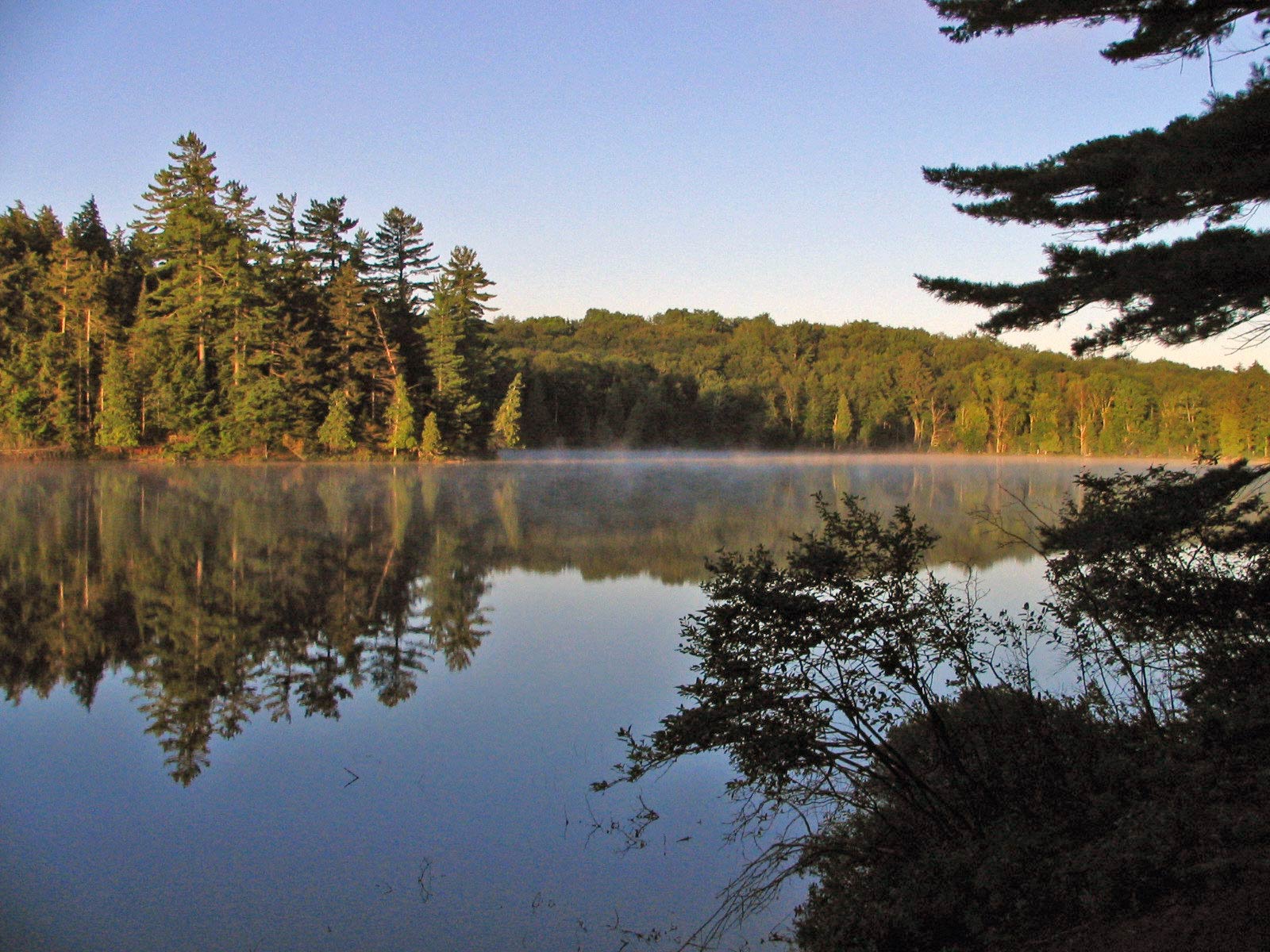
The Adirondack Park contains the 46 High Peaks, 2,800 lakes and ponds, 30,000 miles (48,000 km) of rivers and streams, and an estimated 200,000 acres (81,000 ha) of old-growth forests. It is home to 105 towns and villages, as well as numerous farms, businesses, and a timber-harvesting industry. The park has a population of 130,000 permanent and 200,000 seasonal residents, and sees over 12.4 million annual visitors. The inclusion of human communities makes the park one of the most successful experiments in conserving previously developed lands in the industrialized world.
The Adirondack Forest Preserve was designated a National Historic Landmark in 1963.
Before the 19th century, the wilderness was viewed as desolate and forbidding. As Romanticism developed in the United States, the view of wilderness became more positive, as seen in the writings of James Fenimore Cooper, Ralph Waldo Emerson, John Muir, and Henry David Thoreau.
The 1849 publication of Joel Tyler Headley's Adirondack; or, Life in the Woods triggered the development of hotels and stage coach lines. William Henry Harrison Murray's 1869 wilderness guidebook depicted the area as a place of relaxation and pleasure rather than a natural obstacle.
Financier and railroad promoter Thomas Clark Durant acquired a large tract of central Adirondack land and built a railroad from Saratoga Springs to North Creek. By 1875, there were more than two hundred hotels in the Adirondacks including Paul Smith's Hotel. About this time, the Great Camps were developed.
Following the Civil War, Reconstruction Era economic expansion led to an increase in logging and deforestation, especially in the southern Adirondacks.
Hub AI
Adirondack Park AI simulator
(@Adirondack Park_simulator)
Adirondack Park
The Adirondack Park is the designation for a large area of northeastern New York centered on the Adirondack Mountains. Like Catskill Park to the south, the area is unusual in the United States because, while the entire area is considered "parkland", about 52 percent of the land within the boundary consists of privately owned inholdings. The remaining 48 percent is publicly owned by the state as part of the Forest Preserve. Use of public and private lands in the park is regulated by the Adirondack Park Agency.
The park was established in 1892 for "the free use of all the people for their health and pleasure", and for watershed protection. At 6.1 million acres (25,000 km2), it is the largest park in the contiguous United States.
The Adirondack Park contains the 46 High Peaks, 2,800 lakes and ponds, 30,000 miles (48,000 km) of rivers and streams, and an estimated 200,000 acres (81,000 ha) of old-growth forests. It is home to 105 towns and villages, as well as numerous farms, businesses, and a timber-harvesting industry. The park has a population of 130,000 permanent and 200,000 seasonal residents, and sees over 12.4 million annual visitors. The inclusion of human communities makes the park one of the most successful experiments in conserving previously developed lands in the industrialized world.
The Adirondack Forest Preserve was designated a National Historic Landmark in 1963.
Before the 19th century, the wilderness was viewed as desolate and forbidding. As Romanticism developed in the United States, the view of wilderness became more positive, as seen in the writings of James Fenimore Cooper, Ralph Waldo Emerson, John Muir, and Henry David Thoreau.
The 1849 publication of Joel Tyler Headley's Adirondack; or, Life in the Woods triggered the development of hotels and stage coach lines. William Henry Harrison Murray's 1869 wilderness guidebook depicted the area as a place of relaxation and pleasure rather than a natural obstacle.
Financier and railroad promoter Thomas Clark Durant acquired a large tract of central Adirondack land and built a railroad from Saratoga Springs to North Creek. By 1875, there were more than two hundred hotels in the Adirondacks including Paul Smith's Hotel. About this time, the Great Camps were developed.
Following the Civil War, Reconstruction Era economic expansion led to an increase in logging and deforestation, especially in the southern Adirondacks.