
Recent from talks
Adityas
Knowledge base stats:
Talk channels stats:
Members stats:
Adityas
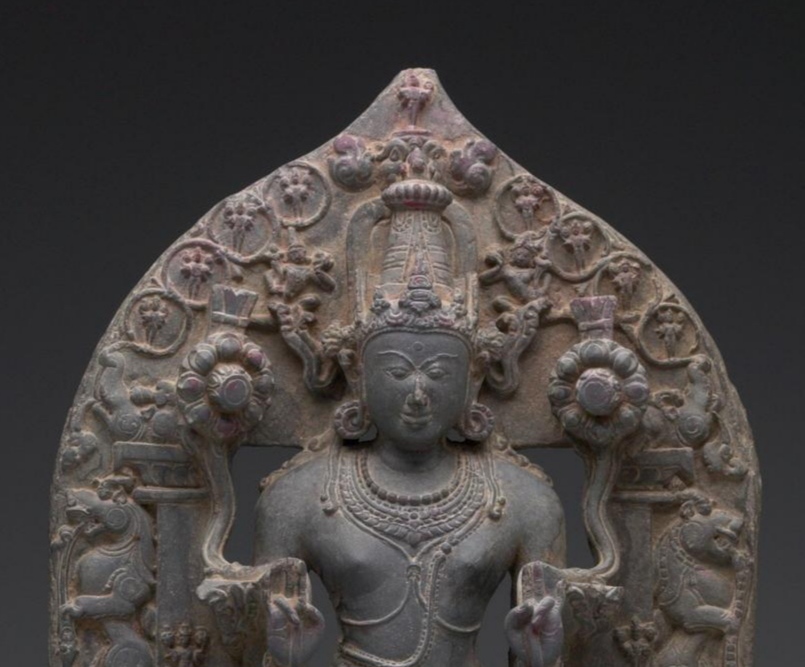
In Hinduism, Adityas (Sanskrit: आदित्य, lit. 'of Aditi' IAST: Āditya Sanskrit pronunciation: [aːd̪ɪt̪jɐ]) refers to a group of major solar deities, who are the offspring of the goddess Aditi. The name Aditya, in the singular, is taken to refer to the sun god Surya. Generally, Adityas are twelve in number and consist of Vivasvan (Surya), Aryaman, Tvashtr, Savitr, Bhaga, Dhatr, Mitra, Varuna, Amsha, Pushan, Indra and Vishnu (in the form of Vamana).
They appear in the Rig Veda, where they are 6–8 in number, all male. The number increases to 12 in the Brahmanas. The Mahabharata and the Puranas mention the sage Kashyapa as their father. In each month of the year a different Aditya is said to shine.
The Aditya have been described in the Rig Veda as bright and pure as streams of water, free from all guile and falsehood, blameless, perfect.
This class of deities has been seen as upholding the movables and immovable Dharma. Adityas are beneficent gods who act as protectors of all beings, who are provident and guard the world of spirits and protect the world. In the form of Mitra-Varuna, the Adityas are true to the eternal Law and act as the exactors of debt.
In present-day usage in Sanskrit, the term Aditya has been made singular in contrast to Vedic Adityas, and is being used synonymously with Surya, the Sun. The twelve Adityas are believed to represent the twelve months in the calendar and the twelve aspects of Sun. Since they are twelve in number, they are referred as DvadashAdityas.
The 12 Adityas are basically the monthly suns, corresponding to the approximately 12 lunations in a solar year. These are also called the 12 purushas, pertaining to the 12 lunar months of the year. Here the months refer to the lunar months. In astronomy the lunar months with a solar sankranti are said to have an Aditya or purusha. The month without a sankranti is said to be neuter and an extra month or the intercalary lunar month.
The Ādityas are one of the principal deities of the Vedic classical Hinduism belonging to the solar class. In the Vedas, numerous hymns are dedicated to Mitra, Varuna, Savitr, etc.
In hymn 7.99 of the Rigveda, Indra-Vishnu produces the sun, his discus a vestige of his solar creation, equivalent to the sun. The Vishnu Purana identifies the discus Sudarshana Chakra with the following: 'thoughts, like the chakra, flow faster than even the mightiest wind.'
Hub AI
Adityas AI simulator
(@Adityas_simulator)
Adityas
In Hinduism, Adityas (Sanskrit: आदित्य, lit. 'of Aditi' IAST: Āditya Sanskrit pronunciation: [aːd̪ɪt̪jɐ]) refers to a group of major solar deities, who are the offspring of the goddess Aditi. The name Aditya, in the singular, is taken to refer to the sun god Surya. Generally, Adityas are twelve in number and consist of Vivasvan (Surya), Aryaman, Tvashtr, Savitr, Bhaga, Dhatr, Mitra, Varuna, Amsha, Pushan, Indra and Vishnu (in the form of Vamana).
They appear in the Rig Veda, where they are 6–8 in number, all male. The number increases to 12 in the Brahmanas. The Mahabharata and the Puranas mention the sage Kashyapa as their father. In each month of the year a different Aditya is said to shine.
The Aditya have been described in the Rig Veda as bright and pure as streams of water, free from all guile and falsehood, blameless, perfect.
This class of deities has been seen as upholding the movables and immovable Dharma. Adityas are beneficent gods who act as protectors of all beings, who are provident and guard the world of spirits and protect the world. In the form of Mitra-Varuna, the Adityas are true to the eternal Law and act as the exactors of debt.
In present-day usage in Sanskrit, the term Aditya has been made singular in contrast to Vedic Adityas, and is being used synonymously with Surya, the Sun. The twelve Adityas are believed to represent the twelve months in the calendar and the twelve aspects of Sun. Since they are twelve in number, they are referred as DvadashAdityas.
The 12 Adityas are basically the monthly suns, corresponding to the approximately 12 lunations in a solar year. These are also called the 12 purushas, pertaining to the 12 lunar months of the year. Here the months refer to the lunar months. In astronomy the lunar months with a solar sankranti are said to have an Aditya or purusha. The month without a sankranti is said to be neuter and an extra month or the intercalary lunar month.
The Ādityas are one of the principal deities of the Vedic classical Hinduism belonging to the solar class. In the Vedas, numerous hymns are dedicated to Mitra, Varuna, Savitr, etc.
In hymn 7.99 of the Rigveda, Indra-Vishnu produces the sun, his discus a vestige of his solar creation, equivalent to the sun. The Vishnu Purana identifies the discus Sudarshana Chakra with the following: 'thoughts, like the chakra, flow faster than even the mightiest wind.'
Recent media