
Hubbry Logo
Nodal admittance matrixNodal admittance matrixMain
Open search
Nodal admittance matrix
Community hub
Nodal admittance matrix
logo
7 pages, 0 posts
0 subscribers
Be the first to start a discussion here.
Nodal admittance matrix
from Wikipedia

In power engineering, nodal admittance matrix (or just admittance matrix) is an N x N matrix describing a linear power system with N buses. It represents the nodal admittance of the buses in a power system. In realistic systems which contain thousands of buses, the admittance matrix is quite sparse. Each bus in a real power system is usually connected to only a few other buses through the transmission lines.[1] The nodal admittance matrix is used in the formulation of the power flow problem.

Construction from a single line diagram

[edit]

The nodal admittance matrix of a power system is a form of Laplacian matrix of the nodal admittance diagram of the power system, which is derived by the application of Kirchhoff's laws to the admittance diagram of the power system. Starting from the single line diagram of a power system, the nodal admittance diagram is derived by:

  • replacing each line in the diagram with its equivalent admittance, and
  • converting all voltage sources to their equivalent current source.

Consider an admittance graph with buses. The vector of bus voltages, , is an vector where is the voltage of bus , and vector of bus current injections, , is an vector where is the cumulative current injected at bus by all loads and sources connected to the bus. The admittance between buses and is a complex number , and is the sum of the admittance of all lines connecting busses and . The admittance between the bus and ground is , and is the sum of the admittance of all the loads connected to bus .

Consider the current injection, , into bus . Applying Kirchhoff's current law
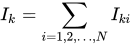
where is the current from bus to bus for and is the current from bus to ground through the bus load. Applying Ohm's law to the admittance diagram, the bus voltages and the line and load currents are linked by the relation

Therefore,

This relation can be written succinctly in matrix form using the admittance matrix. The nodal admittance matrix is a matrix such that bus voltage and current injection satisfy Ohm's law

in vector format. The entries of are then determined by the equations for the current injections into buses, resulting in

Figure 1: The admittance diagram of a three bus network.

As an example, consider the admittance diagram of a fully connected three bus network of figure 1. The admittance matrix derived from the three bus network in the figure is:

The diagonal entries are called the self-admittances of the network nodes. The non-diagonal entries are the mutual admittances of the nodes corresponding to the subscripts of the entry. The admittance matrix is typically a symmetric matrix as . However, extensions of the line model may make asymmetrical. For instance, modeling phase-shifting transformers, results in a Hermitian admittance matrix.[2]

Applications

[edit]

The admittance matrix is most often used in the formulation of the power flow problem.[3][4]

See also

[edit]

References

[edit]
[edit]
Revisions and contributorsEdit on WikipediaRead on Wikipedia
from Grokipedia
The nodal matrix, also known as the Y-bus or bus matrix, is an N×NN \times N in electrical that models the linear relationships between nodal current injections and nodal voltages in a power system with NN buses, expressed by the equation I=YV\mathbf{I} = \mathbf{Y} \mathbf{V}, where I\mathbf{I} is the vector of current injections, V\mathbf{V} is the vector of bus voltages, and Y\mathbf{Y} contains the network . It is derived from Kirchhoff's current law and serves as the foundational representation for analyzing interconnected AC networks, facilitating computations in per-unit values. The matrix's diagonal elements YiiY_{ii} represent the sum of all admittances connected to bus ii, including shunt admittances and branch admittances to other buses, while off-diagonal elements YijY_{ij} (for iji \neq j) are the negative of the mutual admittance between buses ii and jj, and zero if no direct connection exists, ensuring sparsity in large networks. This structure arises from the network's topology and branch parameters, such as impedances of transmission lines and transformers, which are converted to admittances (y=1/zy = 1/z) during formation. The matrix's rank is typically N1N-1 in shunt-free networks due to the reference bus, but full rank with shunts, enabling techniques like Kron reduction to simplify models by eliminating internal nodes. In power system applications, the nodal admittance matrix is essential for solving nonlinear power flow equations iteratively, such as via the Newton-Raphson method, to determine steady-state voltages, power flows, and losses across grids as large as 50,000 buses. It supports state estimation, voltage stability assessments through hybrid parameter derivations, and modeling of phenomena like , while its graph Laplacian properties link it to broader in and physics.

Fundamentals

Definition

The nodal matrix, commonly denoted as the Y-bus matrix, is a fundamental construct in electrical power analysis, representing the interconnections among the nodes (buses) of a network. For a power comprising N buses, the Y-bus is an N × N whose elements quantify the linking these buses, enabling the systematic formulation of network equations. This matrix encapsulates the topological and impedance characteristics of the , distinguishing self- on the diagonal from mutual off the diagonal. The primary purpose of the Y-bus matrix is to relate the vector of injected currents I\mathbf{I} at each bus to the vector of nodal voltages V\mathbf{V} through the linear equation I=YV\mathbf{I} = \mathbf{Y} \mathbf{V}, where I\mathbf{I} and V\mathbf{V} are N × 1 column vectors. This relationship stems from the application of Kirchhoff's current law at each node, providing a matrix-based framework for solving power flow problems and analyzing steady-state behavior. By expressing currents as functions of voltages, the Y-bus facilitates efficient computational methods for determining voltage profiles and power distributions across the network. In standard notation, branch admittances are denoted by lowercase yijy_{ij}, representing the of the impedance connecting buses i and j. The diagonal elements of the Y-bus, known as self-admittances YiiY_{ii}, are the sum of all admittances directly connected to bus i, including shunt elements. Off-diagonal elements, or mutual admittances YijY_{ij} (for iji \neq j), are the negative of the yijy_{ij} between buses i and j, reflecting the current flow influences between nodes. This convention ensures the matrix's in reciprocal networks, where Yij=YjiY_{ij} = Y_{ji}. To illustrate, consider a simple two-bus system with a branch admittance y12y_{12} between bus 1 and bus 2, along with shunt admittances y1y_1 at bus 1 and y2y_2 at bus 2. The Y-bus matrix takes the form: Y=[y1+y12y12y12y2+y12]\mathbf{Y} = \begin{bmatrix} y_1 + y_{12} & -y_{12} \\ -y_{12} & y_2 + y_{12} \end{bmatrix} Here, the injected current at bus 1 is I1=(y1+y12)V1y12V2I_1 = (y_1 + y_{12}) V_1 - y_{12} V_2, demonstrating how the matrix encodes the nodal relationships. For a purely inductive branch with y12=j0.1y_{12} = j0.1 pu (per unit) and negligible shunts, the matrix simplifies to Y=j0.1[1111]\mathbf{Y} = j0.1 \begin{bmatrix} 1 & -1 \\ -1 & 1 \end{bmatrix}.

Relation to Kirchhoff's Laws

The nodal admittance matrix arises directly from Kirchhoff's current law (KCL), which states that the algebraic sum of currents entering a node in an electrical network equals the net current injected into that node. For a network with nn nodes, KCL applied at each node kk yields an equation relating the injected current IkI_k to the currents flowing through connected branches. To express these currents in terms of nodal voltages, consider a connecting nodes ii and jj with yijy_{ij}. The current through this from ii to jj is given by Iij=yij(ViVj)I_{ij} = y_{ij} (V_i - V_j), where ViV_i and VjV_j are the voltages at nodes ii and jj, respectively. This linear relationship allows the branch currents to be rewritten solely in nodal voltage form, transforming the KCL equations from a mix of voltage and current variables into a system dependent only on voltages. Applying this to a general node kk, the injected current IkI_k equals the sum of currents leaving the node through all connected branches: Ik=j=1,jknykj(VkVj)+yk0VkI_k = \sum_{j=1, j \neq k}^n y_{kj} (V_k - V_j) + y_{k0} V_k where yk0y_{k0} represents the to ground (if present), and the sum is over all nodes jj connected to kk. Rearranging terms collects coefficients for each VjV_j: Ik=(j=1,jknykj+yk0)Vkj=1,jknykjVj.I_k = \left( \sum_{j=1, j \neq k}^n y_{kj} + y_{k0} \right) V_k - \sum_{j=1, j \neq k}^n y_{kj} V_j.
Add your contribution
Related Hubs
User Avatar
No comments yet.
