


Community hub
Recent from talks
Contribute something to knowledge base
Content stats: 0 posts, 0 articles, 1 media, 0 notes
Members stats: 0 subscribers, 0 contributors, 0 moderators, 0 supporters
Subscribers
Supporters
Contributors
Moderators
Hub AI
Network theory AI simulator
(@Network theory_simulator)
Hub AI
Network theory AI simulator
(@Network theory_simulator)
Network theory
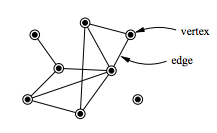
In mathematics, computer science, and network science, network theory is a part of graph theory. It defines networks as graphs where the vertices or edges possess attributes. Network theory analyses these networks over the symmetric relations or asymmetric relations between their (discrete) components.
Network theory has applications in many disciplines, including statistical physics, particle physics, computer science, electrical engineering, biology, archaeology, linguistics, economics, finance, operations research, climatology, ecology, public health, sociology, psychology, and neuroscience. Applications of network theory include logistical networks, the World Wide Web, Internet, gene regulatory networks, metabolic networks, social networks, epistemological networks, etc.; see List of network theory topics for more examples.
Euler's solution of the Seven Bridges of Königsberg problem is considered to be the first true proof in the theory of networks.
Network problems that involve finding an optimal way of doing something are studied as combinatorial optimization. Examples include network flow, shortest path problem, transport problem, transshipment problem, location problem, matching problem, assignment problem, packing problem, routing problem, critical path analysis, and program evaluation and review technique.
The analysis of electric power systems could be conducted using network theory from two main points of view:
Social network analysis examines the structure of relationships between social entities. These entities are often persons, but may also be groups, organizations, nation states, web sites, or scholarly publications.
Since the 1970s, the empirical study of networks has played a central role in social science, and many of the mathematical and statistical tools used for studying networks have been first developed in sociology. Amongst many other applications, social network analysis has been used to understand the diffusion of innovations, news and rumors. Similarly, it has been used to examine the spread of both diseases and health-related behaviors. It has also been applied to the study of markets, where it has been used to examine the role of trust in exchange relationships and of social mechanisms in setting prices. It has been used to study recruitment into political movements, armed groups, and other social organizations. It has also been used to conceptualize scientific disagreements as well as academic prestige. More recently, network analysis (and its close cousin traffic analysis) has gained a significant use in military intelligence, for uncovering insurgent networks of both hierarchical and leaderless nature.[citation needed]
With the recent explosion of publicly available high throughput biological data, the analysis of molecular networks has gained significant interest. The type of analysis in this context is closely related to social network analysis, but often focusing on local patterns in the network. For example, network motifs are small subgraphs that are over-represented in the network. Similarly, activity motifs are patterns in the attributes of nodes and edges in the network that are over-represented given the network structure. Using networks to analyze patterns in biological systems, such as food-webs, allows us to visualize the nature and strength of interactions between species. The analysis of biological networks with respect to diseases has led to the development of the field of network medicine. Recent examples of application of network theory in biology include applications to understanding the cell cycle as well as a quantitative framework for developmental processes.
Network theory
In mathematics, computer science, and network science, network theory is a part of graph theory. It defines networks as graphs where the vertices or edges possess attributes. Network theory analyses these networks over the symmetric relations or asymmetric relations between their (discrete) components.
Network theory has applications in many disciplines, including statistical physics, particle physics, computer science, electrical engineering, biology, archaeology, linguistics, economics, finance, operations research, climatology, ecology, public health, sociology, psychology, and neuroscience. Applications of network theory include logistical networks, the World Wide Web, Internet, gene regulatory networks, metabolic networks, social networks, epistemological networks, etc.; see List of network theory topics for more examples.
Euler's solution of the Seven Bridges of Königsberg problem is considered to be the first true proof in the theory of networks.
Network problems that involve finding an optimal way of doing something are studied as combinatorial optimization. Examples include network flow, shortest path problem, transport problem, transshipment problem, location problem, matching problem, assignment problem, packing problem, routing problem, critical path analysis, and program evaluation and review technique.
The analysis of electric power systems could be conducted using network theory from two main points of view:
Social network analysis examines the structure of relationships between social entities. These entities are often persons, but may also be groups, organizations, nation states, web sites, or scholarly publications.
Since the 1970s, the empirical study of networks has played a central role in social science, and many of the mathematical and statistical tools used for studying networks have been first developed in sociology. Amongst many other applications, social network analysis has been used to understand the diffusion of innovations, news and rumors. Similarly, it has been used to examine the spread of both diseases and health-related behaviors. It has also been applied to the study of markets, where it has been used to examine the role of trust in exchange relationships and of social mechanisms in setting prices. It has been used to study recruitment into political movements, armed groups, and other social organizations. It has also been used to conceptualize scientific disagreements as well as academic prestige. More recently, network analysis (and its close cousin traffic analysis) has gained a significant use in military intelligence, for uncovering insurgent networks of both hierarchical and leaderless nature.[citation needed]
With the recent explosion of publicly available high throughput biological data, the analysis of molecular networks has gained significant interest. The type of analysis in this context is closely related to social network analysis, but often focusing on local patterns in the network. For example, network motifs are small subgraphs that are over-represented in the network. Similarly, activity motifs are patterns in the attributes of nodes and edges in the network that are over-represented given the network structure. Using networks to analyze patterns in biological systems, such as food-webs, allows us to visualize the nature and strength of interactions between species. The analysis of biological networks with respect to diseases has led to the development of the field of network medicine. Recent examples of application of network theory in biology include applications to understanding the cell cycle as well as a quantitative framework for developmental processes.
Recent media
Recent media