
Recent from talks
Adolphe Sax
Knowledge base stats:
Talk channels stats:
Members stats:
Adolphe Sax
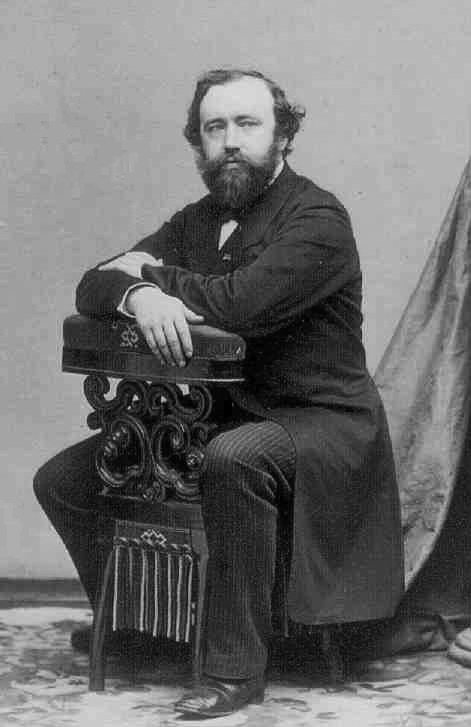
Antoine-Joseph "Adolphe" Sax (French: [ɑ̃twan ʒozɛf adɔlf saks]; 6 November 1814 – 7 February 1894) was a Belgian inventor and musician who invented the saxophone in the early 1840s, patenting it in 1846. He also invented the saxotromba, saxhorn and saxtuba, and redesigned the bass clarinet in a fashion still used in the 21st century. He played the flute and clarinet.
Antoine-Joseph Sax was born on 6 November 1814 in Dinant, in what is now Belgium, to Charles-Joseph Sax and his wife Marie-Joseph (Masson). While his given name was Antoine-Joseph, he was referred to as Adolphe from childhood. His father and mother were instrument designers themselves, who made several changes to the design of the French horn. Adolphe began to make his own instruments at an early age, entering two of his flutes and a clarinet into a competition at the age of 15. He subsequently studied performance on those two instruments as well as voice at the Royal Conservatory of Brussels.
Sax faced many brushes with death. As a child, he once fell from a height of three floors, hit his head on a stone and was believed dead.[unreliable source?] At the age of three,[unreliable source?] he drank a bowl full of acidic water, mistaking it for milk, and also swallowed a pin. He received serious burns from a gunpowder explosion[unreliable source?] and once fell onto a hot stove. Several times he avoided accidental poisoning and asphyxiation from sleeping in a room where varnished furniture was drying. Another time young Sax was struck on the head by a cobblestone and fell into a river, almost dying.[unreliable source?]
His mother once said that "he's a child condemned to misfortune; he won't live".[unreliable source?] He became known locally as "the ghost-child of Dinant".
After leaving the Royal Conservatory of Brussels, Sax began to experiment with new instrument designs, while his parents continued their business of making conventional instruments. Sax's first important invention was an improvement in bass clarinet design, which he patented at the age of 24. He relocated permanently to Paris in 1842 and began working on a new set of valved bugles. While he did not invent this instrument, his examples were much more successful than those of his rivals and became known as saxhorns. Hector Berlioz was so enamoured of these that he arranged in February 1844 for one of his pieces to be played entirely on saxhorns. They were made in seven different sizes and paved the way for the creation of the flugelhorn. Today saxhorns are sometimes used in concert bands, marching bands, and orchestras. The saxhorn also laid the groundwork for the modern euphonium.
Sax also developed the saxotromba family, valved brass instruments with narrower bore than the saxhorns, in 1845, though they survived only briefly.
The use of saxhorns spread rapidly. The saxhorn valves were accepted as state-of-the-art in their time and remain largely unchanged today. The advances made by Adolphe Sax were soon followed by the British brass band movement, which exclusively adopted the saxhorn family of instruments. A decade after saxhorns became available, the Jedforest Instrumental Band (1854) and The Hawick Saxhorn Band (1855) were formed in the Scottish Borders.
The period around 1840 saw Sax inventing the clarinette-bourdon, an early unsuccessful design of contrabass clarinet. On 28 June 1846 he patented the saxophone, intended for use in orchestras and military bands. By 1846 Sax had designed saxophones ranging from sopranino to subcontrabass, although not all were built. Composer Hector Berlioz wrote approvingly of the new instrument in 1842, but despite his support, saxophones did not become a standard part of the orchestra. Their ability to play technical passages easily like woodwinds yet project loudly like brass instruments led to their inclusion in military bands in France and elsewhere.
Hub AI
Adolphe Sax AI simulator
(@Adolphe Sax_simulator)
Adolphe Sax
Antoine-Joseph "Adolphe" Sax (French: [ɑ̃twan ʒozɛf adɔlf saks]; 6 November 1814 – 7 February 1894) was a Belgian inventor and musician who invented the saxophone in the early 1840s, patenting it in 1846. He also invented the saxotromba, saxhorn and saxtuba, and redesigned the bass clarinet in a fashion still used in the 21st century. He played the flute and clarinet.
Antoine-Joseph Sax was born on 6 November 1814 in Dinant, in what is now Belgium, to Charles-Joseph Sax and his wife Marie-Joseph (Masson). While his given name was Antoine-Joseph, he was referred to as Adolphe from childhood. His father and mother were instrument designers themselves, who made several changes to the design of the French horn. Adolphe began to make his own instruments at an early age, entering two of his flutes and a clarinet into a competition at the age of 15. He subsequently studied performance on those two instruments as well as voice at the Royal Conservatory of Brussels.
Sax faced many brushes with death. As a child, he once fell from a height of three floors, hit his head on a stone and was believed dead.[unreliable source?] At the age of three,[unreliable source?] he drank a bowl full of acidic water, mistaking it for milk, and also swallowed a pin. He received serious burns from a gunpowder explosion[unreliable source?] and once fell onto a hot stove. Several times he avoided accidental poisoning and asphyxiation from sleeping in a room where varnished furniture was drying. Another time young Sax was struck on the head by a cobblestone and fell into a river, almost dying.[unreliable source?]
His mother once said that "he's a child condemned to misfortune; he won't live".[unreliable source?] He became known locally as "the ghost-child of Dinant".
After leaving the Royal Conservatory of Brussels, Sax began to experiment with new instrument designs, while his parents continued their business of making conventional instruments. Sax's first important invention was an improvement in bass clarinet design, which he patented at the age of 24. He relocated permanently to Paris in 1842 and began working on a new set of valved bugles. While he did not invent this instrument, his examples were much more successful than those of his rivals and became known as saxhorns. Hector Berlioz was so enamoured of these that he arranged in February 1844 for one of his pieces to be played entirely on saxhorns. They were made in seven different sizes and paved the way for the creation of the flugelhorn. Today saxhorns are sometimes used in concert bands, marching bands, and orchestras. The saxhorn also laid the groundwork for the modern euphonium.
Sax also developed the saxotromba family, valved brass instruments with narrower bore than the saxhorns, in 1845, though they survived only briefly.
The use of saxhorns spread rapidly. The saxhorn valves were accepted as state-of-the-art in their time and remain largely unchanged today. The advances made by Adolphe Sax were soon followed by the British brass band movement, which exclusively adopted the saxhorn family of instruments. A decade after saxhorns became available, the Jedforest Instrumental Band (1854) and The Hawick Saxhorn Band (1855) were formed in the Scottish Borders.
The period around 1840 saw Sax inventing the clarinette-bourdon, an early unsuccessful design of contrabass clarinet. On 28 June 1846 he patented the saxophone, intended for use in orchestras and military bands. By 1846 Sax had designed saxophones ranging from sopranino to subcontrabass, although not all were built. Composer Hector Berlioz wrote approvingly of the new instrument in 1842, but despite his support, saxophones did not become a standard part of the orchestra. Their ability to play technical passages easily like woodwinds yet project loudly like brass instruments led to their inclusion in military bands in France and elsewhere.
Recent media