Hubbry Logo
Contrabass clarinetContrabass clarinetMain
Open search
Contrabass clarinet
Community hub
Contrabass clarinet
logo
8 pages, 0 posts
0 subscribers
Be the first to start a discussion here.
Contrabass clarinet
Contrabass clarinet
from Wikipedia
Contrabass clarinet
Clarinets: contrabass in B♭ (left), contra-alto in E♭ (right)
Woodwind instrument
Classification Single-reed
Developed1808
Playing range

    {
      \new Staff \with { \remove "Time_signature_engraver" }
      \clef treble \key c \major ^ \markup "written" \cadenzaOn
      \tweak font-size #-2 c1 \finger \markup \text "low C"
      \arpeggioBracket <e f'''>1 \arpeggio
      \once \hide r1
      \clef bass ^ \markup "sounds"
      \tweak font-size #-2 bes,,, \finger \markup \text "low C"
      \arpeggioBracket
      <d,, ees'>1\arpeggio
    }
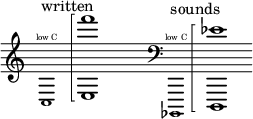
The contrabass clarinet in B♭ sounds two octaves and a major second lower than written.
Related instruments
Musicians

The contrabass clarinet or double bass clarinet (also pedal clarinet, after the pedals of pipe organs) and contra-alto clarinet are the two largest members of the clarinet family that are in common usage.[1][2] Modern contrabass clarinets are transposing instruments pitched in B♭, sounding two octaves lower than the common B♭ soprano clarinet and one octave below the bass clarinet.[1] Some contrabass clarinet models have extra keys to extend the range down to low written E♭3, D3 or C3. This gives a tessitura written range, notated in treble clef, of C3 – F6, which sounds B♭0 – E♭4.[3] Some early instruments were pitched in C; Arnold Schoenberg's Fünf Orchesterstücke specifies a contrabass clarinet in A,[4] but there is no evidence such an instrument has ever existed.[5]

The smaller E♭ contra-alto clarinet is sometimes referred to as the "E♭ contrabass clarinet" and is pitched one octave lower than the E♭ alto clarinet.[1]

Two models of subcontrabass clarinet (the octocontra-alto and octocontrabass) were built as prototypes by Leblanc in the 1930s and survive in the Leblanc museum.[6]

History

[edit]

Contrabass

[edit]

The earliest known contrabass clarinet was the contre-basse guerrière invented in 1808 by a goldsmith named Dumas of Sommières; little else is known of this instrument. The batyphone (also spelled bathyphone, Ger. and Fr. batyphon) was a contrabass clarinet which was the outcome of W. F. Wieprecht's endeavor to obtain a contrabass for the reed instruments. The batyphone was made to a scale twice the size of the clarinet in C, the divisions of the chromatic scale being arranged according to acoustic principles. For convenience in stopping holes too far apart to be covered by the fingers, crank or swivel keys were used. The instrument was constructed of maple-wood, had a clarinet mouthpiece of suitable size connected by means of a cylindrical brass crook with the upper part of the tube and a brass bell. The pitch was two octaves below the clarinet in C, the compass being the same, and thus corresponding to the modern bass tuba. The tone was pleasant and full, but not powerful enough for the contrabass register in a military band. The batyphone had besides one serious disadvantage: it could be played with facility only in its nearly related keys, G and F major. The batyphone was invented and patented in 1839 by F.W. Wieprecht, director general of all the Prussian military bands, and E. Skorra, the court instrument manufacturer of Berlin. In practice the instrument was found to be of little use, and was superseded by the bass tuba.

A batyphone bearing the name of its inventors formed part of the Snoeck collection which was acquired for Berlin's collection of ancient musical instruments at the Hochschule für Musik.[7] Soon after Wieprecht's invention, Adolphe Sax created his clarinette-bourdon in B.

In 1889, Fontaine-Besson began producing a new pedal clarinet (see photograph). This instrument consists of a tube 10 feet (3.0 m) long, in which cylindrical and conical bores are combined. The tube is doubled up twice upon itself. There are 13 keys and 2 rings on the tube, and the fingering is the same as for the B clarinet except for the eight highest semitones. The tone is rich and full except for the lowest notes, which are unavoidably a little rough in quality, but much more sonorous than the corresponding notes on the contrabassoon. This is an octave lower than a bass clarinet and two octaves lower than a B♭ clarinet. The upper register resembles the chalumeau register of the B clarinet, being reedy and sweet.[8] Besson exhibited a new pedal clarinet in London in 1892.[9] None of these instruments saw widespread use, but they provided a basis for contrabass clarinets made beginning in the late 19th and early 20th centuries by several manufacturers, notably those designed by Charles Houvenaghel [fr]

for Leblanc, which were more successful.

Contra-alto

[edit]

The contra-alto clarinet is higher-pitched than the contrabass and is pitched in the key of E rather than B. The unhyphenated form "contra alto clarinet" is also sometimes used, as is "contralto clarinet", but the latter is confusing since the instrument's range is much lower than the contralto vocal range; the more correct term "contra-alto" is meant to convey, by analogy with "contrabass", that the instrument plays an octave lower than the alto clarinet. It is also referred to as the E contrabass clarinet. It is the second-largest member of the clarinet family in regular use, larger than the more common bass clarinet but not as large as the B contrabass clarinet.

Like other clarinets, the contra-alto clarinet is a wind instrument that uses a reed to produce sound. The keys of the contra-alto are similar to the keys on smaller clarinets, and are played in the same way. Some contra-alto clarinet models have a range extending down to low (written) E, sounding as the lowest G on the piano (aka G1), while others can play down to low (written) C, sounding E1.

The earliest contra-alto clarinets were developed in the first half of the nineteenth century; these were usually pitched in F and were called contrabasset horns, being an octave lower than the basset horn. Albert (probably E. J. Albert, son of Eugène Albert) built an instrument in F around 1890.[10] In the late 19th and early 20th century contra-alto clarinets in E finally attained some degree of popularity.

The contra-alto clarinet is used mostly in concert bands and clarinet choirs, where it usually, though not always, plays the bass line of a piece of music. While there are few parts written specifically for it, the contra-alto can play the baritone saxophone part and sounds the same pitch; it is also possible to read parts written in the bass clef for instruments pitched in C (such as bassoon or tuba) as if the part were in the treble clef, while adjusting the key signature and any accidentals as necessary by adding three sharps to the music.[11] It is occasionally used in jazz, and a few solo pieces have been written for it. The contra-alto clarinet is also used in a few Broadway pit orchestras, with its parts being written in reed books as a doubled instrument (e.g. with soprano clarinet and bass clarinet).

Subcontrabass (octocontra-alto, octocontrabass)

[edit]
Subcontrabass clarinets by Leblanc 1939 and Foag 2025

In 1935, Belgian instrument maker Charles Houvenaghel [fr] at Leblanc built a single prototype octocontrabass clarinet in B♭ a full octave below the contrabass and standing 8 foot 2 inches (2.49 m) high. It was exhibited at the World's Fair that year.[6] Its lowest note, C0 (written D3), is the lowest note on a 32′ pedal organ stop. This instrument survives in non-playable condition in the Leblanc collection of the Musée des Instruments à vent [fr] in La Couture-Boussey, France.[12][13] Houvenaghel also built two slightly smaller prototype octocontra-alto clarinets in E♭ for Leblanc in the 1930s, pitched a fifth below the B♭ contrabass and one octave below the E♭ contra-alto clarinet.[14] Only one was ever finished with key work, in 1971 to low C (sounding E♭0).[6] That year, Leblanc announced its "retail price" as $3700 USD (equivalent to $29,000 in 2024),[15] though none were apparently sold.[16] This instrument is also on permanent exhibit at the museum, donated in 2011 by Leblanc president Leon Pascucci and restored to playable condition by French clarinettist and technician Cyrille Mercadier.[17][18]

Although these enormous "octo" clarinets are mentioned in some texts (e.g. Baines, 1991) neither were manufactured by Leblanc beyond the prototype stage.[19][20] There are some contemporary efforts to recreate them using modern materials and 3D printing technology. In late 2018, American instrument maker and woodwind technician Jared De Leon began work on prototypes for B♭ octocontrabass and E♭ octocontra-alto clarinets, and in January 2025 demonstrated a working E♭ octocontra-alto clarinet based on a 3D printed design.[21][22] In April 2025 at the Akustika Nürnberg trade show after five years of development, the German instrument maker Foag Klarinetten presented their first production all-metal B♭ octocontrabass clarinet, with keys to low C (sounding B♭-1).[23][24]

At least three pieces of music have been written specifically for octocontrabass by Norwegian composer Terje Lerstad (Trisonata, Op. 28; De Profundis, Op. 139; and Mirrors in Ebony for clarinet choir, Op. 144). There are no known recordings of these pieces.[25]

Manufacturers

[edit]
Image of Fritz Wurlitzer's prototype of a German system contrabass clarinet.
Fritz Wurlitzer German contrabass clarinet (prototype ca. 1975)
Contrabass clarinets by Benedikt Eppelsheim and Leblanc

France:

  • Henri Selmer Paris
    • Contrabass (Model 41- pictured in the info box above) to low C in bass clarinet-shape with rosewood body.
    • Contra-alto (Model 40) to low E♭ in bass clarinet-shape with rosewood body.
  • Buffet Crampon makes a contra-alto clarinet, grenadilla body in bass clarinet-shape, pictured in the info box above.

USA:

  • Conn-Selmer has one model of each of the two clarinets under its brand Leblanc.
    • Contrabass: Leblanc L7182, to low E-flat, ABS body.
    • Contra-alto: Leblanc L7181, to low E-flat, ABS body.

Germany:

Italy:

China:

  • Tianjin Frater Musical Instrument Co. produces a double bass clarinet made of metal in paperclip form.

Development

[edit]
Contrabass Clarinet Extended (CLEX)

Since 2012, a research team led by Ernesto Molinari (professor at the Bern University of the Arts), Jochen Seggelke (clarinet maker) and Daniel Debrunner (mechatronics engineer) has been developing various prototypes of a new double bass clarinet called CLEX' (Contrabass Clarinet Extended) as a mechatronic solution.[26][27] The motorised keys are remotely controlled by the musician's fingers via keys equipped with electronic sensors. This type of instrument opens up new musical perspectives for instrumentalists and composers. The positioning of the holes on the clarinet body is completely free of traditional mechanical constraints.[28]

In June 2016, Molinari presented the first of three working prototypes at two concert events.

In a video posted in December 2021, Jared De Leon cited the CLEX project as an inspiration for a new theoretical prototype octocontrabass clarinet that would utilize mechatronic keywork.[29]

Performers

[edit]
Anthony Braxton playing a paperclip contrabass clarinet in Rochester, NY, 1976

Probably the best-known musician who has made significant use of the contrabass clarinet as a solo instrument is Anthony Braxton. Other performers (most of whom use the instrument in the genres of jazz and free improvised music) include James Carter, Brian Landrus, Douglas Ewart, Vinny Golia, Mwata Bowden, Ernst Ulrich Deuker, Paolo Ravaglia, Hamiet Bluiett, Edward "Kidd" Jordan, Harry Sparnaay (NL), Armand Angster (F) and Jason Alder. Leroi Moore of the Dave Matthews Band played a contrabass clarinet on the song "So Right" from the 2001 album Everyday and John Linnell of They Might Be Giants utilizes the contra-alto clarinet on their 2013 album Nanobots, as well as subsequent releases by the band. Colin Stetson makes use of the instrument on his 2015 collaboration album Never Were the Way She Was with violinist Sarah Neufeld and Jochen Seggelke. In 2020, Sarah Watts, a bass clarinet specialist who also plays an active role in commissioning and performing new works for the contrabass clarinet, released a solo album featuring works for contrabass clarinet and piano entitled Into the Depths.[30]

Use in contemporary classical music

[edit]

The contrabass clarinet has a relatively modest yet increasing presence in modern compositions. It is most commonly used in works for wind band, clarinet choir, and solo contrabass clarinet, though there exist pieces for orchestra and other ensembles that call for the contrabass clarinet, and the contrabass clarinet is heavily featured in many film scores.

Some notable composers who have written for the contrabass or contra-alto clarinet include Alfred Reed, Vincent Persichetti, John Adams, Philip Glass, David Maslanka, John Mackey, Daniel Dorff, Franco Donatoni, and David Bennett Thomas.[31][32][33][34]

A catalog of compositions featuring the contrabass clarinet was compiled in 2017 by performer Sarah Watts and may be downloaded without a fee from her website.[35]

Concert band

[edit]

The modern concert band (also known as a wind band or wind orchestra) is the ensemble in which the contrabass clarinet is most often found. Most modern concert band scores have parts for either contrabass or contra-alto clarinet, and the contrabass clarinet is useful within a balanced band instrumentation to solidify the low range of the woodwind section.[36] The increasing consistency of the contrabass clarinet's inclusion in the modern concert band allows contemporary band composers to score exposed passages or solos for the instrument, which are not typically seen in other ensembles that may include the contrabass clarinet.

Some notable band works that feature the contrabass clarinet include Blue Shades by Frank Ticheli,[37] which features a contrabass clarinet solo, and One Life Beautiful by Julie Giroux, which calls for either a contrabass clarinet in B♭ or a contra-alto clarinet in E♭. It is specified by the composer that this part is not optional.[38]

Clarinet choir

[edit]

The contrabass clarinet forms the lowest bass voice of a modern clarinet choir. While not all contemporary compositions for clarinet choir include parts for the contrabass clarinet, many do, especially more recent pieces.

Some notable works for clarinet choir that call for contrabass clarinet include Gather at The Rock by Jenni Brandon[39] and Dusk by Steven Bryant.[40]

Solo repertoire

[edit]

The contrabass clarinet as a solo instrument has only been explored relatively recently, mirroring the relative recency of the instrument's modern development. The body of works for solo contrabass clarinet, encompassing works for unaccompanied contrabass clarinet, contrabass clarinet and piano, and contrabass clarinet and orchestra, is expanding rapidly as contemporary composers continue to explore its unique characteristics and capabilities.

Some notable works for solo contrabass clarinet include Lucien Goethals's Concerto for Contrabass Clarinet and Orchestra, Soul Searching - Contrabass Clarinet Concerto by Martin Georgiev,[41] Ombra I and Ombra II by Franco Donatoni,[42] and Into the Depths by Elizabeth Kelly.[43]

Orchestra

[edit]

The contrabass clarinet is a very rare visitor to the standard symphony orchestra as a member of the clarinet section, and most orchestra pieces that call for contrabass clarinet feature the instrument as a soloist. Still, there have been occasional additions to the orchestral repertoire that feature the contrabass clarinet, including On the Transmigration of Souls by John Adams,[44] Amériques by Edgard Varèse, and La Terre est un homme by Brian Ferneyhough, which all call for contrabass clarinet as a part of their expanded woodwind sections.[45]

Notable appearances in opera and film

[edit]

References

[edit]

Sources

[edit]
[edit]
Revisions and contributorsEdit on WikipediaRead on Wikipedia
from Grokipedia
The contrabass clarinet is the largest and lowest-pitched instrument in the , a single-reed woodwind typically constructed in B♭ that produces a deep, resonant tone through its elongated, curved body measuring up to approximately 2.7 meters when fully assembled. It features a cylindrical bore, an upturned bell, and complex keywork adapted from the to facilitate playability despite its size, with the body often divided into four sections—neck, upper joint, lower joint, and bell—for easier handling and transport. The clarinet's development traces back to the , as part of broader innovations in large-sized clarinets to extend the instrument family's range for use in ensembles, wind bands, and orchestras, with early prototypes appearing as far back as 1808 in the form of the contre-basse guerrière invented by a named Dumas. Practical, playable models emerged around 1890 in , building on keywork systems developed by Louis-Auguste Buffêt and incorporating influences from earlier bass clarinets patented by in the 1840s. By the mid-20th century, manufacturers like Selmer Paris began producing professional-grade Bb contrabass instruments, with Selmer's first model in 1976, though production remains limited due to the instrument's rarity and complexity. Modern contrabass clarinets are crafted from materials such as grenadilla wood or for the body, with or silver-plated for keys and the neck and bell sections to ensure durability and tonal richness. Leading modern manufacturer is Selmer Paris, which offers the only professional model combining wood and metal elements; historical manufacturers include Leblanc and , with some models featuring plastic bodies for affordability and lighter weight. In terms of range, the contrabass clarinet spans nearly four octaves chromatically, with a practical written range from low E♭ (sounding D♭¹) to high C (sounding B♭ below middle C), though some instruments extend to written low C (sounding B♭⁰); notation is transposed in treble clef, sounding a major ninth lower than written. Its timbre varies by register: the lowest notes offer a powerful, penetrating quality reminiscent of a chalumeau, while the upper register provides a softer, saxophone-like warmth, making it versatile for blending with low brass, bassoons, or string basses in ensembles. Primarily employed in clarinet choirs, wind bands, and modern orchestras for bass reinforcement, the clarinet appears in 20th- and 21st-century compositions and in contemporary works exploring extended techniques, though its scarcity limits widespread use compared to standard .

Design and Construction

Physical Characteristics

The contrabass clarinet is one of the largest members of the , measuring approximately 2.7 meters in length when fully assembled, though its folded or looped design reduces the playable height to about 1.2 meters for practical handling. This configuration, often constructed in four interlocking sections, allows for disassembly into more manageable parts for transport. The instrument typically weighs between 5 and 8 kg, varying by model and materials, which contributes to its substantial presence but requires supportive accessories during use. The body is primarily crafted from dense hardwoods such as grenadilla (African blackwood) or for optimal acoustic properties and durability, with alternatives including wood or synthetic materials like ABS resin or composite plastics to enhance resistance to environmental changes. Metal components, including silver-plated keys and a bell, provide structural reinforcement and precise mechanical function. The core structure features a cylindrical bore—typically around 33.9 mm in diameter—gradually expanding into a flared bell, paired with a larger single-reed mouthpiece akin to those on bass clarinets. Ergonomic considerations are essential given the instrument's scale, including an adjustable, upward-bending to position the mouthpiece comfortably for the player and attachments for a neck strap to distribute weight. An adjustable floor peg at the base supports the majority of the weight when standing, preventing strain. The , often based on the Boehm mechanism with over 20 tone holes, incorporates adaptations like articulated keys and extended levers to span the larger dimensions effectively, using leather pads with metal resonators for reliable sealing.

Range, Notation, and Key System

The contrabass clarinet is pitched in B-flat (Bb), functioning as a that sounds two s and second lower than written notation, and effectively an octave below the Bb bass clarinet. Its written range typically spans from low written Eb3 (sounding Db1) to high written F6 (sounding Eb4), covering approximately 3.5 octaves, though many professional models extend to low written C3 (sounding Bb0) for nearly four octaves. Some instruments reach higher to written c6 or beyond with extended keywork. However, the practical performing range is often restricted to written low Eb3 (or C3 where available) to high e'' (e5) due to intonation difficulties in the lowest and highest registers, where stability and response can be challenging without specialized techniques or adjustments. Notation for the Bb contrabass clarinet follows practices similar to the , primarily using treble with the same transposition (two s and a major second down), such that written middle C sounds as Bb below the bass staff; this results in the instrument producing pitches an lower than a reading the same notation. Bass is occasionally employed for very low passages to improve readability, particularly in orchestral scores. Instruments pitched in C are uncommon and typically notated at without transposition, though such models are rare in modern use. The key system is derived from the Boehm mechanism, adapted for the contrabass's extended body with 18 to 24 keys and 7 rings, including articulated G# for smoother transitions, an Eb lever, and an automatic octave key. Additional low-register keys—such as for Eb (operated by the right ), D (left on select models), and Db/C (right thumb)—extend the chromatic range downward, while side keys facilitate the register vent for better tone control across octaves. To address the instrument's length, the thumb rest is positioned for ergonomic support, and left-hand pinky keys are extended or linked via rods and levers, often in , to ensure reliable operation despite the greater reach required. The throat tones (F#4 to Bb4) and clarion register (B4 to C6) share fingerings with smaller Boehm-system , promoting familiarity for players transitioning from bass models.

History

Early Invention and Contra-alto Origins

The earliest known precursor to large low clarinets was the contre-basse guerrière, invented in 1808 by a goldsmith named Dumas of Sommières, though little else is known of this prototype. The contra-alto clarinet, pitched in E♭ and serving as a lower extension of the bass clarinet, emerged in the mid-19th century as part of broader efforts to expand the clarinet family's range for harmonic depth in ensembles. Precursors included the bass clarinet, which Adolphe Sax redesigned in 1838 with improvements to bore and keywork, influencing subsequent low-register developments by shifting from earlier bass horn designs—double-reed instruments like the serpent—to single-reed configurations better suited for clarinet timbre. This transition addressed the need for more agile low voices in military and wind bands, where the contra-alto would provide foundational harmony an octave below the alto clarinet. One of the earliest documented attempts at a contra-alto design appeared in the 1850s, with Adolphe Sax securing a French patent on September 11, 1851, for a metal-bodied contra-alto clarinet in E♭ featuring an upturned bell and simplified key mechanism to facilitate low-note production. Earlier prototypes in the first half of the century, often termed contra basset horns and pitched in F, incorporated extension keys for sub-low notes but remained experimental and straight-formed. These designs, primarily from German makers, prioritized durability for band use over orchestral finesse. Adoption was confined to , particularly and , where patents and exhibitions highlighted the instrument's potential despite persistent challenges, such as uneven intonation in the extreme low register due to acoustic complexities in the elongated bore. The earliest surviving E♭ contra-alto, crafted by Italian maker Alessandro Maldura in 1881 for the Exhibition of Industry, exemplifies this refinement, building on his 1866 patent with a wooden body and enhanced for better tonal stability. Initial use focused on bands for harmonic support, though limited production and mechanical unreliability hindered widespread integration until later refinements paved the way for the Bb contrabass model.

Contrabass Development and Evolution

The Bb contrabass clarinet emerged in the mid-19th century as an extension of earlier contra-alto developments, providing an even lower-pitched member of the clarinet family pitched an octave below the bass clarinet. The first documented Bb contrabass was the clarinette-bourdon, constructed by Belgian instrument maker Adolphe Sax around 1840, featuring a wooden body with metal fittings and a single reed mouthpiece. This design closely followed Wilhelm Friedrich Wieprecht's 1839 batyphone, a precursor low clarinet, but Sax's instrument established the Bb tuning that became standard for contrabass models. Early adoption in professional settings was slow due to the instrument's size and complexity, but by the 1880s, it began appearing in orchestral scores as composers sought expanded low-register capabilities. For instance, Richard Strauss specified a contrabass clarinet in his tone poem Don Juan (Op. 20, 1889), using it for dramatic color in the woodwind section. Throughout the late 19th and early 20th centuries, design evolutions addressed practical challenges of the contrabass clarinet's unwieldy length—often exceeding 7 feet—and acoustic demands. Initial wooden constructions suffered from cracking risks due to the large bore and thin walls required for tonal projection, prompting a shift to metal bodies by the early 1900s, which eliminated wood-related structural failures while improving durability and maintenance. Metal bells also enhanced sound projection in ensemble settings, allowing the instrument to cut through larger orchestras or bands. Curved or looped configurations appeared in the early 20th century to enhance portability, reducing the straight model's transport difficulties without compromising intonation; these "paperclip" styles folded the upper joint for easier handling. By the 1920s, refinements in bore uniformity—achieved through more consistent cylindrical and conical sections—and expanded keywork, including Boehm-inspired mechanisms for better chromatic access, improved playability and intonation across the four-octave range. In the post-World War I era, the contrabass clarinet saw greater standardization in wind bands, where it filled foundational roles alongside tubas and contrabassoons, particularly in European and American military ensembles adapting to modern scoring needs. This period marked a milestone in its integration, as band leaders like incorporated it for richer bass textures in concert repertoire, solidifying its place beyond experimental orchestral use. Composers such as continued to influence its evolution through scores like (1889), encouraging further acoustic tweaks for reliability in performance.

Variants

Contra-alto Clarinet

The is pitched in E♭, sounding an and sixth below its written pitch, distinguishing it from the standard B♭ contrabass clarinet by sounding a higher for the same written note. Its body is shorter than that of the , measuring approximately 1.8 meters, while retaining a similar folded with an upward-curving bell to improve balance and playability during performance. This configuration allows for a more compact instrument suitable for ensemble settings where space is limited. Historical models of the were often constructed in a straight form without the fold, as seen in early instruments by makers like Leblanc. The typical range spans from written low E♭ (sounding F♯1) to high g'', providing a versatile span for harmonic support. It is valued for its brighter tone quality relative to the deeper , making it effective in filling harmony parts within woodwind sections. In modern production, the contra-alto is less common than its B♭ counterpart, often built from grenadilla or with silver-plated keys, and features a Boehm with fewer extensions for the lower register compared to the model. The contra-alto clarinet finds primary application in clarinet choirs and concert bands, where it adds depth to the alto register without overpowering the ensemble. It remains rare in orchestral repertoire compared to the B♭ contrabass, with only occasional use in wind ensembles for its supportive role.

Subcontrabass Clarinet

The subcontrabass clarinet, also known as the octocontrabass clarinet, is pitched in B♭ (BBB♭), sounding a full octave below the standard contrabass clarinet in B♭ and three octaves below the soprano clarinet in B♭. Another variant, the octo-contra-alto clarinet, is pitched in E♭ (EEE♭), extending two octaves below the contra-alto clarinet in E♭. These instruments represent the lowest extensions of the clarinet family, with the octocontrabass capable of producing notes down to a sounding B♭−1 (approximately 29 Hz), often reported as having keywork extending to written low C. Their range typically pushes to pedal low F or below in the sub-pedal register, though practical playability diminishes at the extremes due to acoustic challenges. Designs for these ultra-low clarinets demand extreme proportions, with the octocontrabass standing approximately 2.5 meters tall when assembled, necessitating multiple folds in the body to manage the overall length and requiring a dedicated stand for performance. emphasizes reinforced materials to support the instrument's massive size and maintain structural integrity under the tension of the single reed and keywork, though historical prototypes were primarily built from grenadilla wood with metal fittings. Modern experimental builds, such as a prototype by Martin Foag, have explored alternative materials like ABS tubing for the body, though these have faced acoustic limitations; the instrument's cylindrical bore and elaborate key mechanism amplify intonation difficulties, particularly in the sub-pedal register where become indistinct. In , German manufacturer Foag Klarinetten began producing B♭ octocontrabass clarinets, marking the first series of this variant. These variants are extremely rare, with only a few historical prototypes constructed worldwide, including the original Leblanc octocontrabass and octo-contra-alto from the 1930s, both preserved in the Leblanc museum in La Couture-Boussey, ; the recent production by Foag has resulted in a small number of additional playable instruments as of November 2025. Production remains limited due to technical complexities and limited demand. The octocontrabass holds recognition in the Guinness Book of World Records for the lowest range of any orchestral . In musical applications, subcontrabass clarinets appear primarily in experimental contemporary compositions and specialized ensembles, such as all-clarinet orchestras or single-reed groups, where their infrasonic tones add profound depth. There is no standardized notation system; they are typically treated as transposing instruments (down three octaves for the octocontrabass and two for the octo-contra-alto), though some performers approach them as non-transposing for simplicity in avant-garde settings. Notable recordings include duets featuring the Leblanc prototypes, demonstrating their use in exploratory reed music.

Production and Manufacturers

Historical Manufacturers

The development of the contrabass clarinet in the 19th century was driven by European instrument makers seeking to extend the family's range for bands and orchestras. Early prototypes emerged in and , often as experimental extensions of designs. In around 1840, Wilhelm Friedrich Wieprecht and Eduard Skorra created an 18-key contrabass clarinet in C, known as the batyphon, which represented one of the first attempts at a playable instrument in this register. Similarly, in patented a design in 1838 and later produced contrabass models, as documented in his 1867 prospectus, incorporating innovative key mechanisms to handle the instrument's extended low range. In , , the firm Kruspe offered early 19th-century contrabass clarinets that were functional but remained niche until broader adoption in the 1890s. By the mid-19th century, French makers advanced serial production using established key systems. Louis-Auguste Buffet, in collaboration with clarinetist Hyacinthe Klosé around 1840, developed a Boehm-inspired fingering system originally for bass clarinets, which French manufacturers adapted for contrabass models starting around 1890 to improve playability and intonation. This system facilitated the instrument's upright, wooden construction, typically in grenadilla or similar hardwoods, with handcrafted components due to the complexity of low-register keys. American contributions were more limited, reflecting the instrument's niche demand outside European ensembles. Firms like in , influenced by the Albert system, produced early 20th-century band-oriented low clarinets, such as metal bass clarinets for marching use, though output remained small. Overall, historical production emphasized wooden instruments, often one-off commissions, with total units likely numbering in the low hundreds before factory standardization post-1920. These makers' patents, such as Sax's for extended keywork, laid the groundwork for modern low-register mechanisms and shifted from artisanal crafting to semi-industrial methods.

Modern Manufacturers and Innovations

In the post-1950 era, several manufacturers have sustained and expanded production of contrabass clarinets, emphasizing durability, playability, and accessibility for professional and educational settings. Leblanc, through its Vito brand, pioneered affordable plastic models in the , with the L7182 featuring an ABS resin body for enhanced stability and resistance to environmental changes, making it suitable for student and band use. continues to produce professional-grade instruments, such as the Model 41 contrabass clarinet in grenadilla wood with silver-plated keys, extending to low C for orchestral applications. Boutique makers like Benedikt Eppelsheim offer specialized models, including a compact contrabass clarinet in grenadilla with ergonomic design elements like a hydraulically formed neck and large tone holes for improved response. produces contrabass clarinets in the German (Oehler) system, known for their focused tone. Key innovations since the mid-20th century have focused on materials and manufacturing to address the instrument's size-related challenges, such as weight and intonation variability. Leblanc's introduction of ABS plastic in the 1970s provided greater structural integrity and temperature stability compared to wood, reducing cracking risks in educational environments. More recent advancements include refined bore designs using computer modeling for precise intonation across the wide range, as seen in Selmer's professional lines, which incorporate optimized conical bores for even tone production. Ergonomic features, such as adjustable floor pegs and lightweight key mechanisms, have also emerged to enhance player comfort during extended performances. Production trends reflect growing demand, with annual output reaching hundreds of units globally, driven by ensemble and school programs. Research by Jason Alder in the highlights cross-compatibility in keywork systems across brands, enabling standardized fingering charts that facilitate performer transitions between models like Leblanc and Selmer. Market pricing typically ranges from $5,000 for entry-level plastic instruments to $15,000 for wooden models as of 2025, prioritizing affordability for band and educational markets while maintaining high-quality tone for advanced users.

Notable Performers

Pioneering and Classical Performers

One of the earliest documented performances of the contrabass clarinet in a classical context occurred at the 1956 Hoffnung Music Festival Concert in London, where clarinetists E. O. Pogson and Reginald Tritton played Gordon Jacob's Variations on 'Annie Laurie' for two contrabass clarinets alongside an unconventional ensemble including piccolos, heckelphone, and contrabassoon. This recording marked a pioneering moment in showcasing the instrument's unique timbre in a humorous yet musically rigorous setting, highlighting its potential beyond utilitarian band roles. In the United States during the 1960s, Donald McCathren emerged as a key advocate for the contrabass clarinet through his roles as a clarinetist, band leader, and professor at . He performed as soloist in Alfred Reed's for contrabass clarinet and in a recording with the Woodlawn Sr. High , demonstrating the instrument's agility and expressive range in wind ensemble literature. McCathren also edited significant works for low clarinets, such as Reed's Scherzo Fantastique, facilitating greater accessibility and integration into educational and performance repertoires. European performers further advanced the contrabass clarinet's presence in during the late . Dutch clarinetist Harry Sparnaay (1944–2017), renowned for elevating the , incorporated contrabass clarinets into his Bass Clarinet Collective ensemble, which featured up to three of the instruments among nine players. His 1980s recordings, including Gérard Grisey's Anubis-Nout and Goffredo Petrassi's Gesti, explored extended techniques and timbral possibilities, influencing contemporary classical wind music. Sparnaay's advocacy helped transition the contrabass clarinet from orchestral doubling to more prominent ensemble roles. These pioneers often navigated significant challenges due to the contrabass clarinet's scarcity and mechanical limitations, frequently assuming multi-instrumentalist duties on bass clarinet or contrabassoon in wind ensembles and orchestras. This versatility was essential in establishing the instrument's foundational role in classical wind sections, where it provided vital low-register reinforcement amid limited dedicated repertoire.

Contemporary Performers

Since the , the contrabass clarinet has experienced a notable revival among contemporary performers, who have championed its deep, resonant tones in experimental, improvisational, and contexts, often commissioning new works to expand its . These artists have pushed the instrument beyond traditional orchestral roles, incorporating extended techniques such as multiphonics, microtonality, and electronic integration to explore innovative sonic landscapes. This resurgence aligns with broader trends in new music, where low woodwinds serve as vehicles for expression. Jason , a UK-based specialist in low clarinets, has been instrumental in this revival through his performances, research, and advocacy since relocating to in 2006. Holding a PhD focused on contrabass clarinet from the Royal Northern College of Music, Alder has premiered over a dozen works for the instrument, including pieces by composers such as Christian Wolff and Stefan Prins, and co-founded initiatives like Contrabass Clarinet Day to promote its use. His research emphasizes cross-compatibility between bass and contrabass models, enabling seamless genre-blending in ensembles like Ostravská Banda, and he has advocated for subcontrabass extensions via custom instruments. Heather Roche, a Germany-based clarinetist known for her expertise in extended techniques, has further advanced the clarinet's contemporary profile through solo performances and recordings that highlight its textural versatility. Roche, who maintains an extensive online resource on techniques like spectral multiphonics and reed manipulations, has collaborated with ensembles such as hand werk and premiered works featuring the instrument in multimedia settings, including pieces with live electronics. Her 2021 lockdown recordings of solos, such as those by Dai Fujikura, underscore its role in intimate, experimental formats. Sarah Watts, a British performer and educator, exemplifies the instrument's integration into diverse genres, with a focus on solo and chamber repertoire. Specializing in low clarinets, Watts released the album Into the Depths in 2020, featuring original commissions that traverse the contrabass's full range, from whispery overtones to thunderous lows, accompanied by or electronics. She has curated comprehensive catalogues of contrabass works and performed at international events like ClarinetFest, fostering collaborations with living composers. The global reach of contemporary contrabass clarinet performance is evident in regions beyond , with artists like John McCowen in the employing it in jazz-inflected , as heard in his transformative solos that blend rock influences with acoustic . In , Kosuke Hara contributes to ensemble settings as contrabass clarinetist with the Tokyo Kosei Wind Orchestra, incorporating the instrument into modern wind repertoire and cross-cultural projects. These performers often appear at festivals such as ClarinetFest, where multimedia integrations and composer collaborations, including nods to figures like John Zorn's low-woodwind explorations, highlight the instrument's evolving versatility.

Musical Uses

Ensemble Applications

The contrabass clarinet serves as a foundational instrument in concert bands, particularly in large where it provides the lowest register for the woodwind section. It frequently doubles lines to reinforce the harmonic structure and is essential for delivering the deep pedal tones in marches and other band repertoire. For instance, many scores by , composed from the late 19th century onward, include dedicated parts for the contrabass clarinet, enabling bands like the historic Sousa Band to achieve fuller low-end support during performances. In choirs, the forms the essential bass foundation, typically requiring only one instrument per to anchor the harmonic progression with sustained pedal tones and low harmonies. This setup creates a balanced pyramid of sound, where the supports multiple upper voices without overpowering the 's . Arrangements for all- groups often exploit its range to extend the choir's depth, ensuring cohesive blending across the full spectrum of . Although rare in symphonic orchestras, the contrabass clarinet appears in select 20th-century scores, where it occasionally substitutes for the to access lower pitches or add unique color to the woodwind section. Its parts generally emphasize blending with basses and low brass, focusing on sustained notes rather than melodic lines, and typically span from written low C (sounding B♭0) to middle e (sounding e♭3) to maintain balance within the ensemble texture.

Solo and Orchestral Repertoire

The solo repertoire for the contrabass clarinet emerged prominently in the late , with composers leveraging its extended low range to explore timbral depth and experimental techniques. A key early example is Goethals' Concerto for (doubling contrabass clarinet) and , composed in 1983 and premiered by performer Harry Sparnaay. Other influential solo works from this period include William O. Smith's contributions to extended clarinet techniques, building on his innovations in multiphonics that later influenced low-register compositions. Since the 1980s, the instrument has inspired numerous contemporary solo pieces, with catalogues documenting dozens of dedicated works by composers such as Gérard Grisey ( et Nout, 1978, adapted for contrabass), Franco Donatoni (Ombra, 1984), and Giacinto Scelsi (Maknongan, 1976, frequently arranged for contrabass), reflecting a surge in specialized writing for the instrument. In orchestral contexts, the contrabass clarinet often appears as a featured or doubling instrument, enhancing bass lines with its resonant timbre. has incorporated the contrabass clarinet in several orchestral scores, such as Symphony No. 2 (1994), where it doubles to support minimalist textures, and Kepler (2009), an with prominent contrabass clarinet lines in the woodwind section. Additionally, Glass composed a contrabass clarinet solo excerpt in Le Streghe di Venezia (1995), showcasing the instrument's lyrical potential in a chamber-orchestral setting. Vincent Persichetti's Parable IX, Op. 121 (1972), for , features contrabass clarinet in its scoring, contributing to the work's contemplative, parable-like structure through sustained low tones. Recent developments include new works premiered at the International Clarinet Association's Low Clarinet Festival in 2025 and Sarah Watts's album Into the Depths (2024), which highlights the instrument's versatility in contemporary settings. Compositional trends for the contrabass emphasize extended techniques, particularly multiphonics—simultaneous production of multiple pitches—and microtones, which exploit the instrument's harmonic series for spectral effects and quarter-tone inflections. These elements often present notation challenges, as composers must adapt standard symbols for the contrabass's unique acoustics, including specialized fingerings for multiphonics and coloristic variations in the low register, sometimes requiring scordatura-like adjustments to achieve precise intonation. Such innovations have driven the instrument's evolution from a novelty to a staple in and contemporary orchestral writing. Key collections and recordings preserve this repertoire, with the International Clarinet Association's archives, including ClarinetFest proceedings and journal articles, serving as a primary resource for scores, analyses, and performance practices specific to contrabass clarinet solos and features. Notable recordings include those by Henri Bok, who has documented over 50 bass and low-clarinet solos, some extending to contrabass adaptations in contemporary contexts, highlighting the instrument's versatility across genres.

Notable Appearances in Media

The contrabass clarinet has appeared in several operas, often employed for its deep, resonant to evoke dramatic tension or otherworldly atmospheres. In Luigi Nono's Prometeo (1984), the instrument features prominently in the , including a notable contrabass clarinet in the fragment Io, frammento da Prometeo. Similarly, Philip Glass's opera Kepler (2009) incorporates a contrabass clarinet doubling on within its woodwind section, contributing to the work's expansive, meditative soundscape. In film scores, the contrabass clarinet has been used to heighten suspense and eerie effects, particularly in horror genres. Colin Stetson's score for Hereditary (2018) relies heavily on multiple contrabass clarinets layered with bass clarinets to create droning, unsettling textures that mimic synthetic sounds through acoustic means. Elliot Goldenthal's music for Interview with the Vampire (1994) includes the contrabass clarinet in its concert suite, enhancing the gothic, nocturnal mood with low-register lines. Additionally, the Sherman Brothers' score for Disney's The Many Adventures of Winnie the Pooh (1977) features a distinctive contrabass clarinet solo in the "Heffalumps and Woozles" sequence, providing a whimsical yet ominous waltz underscoring the hallucinatory dream. Notable recordings highlight the instrument's versatility in contemporary media. Stetson's Hereditary soundtrack (2018), released by , showcases contrabass clarinet in tracks like "" and "Murmur of Approaching ," where layered performances produce a visceral, horror-infused drone. In animated media, the contrabass clarinet's recording from has influenced covers and arrangements, preserving its playful low-end role. The contrabass clarinet's cultural impact extends to rare appearances in educational media on instrument histories, such as demonstrations in woodwind evolution videos. Post-2010, digital samples of the instrument have proliferated in modern media production; for instance, the Vienna Symphonic Library's Synchron Clarinet (2018) provides articulations for and scoring, while Acousticsamples' VWinds Clarinet (2022) enables virtual realizations in electronic and hybrid compositions.

References

Add your contribution
Related Hubs
User Avatar
No comments yet.