
Recent from talks
Advanced Mobile Phone System
Knowledge base stats:
Talk channels stats:
Members stats:
Advanced Mobile Phone System
Advanced Mobile Phone System (AMPS) was an analog mobile phone system standard originally developed by Bell Labs and later modified in a cooperative effort between Bell Labs and Motorola. It was officially introduced in the Americas on October 13, 1983, and was deployed in many other countries, including Israel in 1986, Australia in 1987, Singapore in 1988, and Pakistan in 1990. It was the primary analog mobile phone system in North America (and other locales) through the 1980s and into the 2000s. As of February 18, 2008, carriers in the United States were no longer required to support AMPS, and companies such as AT&T and Verizon Communications have discontinued this service permanently. AMPS was discontinued in Australia in September 2000, in India in October 2004 in Israel in January 2010, and in Brazil in 2010.
The first cellular network efforts began at Bell Labs and with research conducted at Motorola. In 1960, John F. Mitchell became Motorola's chief engineer for its mobile-communication products, and oversaw the development and marketing of the first pager to use transistors.
Motorola had long produced mobile telephones for automobiles, but these large and heavy models consumed too much power to allow their use without the automobile's engine running. Mitchell's team, which included Dr. Martin Cooper, developed portable cellular telephony. Cooper and Mitchell were among the Motorola employees granted a patent for this work in 1973. The first call on the prototype reportedly connected to a wrong number.
While Motorola was developing a cellular phone, from 1968 to 1983 Bell Labs worked out a system called Advanced Mobile Phone System (AMPS), which became the first cellular network standard in the United States. The Bell system deployed American Society for Testing and Materials (ASTM) in Chicago, Illinois, first as an equipment test serving approximately 100 units in 1978, and subsequently as a service test planned for 2,000 billed units. Motorola and others designed and built the cellular phones for this and other cellular systems. Louis M. Weinberg, a marketing director at AT&T, was named the first president of the AMPS corporation. He served in this position during the startup of the AMPS subsidiary of AT&T.
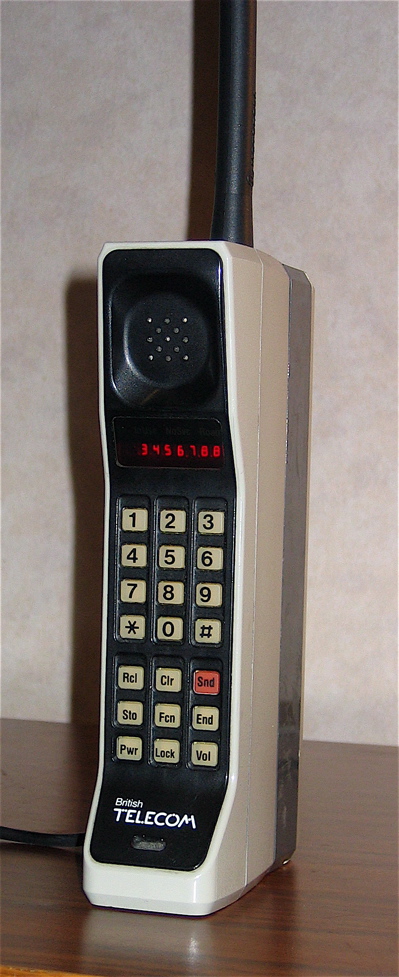
Martin Cooper, a former general manager for the systems division at Motorola, led a team that produced the first cellular handset in 1973 and made the first phone call from it. In 1983 Motorola introduced the DynaTAC 8000x, the first commercially available cellular phone small enough to be easily carried. He later introduced the so-called Bag Phone.
In 1992, the first smartphone, called IBM Simon, used AMPS. Frank Canova led its design at IBM and it was demonstrated that year at the COMDEX computer-industry trade-show. A refined version of the product was marketed to consumers in 1994 by BellSouth under the name Simon Personal Communicator. The Simon was the first device that can be properly referred to as a "smartphone", even though that term was not yet coined.
AMPS is a first-generation cellular technology that uses separate frequencies, or "channels", for each conversation. It therefore required considerable bandwidth for a large number of users. In general terms, AMPS was very similar to the older "0G" Improved Mobile Telephone Service it replaced, but used considerably more computing power to select frequencies, hand off conversations to land lines, and handle billing and call setup.
What really separated AMPS from older systems is the "back end" call setup functionality. In AMPS, the cell centers could flexibly assign channels to handsets based on signal strength, allowing the same frequency to be re-used, without interference, if locations were separated enough. The channels were grouped so a specific set was different from the one used on the cell nearby. This allowed a larger number of phones to be supported over a geographical area. AMPS pioneers coined the term "cellular" because of its use of small hexagonal "cells" within a system.
Hub AI
Advanced Mobile Phone System AI simulator
(@Advanced Mobile Phone System_simulator)
Advanced Mobile Phone System
Advanced Mobile Phone System (AMPS) was an analog mobile phone system standard originally developed by Bell Labs and later modified in a cooperative effort between Bell Labs and Motorola. It was officially introduced in the Americas on October 13, 1983, and was deployed in many other countries, including Israel in 1986, Australia in 1987, Singapore in 1988, and Pakistan in 1990. It was the primary analog mobile phone system in North America (and other locales) through the 1980s and into the 2000s. As of February 18, 2008, carriers in the United States were no longer required to support AMPS, and companies such as AT&T and Verizon Communications have discontinued this service permanently. AMPS was discontinued in Australia in September 2000, in India in October 2004 in Israel in January 2010, and in Brazil in 2010.
The first cellular network efforts began at Bell Labs and with research conducted at Motorola. In 1960, John F. Mitchell became Motorola's chief engineer for its mobile-communication products, and oversaw the development and marketing of the first pager to use transistors.
Motorola had long produced mobile telephones for automobiles, but these large and heavy models consumed too much power to allow their use without the automobile's engine running. Mitchell's team, which included Dr. Martin Cooper, developed portable cellular telephony. Cooper and Mitchell were among the Motorola employees granted a patent for this work in 1973. The first call on the prototype reportedly connected to a wrong number.
While Motorola was developing a cellular phone, from 1968 to 1983 Bell Labs worked out a system called Advanced Mobile Phone System (AMPS), which became the first cellular network standard in the United States. The Bell system deployed American Society for Testing and Materials (ASTM) in Chicago, Illinois, first as an equipment test serving approximately 100 units in 1978, and subsequently as a service test planned for 2,000 billed units. Motorola and others designed and built the cellular phones for this and other cellular systems. Louis M. Weinberg, a marketing director at AT&T, was named the first president of the AMPS corporation. He served in this position during the startup of the AMPS subsidiary of AT&T.
Martin Cooper, a former general manager for the systems division at Motorola, led a team that produced the first cellular handset in 1973 and made the first phone call from it. In 1983 Motorola introduced the DynaTAC 8000x, the first commercially available cellular phone small enough to be easily carried. He later introduced the so-called Bag Phone.
In 1992, the first smartphone, called IBM Simon, used AMPS. Frank Canova led its design at IBM and it was demonstrated that year at the COMDEX computer-industry trade-show. A refined version of the product was marketed to consumers in 1994 by BellSouth under the name Simon Personal Communicator. The Simon was the first device that can be properly referred to as a "smartphone", even though that term was not yet coined.
AMPS is a first-generation cellular technology that uses separate frequencies, or "channels", for each conversation. It therefore required considerable bandwidth for a large number of users. In general terms, AMPS was very similar to the older "0G" Improved Mobile Telephone Service it replaced, but used considerably more computing power to select frequencies, hand off conversations to land lines, and handle billing and call setup.
What really separated AMPS from older systems is the "back end" call setup functionality. In AMPS, the cell centers could flexibly assign channels to handsets based on signal strength, allowing the same frequency to be re-used, without interference, if locations were separated enough. The channels were grouped so a specific set was different from the one used on the cell nearby. This allowed a larger number of phones to be supported over a geographical area. AMPS pioneers coined the term "cellular" because of its use of small hexagonal "cells" within a system.
Recent media