Hubbry Logo
Aegean Sea LinesAegean Sea LinesMain
Open search
Aegean Sea Lines
Community hub
Aegean Sea Lines
logo
8 pages, 0 posts
0 subscribers
Be the first to start a discussion here.
Aegean Sea Lines
Aegean Sea Lines
from Wikipedia
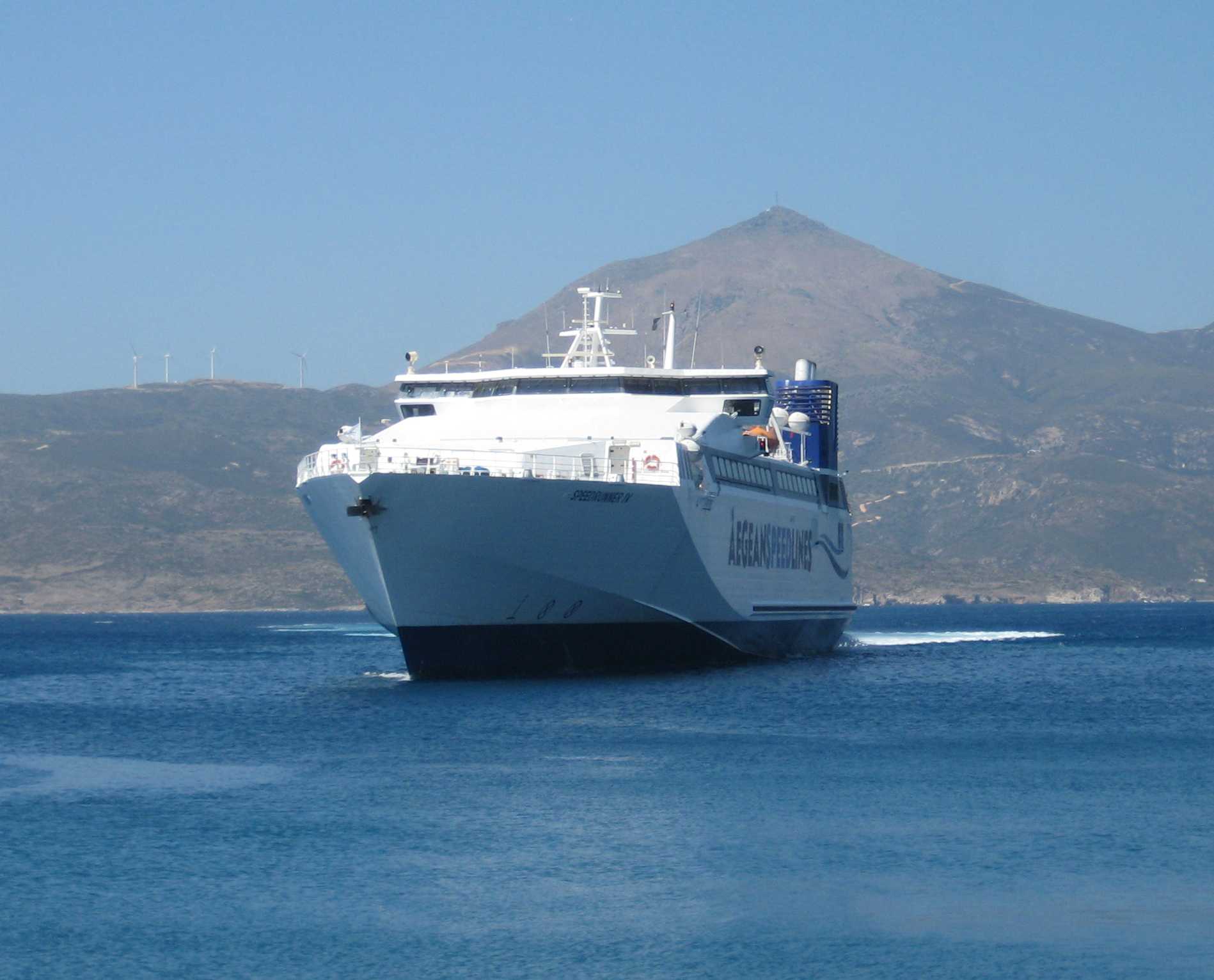
Speedrunner IV arriving at Milos

Key Information

Speedrunner I in Piraeus

Aegean Sea Lines (former Aegean Speed Lines) is a Greek ferry company that is operating ferry services between Piraeus and the Cyclades. Prior to 2022 it was operating high-speed ferries.

History

[edit]

Aegean Speed Lines were formed in 2005 as a joint venture between Sea Containers and the Eugenides Group. Aegean Speed Lines were the first ferry company in Greece to use a European Union flag vessel on a domestic route following deregulation of ferry services in Greece.[1] Sea Containers sold its share in 2006 leaving the Eugenides Group as the major shareholder.

Fleet

[edit]

Aegean Sea Lines began operations using a single high speed catamaran Speedrunner I. Following two successful seasons a Fincantieri built monohull Speedrunner II joined the fleet in 2007. On 2008, the company sold Speedrunner I. In 2009 two more monohulls Speedrunner III and Speedrunner IV joined the fleet. In 2015 and 2016 respectively, the company sold the Speedrunner II and the Speedrunner IV. In 2022 the company decided to stop the operations with its only remaining ship in its fleet Speedrunner III and Aegean Speed Lines sold its ship to Seajets. In 2023 Aegean Speed Lines rebranded as Aegean Sea Lines and decided to return in action with a conventional ferry. It bought the ex-Viking Line ship Rosella and renamed her Anemos.

Current fleet:

Anemos (2023–Present)

Former fleet:

Routes

[edit]

Awards

[edit]

In 2009 Aegean Speed Lines was awarded by "Lloyd's List Greek Shipping Awards" as "The Best Passenger Line of the Year 2009".[2]

References

[edit]
Revisions and contributorsEdit on WikipediaRead on Wikipedia
from Grokipedia
Aegean Sea Lines is a Greek ferry company specializing in passenger and vehicle transportation services across the , primarily connecting the mainland with islands in the archipelago, including key routes to Sifnos, Serifos, Milos, and Kimolos. The company operates year-round schedules, emphasizing reliable, comfortable travel for tourists, residents, and freight, with voyages typically lasting 4 to 7 hours depending on the destination. Its services accommodate cars, motorcycles, pets, and various passenger categories, including discounts for students, seniors, and large families. Founded in as Aegean Speed Lines through a between the Greek Eugenides Group and the British company, the operator initially focused on high-speed ferry services to the and other Aegean routes, introducing innovative vessels like the Speedrunner series that were among the first to fly the flag in Greek domestic waters. In 2022, the company rebranded to Aegean Sea Lines and shifted to conventional Ro-Ro passenger ferries, acquiring the vessel Anemos to better serve for spacious, eco-friendly amid changing maritime regulations and market needs. This evolution earned it recognition, such as the 2009 Passenger Line of the Year award from Greek Shipping Awards for its early contributions to efficient island connectivity. Today, Aegean Sea Lines maintains a fleet centered on the Anemos, a 136-meter conventional built in 1980 with capacity for up to 1,700 passengers and 340 vehicles, featuring amenities like air-conditioned lounges, restaurants, and outdoor decks to enhance the onboard experience. Based in and owned by the Eugenides Group, the company continues to prioritize safety, sustainability, and customer service, playing a vital role in the Greek island economy by facilitating tourism and local transport in one of Europe's most scenic maritime regions.

Company Overview

Profile and Operations

Aegean Sea Lines, formerly known as Aegean Speed Lines until its rebranding in 2022, is a Greek ferry operator headquartered in , . Established in 2005, the company specializes in providing passenger and vehicle ferry services that link the mainland with various islands in the , with a primary emphasis on the archipelago. The company's operations center on reliable connectivity for the Western Cyclades, including routes to , , , and , where its single active vessel, the conventional Ro-Ro passenger ferry Anemos, accommodates up to 1,700 passengers and 340 vehicles per sailing. As of 2025, Aegean Sea Lines maintains a modest fleet of one vessel, supporting multiple weekly sailings on these core routes to meet seasonal and year-round demand. In the broader Greek ferry industry, Aegean Sea Lines plays a vital role in enhancing island accessibility, prioritizing dependable schedules that cater to both residents relying on regular supply chains and visitors seeking efficient travel options across the Aegean. Its focus on the underscores a commitment to regional economic support, where timely ferry services are crucial for sustaining and daily life.

Ownership and Management

Aegean Sea Lines is primarily owned by the Eugenides Group, a conglomerate controlled by the Eugenides family. The company was initially formed in 2005 as a between the Eugenides Group and the international ferry operator , with the latter divesting its stake in 2006, leaving the Eugenides Group with full ownership. As a privately held maritime entity, Aegean Sea Lines operates through its subsidiary, Aegean Sea Lines Maritime Co., which serves as the registered owner, commercial manager, and (International Safety Management) manager for its vessels. The Eugenides family plays a central role in strategic decision-making, with Michael Dimitriadis-Eugenides serving as the managing director, overseeing daily operations and emphasizing safety and service standards. In terms of corporate governance, the company adheres to Greek maritime regulations under the Ministry of Shipping and Island Policy and maintains ISM Code certification to ensure compliance with international safety and environmental management protocols.

History

Establishment and Early Years

Aegean Speed Lines was established in as a between the Greek Eugenides Group and the British , aiming to enter the fast ferry market in the . The 50/50 partnership leveraged Sea Containers' expertise in high-speed operations and the Eugenides Group's local knowledge to introduce services to the islands. This formation marked one of the early efforts to modernize intra-island connectivity following Greece's ferry market in the early 2000s. The company's initial focus centered on deploying high-speed catamaran ferries to drastically cut travel times between Athens and the Western Cyclades, addressing the growing demand for efficient access amid booming tourism. In May 2005, Aegean Speed Lines acquired and refitted the Incat-built Speedrunner I (formerly Hoverspeed Great Britain), a 74-meter wave-piercing catamaran with capacity for 557 passengers and 84 cars, which entered service on the seasonal route from Piraeus to Serifos, Sifnos, and Milos with one daily round trip until October. This vessel reduced the Piraeus-Milos journey from approximately 5-7 hours on conventional ferries to under 3 hours, revolutionizing day-trip and short-stay tourism to these islands. Following two successful seasons, the company expanded by acquiring the Fincantieri-built monohull Speedrunner II (formerly Pegasus One) in 2007, which joined the fleet to support increased demand and extend services. Early operations quickly captured market share in the high-speed segment, with the rapid uptake prompting fleet growth and positioning Aegean Speed Lines as a key player in faster connectivity. However, the venture faced challenges in integrating the international partnership, particularly as encountered financial difficulties and divested its 50% stake in 2006, leaving the Eugenides Group as the sole owner and requiring adaptation to Greece's regulatory framework for domestic and vessel operations. Despite these hurdles, the focus on high-speed innovation solidified the company's foundational role in the Aegean ferry market through 2010.

Renaming and Modernization

In 2022, Aegean Speed Lines initiated a strategic pivot by phasing out its high-speed fleet amid escalating fuel costs and intensifying competition in the Greek ferry market. The company's sole remaining , HSC Speedrunner III, was sold to in May 2022 for an undisclosed sum, marking the end of its operations on the Piraeus-Serifos-Sifnos-Milos route after 17 years. This decision was driven by the economic pressures of maintaining fuel-intensive catamarans, particularly as market dynamics shifted toward more sustainable and cost-effective conventional ferries. Earlier that year, on April 29, 2022, Aegean Speed Lines announced the suspension of all activities on its core line, reflecting broader challenges including the lingering effects of the , which had led to reduced schedules and tourism volumes from 2020 to 2022. As part of this transformation, the company underwent a in 2022, changing its name from Aegean Speed Lines to Aegean Sea Lines to better align with its evolving focus on expanded conventional services and recovery in the post-pandemic sector. The renaming emphasized a broader scope of operations, targeting increased demand for reliable connections to the western and southern islands. This shift positioned the company to capitalize on the rebound in Greek island , which saw significant growth following the easing of restrictions. A pivotal element of the modernization was the acquisition of the ro-pax ferry MS Rosella from in December 2022 for €11 million, which was subsequently reflagged and renamed . Handed over on January 17, 2023, Anemos underwent necessary preparations, including a five-month interior and exterior renovation, and entered service on August 5, 2023, primarily on the Piraeus-Serifos-Sifnos-Kimolos-Milos route, replacing the high-speed operations with a more versatile conventional vessel capable of carrying vehicles and larger passenger volumes. This purchase represented a key investment in fleet renewal, prioritizing operational reliability and alignment with industry trends toward eco-friendlier propulsion systems in conventional ships, which generally offer better fuel economy compared to high-speed alternatives. Following the and fleet adjustment, Aegean Sea Lines experienced steady growth from 2023 onward, resuming full schedules on its Western routes and enhancing service reliability amid a strong recovery. By 2024, the company had recommitted to these lines starting April 16, with Anemos providing consistent daily connections, contributing to improved passenger access during peak seasons. The period also addressed pandemic-era disruptions through optimized operations, such as targeted discounts for educators and residents to boost local travel. As of 2025, Aegean Sea Lines maintains its focus on the Western Cyclades, with published schedules for the Piraeus-Serifos-Sifnos-Kimolos-Milos route extending through the year, including seasonal adjustments for holidays. Services continued without major fleet additions, though a 24-hour by the Panhellenic Seamen's Union in October 2025 led to temporary suspensions. While no major fleet additions have been announced, the company's ongoing route stability signals potential for extensions based on sustained demand in the recovering market.

Fleet

Current Vessels

As of 2025, Aegean Sea Lines operates a single vessel in its fleet, the roll-on/roll-off (Ro-Ro) passenger ferry F/B Anemos, which serves as the company's primary asset for conventional ferry services across the . Acquired from in late 2022 and delivered in January 2023, the ship was originally built in 1980 at the Shipyard in under the name . Following acquisition, Anemos underwent a comprehensive five-month refit in , including interior and exterior renovations to adapt it for Aegean operations, before entering service in August 2023 on routes such as to the Western islands. The vessel measures 136 meters in and 24 meters in beam, with a of 16,879, enabling it to accommodate up to 1,700 passengers and 345 vehicles across its multi-deck configuration, which includes cabins and dedicated spaces for passengers and cargo. It achieves a service speed of 21 knots, suitable for the longer conventional sailings typical of Aegean Sea Lines' itineraries, where emphasis is placed on reliability and passenger comfort rather than high-speed operations. The 2023 refit introduced modern amenities such as updated lounges, dining areas, and onboard facilities to enhance passenger experience, while ensuring compliance with contemporary maritime standards. As the sole active vessel, Anemos handles all of the company's routes, providing a stable platform for Ro-Ro services in the region. Safety features include International Safety Management (ISM) Code certification, advanced navigation systems, and equipment tailored for emergency response in the variable weather conditions of the .

Former Vessels

Aegean Sea Lines' former fleet primarily comprised high-speed vessels that played a pivotal role in the company's operations from 2005 to 2022, focusing on rapid connections across the Cyclades islands. These ships, including the catamaran Speedrunner I and monohulls Speedrunner II, Speedrunner III, and Speedrunner IV, enabled shorter travel times but were eventually phased out due to escalating fuel costs and a broader industry shift toward more environmentally sustainable conventional ferries. The Speedrunner I, a built in 1990 by in , , measured 74 meters in length with a beam of 26 meters and could accommodate up to 573 passengers at speeds of 35 knots. Acquired by Aegean Sea Lines in 2005, it served initial routes from to key destinations like and until its sale in early 2008 to a Cretan operator for day cruises. Its introduction marked the company's entry into high-speed services, establishing quick inter-island links that reduced travel times significantly. Speedrunner II, a constructed in 1996 by in , had a length of 95 meters, a beam of 16 meters, and capacity for approximately 723 passengers and vehicles, achieving service speeds of 36 knots. It joined the fleet in 2007 as the second vessel and operated core routes until 2015, when it was sold to Naviera Paraguana in and renamed Paraguana 1 for South American services. This vessel contributed to fleet expansion during peak growth years, supporting increased passenger volumes without reported major disruptions. The Speedrunner III, built in 1999 in , featured a length of 100.4 meters, beam of 17 meters, and capacity for 808 passengers plus 160 vehicles, with a service speed of 34 knots (maximum 38 knots). Delivered to Aegean Sea Lines in 2009, it became a for fast connections, operating reliably until its sale in May 2022 to , where it was renamed Speedrunner Jet for routes. Its efficiency in high-demand summer schedules helped solidify the company's reputation for punctual, swift travel. Similarly, Speedrunner IV, a sister monohull to Speedrunner III also built in 1999, shared comparable dimensions (100 meters length, 17 meters beam) and capacities (810 passengers, 160 vehicles), with a cruising speed of 34 knots. It entered service in 2009 and supported overlapping routes until late 2016, when it was sold to Golden Star Ferries and renamed Superrunner for Aegean services. Like its counterparts, it facilitated rapid passenger and vehicle transport, enhancing connectivity during the company's expansion phase. These vessels dominated Aegean Sea Lines' operations for nearly 15 years, collectively operating without major incidents and building the company's legacy for speed and reliability in the competitive Greek ferry market. Their disposal to operators in regions like the , , and domestic Greek lines reflected rising operational expenses, particularly , amid global pushes for greener maritime practices. This transition paved the way for the introduction of more efficient vessels like the Anemos.

Routes and Destinations

Core Cyclades Routes

The core Cyclades routes of Aegean Sea Lines primarily consist of year-round ferry services connecting the in to the Western islands, focusing on essential transport links for residents and visitors. The flagship route operates via the ferry F/B Anemos, linking to , , , and in a sequential itinerary that supports daily or near-daily connectivity. This service underscores the company's role in maintaining reliable access to these less-developed islands, distinguishing it from seasonal high-speed options. Schedules for this route typically feature morning departures from around 07:00, with sailings occurring 4-7 times weekly during off-peak periods and increasing to twice daily in peak season. The total journey from to lasts approximately 6-7 hours, accommodating stops at intermediate ports. Specific leg durations include approximately 4 hours to , an additional 1 hour to , about 30-45 minutes to , and around 1 hour to . These timings reflect conventional ferry speeds of up to 21 knots, ensuring a balanced pace for vehicle and passenger transport. At each stop, the route highlights the unique character of the islands: , reached first and known for its rugged mining heritage and serene bays, serves as an initial gateway just 4 hours from the mainland; follows, celebrated for its renowned cuisine including traditional chickpea stews and pottery-influenced baking traditions; , the smallest inhabited island in the Western with only about 900 residents, offers a brief stop emphasizing its quiet, unspoiled beaches; and concludes the itinerary, famed for its dramatic volcanic landscapes, including lunar-like rock formations and thermal springs shaped by ancient eruptions. These stops facilitate short layovers, allowing seamless progression while showcasing the islands' distinct appeals. Logistically, operations prioritize efficient handling at , where vehicles up to 340 in number, including cars and motorcycles, are loaded by drivers at least one hour prior to departure at designated gates like E2, complete with a company for 90 minutes before sailing. Passengers board via foot access or with vehicles, with options for seating categories and pet-friendly policies; upon arrival at islands, integration with local bus and taxi services ensures connectivity to inland sites, though the islands' limited emphasizes the ferry's role as the primary lifeline. The Anemos vessel accommodates up to 1,700 passengers with basic amenities, facilitating both foot travelers and those with vehicles. Economically, this route plays a vital role in sustaining local commerce and across the Western , transporting essential goods and enabling access to these relatively unspoiled destinations that attract visitors seeking authentic experiences away from mass tourism hubs. By providing consistent connectivity, it contributes to the broader region's coastal shipping impact, estimated at €3.1 billion in economic value in , supporting employment and small-scale industries like and on islands with limited alternatives.

Extended and Seasonal Services

Aegean Sea Lines provides occasional extended routes beyond its primary Western Cyclades connections, such as the summer-only service from to , , and , operating 1-2 times weekly to accommodate inter-island travel demands. These extensions typically integrate with the core route backbone, allowing passengers to continue onward from to southern destinations like and during peak periods. Seasonal variations in service frequency are a key feature of Aegean Sea Lines' operations, with increased sailings from to to handle heightened summer ; for instance, additional departures to are added during this period. In contrast, winter schedules are reduced, such as 3 weekly sailings on the Piraeus-Milos route starting from 2025. Special operations include heightened frequencies during holiday peaks, with the 2025 timetable featuring surge sailings around and to support travel during festive periods. The company also offers charter and ad-hoc services for events, tailored to specific group needs in the Aegean region. Route planning for these services is primarily demand-driven, influenced by passenger volumes and tourism trends, while remaining weather-dependent due to the Aegean Sea's variable conditions; Aegean Sea Lines coordinates with other operators to minimize route overlaps and optimize connectivity.

Services and Facilities

Passenger and Vehicle Accommodations

Aegean Sea Lines provides a range of passenger classes on its ferries, primarily the Anemos, which has a capacity of approximately 1,700 passengers. Economy seating offers standard air-conditioned lounges with comfortable seating arrangements, while premium options include VIP seats and first-class areas designed for enhanced comfort, such as recliners and dedicated lounges. Outdoor decks are spacious and equipped with tables and seating, allowing passengers to enjoy sea views during voyages. Cabins are available for longer routes, providing private accommodations with en-suite bathrooms, air conditioning, and amenities like TVs and Wi-Fi access, though Wi-Fi service may incur charges and is subject to connectivity limitations at sea. Onboard amenities cater to diverse traveler needs, including restaurants and snack bars serving light meals, beverages, and Greek-inspired cuisine such as fresh salads, grilled meats, and pastries. Family-friendly facilities feature children's play areas and baby care rooms equipped with changing stations and toys, while shops offer souvenirs and essentials. Additional comforts include lounges for , luggage storage areas, and reception services for assistance. All indoor areas are fully air-conditioned, ensuring a pleasant environment regardless of weather conditions during Cyclades crossings. Vehicle accommodations on the Anemos include ro-ro decks with space for up to 340 cars and motorcycles, featuring priority loading for pre-booked reservations to streamline boarding. Passengers must handle their own vehicle loading and unloading, with designated waiting areas required at least one hour prior to departure. transport is permitted, allowing up to five vaccinated pets per in designated kennels or on outdoor decks; pets are prohibited in indoor public areas or vehicles unless a camping-on-board option is selected, and owners must provide health documentation. Accessibility features emphasize inclusivity, with ramps, lifts, and tactile walkways facilitating movement across decks for passengers with reduced mobility. Specially designed cabins for disabled individuals include widened doors, roll-in showers, and adapted toilets, available on a first-come, first-served basis with advance booking recommended. members provide comprehensive assistance, from priority embarkation to safety briefings and life vest fittings, ensuring all passengers, including families with children or companions for those with disabilities, receive support throughout the journey.

Booking Systems and Loyalty Programs

Aegean Sea Lines offers multiple booking channels to facilitate customer access to its services, including reservations through its official at aegean-sealines.gr, where real-time for passengers and is displayed and bookings can be completed securely. Customers can also book by phone via the line at +30 210 969 0950 or through authorized travel agents, with e-tickets issued immediately upon confirmation to streamline the process. The company's pricing structure employs dynamic fares that adjust based on demand, season, and route, with representative one-way economy fares for the to route ranging from approximately €40 in off-peak periods as of 2025. Discounts are available for various groups, including for children aged 5-10 and students, 20% for seniors over 65 and round-trip tickets, and up to 10% for off-peak autumn travel, while early booking incentives encourage advance reservations without fixed percentage reductions. Vehicle fares vary by size, with small cars up to 3.70 meters qualifying for reduced rates. Loyalty is rewarded through the Aegean Sea Club program, a points-based system where members earn points equivalent to the euro value of their tickets for each journey, redeemable for free or tickets upon accumulating the required number of points, which varies by route and ticket type. Registration is free via the company , and points apply to discounted fares, with no formal tiers but escalating benefits for frequent travelers through free travel issuance subject to availability. The program integrates with banking rewards, such as Eurobank's €pistrofi and Piraeus Bank's , allowing additional point accumulation on purchases. Key policies include cancellation rules that differ by season. In high season (14 April–27 April and 5 June–7 September 2025), full refunds (100%) are available for requests made at least seven days prior to departure or conversion to open-date tickets valid for one year, with 50% refunds available up to 12 hours before sailing. In low season (all other dates), 100% refunds apply up to three days prior, and 50% up to three hours prior, with similar open-date options. Vehicle policies enforce size limits, categorizing cars over 4.40 meters as higher-fare options, and require drivers to arrive one hour early for loading. As of 2025, COVID-era health protocols are no longer in effect, with standard and vessel hygiene measures applying universally. Digital integration enhances accessibility via web check-in available from booking up to 30 minutes before departure, enabling e-ticket generation on mobile devices for paperless boarding when paired with identification. The service supports schedules and real-time updates through the website's mobile-optimized interface, while partnerships with platforms like Ferryhopper provide broader app-based booking and itinerary management options. members receive minor onboard perks, such as priority access, complementing the program's travel rewards.

Awards and Recognition

Industry Awards

In 2009, Aegean Speed Lines (now operating as ) received the "Passenger Line of the Year" award from the Greek Shipping Awards, recognizing its innovative high-speed services and strong . The accolade highlighted the company's fleet renewal with two fast ferries capable of 35 knots, accommodating up to 800 passengers and 175 vehicles each, which enabled new routes to destinations like , , and in the . Presented at the 6th annual Greek Shipping Awards ceremony in on December 4, 2009, the honor celebrated Aegean Speed Lines' disruption of the Cyclades ferry market by revitalizing neglected island services as a quality private operator amid economic challenges. Founder Leonidas Demetriades-Eugenides accepted the award, crediting the crew's efforts in building passenger confidence. The recognition elevated the company's profile in the Greek maritime sector, contributing to subsequent operational expansion. No major industry awards have been bestowed upon Aegean Sea Lines since , reflecting a strategic emphasis on operational reliability rather than .

Operational and Customer Accolades

Aegean Sea Lines has garnered positive feedback for its reliability and value, particularly through platforms facilitating bookings and reviews. Travelers frequently highlight the comfort of the Anemos , describing it as spacious, stable, and well-organized, with professional members ensuring smooth boarding and attentive service. In 2023, the company established a key partnership with Piraeus Bank's Rewards Program, allowing customers to earn and redeem points on tickets purchased at physical locations or online, enhancing accessibility for frequent travelers. This collaboration integrates with broader travel agency networks, such as Ferryhopper, streamlining bookings and promotions for routes to the . Operationally, Aegean Sea Lines achieved a significant milestone with the Anemos refit and entry into service on June 26, 2023, supporting the recovery of Aegean tourism post-pandemic through consistent, year-round connectivity to islands like Sifnos, Serifos, and Milos, contributing to reliable service amid Greece's broader tourism rebound. The Aegean Sea Club loyalty program rewards repeat customers with free passenger and vehicle tickets based on accumulated points from purchases, fostering long-term engagement. Member testimonials emphasize the program's ease and value, while standard safety compliance is upheld through certifications from the Greek Coast Guard, ensuring adherence to maritime standards.

References

Add your contribution
Related Hubs
User Avatar
No comments yet.