Hubbry Logo
CatamaranCatamaranMain
Open search
Catamaran
Community hub
Catamaran
logo
8 pages, 0 posts
0 subscribers
Be the first to start a discussion here.
Contribute something
Catamaran
Catamaran
from Wikipedia

The Spirit of Dallas catamaran on White Rock Lake
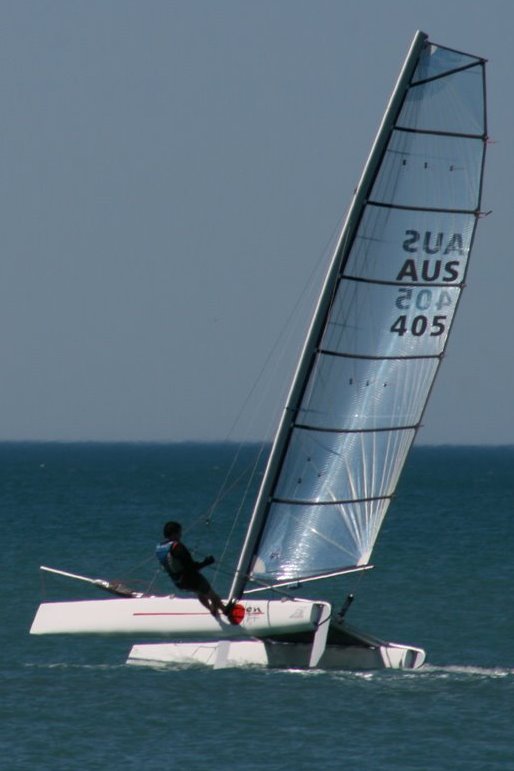
A Formula 16 beachable catamaran
Powered catamaran passenger ferry at Salem, Massachusetts, United States

A catamaran (/ˌkætəməˈræn/) (informally, a "cat") is a watercraft with two parallel hulls of equal size. The wide distance between a catamaran's hulls imparts stability through resistance to rolling and overturning; no ballast is required. Catamarans typically have less hull volume, smaller displacement, and shallower draft (draught) than monohulls of comparable length. The two hulls combined also often have a smaller hydrodynamic resistance than comparable monohulls, requiring less propulsive power from either sails or motors. The catamaran's wider stance on the water can reduce both heeling and wave-induced motion, as compared with a monohull, and can give reduced wakes.

Catamarans were invented by the Austronesian peoples, and enabled their expansion to the islands of the Indian and Pacific Oceans.[1]

Catamarans range in size from small sailing or rowing vessels to large naval ships and roll-on/roll-off car ferries. The structure connecting a catamaran's two hulls ranges from a simple frame strung with webbing to support the crew to a bridging superstructure incorporating extensive cabin or cargo space.

History

[edit]
Succession of forms in the development of the Austronesian boat (Mahdi, 1999)

Catamarans from Oceania and Maritime Southeast Asia became the inspiration for modern catamarans. Until the 20th century catamaran development focused primarily on sail-driven concepts.

Etymology

[edit]

The word "catamaran" is derived from the Tamil word, kattumaram (கட்டுமரம்), which means "logs bound together" and is a type of single-hulled raft made of three to seven tree trunks lashed together. The term has evolved in English usage to refer to unrelated twin-hulled vessels.[2][3][4]

Development in Austronesia

[edit]
A carved and painted voyaging catamaran with tanja sails of the Micronesian inhabitants of Hermit Islands, Bismarck Archipelago (c. 1914)
1827 depiction of Tahitian pahi war-canoes

Catamaran-type vessels were an early technology of the Austronesian peoples. Early researchers like Heine-Geldern (1932) and Hornell (1943) once believed that catamarans evolved from outrigger canoes, but modern authors specializing in Austronesian cultures like Doran (1981) and Mahdi (1988) now believe it to be the opposite.[5][6][1]

Hōkūleʻa, a modern replica of a Polynesian twin-hulled voyaging canoe—an Austronesian innovation

Two canoes bound together developed directly from minimal raft technologies of two logs tied together. Over time, the twin-hulled canoe form developed into the asymmetric double canoe, where one hull is smaller than the other. Eventually the smaller hull became the prototype outrigger, giving way to the single outrigger canoe, then to the reversible single outrigger canoe. Finally, the single outrigger types developed into the double outrigger canoe (or trimarans).[5][6][1]

This would also explain why older Austronesian populations in Island Southeast Asia tend to favor double outrigger canoes, as it keeps the boats stable when tacking. But they still have small regions where catamarans and single-outrigger canoes are still used. In contrast, more distant outlying descendant populations in Oceania, Madagascar, and the Comoros, retained the twin-hull and the single outrigger canoe types, but the technology for double outriggers never reached them (although it exists in western Melanesia). To deal with the problem of the instability of the boat when the outrigger faces leeward when tacking, they instead developed the shunting technique in sailing, in conjunction with reversible single-outriggers.[5][6][1][7][8]

Despite their being the more "primitive form" of outrigger canoes, they were nonetheless effective, allowing seafaring Polynesians to voyage to distant Pacific islands.[9]

Traditional catamarans

[edit]

The following is a list of traditional Austronesian catamarans:

Western development of sailing catamarans

[edit]

The first documented example of twin-hulled sailing craft in Europe was designed by William Petty in 1662 to sail faster, in shallower waters, in lighter wind, and with fewer crew than other vessels of the time. However, the unusual design met with skepticism and was not a commercial success.[10][11]

Nathaniel Herreshoff's 31 ft (9 m) long catamaran, Duplex, on the River Thames—built in 1877

The design remained relatively unused in the West for almost 160 years until the early 19th century, when the Englishman Mayflower F. Crisp built a two-hulled merchant ship in Rangoon, Burma. The ship was christened Original. Crisp described it as "a fast sailing fine sea boat; she traded during the monsoon between Rangoon and the Tenasserim Provinces for several years".[12][13]

Later that century, the American Nathanael Herreshoff constructed a twin-hulled sailing boat of his own design (US Pat. No. 189,459).[14] The craft, Amaryllis, raced at her maiden regatta on June 22, 1876, and performed exceedingly well. Her debut demonstrated the distinct performance advantages afforded to catamarans over the standard monohulls. It was as a result of this event, the Centennial Regatta of the New York Yacht Club, that catamarans were barred from regular sailing classes, and this remained the case until the 1970s.[15] On June 6, 1882, three catamarans from the Southern Yacht Club of New Orleans raced a 15 nm course on Lake Pontchartrain and the winning boat in the catamaran class, Nip and Tuck, beat the fastest sloop's time by over five minutes.[16][17]

In 1916, Leonardo Torres Quevedo patented a multihull steel vessel named Binave (Twin Ship), a new type of catamaran which was constructed and tested in Bilbao (Spain) in 1918. The innovative design included two 30 HP Hispano-Suiza marine engines and could modify its configuration when sailing, positioning two rudders at the stern of each float, with the propellers also placed aft.[18][19][20] In 1936, Eric de Bisschop built a Polynesian "double canoe" in Hawaii and sailed it home to a hero's welcome in France. In 1939, he published his experiences in a book, Kaimiloa, which was translated into English in 1940.[21]

Roland and Francis Prout experimented with catamarans in 1949 and converted their 1935 boat factory in Canvey Island, Essex (England), to catamaran production in 1954. Their Shearwater catamarans easily won races against monohulls. Yellow Bird, a 1956-built Shearwater III, raced successfully by Francis Prout in the 1960s, is in the collection of the National Maritime Museum Cornwall.[22] Prout Catamarans, Ltd. designed a mast aft rig with the mast aft of midships to support an enlarged jib—more than twice the size of the design's reduced mainsail; it was produced as the Snowgoose model.[23] The claimed advantage of this sail plan was to diminish any tendency for the bows of the vessel to dig in.[24][25]

Hobie 16 beachable catamaran

In the mid-twentieth century, beachcats became a widespread category of sailing catamarans, owing to their ease of launching and mass production. In California, a maker of surfboards, Hobie Alter, produced the 250-pound (110 kg) Hobie 14 in 1967, and two years later the larger and even more successful Hobie 16. As of 2016, the Hobie 16 was still being produced with more than 100,000 having been manufactured.[26]

Catamarans were introduced to Olympic sailing in 1976. The two-handed Tornado catamaran was selected for the multihull discipline in the Olympic Games from 1976 through 2008. It was redesigned in 2000.[27] The foiling Nacra 17 was used in the Tokyo 2020 Olympics, which were held in 2021;[28][29] after the 2015 adoption of the Nacra 15 as a Youth World Championships class and as a new class for the Youth Olympic Games.[30][31]

Performance

[edit]
A 45' catamaran under sail, showing minimal bow wave and wake resulting from the hulls being narrow, low displacement and long

Catamarans have two distinct primary performance characteristics that distinguish them from displacement monohull vessels: lower resistance to passage through the water and greater stability (initial resistance to capsize). Choosing between a monohull and catamaran configuration includes considerations of carrying capacity, speed, and efficiency.

Resistance

[edit]

At low to moderate speeds, a lightweight catamaran hull experiences resistance to passage through water that is approximately proportional to its speed. A displacement monohull has the same relationship at low speed since resistance is almost entirely due to surface friction. When boat speed increases and waves are generated the resistance is dependent on several design factors, particularly hull displacement to length and hull separation to length ratio, it is a non trivial resistance curve with many small peaks as wave trains at various speeds combine and cancel[32][33] For powered catamarans, this implies smaller power plants (although two are typically required). For sailing catamarans, low forward resistance[34] allows the sails to derive power from attached flow,[35] their most efficient mode—analogous to a wing—leading to the use of wingsails in racing craft.[36]

Stability

[edit]

Catamarans rely primarily on form stability to resist heeling and capsize.[33] Comparison of heeling stability of a rectangular-cross section monohull of beam, B, compared with two catamaran hulls of width B/2, separated by a distance, 2×B, determines that the catamaran has an initial resistance to heeling that is seven times that of the monohull.[37] Compared with a monohull, a cruising catamaran sailboat has a high initial resistance to heeling and capsize—a fifty-footer requires four times the force to initiate a capsize than an equivalent monohull.[38]

Tradeoffs

[edit]
Vangohh Seafarer, a catamaran motor yacht berthed at Straits Quay, Georgetown, Pulau Pinang, Malaysia

One measure of the trade-off between speed and carrying capacity is the displacement Froude number (FnV),[39] compared with calm water transportation efficiency.[40] FnV applies when the waterline length is too speed-dependent to be meaningful—as with a planing hull.[41] It uses a reference length, the cubic root of the volumetric displacement of the hull, V, where u is the relative flow velocity between the sea and ship, and g is acceleration due to gravity:

Calm water transportation efficiency of a vessel is proportional to the full-load displacement and the maximum calm-water speed, divided by the corresponding power required.[42]

Large merchant vessels have a FnV between one and zero, whereas higher-performance powered catamarans may approach 2.5, denoting a higher speed per unit volume for catamarans. Each type of vessel has a corresponding calm water transportation efficiency, with large transport ships being in the range of 100–1,000, compared with 11-18 for transport catamarans, denoting a higher efficiency per unit of payload for monohulls.[40]

SWATH and wave-piercing designs

[edit]
A SWATH ship has twin hulls (blue) that remain completely submerged.

Two advances over the traditional catamaran are the small-waterplane-area twin hull (SWATH) and the wave-piercing configuration—the latter having become a widely favored design.

SWATH reduces wave-generating resistance by moving displacement volume below the waterline, using a pair of tubular, submarine-like hulls, connected by pylons to the bridge deck with a narrow waterline cross-section. The submerged hulls are minimally affected by waves.[43] The SWATH form was invented by Canadian Frederick G. Creed, who presented his idea in 1938 and was later awarded a British patent for it in 1946. It was first used in the 1960s and 1970s as an evolution of catamaran design for use as oceanographic research vessels or submarine rescue ships.[44] In 1990, the US Navy commissioned the construction of a SWATH ship to test the configuration.[45]

SWATH vessels compare with conventional powered catamarans of equivalent size, as follows:[43]

  • Larger wetted surface, which causes higher skin friction drag
  • Significant reduction in wave-induced drag, with the configuration of struts and submerged hull structures
  • Lower water plane area significantly reduces pitching and heaving in a seaway
  • No possibility of planing
  • Higher sensitivity to loading, which may bring the bridge structure closer to the water
HSV-2 Swift, a wave-piercing catamaran, built by Incat in Tasmania, Australia

Wave-piercing catamarans (strictly speaking they are trimarans, with a central hull and two outriggers) employ a low-buoyancy bow on each hull that is pointed at the water line and rises aft, up to a level, to allow each hull to pierce waves, rather than ride over them. This allows higher speeds through waves than for a conventional catamaran. They are distinguished from SWATH catamarans, in that the buoyant part of the hull is not tubular. The spanning bridge deck may be configured with some of the characteristics of a normal V-hull, which allows it to penetrate the crests of waves.[46]

Wave-piercing catamaran designs have been employed for yachts,[47] passenger ferries,[48] and military vessels.[49]

Applications

[edit]
Emirates Team New Zealand's AC72 Aotearoa on foils in San Francisco Bay

A catamaran configuration fills a niche where speed and sea-kindliness is favored over bulk capacity. In larger vessels, this niche favors car ferries and military vessels for patrol or operation in the littoral zone.

Sport

[edit]
Gitana 13, an ocean-racing catamaran

Recreational and sport catamarans typically are designed to have a crew of two and be launched and landed from a beach. Most have a trampoline on the bridging structure, a rotating mast and full-length battens on the mainsail. Performance versions often have trapezes to allow the crew to hike out and counterbalance capsize forces during strong winds on certain points of sail.[50]

For the 33rd America's Cup, both the defender and the challenger built 90-foot (27 m) long multihulls. Société Nautique de Genève, defending with team Alinghi, sailed a catamaran. The challenger, BMW Oracle Racing, used a trimaran, replacing its soft sail rig with a towering wing sail—the largest sailing wing ever built. In the waters off Valencia, Spain in February 2010, the BMW Oracle Racing trimaran with its powerful wing sail proved to be superior. This represented a break from the traditional monohulls that had always been sailed in previous America's Cup series.[51]

On San Francisco Bay, the 2013 America's Cup was sailed in 72-foot (22 m) long AC72 catamarans (craft set by the rules for the 2013 America's Cup). Each yacht employed hydrofoils and a wing sail. The regatta was won 9–8 by Oracle Team USA against the challenger, Emirates Team New Zealand, in fifteen matches because Oracle Team USA had started the regatta with a two-point penalty.[52][53]

Yachting has seen the development of multihulls over 100 feet (30 m) in length. "The Race" helped precipitate this trend; it was a circumnavigation challenge which departed from Barcelona, Spain, on New Year's Eve, 2000. Because of the prize money and prestige associated with this event, four new catamarans (and two highly modified ones) over 100 feet (30 m) in length were built to compete. The largest, PlayStation, owned by Steve Fossett, was 125 feet (38 m) long and had a mast which was 147 feet (45 m) above the water. Virtually all of the new mega-cats were built of pre-preg carbon fiber for strength and the lowest possible weight. The top speeds of these boats can approach 50 knots (58 mph; 93 km/h). The Race was won by the 33.50 m (109.9 ft)-long catamaran Club Med skippered by Grant Dalton. It went round the globe in 62 days at an average speed of 18 knots (21 mph; 33 km/h).[54]

Cruising

[edit]
A Lagoon 560 cruising catamaran

Cruising sailors must make trade-offs among volume, useful load, speed, and cost in choosing a boat. Choosing a catamaran offers increased speed at the expense of reduced load per unit of cost. Howard and Doane describe the following tradeoffs between cruising monohulls and catamarans:[38] A long-distance, offshore cruising monohull may be as short as 30 feet (9.1 m) for a given crew complement and supporting supplies, whereas a cruising catamaran would need to be 40 feet (12 m) to achieve the same capacity. In addition to greater speed, catamarans draw less water than do monohulls— as little as 3 feet (0.91 m) —and are easier to beach. Catamarans are harder to tack and take up more space in a marina. Cruising catamarans entail added expense for having two engines and two rudders. Tarjan adds that cruising catamarans boats can maintain a comfortable 300 nautical miles (350 mi; 560 km) per day passage, with the racing versions recording well over 400 nautical miles (460 mi; 740 km) per day. In addition, they do not heel more than 10-12 degrees, even at full speed on a reach.[55]

Powered cruising catamarans share many of the amenities found in a sail cruising catamaran. The saloon typically spans two hulls wherein are found the staterooms and engine compartments. As with sailing catamarans, this configuration minimizes boat motion in a seaway.[56]

The Swiss-registered wave-piercing catamaran, Tûranor PlanetSolar, which was launched in March 2010, is the world's largest solar powered boat. It completed a circumnavigation of the globe in 2012.[57]

Passenger transport

[edit]
Drive-on, drive-off deck of a catamaran ferry boat
HSC Francisco, the world's fastest passenger ship

The 1970s saw the introduction of catamarans as high-speed ferries, as pioneered by Westermoen Hydrofoil in Mandal, Norway, which launched the Westamaran design in 1973.[58] The Stena Voyager was an example of a large, fast ferry, typically traveling at a speed of 46 miles per hour (74 km/h), although it was capable of over 70 miles per hour (110 km/h).[59]

The Australian island Tasmania became the site of builders of large transport catamarans—Incat in 1977[60] and Austal in 1988[61]—each building civilian ferries and naval vessels. Incat built HSC Francisco, a High-Speed trimaran that, at 58 knots, is (as of 2014) the fastest passenger ship in service.[62]

Military

[edit]
US Naval Ship Spearhead (JHSV-1) during sea trials in 2012
Iranian corvette Shahid Soleimani IRIS FS313-01 in 2023

The first warship to be propelled by a steam engine, named Demologos or Fulton and built in the United States during the War of 1812, was a catamaran with a paddle wheel between her hulls.

In the early 20th Century several catamarans were built as submarine salvage ships: SMS Vulkan and SMS Cyclop of Germany, Kommuna of Russia, and Kanguro of Spain, all designed to lift stricken submarines by means of huge cranes above a moon pool between the hulls. Two Cold War-era submarine rescue ships, USS Pigeon and USS Ortolan of the US Navy, were also catamarans, but did not have the moon pool feature.

The use of catamarans as high-speed naval transport was pioneered by HMAS Jervis Bay, which was in service with the Royal Australian Navy between 1999 and 2001. The US Military Sealift Command now operates several Expeditionary Fast Transport catamarans owned by the US Navy;[63] they are used for high speed transport of military cargo, and to get into shallow ports.

The Makar-class is a class of two large catamaran-hull survey ships built for the Indian Navy. As of 2012, one vessel, INS Makar (J31), was in service and the second was under construction.[64]

First launched in 2004 at Shanghai, the Houbei class missile boat of the People's Liberation Army Navy (PLAN) has a catamaran design to accommodate the vessel's stealth features.[65]

The Tuo Chiang-class corvette is a class of Taiwanese-designed fast and stealthy multi-mission wave-piercing catamaran corvettes[66] first launched in 2014 for the Republic of China (Taiwan) Navy.

Small, personal boats

[edit]

The distribution of the boat's volume, namely its buoyancy away from its center-line increases its stability beyond the stability offered by mono-hulled vessels of similar size, and even bigger ones. Narrow beamed, personal twin-hulled boats designed for paddling (e.g. kayaks and canoes), and for powering by small portable motors (e.g. microskiffs, johnboats, and dinghies) in which the user/s and passenger/s ride a type of saddle seat similar to the seat featuring in Personal Watercraft (PWC) have been produced since 2004 in the United States by a company named Wavewalk.

See also

[edit]

References

[edit]

Further reading

[edit]
Revisions and contributorsEdit on WikipediaRead on Wikipedia
from Grokipedia
A catamaran is a multi-hulled consisting of two parallel hulls of equal size, connected by a deck structure that provides enhanced transverse stability and a broad platform for operations. These vessels, often propelled by sails or engines, range in size from small recreational boats to large commercial ferries, with the hull separation typically optimized for hydrodynamic . The term "catamaran" originates from the Tamil word kaṭṭumaram, meaning "tied wood," referring to early rafts constructed by lashing logs together in southern and the South Pacific regions. This design concept traces back to ancient and fishing communities in and , where double-hulled vessels were developed for their speed, stability in rough waters, and ability to carry loads over long distances. Primitive catamarans, often up to 21 meters in length and paddled by crews, served purposes such as exploration, warfare, and trade across the Indian and Pacific Oceans as early as several thousand years ago. In the , Western interest grew with designs like Robert Fulton's 1815 steam-powered catamaran Demologos, one of the earliest powered examples, which featured twin hulls to protect its . The modern recreational catamaran emerged in the mid-20th century, influenced by pioneers such as Lock Crowther, Dick Newick, and James Wharram, who built experimental multihulls emphasizing speed and simplicity through trial-and-error ocean racing. By the late , production shifted toward comfortable cruising models using advanced materials like composites for lighter, stronger hulls, enabling widespread adoption in leisure sailing and chartering. Contemporary catamarans excel in stability without heeling, offering larger deck areas and payload capacities compared to monohulls, which makes them ideal for family cruising, , and high-speed ferries. Their slender hulls reduce , allowing efficient operation at speeds of 35-60 knots in optimized designs, though they require careful to manage increased wetted surface and potential torsion between hulls. Today, these vessels are prominent in naval applications, such as the U.S. 's aluminum catamaran Yuma IV for rapid troop transport, and in , like NOAA's hydrofoil-assisted catamaran R/V Auk for marine studies.

Overview

Definition

A catamaran is a type of multi-hulled consisting of two parallel hulls of equal size connected by a rigid frame or . This dual-hull configuration distinguishes it from traditional vessels, providing inherent stability through a wide beam rather than relying on a deep or . Catamarans can be propelled by sails, engines, or a combination thereof, and are employed in recreational , , commercial ferrying, and other maritime applications. The design emphasizes reduced hydrodynamic drag due to finer hull shapes, enabling higher speeds and shallower drafts compared to monohulls of similar displacement. Unlike single-hulled boats, catamarans exhibit minimal heeling under sail, which enhances passenger comfort and allows for more efficient sail trim, though they may experience a pitching motion known as "hobby-horsing" in certain sea conditions. Modern constructions often utilize lightweight materials such as fiberglass or carbon fiber for the hulls, with twin engines—one per hull—for redundancy and maneuverability. Catamarans offer greater interior volume and deck space relative to their length, making them suitable for luxury cruising and liveaboard use, while their stability supports navigation in shallow waters inaccessible to deeper-draft vessels. Fuel efficiency is improved due to lower resistance, particularly in powered variants, though the wider beam requires more berthing space in marinas. Overall, the catamaran's geometry prioritizes balance, speed, and spaciousness over the self-righting capabilities of monohulls.

Basic Design Features

A catamaran is characterized by its twin-hull configuration, consisting of two parallel, slender hulls connected by a rigid bridge deck that forms the main structural platform. This provides inherent stability through a wide beam, reducing the need for deep keels and minimizing heeling under or power, which enhances passenger comfort and allows for shallower draft compared to monohulls. The hulls are typically displacement or semi-displacement types, optimized for low resistance by maintaining fine entry angles and smooth underwater profiles to slice through efficiently. The structural integrity relies on a low center of gravity achieved through balanced weight distribution across the hulls and deck, with bulkheads and crossbeams distributing loads from the mast, rigging, or propulsion systems. Construction often employs composite materials such as fiberglass reinforced with foam cores for the hulls above the waterline, providing lightness and impact resistance, while solid laminates are used below for durability against collisions. Daggerboards or centerboards may be incorporated in sailing models to improve upwind performance and adjust draft for shallow-water access, contrasting with fixed skegs in power catamarans for directional stability. Propulsion systems vary by application: sailing catamarans use rigged sails on a central mast, often with areas ranging from 470 to 2,260 square feet for balanced power, while power catamarans feature twin inboard or outboard engines—one per hull—for enhanced maneuverability and . Modern designs prioritize vacuum-infused lamination techniques to ensure seamless, watertight assemblies, reducing weight without compromising strength, and enabling higher speeds with lower fuel consumption due to reduced despite the increased wetted surface area of the twin hulls.

History

Etymology

The term "catamaran" derives from the Tamil word kaṭṭumaram (கட்டுமரம்), a compound formed from kaṭṭu, meaning "to tie" or "to bind," and māram, meaning "tree," "wood," or "log," literally translating to "tied wood" or "logs bound together." This etymology reflects the original construction of such vessels as simple rafts made by lashing logs or floats side by side for stability in coastal waters of and . The word entered English in the late through accounts of European explorers and traders in the region, with the earliest recorded use dating to 1673 in descriptions of log rafts propelled by paddles or sails. By 1697, it appeared in written English referring to multi-hulled boats, as noted in the travels of buccaneer . Over time, the term evolved to specifically denote twin-hulled vessels, while secondary meanings emerged in English, such as a torture device involving logs or, figuratively, a scolding —though these are less directly tied to the nautical origin.

Origins in Austronesia

The catamaran, in its traditional Austronesian form, refers to the double-hulled canoe (waka hourua in ), a seaworthy vessel that played a pivotal role in the maritime expansion of Austronesian-speaking peoples across the Pacific and Indian Oceans. These boats consisted of two parallel dugout hulls lashed together with a deck platform, often equipped with crab-claw sails for efficient windward sailing. Archaeological and ethnographic evidence suggests their development originated in the region encompassing modern-day , the , and around 3000–1500 BCE, coinciding with the initial phases of the Austronesian dispersal from a homeland in . Linguistic reconstructions support the antiquity of double-hulled designs, with Proto-Austronesian terms such as padaHu (sailing boat) and waŋka (outrigger canoe or hull) indicating early innovations in multi-hull construction derived from simpler rafts or single dugouts. Ethnographic accounts from the 18th and 19th centuries document these vessels in , where they could carry up to 100 people, livestock, and crops over thousands of kilometers, as observed in and . Hypotheses by scholars like Edwin Doran posit that double canoes represent the earliest Austronesian type, evolving into single- and double-outrigger variants for enhanced stability in diverse oceanic conditions; this sequence is evidenced by the distribution of boat forms, with double hulls predominant in open-ocean voyaging zones like eastern . By 1000–600 BCE, Austronesian navigators using double-hulled catamarans had reached the , introducing sewn-plank hull techniques and influencing local maritime traditions, as indicated by historiographic records and boat-burial customs in and . In Insular , these vessels facilitated trade networks and migrations, with variations like asymmetric hulls emerging to optimize load and speed. The design's emphasis on shallow draft and lateral stability made it ideal for island-hopping, underscoring its central role in populating over 20,000 islands across Austronesia.

Traditional Catamarans

Traditional catamarans refer to the indigenous multi-hulled watercraft developed by , primarily consisting of double-hulled canoes used for voyaging, , and across the Pacific and Indian Oceans. These vessels, dating back over 3,000 years, featured two parallel hulls lashed together with a connecting platform, providing exceptional stability and load-carrying capacity compared to single-hulled outriggers. In , such designs enabled the settlement of remote islands, with archaeological evidence from sites like Anaweka, , revealing sophisticated construction around A.D. 1400, including planked hulls reinforced with transverse ribs and longitudinal stringers carved from matai wood () and caulked with totara bark (). The hulls of traditional Polynesian catamarans were typically V-shaped in cross-section to reduce drag and enhance upwind sailing, with lengths ranging from 10 to 20 meters for voyaging craft. Propulsion relied on Oceanic spritsails made from or leaves, triangular in shape and capable of pointing up to 75° to the true wind angle, achieving speeds of 4-5 knots in moderate winds. These sails, as seen in historical examples from (9.68 m × 1.53 m) and (5.15 m × 3.66 m), allowed for efficient two-way ocean crossings, such as from to in 10-11 days, supporting deliberate migrations that peopled East . Stability was further aided by the wide beam between hulls, enabling crews to transport plants, animals, and up to 20 people without excessive . In parallel, traditional catamarans in South India, known as kattumarams, emerged as log-raft designs used primarily for coastal fishing along the east coast from Orissa to Tamil Nadu. Derived from the Tamil term meaning "tied wood," these vessels consisted of 3-7 lashed tree trunks, often from light woods like Melia dubia (density 368-415 kg/m³), forming either raft-like or boat-shaped hulls up to 8 meters long. Construction involved coir ropes or wooden dowels for lashing, with no nails, allowing quick repairs and adaptability to rough surf; they operated 1-15 km offshore for day fishing with nets and lines, supporting around 120,000 fishermen historically. First documented in the 1st century A.D. Periplus Maris Erythraei, kattumarams numbered about 45,000 along a 2,500 km coastline by the mid-20th century, embodying simple, durable maritime technology suited to artisanal needs. Across Austronesian regions, including and , variations of these double-hulled forms facilitated inter-island economies, with examples like the wa (Fijian catamaran) carrying up to 600 people for warfare or migration. These traditional designs prioritized seaworthiness through —slim hulls for speed and lashings for flexibility—contrasting later Western adaptations by emphasizing cultural and environmental integration over mechanical complexity.

Western and Modern Development

The introduction of catamarans to Western maritime culture began in the 17th century, with English inventor William Petty designing the first known Western prototype in 1662. Intended for surveying coastal waters in Ireland, Petty's double-hulled vessel aimed to improve speed and stability over traditional monohulls but met with skepticism from contemporaries due to its unconventional design. A significant milestone occurred in the late 19th century when American naval architect developed the in 1876, a 7.5-meter racing catamaran patented in 1877. This vessel featured a rigid connecting deck between the hulls, enhancing structural integrity and performance, and it quickly demonstrated superior speed in races, leading to temporary bans on catamarans in some competitions due to their competitive edge. Post-World War II innovations propelled catamarans toward modern acceptance, particularly through the efforts of Hawaiian engineer Woodbridge "Woody" Brown, who built the Manu Kai in 1947. Inspired by Pacific twin-hull canoes observed during the war, this 11.6-meter prototype incorporated lightweight construction and aeronautical principles from Brown's glider experience, marking the first viable ocean-going cruising catamaran and achieving speeds that made it the fastest vessel of its era. The mid-20th century saw further advancements by pioneers such as British designer James Wharram, who constructed his first double-hulled catamaran in 1953 and completed the first by a in 1955 aboard the 23.5-foot , promoting simple, plywood-based designs for bluewater cruising. Australian Lock Crowther developed beach-launchable racing catamarans like the in 1955 and larger cruisers in the 1960s, influencing production models. American Dick Newick contributed innovative and catamaran designs in the 1960s, such as the 42-foot Prout Catamaran, emphasizing hydrodynamics for long-distance voyaging and racing. These experimental builders advanced technology through ocean trials, paving the way for recreational adoption. The 1960s saw recreational catamarans gain widespread popularity, largely due to Hobie Alter's introduction of the series, starting with the Hobie 14 prototype in 1968. Designed as a lightweight, beach-launchable playboat with simple , it revolutionized casual sailing by emphasizing fun and accessibility, leading to over a million units sold worldwide and establishing catamarans as a dominant segment in leisure boating. In the latter 20th and early 21st centuries, catamarans evolved into high-performance vessels for commercial and competitive applications. High-speed catamaran ferries emerged in the 1970s, with designs like the Westamaran by Norwegian firm Westermoen Hydrofoil enabling efficient passenger transport at speeds up to 35 knots, later advancing with aluminum and composite materials in the 1990s through builders like Incat Tasmania. In racing, catamarans featured prominently in the from 1988 onward, culminating in foiling catamarans in 2013 that exceeded 40 knots and AC50s in 2017, driving innovations in hydrodynamics and wing sails that influenced broader yacht design. Today, modern catamarans incorporate carbon fiber for luxury cruising yachts and foiling technology for speeds over 50 knots in record attempts, underscoring their versatility across sectors.

Design Principles

Hull and Structure

A catamaran's hull consists of two slender, parallel demi-hulls connected by a bridging , providing inherent stability through wide beam separation without the need for a deep . The demi-hulls are typically symmetric and displacement-type, designed to minimize while supporting the vessel's weight distribution. Key design parameters include the hull length-to-displacement (LDR), often ranging from 6.0 to 7.0 for performance-oriented catamarans, and the separation (s/L), where s is the center-to-center distance between hulls and L is the ; values between 0.3 and 0.5 optimize hydrodynamic efficiency and reduce interference waves. Hull shapes vary to balance performance, construction ease, and . Round hulls feature a smooth, curved cross-section that minimizes wetted surface area (WSA), typically around 25% higher than equivalent monohulls but optimal for speed in semi-displacement regimes (Froude numbers 0.5–1.0). Deep V hulls, with narrower entries forward, offer good wave-piercing but increase WSA and pitching in light winds. Flat-bottom or hard-chine designs simplify building and provide planing potential but require vee-ing forward to mitigate pounding in offshore conditions. Flared topsides and knuckles enhance and spray deflection without significantly impacting speed. Structural integrity relies on the cross-structure, which absorbs transverse loads such as vertical moments (up to 72,000 ft-tons in large designs), shear forces (around 600 tons), and torsion moments that peak with wider separations. In high-speed catamarans, shear and moments escalate with , necessitating reinforcements at hull junctions. For large vessels (e.g., 1000 ft overall), hull beams up to 140 ft are feasible, limited by harbor constraints (400 ft beam max) and draft (35 ft). Modern catamaran hulls predominantly employ composite materials for their high strength-to-weight ratio, enabling lightweight yet rigid construction. Fiber-reinforced polymers (FRP), such as E-glass or with or vinyl ester resins, form laminates with fiber orientations in 0°, ±45°, and 90° directions to handle tensile and shear stresses (e.g., E-glass tensile strength: 500 × 10³ psi). Sandwich construction integrates cores like balsa (density 7 lb/ft³) or PVC foam (2–12 lb/ft³) between skins, boosting (D = E_f t_f h² λ) and shear resistance (U ≈ h G_c) while reducing weight. is used for very large or catamarans, with yield strengths up to 100,000 psi, but composites dominate recreational and high-performance applications due to corrosion resistance and lower life-cycle costs. Durability considerations include moisture absorption ( limited to <2% to avoid 20% strength loss) and impact tolerance, with high-density cores preferred for slamming loads.
Hull ShapeKey FeaturesAdvantagesDisadvantagesExample Applications
Round BilgeSmooth curved section, variable along lengthMinimal WSA, optimal speed and efficiencyComplex, time-intensive constructionPerformance sailing catamarans like Strider
Deep VNarrow forward, wider amidshipsGood wave-piercing, maneuverability with keelsHigher WSA, more pitching in light windsOffshore cruising vessels
Flat Bottom/Hard ChinePlanar sections with chinesEasy to build and transport, self-supportingProne to pounding without forward vee-ingBeach catamarans and simpler designs
Analysis methods like finite element modeling (FEM) and Rankine panel techniques (e.g., SWAN-2) predict structural responses, including buckling under compression (critical loads via orthotropic equations) and dynamic pressures from waves. These ensure the hull withstands primary loads like hydrostatic forces and secondary effects such as slamming (P = DLF × p₀).

Propulsion Systems

Catamarans utilize diverse propulsion systems tailored to their multi-hull configuration, which provides inherent stability and allows for efficient power delivery. Traditional sailing catamarans rely on wind-powered sails as the primary means of propulsion, while modern variants incorporate auxiliary mechanical, electric, or hybrid engines to enhance maneuverability, especially in low-wind conditions or for powered cruising. Sail propulsion in catamarans harnesses aerodynamic lift from wind interacting with sails mounted on one or more masts, enabling high speeds due to the vessel's low resistance and wide beam for sail-carrying capacity. Common rigs include Bermuda sloop setups with a mainsail and jib, or cutter configurations for balanced power distribution across the twin hulls. The dual-hull design minimizes heeling, allowing larger sail areas—often up to 150 m² on a 15-meter catamaran—without requiring heavy keels, which improves upwind performance and overall efficiency. In specialized applications, such as autonomous surface vehicles, wing-sail systems replace traditional fabric sails with rigid, airfoil-shaped structures that self-trim via tail rudders, achieving lift-to-drag ratios superior to conventional sails in variable winds. Mechanical propulsion systems dominate powered and auxiliary setups in contemporary catamarans, typically featuring diesel engines paired with propellers or jets for reliable thrust. A standard configuration includes a diesel engine (e.g., MTU 12V396TE94), reduction gearbox, shaft line, and fixed-pitch propeller, with gear ratios optimized for service speeds around 20 knots; a ratio of 2.963:1 yields 61.8% efficiency and 246 liters/hour fuel consumption at that velocity. Inboard diesel engines, mounted within each hull for redundancy, provide high torque and long range—up to 1,000 nautical miles on typical cruising catamarans—but generate noise and emissions. Outboard motors are favored on smaller recreational models for ease of maintenance and shallow-water operation, while waterjets excel in high-speed ferries, delivering thrust via impeller pumps without exposed propellers for better collision avoidance. For commercial vessels like hospital ships, advanced options include azimuth thrusters for 360-degree maneuverability, tunnel thrusters for lateral control, electrical pods for podded propulsors reducing vibration, and Voith Schneider Propellers for precise, cycloidal thrust in confined waters. Stern optimization, such as parametric hull shaping via CFD, can boost propulsive efficiency to 80% at 27 knots in fast catamarans using large-diameter propellers. Electric and hybrid propulsion represent growing trends for sustainable catamaran operation, integrating batteries and generators to minimize fossil fuel use. Pure electric systems employ lithium-ion batteries (e.g., 60 kWh banks) driving pod or shaft motors, offering silent, emission-free propulsion for short transits up to 50 nautical miles at 6-8 knots, with hydrogeneration from propellers under sail recharging batteries at rates of 5-10 kW. Hybrid configurations, such as parallel diesel-electric setups with 40 kWh batteries and 10 kW motors, allow seamless switching between modes, reducing diesel consumption by 30-50% through regenerative sailing and solar supplementation. These systems suit eco-focused cruising catamarans, where twin electric drives in each hull maintain balance, though initial costs exceed traditional diesels by 20-40%.

Performance

Resistance and Hydrodynamics

The hydrodynamic performance of catamarans is characterized by lower wave-making resistance compared to monohulls of equivalent displacement, primarily due to the slender form of the individual hulls and beneficial interference effects between them. Total resistance RTR_T comprises frictional resistance RFR_F, viscous pressure resistance RVR_V, and wave resistance RWR_W, with RFR_F often dominating at service speeds, accounting for 50-85% of RTR_T. Frictional resistance is estimated using the ITTC 1957 correlation line, CF=0.075/(log10Re2)2C_F = 0.075 / (\log_{10} Re - 2)^2, where ReRe is the Reynolds number based on hull length and speed, adjusted by a form factor 1+k1 + k typically around 1.09 for catamaran demihulls. Wave resistance in catamarans arises from the energy dissipated in generating transverse and divergent Kelvin wave patterns, which are reduced by the demihulls' high length-to-displacement ratios (often L/1/3>17L / \nabla^{1/3} > 17). The Fn=V/gLFn = V / \sqrt{gL}
Add your contribution
Related Hubs
Contribute something
User Avatar
No comments yet.