



Community hub
Recent from talks
Knowledge base stats:
Talk channels stats:
Members stats:
Aegyptopithecus
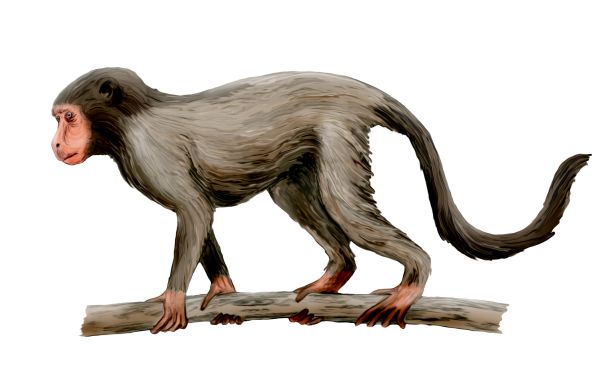
Aegyptopithecus ("Egyptian ape", from Greek Αίγυπτος "Egypt" and πίθηκος "ape") is an early fossil catarrhine that predates the divergence between hominoids (apes) and cercopithecids (Old World monkeys). It is known from a single species, Aegyptopithecus zeuxis, which lived around 38-29.5 million years ago in the early part of the Oligocene epoch. It likely resembled modern-day New World monkeys, and was about the same size as a modern howler monkey, which is about 56 to 92 cm (22 to 36 in) long. Aegyptopithecus fossils have been found in the Jebel Qatrani Formation of modern-day Egypt. Aegyptopithecus is believed to be a stem-catarrhine, a crucial link between Eocene and Miocene fossils.
Aegyptopithecus zeuxis has become one of the best known extinct primates based on craniodental and postcranial remains.
Aegyptopithecus was discovered by Elwyn Simons in 1966 in the Gabal Qatrani Formation, located in the Faiyum Governorate of central Egypt. Aegyptopithecus zeuxis fossils were originally thought to be between 35.4 and 33.3 million years old, based on initial analysis of the formation in which they were found. However, analysis by Erik Seiffert in 2006 concluded that the age of the Gabal Qatrani Formation should be revised. His assessment of more recent evidence indicates an age of between 30.2 and 29.5 million years ago.
If Aegyptopithecus is placed in its own genus, then there is one documented species named A. zeuxis. The type specimen for the species is CGM26901. Its scientific name means "linking Egyptian ape".
There is controversy over whether or not Aegyptopithecus should be a genus on its own or whether it should be moved into the genus Propliopithecus.
Aegyptopithecus zeuxis was a species that had a dental formula of 2.1.2.32.1.2.3, with the lower molars increasing in size posteriorly. The molars showed an adaptation called compartmentalizing shear, which is where the cutting edges involved in the buccal phase serve to surround basins in such a way that food is cut into fragments that are trapped and then ground during the lingual phase.
The canines of this species were sexually dimorphic. The ascending mandibular ramus of this species is relatively broad. The orbits are dorsally oriented and relatively small which suggested that this was a diurnal species. This species showed some postorbital constriction. The interorbital distance of Aegyptopithecus zeuxis is large much like that found in colobines. A sagittal crest developed in older individuals and extends over the brow ridges. This species had an auditory region which is similar to that found in platyrrhines, having no bony tube and the tympanic fused to the lateral surface of the bulla.
The humerus has a head which faces posteriorly and is narrower than primates that practice suspensory behavior. The humerus also shares some features with extinct hominoids: a large medial epicondyle and a comparatively wide trochlea. This species had an ulna that compares to the extinct members of the genus Alouatta. On the foot bones, this species had a grasping hallux. Aegyptopithecus zeuxis shares characteristics with haplorrhines such as a fused mandibular and frontal symphyses, postorbital closure, and superior and inferior transverse tori.
Hub AI
Aegyptopithecus AI simulator
(@Aegyptopithecus_simulator)
Aegyptopithecus
Aegyptopithecus ("Egyptian ape", from Greek Αίγυπτος "Egypt" and πίθηκος "ape") is an early fossil catarrhine that predates the divergence between hominoids (apes) and cercopithecids (Old World monkeys). It is known from a single species, Aegyptopithecus zeuxis, which lived around 38-29.5 million years ago in the early part of the Oligocene epoch. It likely resembled modern-day New World monkeys, and was about the same size as a modern howler monkey, which is about 56 to 92 cm (22 to 36 in) long. Aegyptopithecus fossils have been found in the Jebel Qatrani Formation of modern-day Egypt. Aegyptopithecus is believed to be a stem-catarrhine, a crucial link between Eocene and Miocene fossils.
Aegyptopithecus zeuxis has become one of the best known extinct primates based on craniodental and postcranial remains.
Aegyptopithecus was discovered by Elwyn Simons in 1966 in the Gabal Qatrani Formation, located in the Faiyum Governorate of central Egypt. Aegyptopithecus zeuxis fossils were originally thought to be between 35.4 and 33.3 million years old, based on initial analysis of the formation in which they were found. However, analysis by Erik Seiffert in 2006 concluded that the age of the Gabal Qatrani Formation should be revised. His assessment of more recent evidence indicates an age of between 30.2 and 29.5 million years ago.
If Aegyptopithecus is placed in its own genus, then there is one documented species named A. zeuxis. The type specimen for the species is CGM26901. Its scientific name means "linking Egyptian ape".
There is controversy over whether or not Aegyptopithecus should be a genus on its own or whether it should be moved into the genus Propliopithecus.
Aegyptopithecus zeuxis was a species that had a dental formula of 2.1.2.32.1.2.3, with the lower molars increasing in size posteriorly. The molars showed an adaptation called compartmentalizing shear, which is where the cutting edges involved in the buccal phase serve to surround basins in such a way that food is cut into fragments that are trapped and then ground during the lingual phase.
The canines of this species were sexually dimorphic. The ascending mandibular ramus of this species is relatively broad. The orbits are dorsally oriented and relatively small which suggested that this was a diurnal species. This species showed some postorbital constriction. The interorbital distance of Aegyptopithecus zeuxis is large much like that found in colobines. A sagittal crest developed in older individuals and extends over the brow ridges. This species had an auditory region which is similar to that found in platyrrhines, having no bony tube and the tympanic fused to the lateral surface of the bulla.
The humerus has a head which faces posteriorly and is narrower than primates that practice suspensory behavior. The humerus also shares some features with extinct hominoids: a large medial epicondyle and a comparatively wide trochlea. This species had an ulna that compares to the extinct members of the genus Alouatta. On the foot bones, this species had a grasping hallux. Aegyptopithecus zeuxis shares characteristics with haplorrhines such as a fused mandibular and frontal symphyses, postorbital closure, and superior and inferior transverse tori.