



Community hub
Recent from talks
Knowledge base stats:
Talk channels stats:
Members stats:
Brow ridge
The brow ridge, or supraorbital ridge known as superciliary arch in medicine, is a bony ridge located above the eye sockets of all primates and some other animals. In humans, the eyebrows are located on their lower margin.
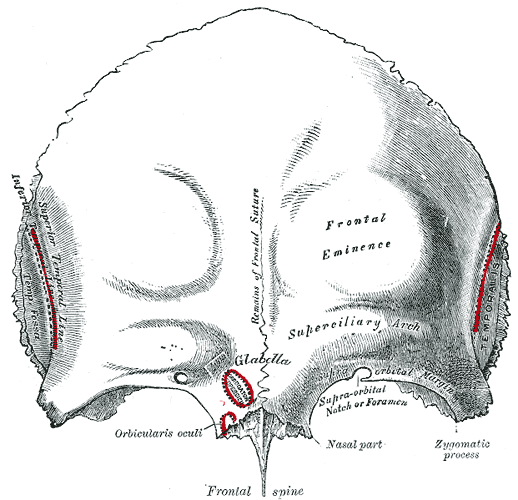
The brow ridge is a nodule or crest of bone situated on the frontal bone of the skull. It forms the separation between the forehead portion itself (the squama frontalis) and the roof of the eye sockets (the pars orbitalis). Normally, in humans, the ridges arch over each eye, offering mechanical protection. In other primates, the ridge is usually continuous and often straight rather than arched. The ridges are separated from the frontal eminences by a shallow groove. The ridges are most prominent medially, and are joined to one another by a smooth elevation named the glabella.
Typically, the arches are more prominent in men than in women, and vary between different human populations. Behind the ridges, deeper in the bone, are the frontal sinuses.
The brow ridges, being a prominent part of the face in some human populations and a trait linked to sexual dimorphism, have a number of names in different disciplines. In vernacular English, the terms eyebrow bone or eyebrow ridge are common. The more technical terms frontal or supraorbital arch, ridge or torus (or tori to refer to the plural, as the ridge is usually seen as a pair) are often found in anthropological or archaeological studies. In medicine, the term arcus superciliaris (Latin) or the English translation superciliary arch. This feature is different from the supraorbital margin and the margin of the orbit.
Some paleoanthropologists distinguish between frontal torus and supraorbital ridge. In anatomy, a torus is a projecting shelf of bone that unlike a ridge is rectilinear, unbroken and goes through glabella. Some fossil hominins, in this use of the word, have the frontal torus, but almost all modern humans only have the ridge.
The Spatial model proposes that supraorbital torus development can be best explained in terms of the disparity between the anterior position of the orbital component relative to the neurocranium.
Much of the groundwork for the spatial model was laid down by Schultz (1940). He was the first to document that at later stages of development (after age 4) the growth of the orbit would outpace that of the eye. Consequently, he proposed that facial size is the most influential factor in orbital development, with orbital growth being only secondarily affected by size and ocular position.
Weindenreich (1941) and Biegert (1957, 1963) argued that the supraorbital region can best be understood as a product of the orientation of its two components, the face and the neurocranium.
Hub AI
Brow ridge AI simulator
(@Brow ridge_simulator)
Brow ridge
The brow ridge, or supraorbital ridge known as superciliary arch in medicine, is a bony ridge located above the eye sockets of all primates and some other animals. In humans, the eyebrows are located on their lower margin.
The brow ridge is a nodule or crest of bone situated on the frontal bone of the skull. It forms the separation between the forehead portion itself (the squama frontalis) and the roof of the eye sockets (the pars orbitalis). Normally, in humans, the ridges arch over each eye, offering mechanical protection. In other primates, the ridge is usually continuous and often straight rather than arched. The ridges are separated from the frontal eminences by a shallow groove. The ridges are most prominent medially, and are joined to one another by a smooth elevation named the glabella.
Typically, the arches are more prominent in men than in women, and vary between different human populations. Behind the ridges, deeper in the bone, are the frontal sinuses.
The brow ridges, being a prominent part of the face in some human populations and a trait linked to sexual dimorphism, have a number of names in different disciplines. In vernacular English, the terms eyebrow bone or eyebrow ridge are common. The more technical terms frontal or supraorbital arch, ridge or torus (or tori to refer to the plural, as the ridge is usually seen as a pair) are often found in anthropological or archaeological studies. In medicine, the term arcus superciliaris (Latin) or the English translation superciliary arch. This feature is different from the supraorbital margin and the margin of the orbit.
Some paleoanthropologists distinguish between frontal torus and supraorbital ridge. In anatomy, a torus is a projecting shelf of bone that unlike a ridge is rectilinear, unbroken and goes through glabella. Some fossil hominins, in this use of the word, have the frontal torus, but almost all modern humans only have the ridge.
The Spatial model proposes that supraorbital torus development can be best explained in terms of the disparity between the anterior position of the orbital component relative to the neurocranium.
Much of the groundwork for the spatial model was laid down by Schultz (1940). He was the first to document that at later stages of development (after age 4) the growth of the orbit would outpace that of the eye. Consequently, he proposed that facial size is the most influential factor in orbital development, with orbital growth being only secondarily affected by size and ocular position.
Weindenreich (1941) and Biegert (1957, 1963) argued that the supraorbital region can best be understood as a product of the orientation of its two components, the face and the neurocranium.