
Recent from talks
Afrighids
Knowledge base stats:
Talk channels stats:
Members stats:
Afrighids
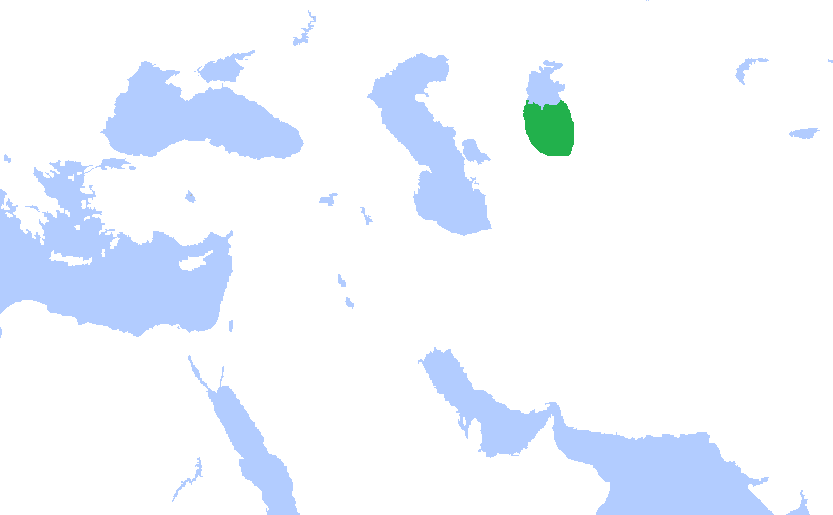
The Afrighids (Khwarazmian: ʾfryḡ) were a native Khwarezmian Iranian dynasty who ruled over the ancient kingdom of Khwarazm. Over time, they were under the suzerainty of the Sasanian Empire, the Hephthalite Empire, the Göktürk Khaganate, the Umayyad Caliphate, Abbasid Caliphate and the Samanid Empire.
They were ultimately deposed by a rival family, the Ma'munids of Gurganj, who became the new rulers of Khwarazm.
Al-Biruni, the native Khwarezmian scholar, mentions twenty-two members of the Afrighid dynasty for a total span of 690 years with an average rule of 31 years for each ruler. According to him, the Afrighids ruled from 305, through the Arab conquests under Qutayba ibn Muslim in 712, and up to their overthrow in 995 by the rising rival family of Ma'munids. The main source on the Afrighids prior to Islam is also Al-Biruni. Part of the reason for the gap in information about this dynasty is mentioned by Al-Biruni.
Al-Biruni states:
When Qutaibah bin Moslem under the command of Al-Ḥajjāj ibn Yūsuf was sent to Khwarazmia with a military expedition and conquered it for the second time, he swiftly killed whoever wrote in the Khwarazmian native language and knew of the Khwarazmian heritage, history, and culture. He then killed all their Zoroastrian priests and burned and wasted their books, until gradually the illiterate only remained, who knew nothing of writing, and hence the region's history was mostly forgotten.
It has been suggested that 'Afrigh' is the Arabicized of 'Abriz' in Persian (آبریز where water flows, a reference to the geography of Khwarazm and its abundant water). However, Dr. Parviz Azkai, in his annotations on Al-Biruni's Chronology of Ancient Nations, explains that this is a popular etymology. Azkai explains that Afrigh was originally Ap-Air-ig meaning from the Aryan descent: ap or af is the same in 'afrashtan' (Persian: افراشتن) to raise; air is the root meaning Aryan as seen in Iraj, and Eran/Iran (land of Aryan); and -ig is the suffix of relation in Iranian languages and cognate to '-ic' in English or '-ique' in French.
Khwarazm was a well-irrigated, rich agricultural region on the lower Oxus. Bordered by steppeland and desert on all sides, Khwarazm was geographically secluded from other areas of civilization, which allowed it to preserve a separate distinctive Iranian language and culture. Khwarazm was possibly the early homeland of the Iranians. In the Islamic era, the region had three main cities; Kath, Gurganj and Hazarasp.
Most of Afrighid history is recorded by the Khwarazmian scholar al-Biruni (died 1050), whose reliability has been questioned. According to al-Biruni, the Afrighids were founded by Afrig in 305, succeeding the semi-legendary line of the Siyavushids, founded by the Iranian king Kay Khosrow. However, extensive Soviet archeological findings demonstrate that al-Biruni was in reality not well-acquainted with pre-Islamic Khwarazmian history. Coin findings show that before the advent of the Afrighids, Khwarazm was part of the Parthian Empire. The start of the Khwarazmian era seemingly took place in the early 1st-century, after they had freed themselves of Parthian rule, and established their own local dynasty of shahs. The dynastic name of "Afrighid" (Khwarazmian: ʾfryḡ) is not attested anywhere besides al-Biruni, which has led scholars to suggest that the name never existed. The Iranologist Clifford Edmund Bosworth adds that "If this [Afrig] era was actually in use, it must have been unofficial." Likewise, many of the Khwarazmshahs recorded by al-Biruni are not supported by archeological evidence; however, this may be due to scribal errors.
Hub AI
Afrighids AI simulator
(@Afrighids_simulator)
Afrighids
The Afrighids (Khwarazmian: ʾfryḡ) were a native Khwarezmian Iranian dynasty who ruled over the ancient kingdom of Khwarazm. Over time, they were under the suzerainty of the Sasanian Empire, the Hephthalite Empire, the Göktürk Khaganate, the Umayyad Caliphate, Abbasid Caliphate and the Samanid Empire.
They were ultimately deposed by a rival family, the Ma'munids of Gurganj, who became the new rulers of Khwarazm.
Al-Biruni, the native Khwarezmian scholar, mentions twenty-two members of the Afrighid dynasty for a total span of 690 years with an average rule of 31 years for each ruler. According to him, the Afrighids ruled from 305, through the Arab conquests under Qutayba ibn Muslim in 712, and up to their overthrow in 995 by the rising rival family of Ma'munids. The main source on the Afrighids prior to Islam is also Al-Biruni. Part of the reason for the gap in information about this dynasty is mentioned by Al-Biruni.
Al-Biruni states:
When Qutaibah bin Moslem under the command of Al-Ḥajjāj ibn Yūsuf was sent to Khwarazmia with a military expedition and conquered it for the second time, he swiftly killed whoever wrote in the Khwarazmian native language and knew of the Khwarazmian heritage, history, and culture. He then killed all their Zoroastrian priests and burned and wasted their books, until gradually the illiterate only remained, who knew nothing of writing, and hence the region's history was mostly forgotten.
It has been suggested that 'Afrigh' is the Arabicized of 'Abriz' in Persian (آبریز where water flows, a reference to the geography of Khwarazm and its abundant water). However, Dr. Parviz Azkai, in his annotations on Al-Biruni's Chronology of Ancient Nations, explains that this is a popular etymology. Azkai explains that Afrigh was originally Ap-Air-ig meaning from the Aryan descent: ap or af is the same in 'afrashtan' (Persian: افراشتن) to raise; air is the root meaning Aryan as seen in Iraj, and Eran/Iran (land of Aryan); and -ig is the suffix of relation in Iranian languages and cognate to '-ic' in English or '-ique' in French.
Khwarazm was a well-irrigated, rich agricultural region on the lower Oxus. Bordered by steppeland and desert on all sides, Khwarazm was geographically secluded from other areas of civilization, which allowed it to preserve a separate distinctive Iranian language and culture. Khwarazm was possibly the early homeland of the Iranians. In the Islamic era, the region had three main cities; Kath, Gurganj and Hazarasp.
Most of Afrighid history is recorded by the Khwarazmian scholar al-Biruni (died 1050), whose reliability has been questioned. According to al-Biruni, the Afrighids were founded by Afrig in 305, succeeding the semi-legendary line of the Siyavushids, founded by the Iranian king Kay Khosrow. However, extensive Soviet archeological findings demonstrate that al-Biruni was in reality not well-acquainted with pre-Islamic Khwarazmian history. Coin findings show that before the advent of the Afrighids, Khwarazm was part of the Parthian Empire. The start of the Khwarazmian era seemingly took place in the early 1st-century, after they had freed themselves of Parthian rule, and established their own local dynasty of shahs. The dynastic name of "Afrighid" (Khwarazmian: ʾfryḡ) is not attested anywhere besides al-Biruni, which has led scholars to suggest that the name never existed. The Iranologist Clifford Edmund Bosworth adds that "If this [Afrig] era was actually in use, it must have been unofficial." Likewise, many of the Khwarazmshahs recorded by al-Biruni are not supported by archeological evidence; however, this may be due to scribal errors.
Recent media