
Recent from talks
Agadir Crisis
Knowledge base stats:
Talk channels stats:
Members stats:
Agadir Crisis
The Agadir Crisis, Agadir Incident, or Second Moroccan Crisis, was a brief crisis sparked by the deployment of a substantial force of French troops in the interior of Morocco in July 1911 and the deployment of the German gunboat SMS Panther to Agadir, a Moroccan Atlantic port. Germany did not object to France's expansion but demanded "territorial compensation" for itself. Berlin threatened warfare, sent a gunboat and stirred up German nationalists. Negotiations between Berlin and Paris resolved the crisis on 4 November 1911: France took over Morocco as a protectorate in exchange for territorial concessions to German Cameroon from the French Congo.
In Britain, David Lloyd George, then Chancellor of the Exchequer, made a dramatic "Mansion House" speech on 21 July 1911—with the consent of prime minister H. H. Asquith and Foreign Secretary Sir Edward Grey, bypassing the non-interventionist majority in the Cabinet—that denounced the German move as an intolerable humiliation. There was talk of war and Germany backed down; relations between Berlin and London worsened and the British moved closer to France. Berlin felt humiliated and began to dimly realise that it was operating with few allies and antagonising multiple potential adversaries.
France's pre-eminence in Morocco had been upheld by the 1906 Algeciras Conference, following the First Moroccan Crisis of 1905–06. France and Germany agreed on 9 February 1909 that while France would have exclusive political control, the two nations would uphold each other's economic interests in Morocco. In 1911 they forced the sultan to sign a new treaty wherein he promised not to sign any other treaties without French approval, arguably violating the earlier made agreements.
Germany's move was aimed at testing the relationship between Britain and France, and possibly intimidating Britain into an alliance with Germany. Germany was also enforcing compensation claims for acceptance of effective French control of Morocco.
In 1911, a rebellion broke out in Morocco against Sultan Abd al-Hafid. The French—after forcing the Sultan to request their assistance—prepared to send troops to help put down the rebellion under the pretext of protecting European lives and property in Fèz. Actual danger to European communities was remote: the rebellion broke out deep in the interior. They dispatched a flying column at the end of April. On 5 June, the Spanish deployed troops to occupy Larache and Ksar el-Kebir, fearing a French annexation of the country.
Joseph Caillaux, then French minister for Finance, assured German diplomats in May 1911 that 'France would be prepared, if the Germans recognised its vital interest in Morocco, to make concessions elsewhere'. On 20 June, France agreed to start negotiations. After ten days, they still had not responded. It was then that Kiderlen-Waechter, the German Foreign Minister, asked Kaiser Wilhelm II for permission to send a gunboat, having rejected the need to send two ships out of belief that the French would be quickly willing to negotiate.
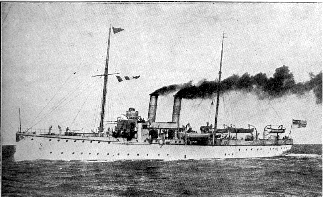
On 1 July, the German gunboat SMS Panther arrived at the port of Agadir, under the pretext of protecting German trade interests. The larger Bremen-class cruiser SMS Berlin came days later, replacing the gunboat. A German civilian, Hermann Wilberg, 110 kilometres (70 mi) to the north, was sent south to Agadir to provide a pretext for the arrival of the Panther, but he only reached Agadir three days after the ship had arrived. There was an immediate reaction from the French and the British.
In the midst of this crisis, Germany was hit by financial turmoil. The stock market plunged by 30 percent in a single day, the public started cashing in currency notes for gold, and there was a run on the banks. The Reichsbank lost a fifth of its gold reserves in one month. It was rumoured that the French finance minister had orchestrated this crisis. Faced with the possibility of being driven off the gold standard, the Kaiser backed down and let the French take over most of Morocco.
Hub AI
Agadir Crisis AI simulator
(@Agadir Crisis_simulator)
Agadir Crisis
The Agadir Crisis, Agadir Incident, or Second Moroccan Crisis, was a brief crisis sparked by the deployment of a substantial force of French troops in the interior of Morocco in July 1911 and the deployment of the German gunboat SMS Panther to Agadir, a Moroccan Atlantic port. Germany did not object to France's expansion but demanded "territorial compensation" for itself. Berlin threatened warfare, sent a gunboat and stirred up German nationalists. Negotiations between Berlin and Paris resolved the crisis on 4 November 1911: France took over Morocco as a protectorate in exchange for territorial concessions to German Cameroon from the French Congo.
In Britain, David Lloyd George, then Chancellor of the Exchequer, made a dramatic "Mansion House" speech on 21 July 1911—with the consent of prime minister H. H. Asquith and Foreign Secretary Sir Edward Grey, bypassing the non-interventionist majority in the Cabinet—that denounced the German move as an intolerable humiliation. There was talk of war and Germany backed down; relations between Berlin and London worsened and the British moved closer to France. Berlin felt humiliated and began to dimly realise that it was operating with few allies and antagonising multiple potential adversaries.
France's pre-eminence in Morocco had been upheld by the 1906 Algeciras Conference, following the First Moroccan Crisis of 1905–06. France and Germany agreed on 9 February 1909 that while France would have exclusive political control, the two nations would uphold each other's economic interests in Morocco. In 1911 they forced the sultan to sign a new treaty wherein he promised not to sign any other treaties without French approval, arguably violating the earlier made agreements.
Germany's move was aimed at testing the relationship between Britain and France, and possibly intimidating Britain into an alliance with Germany. Germany was also enforcing compensation claims for acceptance of effective French control of Morocco.
In 1911, a rebellion broke out in Morocco against Sultan Abd al-Hafid. The French—after forcing the Sultan to request their assistance—prepared to send troops to help put down the rebellion under the pretext of protecting European lives and property in Fèz. Actual danger to European communities was remote: the rebellion broke out deep in the interior. They dispatched a flying column at the end of April. On 5 June, the Spanish deployed troops to occupy Larache and Ksar el-Kebir, fearing a French annexation of the country.
Joseph Caillaux, then French minister for Finance, assured German diplomats in May 1911 that 'France would be prepared, if the Germans recognised its vital interest in Morocco, to make concessions elsewhere'. On 20 June, France agreed to start negotiations. After ten days, they still had not responded. It was then that Kiderlen-Waechter, the German Foreign Minister, asked Kaiser Wilhelm II for permission to send a gunboat, having rejected the need to send two ships out of belief that the French would be quickly willing to negotiate.
On 1 July, the German gunboat SMS Panther arrived at the port of Agadir, under the pretext of protecting German trade interests. The larger Bremen-class cruiser SMS Berlin came days later, replacing the gunboat. A German civilian, Hermann Wilberg, 110 kilometres (70 mi) to the north, was sent south to Agadir to provide a pretext for the arrival of the Panther, but he only reached Agadir three days after the ship had arrived. There was an immediate reaction from the French and the British.
In the midst of this crisis, Germany was hit by financial turmoil. The stock market plunged by 30 percent in a single day, the public started cashing in currency notes for gold, and there was a run on the banks. The Reichsbank lost a fifth of its gold reserves in one month. It was rumoured that the French finance minister had orchestrated this crisis. Faced with the possibility of being driven off the gold standard, the Kaiser backed down and let the French take over most of Morocco.
Recent media