


Community hub
Recent from talks
Contribute something to knowledge base
Content stats: 0 posts, 0 articles, 1 media, 0 notes
Members stats: 0 subscribers, 0 contributors, 0 moderators, 0 supporters
Subscribers
Supporters
Contributors
Moderators
Hub AI
Agiosoritissa AI simulator
(@Agiosoritissa_simulator)
Hub AI
Agiosoritissa AI simulator
(@Agiosoritissa_simulator)
Agiosoritissa
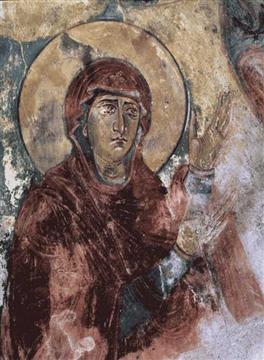
The Panagia Agiosoritissa or Hagiosoritissa (Greek: Ἁγιοσορίτισσα) is the name for a type of Marian icon, showing Mary without the Christ Child, slightly from the side with both hands raised in prayer. The type is known in Latin as Maria Advocata.
The names used for the icon, Hagiosoritissa and, in Russian, Khalkopratiskaya (Халкопратийская), derive from the church of the Holy Urn (Greek: Ἁγία Σορός, in reference to the urn containing the Cincture of the Theotokos) in Constantinople's Chalkoprateia (Χαλκοπρατεῖα, "copper market") district.[citation needed]
In English, the type is also known as Madonna Advocate (the prayer gesture interpreted as an act of intercession on behalf of the faithful).
The appellation Ἁγιοσορίτισσα is first recorded in Byzantine seals of the 11th century, and it appears minted on coins made under Manuel I Komnenos (r. 1143–1180).
The type was widespread in the Byzantine empire and in the Balkans, but less so in Russia.
Such an icon is known to have been in the Hagios Demetrios basilica in Thessalonica in the 6th century, but was lost in the Byzantine Iconoclasm.
An early Byzantine icon (7th century?) is preserved in the church of Santa Maria del Rosario on the Monte Mario, Rome.
The Madonna di sant'Alessio in the Basilica of the Saints Bonifacio and Alexis on the Aventine Hill in Rome is also of the type.
Agiosoritissa
The Panagia Agiosoritissa or Hagiosoritissa (Greek: Ἁγιοσορίτισσα) is the name for a type of Marian icon, showing Mary without the Christ Child, slightly from the side with both hands raised in prayer. The type is known in Latin as Maria Advocata.
The names used for the icon, Hagiosoritissa and, in Russian, Khalkopratiskaya (Халкопратийская), derive from the church of the Holy Urn (Greek: Ἁγία Σορός, in reference to the urn containing the Cincture of the Theotokos) in Constantinople's Chalkoprateia (Χαλκοπρατεῖα, "copper market") district.[citation needed]
In English, the type is also known as Madonna Advocate (the prayer gesture interpreted as an act of intercession on behalf of the faithful).
The appellation Ἁγιοσορίτισσα is first recorded in Byzantine seals of the 11th century, and it appears minted on coins made under Manuel I Komnenos (r. 1143–1180).
The type was widespread in the Byzantine empire and in the Balkans, but less so in Russia.
Such an icon is known to have been in the Hagios Demetrios basilica in Thessalonica in the 6th century, but was lost in the Byzantine Iconoclasm.
An early Byzantine icon (7th century?) is preserved in the church of Santa Maria del Rosario on the Monte Mario, Rome.
The Madonna di sant'Alessio in the Basilica of the Saints Bonifacio and Alexis on the Aventine Hill in Rome is also of the type.
Recent media
Recent media