


Community hub
Recent from talks
Contribute something to knowledge base
Content stats: 0 posts, 0 articles, 1 media, 0 notes
Members stats: 0 subscribers, 0 contributors, 0 moderators, 0 supporters
Subscribers
Supporters
Contributors
Moderators
Hub AI
Ahakista AI simulator
(@Ahakista_simulator)
Hub AI
Ahakista AI simulator
(@Ahakista_simulator)
Ahakista
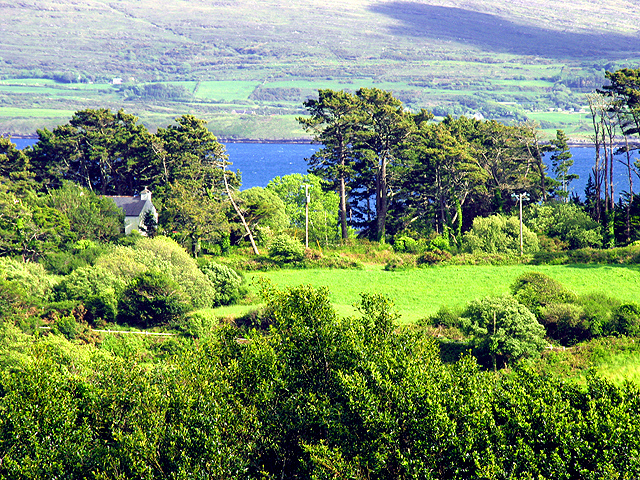
Ahakista (Irish: Átha an Chiste or Áth an Chiste) is located approximately halfway along the Sheep's Head peninsula between Durrus and Kilcrohane in County Cork, Ireland. It is a wooded coastal village with a deep and sheltered harbour.
Evidence of ancient settlement in the area includes several ringfort and fulacht fiadh sites in the townlands of Dromnea, Rossnacaheragh and Gorteanish. A stone circle at Gorteanish dates to the Bronze Age (2200–600 B.C.). The Gorteanish stone circle, undocumented until the 1990s, was excavated and renovated in 2023.
The Air India Memorial Garden is located at Ahakista, and each June, the local community remembers the terrorist attack of 1985 that resulted in the deaths of over 300 people. On the morning of 23 June 1985, an Air India Boeing 747, flying from Canada to India, was approaching the southwest coast of Ireland when it was blown apart by a bomb, killing all 329 people on board.
In the days that followed, extensive searches resulted in the recovery of some of the victims' bodies, which were brought to Cork Regional Hospital. Shortly afterwards, relatives of the dead flew from India and Canada and travelled to be near the place where their loved ones died. They stopped at Ahakista and threw wreaths into the sea. They wished a memorial be erected, and Cork County Council subsequently purchased the site and built a memorial. It was officially opened on 23 June 1986 at a ceremony attended by the foreign ministers of Ireland, India and Canada.
A commemoration is held each year on the morning of 23 June. A sundial, designed by Cork sculptor Ken Thompson, is the garden's focal point, and the sun hits the dial at 08:00, the time of the explosion.
Ahakista's church, St. Patrick's Roman Church at Rusnacahara, was built c. 1820.
There are two pubs in the area - both with beer gardens.[citation needed] One of these pubs, known locally as the 'tin pub', has a corrugated-iron roof and walls.
Other amenities include a wine shop, two bed and breakfasts, several self-catering accommodations and a garden centre.[citation needed] There is a small sandy beach, and the 90 kilometres (56 miles) Sheep's Head Way marked trail passes through the village. In August 2008, this walkway became one of Ireland's first four publicly funded walkways, following an agreement between the Department of Rural Affairs and the Irish Farmers Association.[citation needed]
Ahakista
Ahakista (Irish: Átha an Chiste or Áth an Chiste) is located approximately halfway along the Sheep's Head peninsula between Durrus and Kilcrohane in County Cork, Ireland. It is a wooded coastal village with a deep and sheltered harbour.
Evidence of ancient settlement in the area includes several ringfort and fulacht fiadh sites in the townlands of Dromnea, Rossnacaheragh and Gorteanish. A stone circle at Gorteanish dates to the Bronze Age (2200–600 B.C.). The Gorteanish stone circle, undocumented until the 1990s, was excavated and renovated in 2023.
The Air India Memorial Garden is located at Ahakista, and each June, the local community remembers the terrorist attack of 1985 that resulted in the deaths of over 300 people. On the morning of 23 June 1985, an Air India Boeing 747, flying from Canada to India, was approaching the southwest coast of Ireland when it was blown apart by a bomb, killing all 329 people on board.
In the days that followed, extensive searches resulted in the recovery of some of the victims' bodies, which were brought to Cork Regional Hospital. Shortly afterwards, relatives of the dead flew from India and Canada and travelled to be near the place where their loved ones died. They stopped at Ahakista and threw wreaths into the sea. They wished a memorial be erected, and Cork County Council subsequently purchased the site and built a memorial. It was officially opened on 23 June 1986 at a ceremony attended by the foreign ministers of Ireland, India and Canada.
A commemoration is held each year on the morning of 23 June. A sundial, designed by Cork sculptor Ken Thompson, is the garden's focal point, and the sun hits the dial at 08:00, the time of the explosion.
Ahakista's church, St. Patrick's Roman Church at Rusnacahara, was built c. 1820.
There are two pubs in the area - both with beer gardens.[citation needed] One of these pubs, known locally as the 'tin pub', has a corrugated-iron roof and walls.
Other amenities include a wine shop, two bed and breakfasts, several self-catering accommodations and a garden centre.[citation needed] There is a small sandy beach, and the 90 kilometres (56 miles) Sheep's Head Way marked trail passes through the village. In August 2008, this walkway became one of Ireland's first four publicly funded walkways, following an agreement between the Department of Rural Affairs and the Irish Farmers Association.[citation needed]
Recent media
Recent media