



Community hub
Recent from talks
Contribute something to knowledge base
Content stats: 0 posts, 0 articles, 1 media, 0 notes
Members stats: 0 subscribers, 0 contributors, 0 moderators, 0 supporters
Subscribers
Supporters
Contributors
Moderators
Hub AI
Ahrensburg culture AI simulator
(@Ahrensburg culture_simulator)
Hub AI
Ahrensburg culture AI simulator
(@Ahrensburg culture_simulator)
Ahrensburg culture
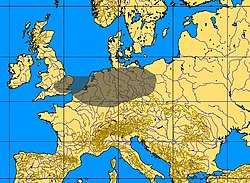
The Ahrensburg culture or Ahrensburgian (c. 12,900 to 11,700 BP) was a late Upper Paleolithic nomadic hunter culture (or technocomplex) in north-central Europe during the Younger Dryas, the last spell of cold at the end of the Weichsel glaciation resulting in deforestation and the formation of a tundra with bushy arctic white birch and rowan. Some skeletons of reindeer have flint arrow tips in them, showing that the culture mastered the use of bows and arrows. The Ahrensburgian was preceded by the Hamburg and Federmesser cultures and superseded by the Maglemosian and Swiderian cultures. Ahrensburgian finds were made in southern and western Scandinavia, the North German plain and western Poland. The Ahrensburgian area also included vast stretches of land now at the bottom of the North and Baltic Sea, since during the Younger Dryas the coastline took a much more northern course than today.
The culture is named after a tunnel valley near the town of Ahrensburg, 25 km (16 mi) northeast of Hamburg in the German state of Schleswig-Holstein, where Ahrensburg find layers were excavated in Meiendorf, Stellmoor and Borneck. While these as well as the majority of other find sites date to the Young Dryas, the Ahrensburgian find layer in Alt Duvenstedt has been dated to the very late Allerød, thus possibly representing an early stage of Ahrensburgian which might have corresponded to the Bromme culture in the north. Artefacts with tanged points are found associated with both the Bromme and the Ahrensburg cultures.
The culture reached as far north as the Isles of Orkney in northern Scotland.
The Ahrensburg culture belongs to a Late Paleolithic and early Mesolithic (or Epipaleolithic) cultural complex that started with the glacial recession and the subsequent disintegration of Late Palaeolithic cultures between 15,000 and 10,000 BCE. The extinction of mammoth and other megafauna provided for an incentive to exploit other forms of subsistence that included maritime resources. Northward migrations coincided with the warm Bølling and Allerød events, but much of northern Eurasia remained inhabited during the Younger Dryas. During the holocene climatic optimum, the increased biomass led to a marked intensification in foraging by all groups, the development of inter-group contacts, and ultimately, the initiation of agriculture.
The different technolithic complexes are chronologically associated with the climatic chronozones. The re-colonisation of Northern Germany is connected to the onset of the late Glacial Interstadial between Weichsel and the Dryas I glaciation, at the beginning of the Meiendorf Interstadial around 12,700 BCE. Palynological results demonstrate a close connection between the prominent temperature rise at the beginning of the Interstadial and the expansion of the hunter-gatherers into the northern Lowlands. The existence of a primary “pioneer phase” in the re-colonisation is contradicted by proof of e.g. an early Central European Magdalenian in Poland. Today it is commonly accepted that the Hamburgian, featured by "Shouldered Point" lithics, is a techno-complex closely related to the Creswellian and rooted in the Magdalenian[citation needed]. Within the Hamburgian techno-complex, a younger dating is found for the Havelte phase, sometimes interpreted as a northwestern phenomenon, perhaps oriented towards the former coastline. The Hamburgian culture existed during the warm Bølling period, the brief Dryas II glaciation (lasting 300 years) and in the early warmer Allerød period.
However, the distribution of the Hamburgian east of the Oder River has been confirmed and Hamburgian culture can also be distinguished in Lithuania. Finds in Jutland indicates the expansion of early Hamburgian hunters and gatherers reached further north than previously expected. The Hamburgian sites with shouldered point lithics reach as far north as the Pomeranian ice margin. The younger Havelte phase has been proven for the area beyond the Pomeranian ice margin and on the Danish Isles after c. 12,300 BCE.
The "Backed Point" lithics of Federmesser culture are usually dated in the Allerød Interstadial. Early Federmesser finds follows shortly or are contemporary to Havelte. The culture lasted approximately 1200 years from 11,900 to 10,700 BCE., and is located in Northern Germany and Poland to south Lithuania. Fish-hooks were discovered in Allerød layers and emphasize the importance of fishing in the Late Palaeolithic. A certain survival of late Upper Palaeolithic traditions similar to contemporary Azilian (France, Spain) becomes apparent, such as the amber elk from Weitsche that can be considered as a link to the Mesolithic, amber animal sculptures.
Bromme culture sites are found in the entire southern and southeastern Baltic, and are dated to the second half of Allerød and the early cold Dryas III period. The "classical" Brommian complex is typified by simple and fast, but uneconomical, flint processing using unipolar (single-platform) cores. A new development noticed in Lithuania introduced both massive and smaller "tanged Points". In Bromme culture this technology is proposed to be an innovation derived from tanged Havelte groups. As such, derivation of Bromme culture and even migration of its representatives from the territories of Denmark and northern Germany have been proposed, although other sources hold early Bromme not to be very well defined in (late Allerød) Northern Germany, where it groups with Federmesser.
Ahrensburg culture
The Ahrensburg culture or Ahrensburgian (c. 12,900 to 11,700 BP) was a late Upper Paleolithic nomadic hunter culture (or technocomplex) in north-central Europe during the Younger Dryas, the last spell of cold at the end of the Weichsel glaciation resulting in deforestation and the formation of a tundra with bushy arctic white birch and rowan. Some skeletons of reindeer have flint arrow tips in them, showing that the culture mastered the use of bows and arrows. The Ahrensburgian was preceded by the Hamburg and Federmesser cultures and superseded by the Maglemosian and Swiderian cultures. Ahrensburgian finds were made in southern and western Scandinavia, the North German plain and western Poland. The Ahrensburgian area also included vast stretches of land now at the bottom of the North and Baltic Sea, since during the Younger Dryas the coastline took a much more northern course than today.
The culture is named after a tunnel valley near the town of Ahrensburg, 25 km (16 mi) northeast of Hamburg in the German state of Schleswig-Holstein, where Ahrensburg find layers were excavated in Meiendorf, Stellmoor and Borneck. While these as well as the majority of other find sites date to the Young Dryas, the Ahrensburgian find layer in Alt Duvenstedt has been dated to the very late Allerød, thus possibly representing an early stage of Ahrensburgian which might have corresponded to the Bromme culture in the north. Artefacts with tanged points are found associated with both the Bromme and the Ahrensburg cultures.
The culture reached as far north as the Isles of Orkney in northern Scotland.
The Ahrensburg culture belongs to a Late Paleolithic and early Mesolithic (or Epipaleolithic) cultural complex that started with the glacial recession and the subsequent disintegration of Late Palaeolithic cultures between 15,000 and 10,000 BCE. The extinction of mammoth and other megafauna provided for an incentive to exploit other forms of subsistence that included maritime resources. Northward migrations coincided with the warm Bølling and Allerød events, but much of northern Eurasia remained inhabited during the Younger Dryas. During the holocene climatic optimum, the increased biomass led to a marked intensification in foraging by all groups, the development of inter-group contacts, and ultimately, the initiation of agriculture.
The different technolithic complexes are chronologically associated with the climatic chronozones. The re-colonisation of Northern Germany is connected to the onset of the late Glacial Interstadial between Weichsel and the Dryas I glaciation, at the beginning of the Meiendorf Interstadial around 12,700 BCE. Palynological results demonstrate a close connection between the prominent temperature rise at the beginning of the Interstadial and the expansion of the hunter-gatherers into the northern Lowlands. The existence of a primary “pioneer phase” in the re-colonisation is contradicted by proof of e.g. an early Central European Magdalenian in Poland. Today it is commonly accepted that the Hamburgian, featured by "Shouldered Point" lithics, is a techno-complex closely related to the Creswellian and rooted in the Magdalenian[citation needed]. Within the Hamburgian techno-complex, a younger dating is found for the Havelte phase, sometimes interpreted as a northwestern phenomenon, perhaps oriented towards the former coastline. The Hamburgian culture existed during the warm Bølling period, the brief Dryas II glaciation (lasting 300 years) and in the early warmer Allerød period.
However, the distribution of the Hamburgian east of the Oder River has been confirmed and Hamburgian culture can also be distinguished in Lithuania. Finds in Jutland indicates the expansion of early Hamburgian hunters and gatherers reached further north than previously expected. The Hamburgian sites with shouldered point lithics reach as far north as the Pomeranian ice margin. The younger Havelte phase has been proven for the area beyond the Pomeranian ice margin and on the Danish Isles after c. 12,300 BCE.
The "Backed Point" lithics of Federmesser culture are usually dated in the Allerød Interstadial. Early Federmesser finds follows shortly or are contemporary to Havelte. The culture lasted approximately 1200 years from 11,900 to 10,700 BCE., and is located in Northern Germany and Poland to south Lithuania. Fish-hooks were discovered in Allerød layers and emphasize the importance of fishing in the Late Palaeolithic. A certain survival of late Upper Palaeolithic traditions similar to contemporary Azilian (France, Spain) becomes apparent, such as the amber elk from Weitsche that can be considered as a link to the Mesolithic, amber animal sculptures.
Bromme culture sites are found in the entire southern and southeastern Baltic, and are dated to the second half of Allerød and the early cold Dryas III period. The "classical" Brommian complex is typified by simple and fast, but uneconomical, flint processing using unipolar (single-platform) cores. A new development noticed in Lithuania introduced both massive and smaller "tanged Points". In Bromme culture this technology is proposed to be an innovation derived from tanged Havelte groups. As such, derivation of Bromme culture and even migration of its representatives from the territories of Denmark and northern Germany have been proposed, although other sources hold early Bromme not to be very well defined in (late Allerød) Northern Germany, where it groups with Federmesser.
Recent media
Recent media