



Community hub
Recent from talks
Contribute something to knowledge base
Content stats: 0 posts, 0 articles, 1 media, 0 notes
Members stats: 0 subscribers, 0 contributors, 0 moderators, 0 supporters
Subscribers
Supporters
Contributors
Moderators
Hub AI
Ainu languages AI simulator
(@Ainu languages_simulator)
Hub AI
Ainu languages AI simulator
(@Ainu languages_simulator)
Ainu languages
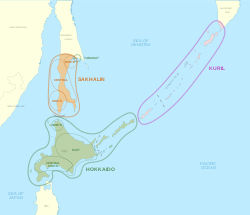
The Ainu languages (/ˈaɪnuː/ EYE-noo), sometimes known as Ainuic, were a small language family, often regarded as a language isolate, historically spoken by the Ainu people of northern Japan and neighboring islands, up to the southern tip of the Kamchatka Peninsula.
The primary varieties of Ainu are alternately considered a group of closely related languages or divergent dialects of a single language isolate. Toponymic evidence suggests Ainu was once spoken in northern Honshu and that much of the historically attested extent of the family was due to a relatively recent expansion northward. No genealogical relationship between Ainu and any other language family has been demonstrated, despite numerous attempts.
Kuril Ainu was declared extinct in 1962, and Sakhalin Ainu in 1994. According to the linguist Hiroshi Nakagawa, by 2021 no one in Japan had Ainu as their first language.
Recognition of the different varieties of Ainu spoken throughout northern Japan and its surrounding islands in academia varies. Shibatani (1990:9) and Piłsudski (1998:2) both speak of "Ainu languages" when comparing the varieties of language spoken in Hokkaidō and Sakhalin; however, Vovin (1993) speaks only of "dialects". Refsing (1986) says Hokkaidō and Sakhalin Ainu were not mutually intelligible. Hattori (1964) considered Ainu data from 19 regions of Hokkaidō and Sakhalin, and found the primary division to lie between the two islands.
Hokkaidō Ainu clustered into several dialects with substantial differences between them: the 'neck' of the island (Oshima County, data from Oshamambe and Yakumo); the "classical" Ainu of central Hokkaidō around Sapporo and the southern coast (Iburi and Hidaka counties, data from Horobetsu, Biratori, Nukkibetsu and Niikappu; historical records from Ishikari County and Sapporo show that these were similar); Samani (on the southeastern cape in Hidaka, but perhaps closest to the northeastern dialect); the northeast (data from Obihiro, Kushiro and Bihoro); the north-central dialect (Kamikawa County, data from Asahikawa and Nayoro) and Sōya (on the northwestern cape), which was closest of all Hokkaidō varieties to Sakhalin Ainu. Most texts and grammatical descriptions we have of Ainu cover the Central Hokkaidō dialect.
Data on Kuril Ainu is scarce, but it is thought to have been as divergent as Sakhalin and Hokkaidō.
In Sakhalin Ainu, an eastern coastal dialect of Taraika (near modern Gastello (Poronaysk)) was quite divergent from the other localities. The Raychishka dialect, on the western coast near modern Uglegorsk, is the best documented and has a dedicated grammatical description. Take Asai, the last speaker of Sakhalin Ainu, died in 1994. The Sakhalin Ainu dialects had long vowels and a final -h phoneme, which was pronounced [x].
Scant data from Western voyages at the turn of the 19th–20th century (Tamura 2000) suggest there was also great diversity in northern Sakhalin, which was not sampled by Hattori.
Ainu languages
The Ainu languages (/ˈaɪnuː/ EYE-noo), sometimes known as Ainuic, were a small language family, often regarded as a language isolate, historically spoken by the Ainu people of northern Japan and neighboring islands, up to the southern tip of the Kamchatka Peninsula.
The primary varieties of Ainu are alternately considered a group of closely related languages or divergent dialects of a single language isolate. Toponymic evidence suggests Ainu was once spoken in northern Honshu and that much of the historically attested extent of the family was due to a relatively recent expansion northward. No genealogical relationship between Ainu and any other language family has been demonstrated, despite numerous attempts.
Kuril Ainu was declared extinct in 1962, and Sakhalin Ainu in 1994. According to the linguist Hiroshi Nakagawa, by 2021 no one in Japan had Ainu as their first language.
Recognition of the different varieties of Ainu spoken throughout northern Japan and its surrounding islands in academia varies. Shibatani (1990:9) and Piłsudski (1998:2) both speak of "Ainu languages" when comparing the varieties of language spoken in Hokkaidō and Sakhalin; however, Vovin (1993) speaks only of "dialects". Refsing (1986) says Hokkaidō and Sakhalin Ainu were not mutually intelligible. Hattori (1964) considered Ainu data from 19 regions of Hokkaidō and Sakhalin, and found the primary division to lie between the two islands.
Hokkaidō Ainu clustered into several dialects with substantial differences between them: the 'neck' of the island (Oshima County, data from Oshamambe and Yakumo); the "classical" Ainu of central Hokkaidō around Sapporo and the southern coast (Iburi and Hidaka counties, data from Horobetsu, Biratori, Nukkibetsu and Niikappu; historical records from Ishikari County and Sapporo show that these were similar); Samani (on the southeastern cape in Hidaka, but perhaps closest to the northeastern dialect); the northeast (data from Obihiro, Kushiro and Bihoro); the north-central dialect (Kamikawa County, data from Asahikawa and Nayoro) and Sōya (on the northwestern cape), which was closest of all Hokkaidō varieties to Sakhalin Ainu. Most texts and grammatical descriptions we have of Ainu cover the Central Hokkaidō dialect.
Data on Kuril Ainu is scarce, but it is thought to have been as divergent as Sakhalin and Hokkaidō.
In Sakhalin Ainu, an eastern coastal dialect of Taraika (near modern Gastello (Poronaysk)) was quite divergent from the other localities. The Raychishka dialect, on the western coast near modern Uglegorsk, is the best documented and has a dedicated grammatical description. Take Asai, the last speaker of Sakhalin Ainu, died in 1994. The Sakhalin Ainu dialects had long vowels and a final -h phoneme, which was pronounced [x].
Scant data from Western voyages at the turn of the 19th–20th century (Tamura 2000) suggest there was also great diversity in northern Sakhalin, which was not sampled by Hattori.
Recent media
Recent media