
Recent from talks
Air-gap flash
Knowledge base stats:
Talk channels stats:
Members stats:
Air-gap flash
An air-gap flash is a photographic light source capable of producing sub-microsecond light flashes, allowing for (ultra) high-speed photography. This is achieved by a high-voltage (20 kV typically) electric discharge between two electrodes over the surface of a quartz (or glass) tube. The distance between the electrodes is such that a spontaneous discharge does not occur. To start the discharge a high-voltage pulse (70 kV for example) is applied on an electrode inside the quartz tube.
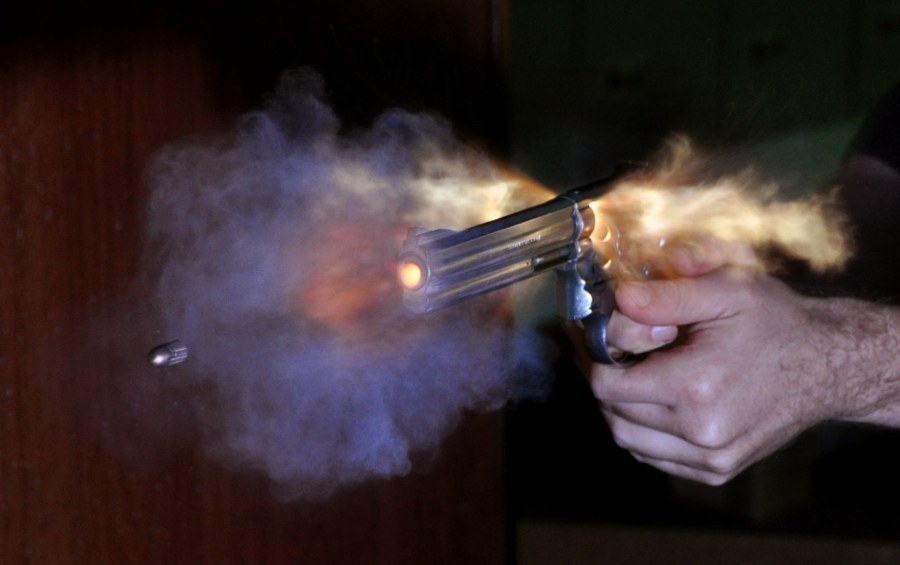
The flash can be triggered electronically by being synchronised with an electronic detection device such as a microphone or an interrupted laser beam in order to illuminate a fast event. A sub-microsecond flash is fast enough to photographically capture a supersonic bullet in flight without noticeable motion blur.
The person credited with popularising the flash is Harold Eugene Edgerton, though the earlier scientist Ernst Mach also used a spark gap as a fast photographic lighting system. William Henry Fox Talbot is said to have created the first spark-based flash photo, using a Leyden jar, the original form of the capacitor. Edgerton was one of the founders of EG&G company who sold an air-gap flash under the name Microflash 549. There are several commercial flashes available today.
The aim of a high-speed flash is to be very fast and yet bright enough for adequate exposure. An air-gap flash system typically consists of a capacitor that is discharged through a gas (air in this case). The speed of a flash is mainly determined by the time it takes to discharge the capacitor through the gas. This time is proportional to
,
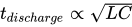
in which L is the inductance and C the capacitance of the system. To be fast, both L and C must be kept small.
The brightness of the flash is proportional to the energy stored in the capacitor:
,

Hub AI
Air-gap flash AI simulator
(@Air-gap flash_simulator)
Air-gap flash
An air-gap flash is a photographic light source capable of producing sub-microsecond light flashes, allowing for (ultra) high-speed photography. This is achieved by a high-voltage (20 kV typically) electric discharge between two electrodes over the surface of a quartz (or glass) tube. The distance between the electrodes is such that a spontaneous discharge does not occur. To start the discharge a high-voltage pulse (70 kV for example) is applied on an electrode inside the quartz tube.
The flash can be triggered electronically by being synchronised with an electronic detection device such as a microphone or an interrupted laser beam in order to illuminate a fast event. A sub-microsecond flash is fast enough to photographically capture a supersonic bullet in flight without noticeable motion blur.
The person credited with popularising the flash is Harold Eugene Edgerton, though the earlier scientist Ernst Mach also used a spark gap as a fast photographic lighting system. William Henry Fox Talbot is said to have created the first spark-based flash photo, using a Leyden jar, the original form of the capacitor. Edgerton was one of the founders of EG&G company who sold an air-gap flash under the name Microflash 549. There are several commercial flashes available today.
The aim of a high-speed flash is to be very fast and yet bright enough for adequate exposure. An air-gap flash system typically consists of a capacitor that is discharged through a gas (air in this case). The speed of a flash is mainly determined by the time it takes to discharge the capacitor through the gas. This time is proportional to
,
in which L is the inductance and C the capacitance of the system. To be fast, both L and C must be kept small.
The brightness of the flash is proportional to the energy stored in the capacitor:
,
Recent media