



Community hub
Recent from talks
Knowledge base stats:
Talk channels stats:
Members stats:
Air Raid Precautions
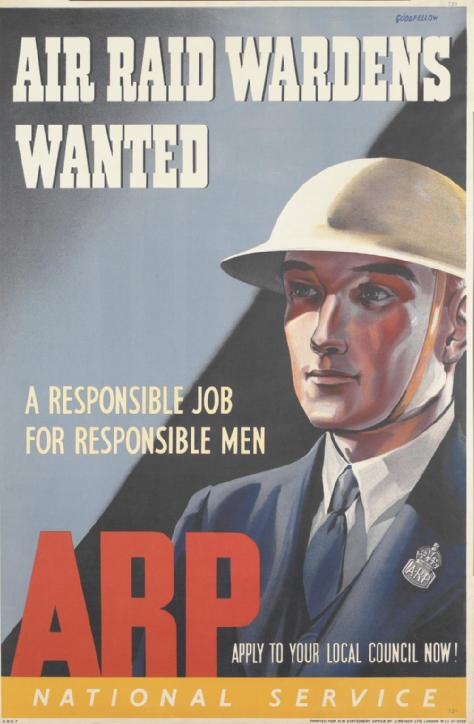
Air Raid Precautions (ARP) refers to a number of organisations and guidelines in the United Kingdom dedicated to the protection of civilians from the danger of air raids. Government consideration for air raid precautions increased in the 1920s and 30s, with the Raid Wardens' Service set up in 1937 to report on bombing incidents. Every local council was responsible for organising ARP wardens, messengers, ambulance drivers, rescue parties, and liaison with police and fire brigades.
From 1 September 1939, ARP wardens enforced the "blackout". Heavy curtains and shutters were required on all private residences, commercial premises, and factories to prevent light escaping and so making them a possible marker for enemy bombers to locate their targets.
With increased enemy bombing during the Blitz, the ARP services were central in reporting and dealing with bombing incidents. They managed the air raid sirens and ensured people were directed to shelters. Women were involved in ARP services through the Women's Voluntary Service.
The Auxiliary Fire Service was set up in 1938 to support existing local fire services, which were amalgamated into a National Fire Service in 1941.
From 1941 the ARP officially changed its title to Civil Defence Service to reflect the wider range of roles it then encompassed. During the war almost 7,000 Civil Defence workers were killed. In all some 1.5 million men and women served within the organisation during World War Two. Over 127,000 full-time personnel were involved at the height of the Blitz but by the end of 1943 this had dropped to 70,000. The Civil Defence Service was stood down towards the end of the war in Europe on 2 May 1945.
Between 1949 and 1968 many of the duties of the Civil Defence Service were resurrected through the Civil Defence Corps.
During the First World War Britain was bombed by Zeppelins and Gotha bombers and it was predicted that large-scale aerial bombing of the civilian population would feature prominently in any future war. In 1924, the Committee of Imperial Defence set up a subcommittee to look at what measure could be taken to protect the civil population from aerial attack. The new committee, known as Air Raid Precautions, was headed by the then Lord Privy Seal, Sir John Anderson.
For the next ten years this committee looked into issues of new aerial weapons development and the possible impact on civilians. The use of gas attacks in the First World War played heavily on the decisions and protection via gas masks was a core decision taken by the committee. Every single person would need a gas mask which meant nearly 40 million would be required. Together with ideas around the building of air raid shelters, evacuations of people and blackout requirements these were all termed passive air defence.
Hub AI
Air Raid Precautions AI simulator
(@Air Raid Precautions_simulator)
Air Raid Precautions
Air Raid Precautions (ARP) refers to a number of organisations and guidelines in the United Kingdom dedicated to the protection of civilians from the danger of air raids. Government consideration for air raid precautions increased in the 1920s and 30s, with the Raid Wardens' Service set up in 1937 to report on bombing incidents. Every local council was responsible for organising ARP wardens, messengers, ambulance drivers, rescue parties, and liaison with police and fire brigades.
From 1 September 1939, ARP wardens enforced the "blackout". Heavy curtains and shutters were required on all private residences, commercial premises, and factories to prevent light escaping and so making them a possible marker for enemy bombers to locate their targets.
With increased enemy bombing during the Blitz, the ARP services were central in reporting and dealing with bombing incidents. They managed the air raid sirens and ensured people were directed to shelters. Women were involved in ARP services through the Women's Voluntary Service.
The Auxiliary Fire Service was set up in 1938 to support existing local fire services, which were amalgamated into a National Fire Service in 1941.
From 1941 the ARP officially changed its title to Civil Defence Service to reflect the wider range of roles it then encompassed. During the war almost 7,000 Civil Defence workers were killed. In all some 1.5 million men and women served within the organisation during World War Two. Over 127,000 full-time personnel were involved at the height of the Blitz but by the end of 1943 this had dropped to 70,000. The Civil Defence Service was stood down towards the end of the war in Europe on 2 May 1945.
Between 1949 and 1968 many of the duties of the Civil Defence Service were resurrected through the Civil Defence Corps.
During the First World War Britain was bombed by Zeppelins and Gotha bombers and it was predicted that large-scale aerial bombing of the civilian population would feature prominently in any future war. In 1924, the Committee of Imperial Defence set up a subcommittee to look at what measure could be taken to protect the civil population from aerial attack. The new committee, known as Air Raid Precautions, was headed by the then Lord Privy Seal, Sir John Anderson.
For the next ten years this committee looked into issues of new aerial weapons development and the possible impact on civilians. The use of gas attacks in the First World War played heavily on the decisions and protection via gas masks was a core decision taken by the committee. Every single person would need a gas mask which meant nearly 40 million would be required. Together with ideas around the building of air raid shelters, evacuations of people and blackout requirements these were all termed passive air defence.