



Community hub
Recent from talks
Knowledge base stats:
Talk channels stats:
Members stats:
Airgíalla
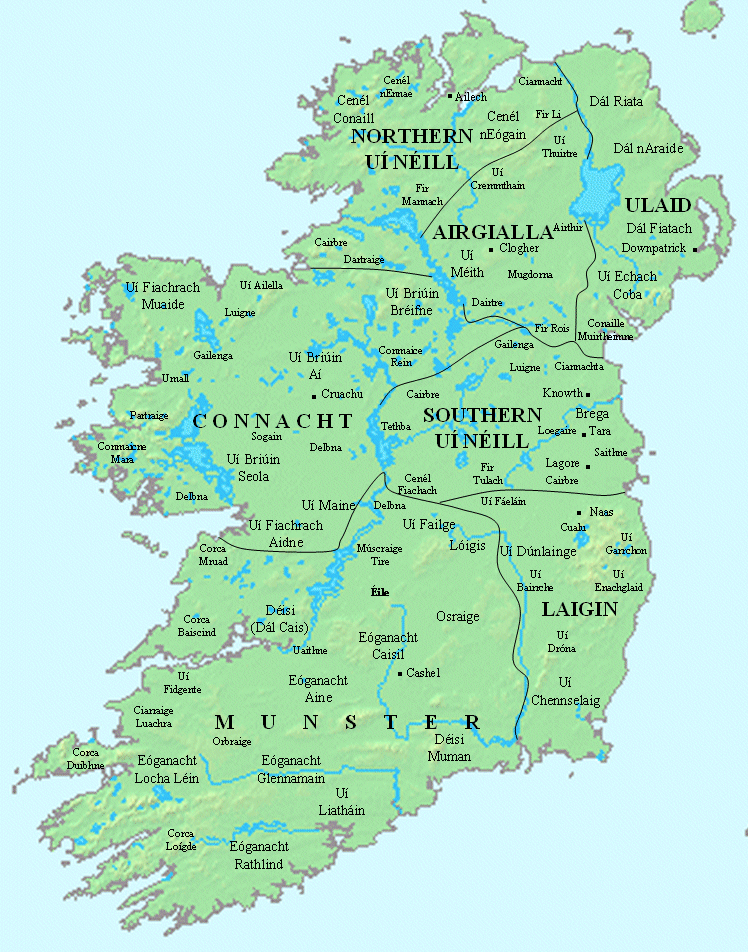
Airgíalla (Old Irish pronunciation: [ˈœɾʲɣʲiːa̯l̪a]; Modern Irish: Oirialla, English: Oriel, Latin: Ergallia) was a medieval Irish over-kingdom and the collective name for the confederation of tribes that formed it. The confederation consisted of nine minor kingdoms, all independent of each other but paying nominal suzerainty to an overking, usually from the most powerful dynasty. Airgíalla at its peak roughly matched the modern dioceses of Armagh and Clogher, spanning parts of counties Armagh, Monaghan, Louth, Fermanagh, Tyrone and Londonderry. Its main towns were Armagh and Clogher. The name's usage survives as a cultural area of folk tradition in South East Ulster and adjoining areas of County Louth.
According to legend, Airgíalla was founded by the Three Collas, who are said to have conquered what is now central Ulster from the Ulaid. The decisive victory was the battle of Achadh Leithdheirg, said to have been fought around the year 331. However, this tale is thought to be mostly fiction, and the actual year and circumstances of how the Airgíalla confederation came about is unknown.
Originally thought to have been under the dominance of the neighbouring Ulaid to the east, the territory of the Airgíalla from the 6th century onwards was gradually eroded by the encroachment of their northern neighbours, the Cenél nEógain of the Northern Uí Néill, as well as the Southern Uí Néill to their south. From 735 they fell under the dominance of the Cenél nEógain, and by 827 had become their vassals. The kingdom of Airgíalla was at its peak in the 12th century, under king Donnchad Ua Cerbaill. The later constricted kingdom of Airgíalla survived in Monaghan—which was known as Oirghialla and Oriel after the Norman Invasion of Ireland—under the Mac Mathghamhna, until the end of the Gaelic order in Ireland.
Airgíalla, referring to both the Irish over-kingdom of Airgíalla, and the confederation of tribes that formed it, may mean 'those who give hostages' or 'hostage givers', presumably in reference to the included territories' vassalage. It is commonly anglicised as Oriel; however, archaic anglicisations include Uriel, Orial, Orgialla, Orgiall, and Oryallia, along with the latinisation Ergallia.[citation needed]
After the Anglo-Norman invasion, the anglicisation Uriel became the name of the part of Airgíalla that had extended into modern-day County Louth. Similarly, the portion of Airgíalla that survived in modern-day County Monaghan, became known as Oirghialla, from which derives the anglicisation Oriel.
In early manuscripts, the Bishop of Clogher was styled "Bishop of Oirialla".
In the beginning of the 4th century, three warlike brothers, known as the Three Collas, made a conquest of a great part of Ulster, which they wrested from the Ulaid. It was the after the battle of Achadh Leithdheirg, fought around 331, that they founded Airgíalla. In this battle the forces of the Three Collas defeated the forces of Fergus Foga, king of Ulster, who was slain, and the victors burned to the ground Emain Macha, the ancient capital of Ulaid.
However, in general it can be shown that the origin legend was written (or composed) in the second quarter of the 8th century to seal their alliance with the Northern Uí Néill.[attribution needed]
Hub AI
Airgíalla AI simulator
(@Airgíalla_simulator)
Airgíalla
Airgíalla (Old Irish pronunciation: [ˈœɾʲɣʲiːa̯l̪a]; Modern Irish: Oirialla, English: Oriel, Latin: Ergallia) was a medieval Irish over-kingdom and the collective name for the confederation of tribes that formed it. The confederation consisted of nine minor kingdoms, all independent of each other but paying nominal suzerainty to an overking, usually from the most powerful dynasty. Airgíalla at its peak roughly matched the modern dioceses of Armagh and Clogher, spanning parts of counties Armagh, Monaghan, Louth, Fermanagh, Tyrone and Londonderry. Its main towns were Armagh and Clogher. The name's usage survives as a cultural area of folk tradition in South East Ulster and adjoining areas of County Louth.
According to legend, Airgíalla was founded by the Three Collas, who are said to have conquered what is now central Ulster from the Ulaid. The decisive victory was the battle of Achadh Leithdheirg, said to have been fought around the year 331. However, this tale is thought to be mostly fiction, and the actual year and circumstances of how the Airgíalla confederation came about is unknown.
Originally thought to have been under the dominance of the neighbouring Ulaid to the east, the territory of the Airgíalla from the 6th century onwards was gradually eroded by the encroachment of their northern neighbours, the Cenél nEógain of the Northern Uí Néill, as well as the Southern Uí Néill to their south. From 735 they fell under the dominance of the Cenél nEógain, and by 827 had become their vassals. The kingdom of Airgíalla was at its peak in the 12th century, under king Donnchad Ua Cerbaill. The later constricted kingdom of Airgíalla survived in Monaghan—which was known as Oirghialla and Oriel after the Norman Invasion of Ireland—under the Mac Mathghamhna, until the end of the Gaelic order in Ireland.
Airgíalla, referring to both the Irish over-kingdom of Airgíalla, and the confederation of tribes that formed it, may mean 'those who give hostages' or 'hostage givers', presumably in reference to the included territories' vassalage. It is commonly anglicised as Oriel; however, archaic anglicisations include Uriel, Orial, Orgialla, Orgiall, and Oryallia, along with the latinisation Ergallia.[citation needed]
After the Anglo-Norman invasion, the anglicisation Uriel became the name of the part of Airgíalla that had extended into modern-day County Louth. Similarly, the portion of Airgíalla that survived in modern-day County Monaghan, became known as Oirghialla, from which derives the anglicisation Oriel.
In early manuscripts, the Bishop of Clogher was styled "Bishop of Oirialla".
In the beginning of the 4th century, three warlike brothers, known as the Three Collas, made a conquest of a great part of Ulster, which they wrested from the Ulaid. It was the after the battle of Achadh Leithdheirg, fought around 331, that they founded Airgíalla. In this battle the forces of the Three Collas defeated the forces of Fergus Foga, king of Ulster, who was slain, and the victors burned to the ground Emain Macha, the ancient capital of Ulaid.
However, in general it can be shown that the origin legend was written (or composed) in the second quarter of the 8th century to seal their alliance with the Northern Uí Néill.[attribution needed]