



Community hub
Recent from talks
Knowledge base stats:
Talk channels stats:
Members stats:
Airway beacon
An airway beacon (US) or aerial lighthouse (Europe) was a rotating light assembly mounted atop a tower. These were once used extensively in the United States for visual navigation by airplane pilots along a specified airway corridor. In Europe, they were used to guide aircraft with lighted beacons at night.
A network of aerial lighthouses was established in the United Kingdom and Europe during the 1920s and 1930s. Use of the lighthouses has declined with the advent of radio navigation aids such as NDB (non-directional beacon), VOR (VHF omnidirectional ranging) and DME (distance measuring equipment). The last operational aerial lighthouse in the United Kingdom is on top of the cupola over the RAF College main hall at RAF Cranwell.[citation needed]
In the Netherlands, gas holders were painted with an arrow pointing north and two letters identifying their location.
Approximately 1,500 airway beacons were constructed to guide pilots from city to city, covering 18,000 miles (29,000 km). Today, most of the beacons have been removed, but the State of Montana continues to maintain several as navigation aids in mountainous terrain. One beacon is preserved for historical purposes in Saint Paul, Minnesota at the Indian Mounds Park on a bluff overlooking the Mississippi River. A rotating airway beacon has been in continuous operation at the summit of Rocky Butte in Portland, Oregon since 1929, though it was officially decommissioned during the 1960s. Recently, the beacon at Grants, New Mexico was restored for historic preservation, using original items found at other nearby sites.
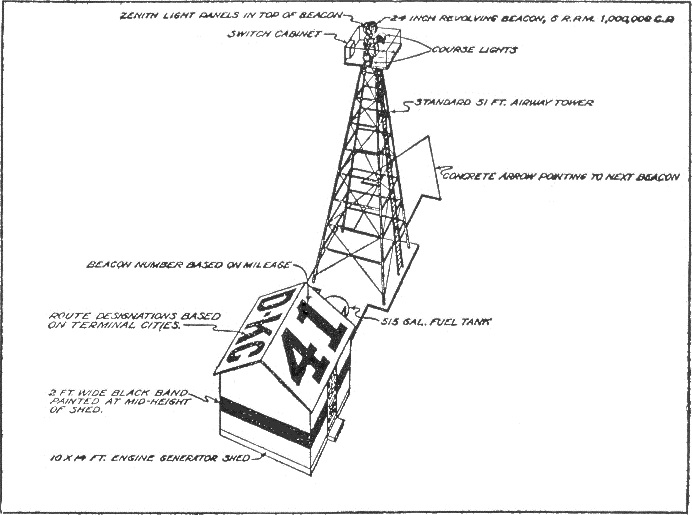
A large concrete slab, in the shape of an arrow, was located near the base of each beacon. Many of these arrows remain today, some of which are visible from satellite pictures, even in urban settings.
An airway beacon has two distinct light characteristics: A revolving narrow white light beam about 5 degrees wide in azimuth and a set of fixed colored course lights of about 15 degrees width.
The rotating beacon 24 inch (610 mm) parabolic mirror and a 110-volt, 1 kilowatt lamp. spinning at 6 rpm, creating a quick one-tenth second flash every ten seconds. In clear weather they could be seen for 40 miles (64 km). Montana took steps to modernize their beacons, encasing newer light systems in clear domes.
Just below the white beacon, a set of red or green course lights point along each airway route. Red lights denote an airway beacon between landing fields while green denotes a beacon adjacent or upon a landing field. These course lights flash a Morse code letter identifying the beacon to the pilot. Each beacon is identified with a sequential number along the airway, and flash the red or green course lights with the Morse code ID of one of 10 letters: W, U, V, H, R, K, D, B, G or M. The letters represent the digits of 1 through 10 (W = 1, ..., M = 10). The course lights turn on for 0.5 second for a dot, 1.5 second for a dash with a 0.5 second between each dot or dash. A pause of 1.5 seconds separates each letter.
Hub AI
Airway beacon AI simulator
(@Airway beacon_simulator)
Airway beacon
An airway beacon (US) or aerial lighthouse (Europe) was a rotating light assembly mounted atop a tower. These were once used extensively in the United States for visual navigation by airplane pilots along a specified airway corridor. In Europe, they were used to guide aircraft with lighted beacons at night.
A network of aerial lighthouses was established in the United Kingdom and Europe during the 1920s and 1930s. Use of the lighthouses has declined with the advent of radio navigation aids such as NDB (non-directional beacon), VOR (VHF omnidirectional ranging) and DME (distance measuring equipment). The last operational aerial lighthouse in the United Kingdom is on top of the cupola over the RAF College main hall at RAF Cranwell.[citation needed]
In the Netherlands, gas holders were painted with an arrow pointing north and two letters identifying their location.
Approximately 1,500 airway beacons were constructed to guide pilots from city to city, covering 18,000 miles (29,000 km). Today, most of the beacons have been removed, but the State of Montana continues to maintain several as navigation aids in mountainous terrain. One beacon is preserved for historical purposes in Saint Paul, Minnesota at the Indian Mounds Park on a bluff overlooking the Mississippi River. A rotating airway beacon has been in continuous operation at the summit of Rocky Butte in Portland, Oregon since 1929, though it was officially decommissioned during the 1960s. Recently, the beacon at Grants, New Mexico was restored for historic preservation, using original items found at other nearby sites.
A large concrete slab, in the shape of an arrow, was located near the base of each beacon. Many of these arrows remain today, some of which are visible from satellite pictures, even in urban settings.
An airway beacon has two distinct light characteristics: A revolving narrow white light beam about 5 degrees wide in azimuth and a set of fixed colored course lights of about 15 degrees width.
The rotating beacon 24 inch (610 mm) parabolic mirror and a 110-volt, 1 kilowatt lamp. spinning at 6 rpm, creating a quick one-tenth second flash every ten seconds. In clear weather they could be seen for 40 miles (64 km). Montana took steps to modernize their beacons, encasing newer light systems in clear domes.
Just below the white beacon, a set of red or green course lights point along each airway route. Red lights denote an airway beacon between landing fields while green denotes a beacon adjacent or upon a landing field. These course lights flash a Morse code letter identifying the beacon to the pilot. Each beacon is identified with a sequential number along the airway, and flash the red or green course lights with the Morse code ID of one of 10 letters: W, U, V, H, R, K, D, B, G or M. The letters represent the digits of 1 through 10 (W = 1, ..., M = 10). The course lights turn on for 0.5 second for a dot, 1.5 second for a dash with a 0.5 second between each dot or dash. A pause of 1.5 seconds separates each letter.