


Community hub
Recent from talks
Contribute something
Nothing was collected or created yet.
Morse code
View on Wikipedia


Morse code is a telecommunications method which encodes text characters as standardized sequences of two different signal durations, called dots and dashes, or dits and dahs.[3][4] It is named after Samuel Morse, one of several developers of the system. Morse's preliminary proposal for a telegraph code was replaced by an alphabet-based code developed by Alfred Vail, the engineer working with Morse. Vail's version was used for commercial telegraphy in North America. Friedrich Gerke simplified Vail's code to produce the code adopted in Europe, and most of the alphabetic part of the (ITU) "Morse" is copied from Gerke's revision.
The ITU International Morse code encodes the 26 basic Latin letters A to Z, one accented Latin letter (É), the Indo-Arabic numerals 0 to 9, and some punctuation and messaging procedural signals (prosigns). There is no distinction between upper and lower case letters.[2] Each code symbol is formed by a sequence of dits and dahs. The dit duration can vary for signal clarity and operator skill, but for any one message, once the rhythm is established, a half-beat is the basic unit of time measurement. The duration of a dah is three times the duration of a dit. Each dit or dah within an encoded character is followed by a period of signal absence, called a space, equal to the dit duration. The letters of a word are separated by a space of duration equal to three dits, and words are separated by a space equal to seven dits.[2][5][a]
Morse code can be memorized and sent in a form perceptible to the human senses, e.g. via sound waves or visible light, such that it can be directly interpreted by persons trained in it.[7][8] Morse code is usually transmitted by on-off keying of an information-carrying medium such as electric current, radio waves, visible light, or sound waves.[9][10] The current or wave is present during the time period of the dit or dah and absent during the time between dits and dahs.[11][12] Since many natural languages use more than the 26 letters of the Latin alphabet, Morse alphabets have been developed for those, largely by transliteration of existing codes.[13]
To increase transmission efficiency, Vail designed the original alphabetic code so the duration of each symbol was approximately inverse to the frequency that the character it represents occurs in English text. After revisions that led to ITU Morse code, the assignment of codes to characters in a few cases became non-optimal, although many encodings are. For instance, the most common letter in English, E, has the shortest code – a single dit. Because code elements are specified relatively, by proportion, rather than fixed duration, the code is usually sent at the highest rate the receiver is capable of decoding.[b]
Development and history
[edit]Pre-Morse telegraphs and codes
[edit].jpg)
Early in the nineteenth century, European experimenters made progress with electrical signaling systems, using a variety of techniques including static electricity and electricity from Voltaic piles producing electrochemical and electromagnetic changes. These experimental designs were precursors to practical telegraphic applications.[14]
_and_Co.,_8_Dey_Street,_NY_-_Bennington_Museum_-_Bennington,_VT_-_DSC08636.JPG)
Following the discovery of electromagnetism by Hans Christian Ørsted in 1820 and the invention of the electromagnet by William Sturgeon in 1824, there were developments in electromagnetic telegraphy in Europe and America. Pulses of electric current were sent along wires to control an electromagnet in the receiving instrument. Many of the earliest telegraph systems used a single-needle system which gave a very simple and robust instrument. However, it was slow, as the receiving operator had to alternate between looking at the needle and writing down the message. In Morse code, a deflection of the needle to the left corresponded to a dit and a deflection to the right to a dah.[15] The needle clicked each time it moved to the right or left. By making the two clicks sound different (by installing one ivory and one metal stop), transmissions on the single needle device became audible as well as visible, which led in turn to the Double Plate Sounder System.[16]
William Cooke and Charles Wheatstone in Britain developed an electrical telegraph that used electromagnets in its receivers. They obtained an English patent in June 1837 and demonstrated it on the London and Birmingham Railway, making it the first commercial telegraph. Carl Friedrich Gauss and Wilhelm Eduard Weber (1833) as well as Carl August von Steinheil (1837) used codes with varying word lengths for their telegraph systems.[17] In 1841, Cooke and Wheatstone built a telegraph that printed the letters from a wheel of typefaces struck by a hammer.[18]: 79
Samuel Morse and Alfred Vail
[edit]
The American artist Samuel Morse, the American physicist Joseph Henry, and mechanical engineer Alfred Vail developed an electrical telegraph system. The simple "on or off" nature of its signals made it desirable to find a method of transmitting natural language using only electrical pulses and the silence between them. Around 1837, Morse therefore developed such a method, an early forerunner to the modern International Morse code.[18]: 79
The Morse system for telegraphy was designed to make indentations on a paper tape when electric currents were received.[19] Morse's original telegraph receiver used a mechanical clockwork to move a paper tape. When an electrical current was received, an electromagnet engaged an armature that pushed a stylus onto the moving paper tape, making an indentation on the tape. When the current was interrupted, a spring retracted the stylus and that portion of the moving tape remained unmarked.
In his earliest design for a code, Morse had planned to transmit only numerals, and to use a codebook to look up each word according to the number which had been sent. However, the code was soon expanded by Alfred Vail in 1840 to include letters and special characters, so it could be used more generally. Vail estimated the letter frequency of English by counting the movable type he found in the type cases of a local newspaper in Morristown, New Jersey.[18]: 84 The shorter marks were called "dots" and the longer ones "dashes", and the letters most commonly used were assigned the shortest sequences of dots and dashes. This code, first used in 1844, was what later became known as Morse landline code, American Morse code, or Railroad Morse, until the end of railroad telegraphy in the U.S. in the 1970s.[citation needed]
Operator-led change from graphical to audible code
[edit]In the original Morse telegraph system, the receiver's armature made a clicking noise as it moved in and out of position to mark the paper tape. Early telegraph operators soon learned that they could translate the clicks directly into dots and dashes, and write these down by hand, thus making the paper tape unnecessary. When Morse code was adapted to radio communication, the dots and dashes were sent as short and long tone pulses.
Later telegraphy training found that people become more proficient at receiving Morse code when it is taught "like a language", with each code perceived as a whole "word" instead of a sequence of separate dots and dashes, such as might be shown on a page.[20]
With the advent of tones produced by radiotelegraph receivers, the operators began to vocalize a dot as dit, and a dash as dah, to reflect the sounds of Morse code they heard. To conform to normal sending speed, dits which are not the last element of a code became voiced as di. For example, the letter L ( ▄ ▄▄▄ ▄ ▄ ) is voiced as di dah di dit.[21][22] Morse code was sometimes facetiously known as "iddy-umpty", a dit lampooned as "iddy" and a dah as "umpty", leading to the word "umpteen".[23]
Gerke's refinement of Morse's code
[edit]
The Morse code, as specified in the current international standard, International Morse Code Recommendation, ITU-R M.1677-1,[2] was derived from a much-improved proposal by Friedrich Gerke in 1848 that became known as the "Hamburg alphabet", its only real defect being the use of an excessively long code ( ▄ ▄▄▄ ▄ ▄ ▄ and later the equal duration code ▄▄▄ ▄▄▄ ▄▄▄ ) for the frequently used vowel O.
Gerke changed many of the codepoints, in the process doing away with the different length dashes and different inter-element spaces of American Morse, leaving only two coding elements, the dot and the dash. Codes for German umlauted vowels and CH were introduced. Gerke's code was adopted in Germany and Austria in 1851.[24]
This finally led to the International Morse code in 1865. The International Morse code adopted most of Gerke's codepoints. The codes for O and P were taken from a code system developed by Steinheil. A new codepoint was added for J since Gerke did not distinguish between I and J. Changes were also made to X, Y, and Z. The codes for the digits 0–9 in International Morse were completely revised from both Vail's original and Gerke's revised encodings. This left only four codes identical to the original Morse code, namely E, H, K, and N; and K and N had their original short dahs extended to full length.[17][c]
Radiotelegraphy and aviation
[edit]In the 1890s, Morse code began to be used extensively for early radio communication before it was possible to transmit voice. In the late 19th and early 20th centuries, most high-speed international communication used Morse code on telegraph lines, undersea cables, and radio circuits.
Although previous transmitters were bulky and the spark gap system of transmission was dangerous and difficult to use, there had been some early attempts: In 1910, the U.S. Navy experimented with sending Morse from an airplane.[25] However the first regular aviation radiotelegraphy was on airships, which had space to accommodate the large, heavy radio equipment then in use. The same year, 1910, a radio on the airship America was instrumental in coordinating the rescue of its crew.[26]
During World War I, Zeppelin airships equipped with radio were used for bombing and naval scouting,[27] and ground-based radio direction finders were used for airship navigation.[27] Allied airships and military aircraft also made some use of radiotelegraphy.
However, there was little aeronautical radio in general use during World War I, and in the 1920s, there was no radio system used by such important flights as that of Charles Lindbergh from New York to Paris in 1927. Once he and the Spirit of St. Louis were off the ground, Lindbergh was truly incommunicado and alone. Morse code in aviation began regular use in the mid-1920s. By 1928, when the first airplane flight was made by the Southern Cross from California to Australia, one of its four crewmen was a radio operator who communicated with ground stations via radio telegraph.
Beginning in the 1930s, both civilian and military pilots were required to be able to use Morse code, both for use with early communications systems and for identification of navigational beacons that transmitted continuous two- or three-letter identifiers in Morse code. Aeronautical charts show the identifier of each navigational aid next to its location on the map.
In addition, rapidly moving field armies could not have fought effectively without radiotelegraphy; they moved more quickly than their communications services could put up new telegraph and telephone lines. This was seen especially in the blitzkrieg offensives of the Nazi German Wehrmacht in Poland, Belgium, France (in 1940), the Soviet Union, and in North Africa; by the British Army in North Africa, Italy, and the Netherlands; and by the U.S. Army in France and Belgium (in 1944), and in southern Germany in 1945.
Maritime flash telegraphy and radio telegraphy
[edit]
Radiotelegraphy using Morse code was vital during World War II, especially in carrying messages between the warships and the naval bases of the belligerents. Long-range ship-to-ship communication was by radio telegraphy, using encrypted messages because the voice radio systems on ships then were quite limited in both their range and their security. Radiotelegraphy was also extensively used by warplanes, especially by long-range patrol planes that were sent out by navies to scout for enemy warships, cargo ships, and troop ships.
Morse code was used as an international standard for maritime distress until 1999 when it was replaced by the Global Maritime Distress and Safety System. When the French Navy ceased using Morse code on 31 January 1997, the final message transmitted was "Calling all. This is our last call before our eternal silence."[28]
Demise of commercial telegraphy
[edit]In the United States the final commercial Morse code transmission was on 12 July 1999, signing off with Samuel Morse's original 1844 message, WHAT HATH GOD WROUGHT, and the prosign SK ("end of contact").[29]
As of 2015[update], the United States Air Force still trains ten people a year in Morse.[30]
The United States Coast Guard has ceased all use of Morse code on the radio, and no longer monitors any radio frequencies for Morse code transmissions, including the international medium frequency (MF) distress frequency of 500 kHz.[31] However, the Federal Communications Commission still grants commercial radiotelegraph operator licenses to applicants who pass its code and written tests.[32] Licensees have reactivated the old California coastal Morse station KPH and regularly transmit from the site under either this call sign or as KSM. Similarly, a few U.S. museum ship stations are operated by Morse enthusiasts.[33]
Operator proficiency
[edit]
Morse code speed is measured in words per minute (WPM) or characters per minute (CPM). Characters have differing lengths because they contain differing numbers of dits and dahs. Consequently, words also have different lengths in terms of dot duration, even when they contain the same number of characters. For this reason, some standard word is adopted for measuring operators' transmission speeds: Two such standard words in common use are PARIS and CODEX.[34] Operators skilled in Morse code can often understand ("copy") code in their heads at rates in excess of 40 WPM.
In addition to knowing, understanding, and being able to copy the standard written alpha-numeric and punctuation characters or symbols at high speeds, skilled high-speed operators must also be fully knowledgeable of all of the special unwritten Morse code symbols for the standard Prosigns for Morse code and the meanings of these special procedural signals in standard Morse code communications protocol.
International contests in code copying are still occasionally held. In July 1939 at a contest in Asheville, North Carolina in the United States, Theodore Roosevelt McElroy (W1JYN) set a still-standing record for Morse copying, 75.2 WPM.[35] Pierpont (2004) also notes that some operators may have passed 100 WPM.[35] By this time, they are "hearing" phrases and sentences rather than words. The fastest speed ever sent by a straight key was achieved in 1942 by Harry Turner (W9YZE) (d. 1992) who reached 35 WPM in a demonstration at a U.S. Army base. To accurately compare code copying speed records of different eras it is useful to keep in mind that different standard words (50 dit durations versus 60 dit durations) and different interword gaps (5 dit durations versus 7 dit durations) may have been used when determining such speed records. For example, speeds run with the CODEX standard word and the PARIS standard may differ by up to 20%.
Today among amateur operators there are several organizations that recognize high-speed code ability, one group consisting of those who can copy Morse at 60 WPM.[36] Also, Certificates of Code Proficiency are issued by several amateur radio societies, including the American Radio Relay League. Their basic award starts at 10 WPM with endorsements as high as 40 WPM, and are available to anyone who can copy the transmitted text. Members of the Boy Scouts of America may put a Morse interpreter's strip on their uniforms if they meet the standards for translating code at 5 WPM.

Through May 2013, the First, Second, and Third Class (commercial) Radiotelegraph Licenses using code tests based upon the CODEX standard word were still being issued in the United States by the Federal Communications Commission. The First Class license required 20 WPM code group and 25 WPM text code proficiency, the others 16 WPM code group test (five letter blocks sent as simulation of receiving encrypted text) and 20 WPM code text (plain language) test. It was also necessary to pass written tests on operating practice and electronics theory. A unique additional demand for the First Class was a requirement of a year of experience for operators of shipboard and coast stations using Morse. This allowed the holder to be chief operator on board a passenger ship. However, since 1999 the use of satellite and very high-frequency maritime communications systems (GMDSS) has made them obsolete. (By that point meeting experience requirement for the First was very difficult.)
Currently, only one class of license, the Radiotelegraph Operator License, is issued. This is granted either when the tests are passed or as the Second and First are renewed and become this lifetime license. For new applicants, it requires passing a written examination on electronic theory and radiotelegraphy practices, as well as 16 WPM code-group and 20 WPM text tests. However, the code exams are currently waived for holders of Amateur Extra Class licenses who obtained their operating privileges under the old 20 WPM test requirement.
International Morse code
[edit]Morse codes of one version or another have been in use for more than 160 years — longer than any other electrical message encoding system. What is today called "Morse code" is different from what was originally actually developed by Vail and Morse. The Modern International Morse code, or continental code, was created by Friedrich Clemens Gerke in 1848 and initially used for telegraphy between Hamburg and Cuxhaven in Germany. Gerke changed nearly half of the alphabet and all of the numerals, providing the foundation for the modern form of the code. After some minor changes to the letters and a complete revision of the numerals, International Morse Code was standardized by the International Telegraphy Congress in 1865 in Paris, and later became the standard adopted by the International Telecommunication Union (ITU). Morse and Vail's final code specification, however, was only really used for land-line telegraphy in the United States and Canada, with the International code used everywhere else, including all ships at sea and sailing in North American waters. Vail's version became known as American Morse code or railroad code, and is now almost never used, with the possible exception of historical re-enactments.
Aviation
[edit]
In aviation, pilots use radio navigation aids. To allow pilots to ensure that the stations they intend to use are serviceable, the stations transmit a set of identification letters (usually a two-to-five-letter version of the station name) in Morse code. Station identification letters are shown on air navigation charts. For example, the VOR-DME based at Vilo Acuña Airport in Cayo Largo del Sur, Cuba is identified by "UCL", and Morse code UCL is repeatedly transmitted on its radio frequency.
In some countries, during periods of maintenance, the facility may instead transmit the signal TEST ( ▄▄▄ ▄ ▄ ▄ ▄ ▄▄▄ ), or the identification may be removed, which tells pilots and navigators that the station is unreliable. In Canada, the identification is removed entirely to signify the navigation aid is not to be used.[37][38]
In the aviation service, Morse is typically sent at a very slow speed of about 5 words per minute. In the U.S., pilots do not actually have to know Morse to identify the transmitter because the dot/dash sequence is written out next to the transmitter's symbol on aeronautical charts. Some modern navigation receivers automatically translate the code into displayed letters.
Amateur radio
[edit]
International Morse code today is most popular among amateur radio operators, in the mode commonly referred to as "continuous wave" or "CW".[f] Other, faster keying methods are available in radio telegraphy, such as frequency-shift keying (FSK).
The original amateur radio operators used Morse code exclusively since voice-capable radio transmitters did not become commonly available until around 1920. Until 2003, the International Telecommunication Union mandated Morse code proficiency as part of the amateur radio licensing procedure worldwide. However, the World Radiocommunication Conference of 2003 made the Morse code requirement for amateur radio licensing optional.[40] Many countries subsequently removed the Morse requirement from their license requirements.[41]
Until 1991, a demonstration of the ability to send and receive Morse code at a minimum of five words per minute (WPM) was required to receive an amateur radio license for use in the United States from the Federal Communications Commission. Demonstration of this ability was still required for the privilege to use the shortwave bands. Until 2000, proficiency at the 20 WPM level was required to receive the highest level of amateur license (Amateur Extra Class); effective April 15, 2000, in the FCC reduced the Extra Class requirement to 5 WPM.[42] Finally, effective on February 23, 2007, the FCC eliminated the Morse code proficiency requirements from all amateur radio licenses.
While voice and data transmissions are limited to specific amateur radio bands under U.S. rules, Morse code is permitted on all amateur bands: LF, MF low, MF high, HF, VHF, and UHF. In some countries, certain portions of the amateur radio bands are reserved for transmission of Morse code signals only.
Because Morse code transmissions employ an on-off keyed radio signal, it requires less complex equipment than other radio transmission modes. Morse code also uses less bandwidth (typically only 100–150 Hz wide, although only for a slow data rate) than voice communication (roughly 2,400~2,800 Hz used by SSB voice).
Morse code is usually received as a high-pitched audio tone, so transmissions are easier to copy than voice through the noise on congested frequencies, and it can be used in very high noise / low signal environments. The fact that the transmitted power is concentrated into a very limited bandwidth makes it possible to use narrow receiver filters, which suppress or eliminate interference on nearby frequencies. The narrow signal bandwidth also takes advantage of the natural aural selectivity of the human brain, further enhancing weak signal readability.[citation needed] This efficiency makes CW extremely useful for DX (long distance) transmissions, as well as for low-power transmissions (commonly called "QRP operation", from the Q-code for "reduce power"). There are several amateur clubs that require solid high speed copy, the highest of these has a standard of 60 WPM. The American Radio Relay League offers a code proficiency certification program that starts at 10 WPM.
The relatively limited speed at which Morse code can be sent led to the development of an extensive number of abbreviations to speed communication. These include prosigns, Q codes, and a set of Morse code abbreviations for typical message components. For example, CQ is broadcast to be interpreted as "seek you" (I'd like to converse with anyone who can hear my signal). The abbreviations OM (old man), YL (young lady), and XYL ("ex-young lady" – wife) are common. YL or OM is used by an operator when referring to the other operator (regardless of their actual age), and XYL or OM (rather than the expected XYM) is used by an operator when referring to his or her spouse. QTH is "transmitting location" (spoken "my Q.T.H." is "my location"). The use of abbreviations for common terms permits conversation even when the operators speak different languages.
Although the traditional telegraph key (straight key) is still used by some amateurs, the use of mechanical semi-automatic keyers[e] (informally called "bugs"), and of fully automatic electronic keyers (called "single paddle" and either "double-paddle" or "iambic" keys) is prevalent today. Software is also frequently employed to produce and decode Morse code radio signals. The ARRL has a readability standard for robot encoders called ARRL Farnsworth spacing[43] that is supposed to have higher readability for both robot and human decoders. Some programs like WinMorse[44] have implemented the standard.
Other uses
[edit]Radio navigation aids such as VORs and NDBs for aeronautical use broadcast identifying information in the form of Morse Code, though many VOR stations now also provide voice identification.[45] Warships, including those of the U.S. Navy, have long used signal lamps to exchange messages in Morse code. Modern use continues, in part, as a way to communicate while maintaining radio silence.
Automatic Transmitter Identification System (ATIS) uses Morse code to identify uplink sources of analog satellite transmissions.
Many amateur radio repeaters identify with Morse, even though they are used for voice communications.
Applications for the general public
[edit]
An important application is signalling for help through SOS, " ▄ ▄ ▄ ▄▄▄ ▄▄▄ ▄▄▄ ▄ ▄ ▄ ". This can be sent many ways: keying a radio on and off, flashing a mirror, toggling a flashlight, and similar methods. The SOS signal is not sent as three separate characters; rather, it is a prosign SOS, and is keyed without gaps between characters.[46] The specific meaning of the SOS prosign is equivalent to "This is the start of a distress message" (all other transmissions to go silent for the duration of the message).
Morse code as an assistive technology
[edit]Morse code has been employed as an assistive technology, helping people with a variety of disabilities to communicate.[47][48][g][50] For example, the Android operating system versions 5.0 and higher allow users to input text using Morse Code as an alternative to a keypad or handwriting recognition.[51]
Morse can be sent by persons with severe motion disabilities, as long as they have some minimal motor control. An original solution to the problem that caretakers have to learn to decode has been an electronic typewriter with the codes written on the keys. Codes were sung by users; see the voice typewriter employing Morse or votem.[52]
Morse code can also be translated by computer and used in a speaking communication aid. In some cases, this means alternately blowing into and sucking on a plastic tube ("sip-and-puff" interface). An important advantage of Morse code over row column scanning is that once learned, it does not require looking at a display. Also, it appears faster than scanning.
In one case reported in the radio amateur magazine QST,[53] an old shipboard radio operator who had a stroke and lost the ability to speak or write could communicate with his physician (a radio amateur) by blinking his eyes in Morse. Two examples of communication in intensive care units were also published in QST magazine.[54][55] Another example occurred in 1966 when prisoner of war Jeremiah Denton, brought on television by his North Vietnamese captors, Morse-blinked the word TORTURE. In these two cases, interpreters were available to understand those series of eye-blinks.
Representation, timing, and speeds
[edit]

International Morse code is composed of five elements:[2]: §3
- short mark, dot or dit ( ▄ ): "dit duration" is one time unit long
- long mark, dash or dah ( ▄▄▄ ): three time units long
- inter-element gap between the dits or dahs within a single character: one dit duration silence, one unit long
- short gap (between letters): one dah duration silence, three time units long
- medium gap (between words): a long silence, duration the same as two (silent) dahs sent with a normal one dit gap, seven time units (formerly five[6])
Note that the two mark signals, the dit and dah, are an odd number of dits long (1 or 3), and the gaps or spaces that always follow them are also odd numbers of dits (1, 3, or 7). Because of that, any code in ITU International Morse always comes out to an even number of dits when both the mark and space timing of the whole symbol are counted. That makes ITU Morse have a two-dit-long staccato beat, which helps telegraphers keep their transmit rate steady.
Transmission
[edit]Morse code can be transmitted in a number of ways: Originally as electrical pulses along a telegraph wire, but later extended to an audio tone, a radio signal with short and long tones, or high and low tones, or as a mechanical, audible, or visual signal (e.g. a flashing light) using devices like an Aldis lamp or a heliograph, a common flashlight, or even a car horn. Some mine rescues have used pulling on a rope - a short pull for a dot and a long pull for a dah. Ground forces send messages to aircraft with panel signalling, where a horizontal panel is a dah and a vertical panel a dit.[56]
Morse messages are generally transmitted by a hand-operated device such as a telegraph key, so there are variations introduced by the skill of the sender and receiver — more experienced operators can send and receive at faster speeds. In addition, individual operators differ slightly, for example, using slightly longer or shorter dahs or gaps, perhaps only for particular characters. This is called their "fist", and experienced operators can recognize specific individuals by it alone. A good operator who sends clearly and is easy to copy is said to have a "good fist". A "poor fist" is a characteristic of sloppy or hard to copy Morse code.
Digital storage
[edit]Morse code is transmitted using just two states (on and off). Morse code may be represented as a binary code, and that is what telegraph operators do when transmitting messages. Working from the above ITU definition and further defining a bit as a dot time, a Morse code sequence may be crudely represented a combination of the following five bit-strings:
- short mark, dot or dit ( ▄ ): '1'b
- longer mark, dash or dah ( ▄▄▄ ): '111'b
- intra-character gap (between the dits and dahs within a character): 0
- short gap (between letters): '000'b
- medium gap (between words): '0000000'b
The marks and gaps alternate: Dits and dahs are always separated by one of the gaps, and that the gaps are always separated by a dit or a dah.
A more efficient binary encoding uses only two-bits for each dit or dah element, with the 1 dit-length pause that must follow after each automatically included for every 2 bit code. One possible coding is by number value for the length of signal tone sent one could use '01'b for a dit and the automatic single-dit pause after it, and '11'b for a dah and the automatic single-dit following pause, and '00'b for the extra pause between letters (in effect, an end-of-letter mark). That leaves the code '10'b available for some other purpose, such as an escape character, or to more compactly represent the extra space between words (an end-of-word mark) instead of '00 00 00'b (only 6 dit lengths, since the 7th is automatically inserted as part of the prior dit or dah).
Although the dit and inter-letter pauses work out to be the same, for any letter containing a dah, the two-bit encoding uses digital memory more compactly than the direct-conversion bit strings mentioned above. Including the letter-separating spaces, all International Morse letter codes pack into 12 bits or less (5 symbols), and most fit into 10 bits or less (4 symbols); most of the procedural signs fit into 14 bits, with a few only needing 12 bits (5 symbols); and all digits require exactly 12 bits.
For example, Morse G ( ▄▄▄ ▄▄▄ ▄ + 2 extra empty dits for "end of letter") would binary-encode as '11'b, '11'b, '01'b, '00'b; when packed it is '1111 0100'b = 'F4'x, which stores into only one byte (two nibbles) (as does every three-element code). The bit encoding for the longer method mentioned earlier the same letter would encode as '1110'b, '1110'b, '1000'b = '1110 1110 1000'b = 'EE8'x, or one-and-a-half bytes (three nibbles). The space saving allows small devices, like portable memory keyers, to have more and longer International Morse code sequences in small, conventional device-driver microprocessors' RAM chips.
Cable code
[edit]The very long time constants of 19th and early 20th century submarine communications cables required a different form of Morse signalling. Instead of keying a voltage on and off for varying times, the dits and dahs were represented by two polarities of voltage impressed on the cable, for a uniform time.[57]
Timing
[edit]Below is an illustration of timing conventions. The phrase MORSE CODE, in Morse code format, would normally be written something like this, where ▄▄▄ represents dahs and ▄ represents dits:
M O R S E C O D E ▄▄▄ ▄▄▄ ▄▄▄ ▄▄▄ ▄▄▄ ▄ ▄▄▄ ▄ ▄ ▄ ▄ ▄ ▄▄▄ ▄ ▄▄▄ ▄ ▄▄▄ ▄▄▄ ▄▄▄ ▄▄▄ ▄ ▄ ▄
Next is the exact conventional timing for this phrase, with ▓ representing "signal on", and ˽ representing "signal off", each for the time length of exactly one dit:
M O R S E C O D E ▓▓▓˽▓▓▓ ˽˽˽ ▓▓▓˽▓▓▓˽▓▓▓ ˽˽˽ ▓˽▓▓▓˽▓ ˽˽˽ ▓˽▓˽▓ ˽˽˽ ▓ ˽˽˽˽˽˽˽ ▓▓▓˽▓˽▓▓▓˽▓ ˽˽˽ ▓▓▓˽▓▓▓˽▓▓▓ ˽˽˽ ▓▓▓˽▓˽▓ ˽˽˽ ▓ ↑ ↑↑↑↑ symbol dahditletterword space spacespace
Spoken representation
[edit]Morse code is often spoken or written with dah for dashes, dit for dots located at the end of a character, and di for dots located at the beginning or internally within the character. Thus, the following Morse code sequence:
▄▄▄ ▄▄▄ ▄▄▄ ▄▄▄ ▄▄▄ ▄ ▄▄▄ ▄ ▄ ▄ ▄ ▄ ▄▄▄ ▄ ▄▄▄ ▄ ▄▄▄ ▄▄▄ ▄▄▄ ▄▄▄ ▄ ▄ ▄ M O R S E C O D E
is spoken (or sung):
dah dah dah dah dah di dah dit di di dit dit dah di dah dit dah dah dah dah di dit dit ▄▄▄ ▄▄▄ ▄▄▄ ▄▄▄ ▄▄▄ ▄ ▄▄▄ ▄ ▄ ▄ ▄ ▄ ▄▄▄ ▄ ▄▄▄ ▄ ▄▄▄ ▄▄▄ ▄▄▄ ▄▄▄ ▄ ▄ ▄ M O R S E C O D E
For use on radio, there is little point in learning to read Morse written in dashes and dots, as above; rather, the sounds of all of the letters and symbols need to be learned, for both sending and receiving.
Speed in words per minute
[edit]All Morse code elements depend on the dot / dit length. A dah is the length of 3 dits (with no gaps between), and spacings are specified in number of dit lengths. An unambiguous method of specifying the transmission speed is to specify the dit duration as, for example, 50 milliseconds.
Specifying the dit duration is, however, not the common practice. Usually, speeds are stated in words per minute. That introduces ambiguity because words have different numbers of characters, and characters have different dit lengths. It is not immediately clear how a specific word rate determines the dit duration in milliseconds.
Some method to standardize the transformation of a word rate to a dit duration is useful. A simple way to do this is to choose a dit duration that would send a typical word the desired number of times in one minute. If, for example, the operator wanted a character speed of 13 words per minute, the operator would choose a dit rate that would send the typical word 13 times in exactly one minute.
The typical word thus determines the dit length. It is common to assume that a word is 5 characters long. There are two common typical words: PARIS and CODEX. PARIS mimics a word rate that is typical of natural language words and reflects the benefits of Morse code's shorter code durations for common characters such as E and T. CODEX offers a word rate that is typical of 5 letter code groups (sequences of random letters). Using the word PARIS as a standard, the number of dit units is 50 and a simple calculation shows that the dit length at 20 words per minute is 60 milliseconds. Using the word CODEX with 60 dit units, the dit length at 20 words per minute is 50 milliseconds.
Because Morse code is usually sent by hand, it is unlikely that an operator could be that precise with the dit length, and the individual characteristics and preferences of the operators usually override the standards.
For commercial radiotelegraph licenses in the United States, the Federal Communications Commission specifies tests for Morse code proficiency in words per minute and in code groups per minute.[58]: §13.207(c), §13.209(d) The FCC specifies that a "word" is 5 characters long. The Commission specifies Morse code test elements at 16 code groups per minute, 20 words per minute, 20 code groups per minute, and 25 words per minute.[58]: §13.203(b) The word per minute rate would be close to the PARIS standard, and the code groups per minute would be close to the CODEX standard.
While the Federal Communications Commission no longer requires Morse code for amateur radio licenses, the old requirements were similar to the requirements for commercial radiotelegraph licenses.[58]: §97.503, 1996
A difference between amateur radio licenses and commercial radiotelegraph licenses is that commercial operators must be able to receive code groups of random characters along with plain language text. For each class of license, the code group speed requirement is slower than the plain language text requirement. For example, for the Radiotelegraph Operator License, the examinee must pass a 20 word per minute plain text test and a 16 word per minute code group test.[32]
Based upon a 50 dit duration standard word such as PARIS, the time for one dit duration or one unit can be computed by the formula:
- T = 1,200/W
where: T is the unit time, or dit duration in milliseconds, and W is the speed in WPM.
High-speed telegraphy contests are held; according to the Guinness Book of Records in June 2005 at the International Amateur Radio Union's 6th World Championship in High Speed Telegraphy in Primorsko, Bulgaria, Andrei Bindasov of Belarus transmitted 230 Morse code marks of mixed text in one minute.[59]
Farnsworth speed
[edit]Sometimes, especially while teaching Morse code, the timing rules above are changed so two different speeds are used: A character speed and a text speed. The character speed is how fast each individual letter is sent. The text speed is how fast the entire message is sent. For example, individual characters may be sent at a 13 words-per-minute rate, but the intercharacter and interword gaps may be lengthened so the word rate is only 5 words per minute.
Using different character and text speeds is, in fact, a common practice, and is used in the Farnsworth method of learning Morse code.
Alternative display of common characters in International Morse code
[edit]Some methods of teaching Morse code use a dichotomic search table.

Learning methods
[edit]People learning Morse code using the Farnsworth method are taught to send and receive letters and other symbols at their full target speed, that is with normal relative timing of the dits, dahs, and spaces within each symbol for that speed. The Farnsworth method is named for Donald R. "Russ" Farnsworth, also known by his call sign, W6TTB. However, initially exaggerated spaces between symbols and words are used, to give "thinking time" to make the sound "shape" of the letters and symbols easier to learn. The spacing can then be reduced with practice and familiarity.
Another popular teaching method is the Koch method, invented in 1935 by the German engineer and former stormtrooper Ludwig Koch,[60] which uses the full target speed from the outset but begins with just two characters. Once strings containing those two characters can be copied with 90% accuracy, an additional character is added, and so on until the full character set is mastered.
In North America, many thousands of individuals have increased their code recognition speed (after initial memorization of the characters) by listening to the regularly scheduled code practice transmissions broadcast by W1AW, the station at the American Radio Relay League's headquarters[61] or by listening to the archived recordings available at its website.[62] As of 2015,[update] the United States military taught Morse code as an 81 day self-paced course, having phased out more traditional classes.[63]
Mnemonics
[edit]
Visual mnemonic charts have been devised over the ages. Baden-Powell included one in the Girl Guides handbook[64] in 1918.
In the United Kingdom, many people learned the Morse code by means of a series of words or phrases that have the same rhythm as a Morse character. For instance, Q in Morse is dah dah di dah , which can be memorized by the phrase "God Save the Queen", and the Morse for F is di di dah dit , which can be memorized as "Did she like it?"[h]
Letters, numbers, punctuations, prosigns for Morse code and non-Latin variants
[edit]| Category | Character | Code |
|---|---|---|
| Letters | A, a | ⓘ |
| B, b | ⓘ | |
| C, c | ⓘ | |
| D, d | ⓘ | |
| E, e | ⓘ | |
| F, f | ⓘ | |
| G, g | ⓘ | |
| H, h | ⓘ | |
| I, i | ⓘ | |
| J, j | ⓘ | |
| K, k Prosign for general invitation to transmit |
ⓘ | |
| L, l | ⓘ | |
| M, m | ⓘ | |
| N, n | ⓘ | |
| O, o | ⓘ | |
| P, p | ⓘ | |
| Q, q | ⓘ | |
| R, r | ⓘ | |
| S, s | ⓘ | |
| T, t | ⓘ | |
| U, u | ⓘ | |
| V, v | ⓘ | |
| W, w | ⓘ | |
| X, x | ⓘ | |
| Y, y | ⓘ | |
| Z, z | ⓘ | |
| Numbers | 0 | ⓘ |
| 1 | ⓘ | |
| 2 | ⓘ | |
| 3 | ⓘ | |
| 4 | ⓘ | |
| 5 | ⓘ | |
| 6 | ⓘ | |
| 7 | ⓘ | |
| 8 | ⓘ | |
| 9 | ⓘ | |
| Punctuation | Period [ . ] | ⓘ |
| Comma [ , ] | ⓘ | |
| Question mark [ ? ] | ⓘ | |
| Apostrophe [ ' ][i] | ⓘ | |
| Slash or Fraction bar [ / ] DN digraph |
ⓘ | |
| Open parenthesis [ ( ] KN digraph; unofficial prosign for exclusive invitation to transmit |
ⓘ | |
| Close parenthesis [ ) ] KK digraph |
ⓘ | |
| Colon [ : ] | ⓘ | |
| Double dash [ = ] BT digraph; prosign for new section or new paragraph |
ⓘ | |
| Plus sign [ + ] RN digraph; prosign for new message or new page |
ⓘ | |
| Hyphen or Minus sign [ − ] | ⓘ | |
| Quotation mark [ " ][i] | ⓘ | |
| At sign [ @ ] AC digraph |
ⓘ | |
| Nonstandard punctuation[j] | Exclamation mark, [ ! ] KW digraph, alt. MN[k] |
ⓘ alt. ⓘ |
| Ampersand [ & ][l] AS digraph; prosign for wait |
ⓘ | |
| Semicolon [ ; ] | ⓘ | |
| Underscore [ _ ][m] | ⓘ | |
| Dollar sign [ $ ] SX digraph |
ⓘ | |
| Prosigns | End of work SK digraph |
ⓘ |
| Error HH digraph |
ⓘ | |
| General invitation to transmit Also used for letter 'K' |
ⓘ | |
| Transmission start signal CT digraph |
ⓘ | |
| Next message follows RN digraph; message or page separator[n] |
ⓘ | |
| Verified Also used for letter Ŝ |
ⓘ | |
| Wait Proposed for use as ampersand [ & ][l] |
ⓘ | |
| non-Latin[j] extensions |
À, à Code shared with Å |
ⓘ |
| Ä, ä Code shared with Æ, Ą |
ⓘ | |
| Å, å Code shared with À |
ⓘ | |
| Ą, ą Code shared with Ä, Æ |
ⓘ | |
| Æ, æ Code shared with Ä, Ą |
ⓘ | |
| Ć, ć Code shared with Ĉ, Ç |
ⓘ | |
| Ĉ, ĉ Code shared with Ć, Ç |
ⓘ | |
| Ç, ç Code shared with Ć, Ĉ |
ⓘ | |
| CH, ch Code shared with Ĥ, Š |
ⓘ | |
| Đ, đ (D with stroke) Code shared with É[o], Ę; distinct from eth (Ð, ð) |
ⓘ | |
| Ð, ð ( Edh or eth) Distinct from D with stroke ( Đ, đ) |
ⓘ | |
| É, é[o] Code shared with Đ ,Ę |
ⓘ | |
| È, è Code shared with Ł |
ⓘ | |
| Ę, ę Code shared with Đ, É[o] |
ⓘ | |
| Ĝ, ĝ | ⓘ | |
| Ĥ, ĥ Code shared with CH, Š |
ⓘ | |
| Ĵ, ĵ | ⓘ | |
| Ł, ł Code shared with È |
ⓘ | |
| Ń, ń Code shared with Ñ |
ⓘ | |
| Ñ, ñ Code shared with Ń |
ⓘ | |
| Ó, ó Code shared with Ö, Ø, [ ! ][k] |
ⓘ | |
| Ö, ö Code shared with Ó, Ø, [ ! ][k] |
ⓘ | |
| Ø, ø Code shared with Ó, Ö, [ ! ][k] |
ⓘ | |
| Ś, ś | ⓘ | |
| Ŝ, ŝ Prosign for verified |
ⓘ | |
| Š, š Code shared with CH, Ĥ |
ⓘ | |
| Þ, þ | ⓘ | |
| Ü, ü Code shared with Ŭ |
ⓘ | |
| Ŭ, ŭ Code shared with Ü |
ⓘ | |
| Ź, ź | ⓘ | |
| Ż, ż | ⓘ |
Cut numbers
[edit]Most numbers have an unofficial short-form, given in the table below. They are only used when both the sender and the receiver understand that numbers, and not letters, are intended;[citation needed] for example, one often sees the most common R-S-T signal report rendered as 5NN[‡] instead of 599.[citation needed]
Cut numbers
[citation needed]Intended
digit"Cut" number
codeSame as code
in Intl. Morse [*]Normal code
(long form) [*]0 ▄▄▄ T ▄▄▄ ▄▄▄ ▄▄▄ ▄▄▄ ▄▄▄ 1 ▄ ▄▄▄ A ▄ ▄▄▄ ▄▄▄ ▄▄▄ ▄▄▄ 2 ▄ ▄ ▄▄▄ U ▄ ▄ ▄▄▄ ▄▄▄ ▄▄▄ 3 ▄ ▄ ▄ ▄▄▄ V ▄ ▄ ▄ ▄▄▄ ▄▄▄ 4 N/A[†] 4[†] ▄ ▄ ▄ ▄ ▄▄▄ [†] 5 ▄ [‡] E or 5[‡] ▄ ▄ ▄ ▄ ▄ [‡] 6 N/A[†] 6[†] ▄▄▄ ▄ ▄ ▄ ▄ [†] 7 ▄▄▄ ▄ ▄ ▄ B ▄▄▄ ▄▄▄ ▄ ▄ ▄ 8 ▄▄▄ ▄ ▄ D ▄▄▄ ▄▄▄ ▄▄▄ ▄ ▄ 9 ▄▄▄ ▄ N ▄▄▄ ▄▄▄ ▄▄▄ ▄▄▄ ▄ . ▄▄▄ ▄ ▄▄▄ K ▄ ▄▄▄ ▄ ▄▄▄ ▄ ▄▄▄
Table notes
| [*] | Codes that are not cut numbers, or are not numbers, are shaded grey in the table. |
| [†] | There are no distinct cut-number codes for 4 or 6, since cut numbers are made by reducing multiple dahs in the standard Morse number codes to only one dah, but keeping all the dits as-is; digits 4 and 6 already have only one dah. |
| [‡] | Some operators just send the standard code for 5, even when using other cut numbers, since five dits are still fairly short (same duration as cut 3 and cut 7), and one might imagine a single dit possibly being misinterpreted as either a mistaken cut 1 or cut decimal point.[citation needed] |
Prosigns
[edit]Prosigns for Morse code are special (usually) unwritten procedural signals or symbols that are used to indicate changes in communications protocol status or white space text formatting actions. Almost all prosigns are also used to encode special characters, such as [ + ], [ = ], or [ ( ]; the receiving telegrapher must distinguish the character-meaning from the prosign-meaning by context.
Symbol representations
[edit]The symbols [ ! ], [ $ ], and [ & ] are not defined inside the official ITU-R International Morse Code Recommendation,[2] but informal conventions for them exist. (The [ @ ] symbol was formally added in 2004. The [ % ] and [ ‰ ] symbols both have recommended long encodings.[2])
- Exclamation mark
- There is no standard representation for the exclamation mark [ ! ], although the KW digraph ( ▄▄▄ ▄ ▄▄▄ ▄ ▄▄▄ ▄▄▄ ) was proposed in the 1980s by the Heathkit Company.[p] While Morse code translation software prefers the Heathkit version, on-air use is not yet universal, as some amateur radio operators in North America and the Caribbean continue to use the older MN digraph ( ▄▄▄ ▄▄▄ ▄▄▄ ▄ )[k] copied over from American Morse landline code.
- Currency symbols
- The ITU has never formally codified any currency symbols into Morse code: The unambiguous ISO 4217 currency codes are preferred for transmission (e.g. CNY, EUR, GBP, JPY, KRW, USD, etc.). However, the symbol [ $ ] was represented in the Phillips Code[q] as two characters "SX"; eventually operators dropped the intervening space and merged the two letter code or abbreviation into the single unofficial punctuation encoding SX ( ▄ ▄ ▄ ▄▄▄ ▄ ▄ ▄▄▄ ).
- Ampersand [ & ]
- The suggested unofficial encoding of the ampersand [ & ] sign listed above,[l] often shown as AS, is also the official Morse prosign for wait. In addition, the American Morse encoding for an ampersand ( ▄ ▄ ▄ ▄ ) was similar to ES ( ▄ ▄ ▄ ▄ ) and hams have nearly universally carried over this use as an abbreviation for "and" (e.g. WX HR COLD ES RAINY "the weather here is cold and rainy"). Since ES is well established and slightly quicker than AS, there is no motivation for replacing it.
- Keyboard "at" sign [ @ ]
- On 24 May 2004 – the 160th anniversary of the first public Morse telegraph transmission – the Radiocommunication Bureau of the International Telecommunication Union (ITU-R) formally added the [ @ ] ("commercial at" or "commat") character to the official Morse character set, using the sequence denoted by the AC digraph: ▄ ▄▄▄ ▄▄▄ ▄ ▄▄▄ ▄ .[2][68]
- This sequence was reported to have been chosen to represent "A[t] C[ommercial]", or a letter 'a' inside a swirl represented by a letter 'C'. The new character facilitates sending e‑mail addresses by Morse code, and is notable since it is the first official addition to the Morse set of characters since World War I.[68]
- Percent [ % ] and permille [ ‰ ] signs
- Percent and permille signs should be encoded with zeroes separated by a slash, joined to the preceding number by a dash; so e.g. "4%" would be sent as "4-0/0", and "5‰" as "5-0/00", and "6.7%" as "6.7-0/0".[2]
Diacritics and non-Latin extensions
[edit]The typical tactic for creating Morse codes for diacritics and non-Latin alphabetic scripts has been to begin by simply re-using the International Morse codes already used for letters whose sound matches the sound of the local alphabet. Because Gerke code (the predecessor to International Morse) was in official use in central Europe,[24] and included four characters not included in the International Morse standard (Ä, Ö, Ü, and CH), these four have served as a beginning-point for other languages that use an alphabetic script, but require codes for letters not accommodated by International Morse.
The usual method has been to first transliterate the sounds represented by the International code and the four unique Gerke codes into the local alphabet, hence Greek, Hebrew, Russian, and Ukrainian Morse codes. If more codes are needed, one can either invent a new code or convert an otherwise unused code from either code set to the non-Latin letter. For example:
- Spanish letter Ñ in Spanish Morse is ▄▄▄ ▄▄▄ ▄ ▄▄▄ ▄▄▄ ; it is a unique code specific to the Spanish language (although also used elsewhere for equivalent Ń), and is not used in either International Morse nor in Gerke Morse.
- For the Greek letter Ψ, Greek Morse code uses the International Morse code for Q, ▄▄▄ ▄▄▄ ▄ ▄▄▄ , which has no corresponding letter in modern Greek. Other than the code being otherwise unused, the choice is arbitrary: Ψ and Q have no historical, phonetic, or shape relationship.
For Russian and Bulgarian, Russian Morse code maps the Cyrillic characters to four-element codes. Many of those characters are encoded the same as their Latin alphabet look-alikes or sound-alikes (A, O, E, I, T, M, N, R, K, etc.). The Bulgarian alphabet contains 30 characters, which exactly matches the number of all possible permutations of 1, 2, 3, and 4 dits and dahs (Russian Ы is used as Bulgarian Ь, Russian Ь is used as Bulgarian Ъ). Russian requires two more codes, for the letters Э and Ъ which are each encoded with 5 elements.
Non-alphabetic scripts require more radical adaption. Japanese Morse code (Wabun code) has a separate encoding for kana script; although many of the codes are used for International Morse, the sounds they represent are mostly unrelated. The Japanese / Wabun code includes special prosigns for switching back-and-forth from International Morse: ▄▄▄ ▄ ▄ ▄▄▄ ▄▄▄ ▄▄▄ signals a switch from International Morse to Wabun, and ▄ ▄ ▄ ▄▄▄ ▄ to return from Wabun to International Morse.
For Chinese, Chinese telegraph code is used to map Chinese characters to four-digit codes and send these digits out using standard Morse code. Korean Morse code[69] uses the SKATS mapping, originally developed to allow Korean to be typed on western typewriters. SKATS maps hangul characters to arbitrary letters of the Latin script and has no relationship to pronunciation in Korean.
Unusual variants
[edit]During early World War I (1914–1916), Germany briefly experimented with 'dotty' and 'dashy' Morse, in essence adding a dot or a dash at the end of each Morse symbol. Each one was quickly broken by Allied SIGINT, and standard Morse was resumed by Spring 1916. Only a small percentage of Western Front (North Atlantic and Mediterranean Sea) traffic was in 'dotty' or 'dashy' Morse during the entire war. In popular culture, this is mostly remembered in the book The Codebreakers by David Kahn and in the national archives of the UK and Australia (whose SIGINT operators copied most of this Morse variant). Kahn's cited sources come from the popular press and wireless magazines of the time.[70]
Other variations include forms of "fractional Morse" or "fractionated Morse", which recombine the characters of the Morse code–encoded message and then encrypt them using a cipher in order to disguise the text.[71]
Decoding software
[edit]Decoding software for Morse code ranges from software-defined wide-band radio receivers, coupled to the Reverse Beacon Network,[72] which decodes signals and detects CQ messages on ham bands, to smartphone applications.[73]
See also
[edit]Footnotes
[edit]- ^ Until 1949, words were separated by a space equal to five dits.[6]
- ^ Morse code transmission rate (speed) is specified in groups per minute, commonly referred to as words per minute. The time needed to transmit the word PARIS is typically the standard "word" for calculating the "word per minute" rate. Standards using other "words" such as CODEX are also seen occasionally, so it is important to specify what "word" was used for any reported rate.[7]
- ^ a b The original American code being compared dates to 1838; the later American code shown in the table was developed in 1844.[17]
- ^
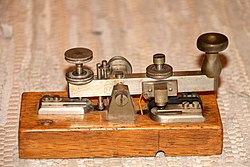
These modern "iambic" keys are operated by one or two "paddles" pressed left and right, instead of pressing down a lever, as in the traditional telegraph keys, pictured at the start of this article. Operating paddle keys is similar to using the old Vibroplex clockwork telegraph keys: Pressing the paddle to the right generates a series of repeated dits until the paddle is released; pressing the paddle to the left produces a similar series of dahs; and with two-paddle electronic keys, squeezing the two paddles from both sides produces an alternating dit dah dit dah sequence.
- ^ a b The semiautomatic key paddle, when pressed to the right by the thumb, kicks a clockwork-like horizontal pendulum that generates a series of dits, the length and timing of which are controlled by a sliding the pendulum weight toward the rear of the unit. When pressed to the left by the knuckle of the index finger, the paddle generates a single dah, the length of which is controlled by the operator. Multiple dahs require multiple presses. Left-handed operators may use a key built as a mirror image of this one.
- ^ The name continuous wave was chosen to distinguish the single-frequency transmission mode from the sliding-frequency damped wave signals from now-banned spark-gap transmitters. Although the modern ON / OFF signal itself is interrupted, not continuous, it does (ideally) maintain a single, constant frequency carrier wave throughout any one transmission.
- ^ For people with severe disabilities, both one- and two-switch Morse can be difficult because both depend, to some extent, on timing. ... access products can also offer "three-switch Morse.". In three-switch Morse code, one switch signals dit, while another signals dah, just like two-switch Morse. But a third switch is used to indicate that the letter is complete. This removes the necessity of timing to send Morse code. – D.K. Anson (2018)[49]
- ^ A well-known Morse code rhythm from the Second World War period derives from Beethoven's Fifth Symphony, the opening phrase of which was regularly played at the beginning of BBC broadcasts. The timing of the notes corresponds to the Morse for V, di di di dah ( ▄ ▄ ▄ ▄▄▄ ), promoted by prime minister Churchill as "'V' for Victory".[65][66]
- ^ a b When reporting bearings in degrees, minutes, and seconds of arc, the double quotation mark is never used; the symbol representing seconds is two apostrophes (
''). - ^ a b
The character or symbol encoding is not in either ITU-R M.1172[67] or ITU-R M.1677-1 .[2] - ^ a b c d e MN or OE, ▄▄▄ ▄▄▄ ▄▄▄ ▄ , which some telegraphers unofficially use for an exclamation mark [ ! ], is shared with unofficial letters Ö, Ó, and Ø used in some non-Latin alphabets.
- ^ a b c The well-established standard abbreviation for and is E S, adapted from the code for ampersand in Railroad Morse. The code for E S ( ▄ ▄ ▄ ▄ ) is actually slightly shorter in duration than the wait prosign ( ▄ ▄▄▄ ▄ ▄ ▄ ), so there is no motivative to replace it.
- ^ The underscore code is unofficial, so there is no prescription for using it. However, typically, when a whole word is meant to be underlined, the word begins with an underscore mark, followed by a letter space and the first letter of the word, and ends with the last letter of the word, followed by a letter space and another underscore mark. For example, read _MORSE_ as "Morse". Telegraphers may improvise other forms of use as needed (for example, for an underscore character embedded in a computer software keyword).
- ^ Single-line decoding display may use printed "+" for message separator prosign.
- ^ a b c Although not strictly a Latin alphabet character, the code for É is part of the ITU-R Morse code standard, and is the only accented character included in the recommendation.[2]
- ^ Heathkit was a popular, long-standing vendor of kits for amateur radio equipment.
- ^ The Phillips Code was a huge collection of abbreviations used on land line telegraphy.
References
[edit]- ^ Gotthard morse key used by shortwave radio amateur. qrz.com (photo image). user HB9BFM. Retrieved 25 September 2021.
- ^ a b c d e f g h i j k International Morse Code Recommendation. Radiocommunication Sector. itu.int (Report). ITU Recommendation. International Telecommunication Union. October 2009. ITU-R M.1677-1. Archived from the original on 6 November 2012. Retrieved 23 December 2011.
- ^ Beechey, F.S. (1876). Electro-Telegraphy. London, UK: E. & F.N. Spon. p. 71 – via Archive.org.
- ^ Camm, F.J. (1941). Radio Engineers' Pocket Book (2nd ed.). Chemical Publishing Co. p. 72 – via Archive.org.
- ^ Telegraph Regulations (PDF) (Report). ITU History. Geneva, CH: International Telecommunication Union. 1949 [1947]. p. 42.
the space between two words is equal to seven dots;
— Annexed to the International Telecommunication Convention, Atlantic City, 1947; revised Paris, 1949. - ^ a b Telegraph Regulations (PDF) (Report). ITU History. Geneva, CH: International Telecommunication Union. 1938 [1932]. p. 39.
The space between two words is equal to five dots.
— Annexed to the International Telecommunication Convention, Madrid, 1932; revised Cairo, 1938. - ^ a b TM 11-459. International Morse Code (Instructions). Washington, DC: Department of the Army / U.S. Government Printing Office. 1968. pp. 6–7.
- ^ Preece, W.H.; Sivewright, J. (1891). Telegraphy. London, UK: Longmans, Green, and Co. p. 40.
- ^ Signal Communication. Signal Corps. U.S. Army. 1939. pp. 83, 101–108, 227. FM 24-5.
- ^ Everitt, W.L. (1937). Communication Engineering (2nd ed.). New York, NY: McGraw-Hill. p. 6.
- ^ Smith, W.W.; Dawley, Ray L.; et al., eds. (1940). The "Radio" Handbook (7th ed.). Santa Barbara, CA: Editors and Engineers Ltd. p. 178. Retrieved 18 July 2022.
- ^ Instructions for Learning International Morse Characters. War Department. 1943. pp. 52, 68–72. TM 11-459.
- ^ Fahie, John Joseph (1884). A History of Electric Telegraphy, to the Year 1837 (PDF). E. & F.N. Spon. Archived (PDF) from the original on 15 July 2017. Retrieved 21 November 2017.
- ^ Engineer-in-Chief's Office (1938) [1919]. Elementary Principles of Telegraphy and Systems up to Morse Duplex (Report). Technical Pamphlets for Workmen. London, UK: His Majesty's Stationery Office. p. 6.
- ^ Freebody, J.W. (1959). "Historical survey of telegraphy". Telegraphy. London, UK: Sir Isaac Pitman & Sons, Ltd. pp. 28–29.
- ^ a b c d Annual Report of the Board of Regents of the Smithsonian Institution for the Year 1878 (Report). Washington, DC: Smithsonian Institution. 1879. pp. 358–360. Retrieved 17 March 2021 – via Archive.org.
- ^ a b c Burns, R.W. (2004). Communications: An international history of the formative years. Institution of Electrical Engineers. pp. 79, 84. ISBN 0-86341-327-7.
- ^ André Twigt and Henny de Boer (19 August 2025). "Materieel van toen: de seinsleutel". Materieelgezien (in Dutch). Defensie.nl.
- ^ "Learning Morse code". Arrl.org. Newington, CT: American Radio Relay League. Archived from the original on 20 September 2017. Retrieved 1 December 2017.
- ^ Carron, L. Peter (1986). Morse Code: The essential language. Radio amateur's library. Vol. 69. American Radio Relay League. ISBN 0-87259-035-6.
- ^ Eckersley, R.J., ed. (1985). Amateur Radio Operating Manual. Radio Society of Great Britain. ISBN 0-900612-69-X.
- ^ "Iddy-umpty". Oxford English Dictionary. Retrieved 22 October 2016.
- ^ a b
[No title cited] (Report) (in German). Deutsch-Österreichischer Telegraphenverein (German-Austrian Telegraph Union). 1851.
The Deutsch-Österreichischer Telegraphenverein officially adopted Gerke's redaction / revision of Morse code in 1851.
[full citation needed] - ^ Howeth, Linwood S. (1963). History of Communications-Electronics in the United States: Early Navy efforts to develop aircraft radio. For sale by the Superintendent of Documents, U. S. Govt. Print. Off.
- ^ "K2TQN vintage radio column". K2tqn.com (blog). Archived from the original on 11 September 2017. Retrieved 1 December 2017.
- ^ a b "How the Zeppelin raiders are guided by radio signals". Popular Science Monthly. April 1918. pp. 632–634. Retrieved 4 March 2018.
- ^ "An obituary for Morse code". The Economist. 23 January 1999. Archived from the original on 30 March 2017.
- ^ "Maritime Radio Historical Society". radiomarine.org. Archived from the original on 25 January 2018. Retrieved 1 December 2017.
- ^ "Morse code training in the Air Force". Swling.com. 10 December 2015. Archived from the original on 2 July 2017. Retrieved 1 December 2017.
- ^ "Amendments to the International Aeronautical and Maritime Search and Rescue (IAMSAR) Manual" (PDF). USCG.mil. 2011. Circ 1367, Amd. Retrieved 1 December 2017.
- ^ a b "Radiotelegraph Operator License (T)". fcc.gov. Federal Communications Commission. Archived from the original on 13 January 2015. Retrieved 21 January 2015.
- ^ "Maritime Radio Historical Society". radiomarine.org. Archived from the original on 9 October 2017. Retrieved 1 December 2017.
- ^ Perera, Tom. "The "Morse" code and the continental code". W1TP Telegraph & Scientific Instruments Museums. Archived from the original on 9 December 2011. Retrieved 23 December 2011.
- ^ a b Pierpont, William G. (13 May 2004) [2002]. The Art & Skill of Radio Telegraphy (PDF). Archived (PDF) from the original on 26 February 2012. Retrieved 14 June 2013 – via pcpractice.com.
- ^ "Extremely High Speed Club official web page". Morsecode.nl. Archived from the original on 28 June 2017. Retrieved 1 December 2017.
- ^ "COM 3.2" (PDF). Canadian AIM. 2003. Archived from the original (PDF) on 22 November 2013.
- ^ "rel 2003-07-03 att-2". IARU web (iaru.org) (Press release). The International Amateur Radio Union. Archived from the original on 6 September 2012.
- ^ "Italy joins no-code ranks as FCC revives Morse debate in the U.S." The ARRL Letter. Vol. 24, no. 31. 12 August 2005. Archived from the original on 5 November 2011. Retrieved 2 April 2012.
- ^ "Amendment of Part 97 of the Commission's Amateur Service Rules" (PDF). 1998 Biennial Regulatory Review. c. 2000. Archived from the original (PDF) on 31 October 2005. Retrieved 4 December 2005.
- ^ "A standard for Morse timing using the Farnsworth technique" (PDF). ARRL.org. Archived (PDF) from the original on 25 January 2018. Retrieved 1 December 2017.
- ^ "Custom Farnsworth spacing configuration". Winmorse.com. Archived from the original on 4 March 2016. Retrieved 21 November 2013.
- ^ "Chapter 1". Aeronautical Information Manual (AIM). U.S. Federal Aviation Administration. Archived from the original on 4 September 2009. Retrieved 10 December 2007.
- ^ "Prosigns". QTH.Com. Archived from the original on 24 September 2015. Retrieved 21 January 2015 – via QSL.net.
- ^ King, Thomas W. (2000). Modern Morse code in rehabilitation and education: New applications in assistive technology. Allyn & Bacon. ISBN 9780205287512. OCLC 41070880.
- ^ Lubin, Jim (2020). "Morse Codes for Computer Access".
- ^ Anson, Denis K. (2018). "Chapter 5. Input strategies: Morse strategies". Assitive Technology for People with Disabilies. ABC-CLIO. p. 74. ISBN 978-1-4408-3512-4.
- ^ "Morse Code". Ace Centre (UK ACC Charity). 2020.
- ^ "Android accessibility help: Use Morse code". Google support. 2018. Retrieved 21 December 2018.
- ^ Newell and, A.F.; Nabavi, C.D. (1969). "VOTEM: the voice operated typewriter employing Morse code". J. Phys. E: Sci. Instrum. 2 (8): 655–657. doi:10.1088/0022-3735/2/8/314. PMID 5807885.
- ^ Ross, Dennis W. (March 1992). "Morse code: A place in the mind". QST magazine. p. 51.
- ^ Curt, Ronald J. (July 1990). "In the blink of an eye". QST magazine. p. 44.
- ^ Burch, Donna (July 1990). "Morse code from the heart". QST magazine. p. 45.
- ^ NATO phonetic alphabet, codes & signals (PDF) (poster). Communications Services, Public Diplomacy Division. Brussels, Belgium: NATO Headquarters. 11 January 2018. Retrieved 24 August 2025 – via nato.int.
{{cite AV media}}: CS1 maint: url-status (link) - ^ Beauchamp, Ken (2001). History of Telegraphy. Institution of Electrical Engineers IET. p. 150. ISBN 0852967926.
- ^ a b c United States Code of Federal Regulations Title 47 §13.207(c), §13.209(d), §97.503 [1996]
- ^ "Fastest speed for a Morse code transmission". Guinnessworldrecords.com. Archived from the original on 3 July 2017. Retrieved 1 December 2017.
- ^ Koch, Ludwig (1936). Arbeitspsychologische Untersuchung der Tätigkeit bei der Aufnahme von Morsezeichen (Dissertation). Technische Hochschule Carolo-Wilhelmina. 10247-549-4.
- ^ "W1AW code practice schedule". ARRL (arrl.org). American Radio Relay League. Retrieved 3 June 2022.
- ^ "W1AW code practice MP3 files". ARRL (arrl.org). American Radio Relay League. Retrieved 25 September 2025.
- ^ Linton, Tanja (30 April 2015). "Fort Huachuca bids farewell to Morse code training". Army News Service (ARNEWS). United States Army. Retrieved 29 May 2021 – via army.mil/article.
- ^
Baden-Powell, Robert (1938). "Girl Guiding" (PDF). Pearson. p. 61. Archived (PDF) from the original on 6 October 2015. Retrieved 6 September 2015.
Some people find it easier to remember the [dots] and dashes by picturing them as forming the letters ...(page 61)
- ^ Stanley, Glenn (2000). The Cambridge Companion to Beethoven. Cambridge Companions to Music. Cambridge, UK: Cambridge University Press. p. 269. ISBN 0-521-58934-7.
- ^ Studwell, William Emmett (1997). The Americana Song Reader. Routledge. p. 62. ISBN 0-7890-0150-0.
- ^ Miscellaneous abbreviations and signals to be used for radiocommunications in the maritime mobile service. Radiocommunication Sector. ITU.int (Report). ITU Recommendation. Geneva, CH: International Telecommunication Union. ITU-R M.1172.
- ^ a b "International Morse code gets a new ITU home, new character". ARRL.org/news. Newington, CT: American Radio Relay League. 10 December 2003. Archived from the original on 30 September 2007. Retrieved 27 February 2007.
- ^ "Morse". homepages.cwi.nl/~dik. Codes. Archived from the original on 9 November 2010. Retrieved 19 May 2021.
- ^ Wythoff, Grant (July 2014). "The Invention of Wireless Cryptography". The Appendix: Futures of the Past. Vol. 2, no. 3. Archived from the original on 8 December 2014. Retrieved 28 January 2015.
- ^ "Fractionated Morse, and other oddities". Quadibloc.com. Crypto. Retrieved 21 November 2013.
- ^ "Welcome! - Reverse Beacon Network". Reversebeacon.net. Archived from the original on 12 September 2017. Retrieved 1 December 2017.
- ^ Ziegenhain, Gerolf (20 May 2013). "Morse decoder test – iPhone / iPad". Gerolfziegenhain.wordpress.com. Archived from the original on 27 July 2017. Retrieved 17 September 2016.
External links
[edit]
- "Morse code". Encyclopædia Britannica. 16 October 2023.
- "Morse code". Radio Amateur. Curlie.org. Recreation.
- "Morse Code resources". DXZone.com.
- "Morse code MP3 practice files". starling.us. — 200 hours of at increasing speeds plus an ASCII-to-CW file generator program.
- International Morse code, hand sending. YouTube (training film). U.S. Army. 1966. Archived at Ghostarchive and the Wayback Machine:
- Technique of hand sending. YouTube (training film). Morse code radio operator training. U.S. Navy. 1944. Archived from the original on 7 July 2012.
- "Codes of the World" (PDF). nonstopsystems.com.


| Early telecommunications | |
|---|---|
| ISO/IEC 8859 |
|
| Bibliographic use | |
| National standards | |
| ISO/IEC 2022 | |
| Mac OS Code pages ("scripts") | |
| DOS code pages | |
| IBM AIX code pages | |
| Windows code pages | |
| EBCDIC code pages | |
| DEC terminals (VTx) | |
| Platform specific |
|
| Unicode / ISO/IEC 10646 | |
| TeX typesetting system | |
| Miscellaneous code pages | |
| Control character | |
| Related topics | |
| International | |
|---|---|
| National | |
| Other | |

Morse code
View on GrokipediaHistory and Development
Origins in Early Telegraphs
Early optical telegraphs, such as semaphore systems, represented the first organized attempts at long-distance visual signaling. In 1792, French inventor Claude Chappe established a semaphore line between Paris and Lille using a series of towers spaced about 10 to 20 miles apart, where operators manually adjusted pivoting arms into various positions to encode letters and numbers, relayed via telescopes.[7] These systems transmitted messages faster than couriers on horseback—a dispatch from Paris to Lille took roughly 32 minutes—but were severely limited by their dependence on clear line-of-sight visibility, restricting operations to daylight hours and fair weather conditions like fog, rain, or snow that obscured signals.[8] Additionally, geographical barriers such as mountains or bodies of water prevented expansion, confining networks to linear routes and requiring extensive infrastructure of relay stations.[9] The quest for more reliable communication led to the invention of electrical telegraphs in the early 19th century. In 1816, British inventor Francis Ronalds constructed the first working electric telegraph in his garden in Hammersmith, London, spanning about 8 miles of wire insulated with pitch and connected to an electrostatic generator that produced pulses to move indicators on synchronized dials at each end.[10] Ronalds demonstrated instantaneous signal transmission over this distance, using a friction wheel to generate static electricity and paper tape to record messages, though his design was rejected by the British Admiralty as unnecessary given the prevalence of optical systems.[11] This electrostatic approach marked a shift from visual to electric signaling but remained experimental due to the complexity of maintaining charge over wires.[12] Building on such foundations, Charles Wheatstone and William Fothergill Cooke developed a practical electromagnetic telegraph in 1837, patented as a five-needle instrument that used electromagnets to deflect needles on a diamond-shaped board toward letters of the alphabet.[13] The system operated by sending current pulses through wires to activate specific needles, allowing operators to spell out messages by pointing to characters, and was first installed along a 2-kilometer railway line between Paddington and West Drayton in London.[14] Later refinements reduced the number of needles to two or one, simplifying installation while retaining the deflection mechanism for signaling.[15] These step-by-step needle telegraphs enabled commercial use, particularly for railway signaling, by providing a visual readout without requiring auditory interpretation.[16] Early codes for these electrical systems, such as the Wheatstone ABC code introduced in the 1840s for single-needle instruments, relied on sequences of needle deflections to represent letters, where left or right movements in combinations (e.g., one left for A, one right for B) encoded the alphabet without directly pointing to it.[17] This binary-like deflection system, akin to a simplified Baconian cipher, allowed for compact transmission using minimal wires but demanded operator familiarity with the codebook to decode rapid sequences.[18] Unlike optical semaphores' positional codes, these electrical variants prioritized electrical efficiency over visual clarity, though they still faced issues with ambiguous signals in noisy environments. Without standardized codes, long-distance electrical transmission posed significant challenges, including signal distortion from wire resistance and capacitance, which weakened pulses and caused fading or overlap over distances beyond a few miles.[19] Early setups required frequent relays or boosters to maintain intelligibility, as uninsulated or poorly grounded wires led to electrostatic interference and inconsistent deflections, complicating message accuracy across networks.[20] These limitations in reliability and scalability for extended lines underscored the need for more robust, code-efficient systems. Samuel Morse's independent development in the 1830s addressed many of these issues by introducing a simpler, audible signaling method.[21]Invention by Morse and Vail
Samuel F. B. Morse, a renowned portrait painter, conceived the idea for an electromagnetic telegraph during his return voyage from Europe in 1832, inspired by discussions on electromagnetism with fellow passenger Charles Thomas Jackson, who demonstrated principles involving electromagnets.[22] This spark of inspiration came after Morse had spent several years in Europe studying art, during which he was exposed to emerging scientific lectures and experiments in the 1820s that heightened his interest in electricity.[23] Over the next five years, Morse, with assistance from physicist Leonard Gale, iteratively developed a working model using rudimentary components like homemade batteries and clockwork mechanisms, addressing key challenges such as signal relay to extend transmission distance.[24] By late 1837, Morse had refined the system sufficiently to apply for a U.S. patent and seek federal funding for a demonstration line, culminating in his first public exhibition of the electromagnetic telegraph in New York in January 1838.[22] In September 1837, Alfred Vail, a recent graduate and skilled machinist from New York University, joined Morse after witnessing an early demonstration and offered his father's ironworks facilities for further development.[2] Vail's pivotal contributions included mechanizing the transmitter and receiver, as well as devising the dot-dash signaling system that replaced Morse's initial numerical code, which assigned sequences of up to five pulses (represented as dots or dashes) to numbers 1 through 5, with letters then mapped to those numbers via a reference dictionary.[2] This original 1838 code table streamlined encoding by using shorter combinations for frequent letters like E (one dot) and T (one dash), while the receiver electromagnetically marked graphical dots and dashes on a moving paper tape for visual decoding, eliminating the need for constant operator attendance.[22] Working at the Speedwell Ironworks in Morristown, New Jersey, Vail and Morse tested the apparatus over increasingly longer wires, successfully transmitting messages up to over two miles by early 1838, validating the system's practicality.[2][25] The invention reached its public milestone on May 24, 1844, when Morse transmitted the first official telegraph message from the U.S. Capitol in Washington, D.C., to Vail in Baltimore, Maryland, over a 40-mile line funded by Congress.[22] The message, "What hath God wrought," drawn from the Bible (Numbers 23:23) and suggested by Annie Ellsworth, daughter of a patent office commissioner, marked the telegraph's debut and heralded instantaneous long-distance communication.[26] This event, conducted from the Supreme Court chamber, demonstrated the code's efficacy in real-world use and paved the way for commercial expansion.[27]Transition to Audible Code
The initial Morse telegraph system utilized a mechanical register where an electromagnet actuated a stylus to imprint dots and dashes onto a paper tape advanced by a clockwork motor, requiring operators to visually interpret the markings after each transmission. This graphical method, first demonstrated on the 1844 Washington-to-Baltimore line, proved cumbersome, as deciphering the tape was time-consuming and vulnerable to errors from smudged impressions or mechanical failures.[22] During the 1840s, telegraph operators pioneered a shift to audible reception by training themselves to recognize the rhythmic clicking sounds emitted by the receiver's electromagnet during signal pulses, allowing messages to be transcribed in real time without paper records. As early as 1845, proficient operators could identify most letters aurally from these clicks on the original recording apparatus, marking the onset of this efficiency-driven innovation. By 1846, widespread use among regular operators had emerged, despite initial resistance in some offices.[28] Alfred Vail significantly advanced audible reception by incorporating it into demonstrations of the telegraph system and standardizing its application in early commercial offices, where he served as one of the first operators alongside Morse. His efforts helped transition the technology from experimental setups to practical, operator-led communication.[29] This evolution to audible code yielded key advantages, boosting effective speeds from approximately 10 words per minute in early visual decoding to over 30 words per minute for trained listeners by the 1850s, while eliminating the need for paper supplies and simplifying equipment maintenance.[28] Among the early hurdles were the demands of operator training to differentiate short dot clicks from longer dash sounds amid varying signal qualities, prompting refinements in tone duration consistency to reduce confusions between similar characters like "I," "O," and "EE."[28]Refinements by Gerke and Others
In 1848, Friedrich Clemens Gerke, a German telegraph operator and pioneer, introduced significant refinements to the original American Morse code to better suit European languages and improve transmission efficiency over landlines. His version, often called the German Morse code, simplified the system by eliminating variable-length dashes and internal spaces within characters, reducing the complexity that made the American code prone to errors in noisy environments. Gerke shortened codes for frequently used letters, assigning the briefest sequences to high-frequency characters in German and other continental languages, such as reconfiguring patterns to minimize total strokes—for instance, optimizing the representation of vowels and consonants common in European texts—while adding symbols for accented letters like Ä, Ö, and Ü. This resulted in nearly half the alphabet being revised, making transmissions faster and more reliable compared to the original American Morse, which retained longer, more varied elements suited to early paper-tape recorders.[30][31][32] Gerke's code was first implemented on the telegraph line between Hamburg and Cuxhaven in 1848, marking Europe's initial adoption of Morse-based signaling. By 1851, it had gained widespread acceptance in continental Europe, particularly after the Austro-German Telegraph Union standardized a version for cross-border communications, highlighting its advantages in efficiency with fewer average strokes per character—often 20-30% shorter than American equivalents for common words. This European variant diverged notably from American Morse, which continued in use primarily for domestic railroad and landline telegraphy in the United States, where its rhythmic patterns aided operators listening to mechanical sounders. Gerke's adjustments emphasized uniformity in dot and dash durations, facilitating the shift toward audible reception that enhanced operator speed.[33][31][34] The path to global standardization began with the 1851 International Telegraph Conference in Berlin, where delegates adopted a modified form of Gerke's code as the foundation for international use, incorporating minor tweaks to align with multiple languages. Further refinements occurred in the 1860s, including expanded punctuation marks (such as periods and commas) and revised numeral encodings to reduce ambiguity in commercial messages. These changes culminated in 1865 at the founding congress of the International Telegraph Union in Paris, where the code was formally ratified as International Morse Code, distinct from American Morse and optimized for worldwide telegraph networks. This version prioritized brevity and clarity, enabling faster intercontinental exchanges and solidifying its role in global communication until the late 20th century.[34][31][35]Expansion into Radio and Maritime Use
In the late 1890s, Guglielmo Marconi pioneered the adaptation of Morse code for wireless telegraphy, transmitting signals via radio waves over increasing distances.[36] By 1901, Marconi achieved the first transatlantic wireless transmission, receiving the Morse code letter "S"—represented by three dots—from his station in Poldhu, Cornwall, to St. John's, Newfoundland.[37] This breakthrough extended Morse code beyond land-based wires, enabling long-distance communication without physical connections and laying the foundation for global radiotelegraphy.[38] Maritime adoption accelerated in the early 20th century, driven by international efforts to standardize wireless use on ships. The 1903 Preliminary Conference on Wireless Telegraphy in Berlin established principles for radiotelegraph regulations, leading to the 1906 International Radiotelegraph Convention, which mandated intercommunication between ships and shore stations using Morse code.[39] This framework required large passenger and cargo vessels to equip wireless installations, enhancing safety at sea. The 1912 Titanic disaster underscored Morse code's critical role, as operators Jack Phillips and Harold Bride transmitted the newly adopted SOS prosign—a continuous sequence of three dots, three dashes, and three dots—alerting nearby vessels like the Carpathia to the sinking, though initial calls also used the older CQD signal.[40] The event prompted stricter enforcement of wireless regulations worldwide.[39] Post-World War I, Morse code integrated into aviation for radio telegraphs aiding aircraft navigation and communication. In the 1920s, the U.S. federal government deployed radio ranges along airways, where stations broadcast directional Morse code signals—such as "A" (dot-dash) for one quadrant and "N" (dash-dot) for the adjacent—to guide pilots.[41] These systems, precursors to modern aids, served as backups to visual beacons and voice radio, with international standards under the International Commission for Air Navigation (ICAN) promoting Morse in beacons by the late 1920s.[42] Radiotelegraphy expanded commercially in the 1910s-1930s through networks like those operated by the Marconi Company, facilitating transoceanic press and business messages, while military forces in World War I and II relied on it for secure, long-range tactical signaling, including submarine and aircraft operations.[43][44] Complementing radio, visual flash telegraphy emerged for maritime use, employing Morse code patterns via intense light signals. Invented by Arthur Cyril Webb Aldis around 1909, the Aldis lamp—a powerful, shuttered spotlight—allowed ships to communicate optically over several miles in clear weather, transmitting dots and dashes by brief flashes for identification, distress, or coordination when radio was unavailable or jammed.[45] This method proved vital in naval and merchant fleets during the world wars, maintaining signaling reliability in electromagnetic silence.[45]Decline of Commercial Telegraphy
The invention of the telephone in 1876 by Alexander Graham Bell introduced a direct competitor to the telegraph, offering real-time voice communication that gradually eroded demand for Morse code-based messaging, particularly for short-distance and personal exchanges.[20] By the 1890s, advancements in long-distance telephony further intensified this rivalry, with telegraph traffic beginning a steady decline as telephones proved faster and more convenient for many commercial applications.[46] Although the telegraph reached its peak expansion during the radio and maritime eras in the early 20th century, the telephone's widespread adoption had already reduced overall demand by more than half in key markets by the 1930s.[20] In the 1920s, the introduction of teletypewriters, using variations of the Baudot code for automated printing, accelerated the replacement of manual Morse operators, as these machines allowed typists to transmit text at higher speeds without specialized code training.[47] By the 1930s, services like AT&T's Teletypewriter Exchange (TWX), launched in 1931, further diminished the need for Morse code in business communications, shifting traffic to printed telegrams and reducing operator roles significantly.[20] Post-World War II, automation intensified with the adoption of Baudot-based systems and emerging digital technologies, such as early facsimile and computer-assisted transmission, which eliminated the reliance on skilled Morse operators and contributed to a sharp drop in telegraph messages from a 1945 peak of 236 million to under 70 million by 1970.[20] Regulatory changes in the late 20th century marked the formal end of mandatory Morse use in commercial sectors. The International Maritime Organization (IMO) phased out the Morse code requirement for maritime radio operations on February 1, 1999, under the Global Maritime Distress and Safety System (GMDSS), replacing it with satellite and digital alternatives.[48] In the United States, the final commercial Morse code transmission occurred on July 12, 1999, from station KFS, signaling the close of an era for maritime and coastal telegraphy.[49] Western Union, once the dominant telegraph provider, discontinued all telegram services on January 27, 2006, fully pivoting to financial transfers amid the rise of email and fax.[50] In aviation, the Federal Aviation Administration (FAA) reduced reliance on Morse code for navigation aids in the 2000s, with pilots no longer required to demonstrate proficiency for licensing as digital GPS systems supplanted traditional radio beacons.[51] Despite these developments, Morse code did not vanish entirely but shifted to niche and emergency roles, persisting in amateur radio, military signaling, and as a backup protocol where digital systems might fail, underscoring its enduring legacy in communication history.[19]International Morse Code Standard
Character Encoding and Structure
International Morse Code encodes characters using sequences of short signals, known as dots or "dits," and long signals, known as dashes or "dahs," which function as binary-like elements to represent letters, numbers, and symbols.[1] These sequences follow specific rules for transmission: elements within a character are separated by a brief pause equivalent to one dot duration, characters within a word are separated by a pause of three dot durations, and words are separated by a longer pause of seven dot durations.[1] This structure ensures unambiguous decoding during real-time transmission.[1] The assignment of code lengths is based on the frequency of letters in English text, a principle developed by Alfred Vail during the code's refinement in the 1830s, where more common letters receive shorter sequences to minimize overall transmission time.[29] For example, the letter E, the most frequent in English, is represented by a single dot (.), while rarer letters like Z receive longer sequences such as --..[52] This frequency-optimized design, confirmed in the International Telecommunication Union (ITU) standard, enhances efficiency by reducing the average length of messages.[1] The ITU standard also provides specific codes for some accented letters, such as É (..-..), and additional procedural signals (prosigns). The full encoding for the 26 Latin letters A-Z, as standardized by the ITU, is presented below:| Letter | Code | Letter | Code |
|---|---|---|---|
| A | .- | N | -. |
| B | -... | O | --- |
| C | -.-. | P | .--. |
| D | -.. | Q | --.- |
| E | . | R | .-. |
| F | ..-. | S | ... |
| G | --. | T | - |
| H | .... | U | ..- |
| I | .. | V | ...- |
| J | .--- | W | .-- |
| K | -.- | X | -..- |
| L | .-.. | Y | -.-- |
| M | -- | Z | --.. |
| Number | Code |
|---|---|
| 0 | ----- |
| 1 | .---- |
| 2 | ..--- |
| 3 | ...-- |
| 4 | ....- |
| 5 | ..... |
| 6 | -.... |
| 7 | --... |
| 8 | ---.. |
| 9 | ----. |