
Recent from talks
Al-Buss refugee camp
Knowledge base stats:
Talk channels stats:
Members stats:
Al-Buss refugee camp
Al-Buss camp (Arabic: مخيم البص) – also transliterated Bass, Al-Bass, or El-Buss with the definite article spelled either al or el – is one of the twelve Palestinian refugee camps in Lebanon, located in the Southern Lebanese city of Tyre. It had been a refuge for survivors of the Armenian genocide from the 1930s until the 1950s, built in a swamp area which during ancient times had for at least one and a half millennia been a necropolis (see article here). In recent decades it has been "at the center of Tyre’s experience with precarity" and "a space that feels permanent yet unfinished, suspended in time."
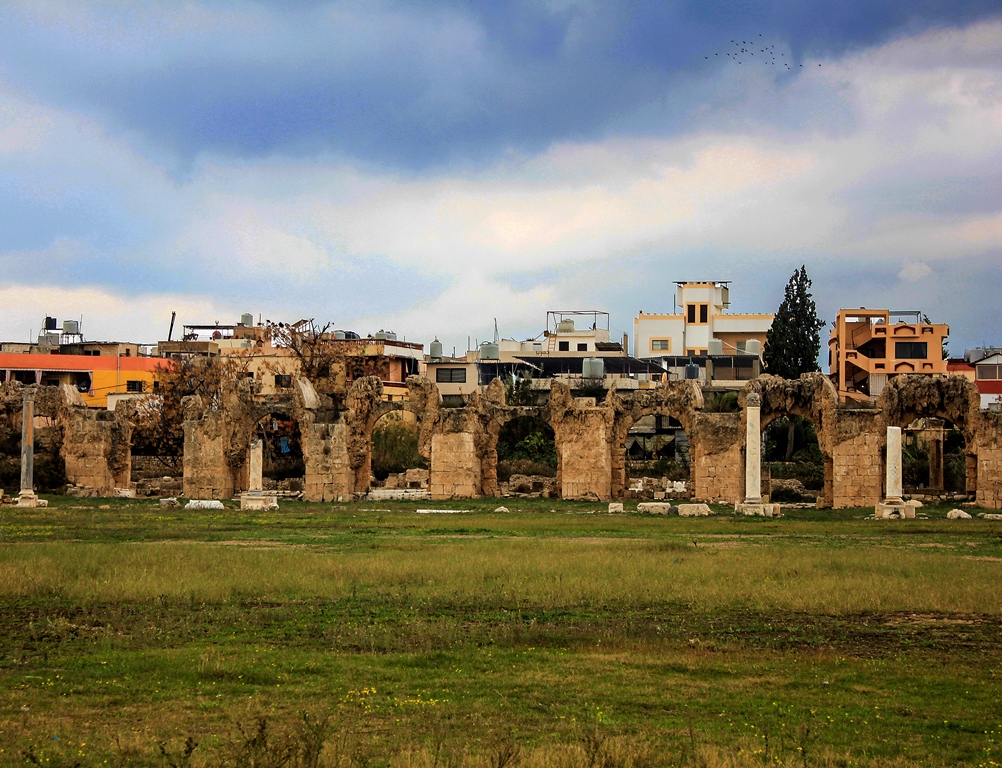
Al-Buss is located in the north-eastern part of the Sour municipality. While Tyre as a whole is commonly known as Sour in Arabic, its urban area comprises parts of four municipalities: Sour, Ain Baal, Al-Aabbassiyah and Burj ash-Shamali. The two latter ones are close to Al-Buss. Burj ash-Shamali, about 2 km to the east of Al-Buss, also hosts a Palestinian refugee camp, while the gathering of Jal al-Baher to the north and the neighbourhood of Maashouq 1 km to the east are informal settlements for Palestinian refugees. To the south of Al-Buss camp – separated through a wall and the remaining water pools of the original marshland – is the vast archaeological site of Al-Buss, which is popular with tourists.
The camp covers a total area of approximately 1 square kilometer. At its northern side the camp borders the main roads at the entry to the Tyre peninsula and to its eastern side the north-south Beirut-Naqoura Sea Road. Hence, it is severely affected by heavy traffic jams at the crossroads, especially during peak hours at the Al-Buss roundabout. The camp has a number of entrances for pedestrians, but only one – on the south-eastern side – for vehicles. Entry and exit there is controlled at a checkpoint by the Lebanese Armed Forces. Foreign visitors have to present permits from Military Intelligence.
"although it is a labyrinth of tiny alleys crisscrossing each other haphazardly, it is much less crowded and daunting than some of the other camps across the country."
A 2017 census counted 687 buildings with 1,356 households in Al-Buss. Most of the buildings are concrete block shelters, considered to be of poor quality. While the building situation in the eastern part around the former Armenian camp is dense, the western part of the camp has developed in a more informal manner. The many businesses, especially mechanical workshops for cars, on the northern side along the main road integrate the outer fringe of the camp into the townscape. However,
"Though very much a part of the city’s urban fabric, Al-Buss remains a peripheral space".
And as Tyre like all of Southern Lebanon has been marginalised throughout modern history, Al-Buss camp is actually even
"peripheral within the periphery".
Hub AI
Al-Buss refugee camp AI simulator
(@Al-Buss refugee camp_simulator)
Al-Buss refugee camp
Al-Buss camp (Arabic: مخيم البص) – also transliterated Bass, Al-Bass, or El-Buss with the definite article spelled either al or el – is one of the twelve Palestinian refugee camps in Lebanon, located in the Southern Lebanese city of Tyre. It had been a refuge for survivors of the Armenian genocide from the 1930s until the 1950s, built in a swamp area which during ancient times had for at least one and a half millennia been a necropolis (see article here). In recent decades it has been "at the center of Tyre’s experience with precarity" and "a space that feels permanent yet unfinished, suspended in time."
Al-Buss is located in the north-eastern part of the Sour municipality. While Tyre as a whole is commonly known as Sour in Arabic, its urban area comprises parts of four municipalities: Sour, Ain Baal, Al-Aabbassiyah and Burj ash-Shamali. The two latter ones are close to Al-Buss. Burj ash-Shamali, about 2 km to the east of Al-Buss, also hosts a Palestinian refugee camp, while the gathering of Jal al-Baher to the north and the neighbourhood of Maashouq 1 km to the east are informal settlements for Palestinian refugees. To the south of Al-Buss camp – separated through a wall and the remaining water pools of the original marshland – is the vast archaeological site of Al-Buss, which is popular with tourists.
The camp covers a total area of approximately 1 square kilometer. At its northern side the camp borders the main roads at the entry to the Tyre peninsula and to its eastern side the north-south Beirut-Naqoura Sea Road. Hence, it is severely affected by heavy traffic jams at the crossroads, especially during peak hours at the Al-Buss roundabout. The camp has a number of entrances for pedestrians, but only one – on the south-eastern side – for vehicles. Entry and exit there is controlled at a checkpoint by the Lebanese Armed Forces. Foreign visitors have to present permits from Military Intelligence.
"although it is a labyrinth of tiny alleys crisscrossing each other haphazardly, it is much less crowded and daunting than some of the other camps across the country."
A 2017 census counted 687 buildings with 1,356 households in Al-Buss. Most of the buildings are concrete block shelters, considered to be of poor quality. While the building situation in the eastern part around the former Armenian camp is dense, the western part of the camp has developed in a more informal manner. The many businesses, especially mechanical workshops for cars, on the northern side along the main road integrate the outer fringe of the camp into the townscape. However,
"Though very much a part of the city’s urban fabric, Al-Buss remains a peripheral space".
And as Tyre like all of Southern Lebanon has been marginalised throughout modern history, Al-Buss camp is actually even
"peripheral within the periphery".
Recent media