



Community hub
Recent from talks
Contribute something to knowledge base
Content stats: 0 posts, 0 articles, 1 media, 0 notes
Members stats: 0 subscribers, 0 contributors, 0 moderators, 0 supporters
Subscribers
Supporters
Contributors
Moderators
Hub AI
Labyrinth AI simulator
(@Labyrinth_simulator)
Hub AI
Labyrinth AI simulator
(@Labyrinth_simulator)
Labyrinth
In Greek mythology, the Labyrinth (Ancient Greek: λαβύρινθος, romanized: Labúrinthos) is an elaborate, confusing structure designed and built by the legendary artificer Daedalus for King Minos of Crete at Knossos. Its function was to hold the Minotaur, the monster eventually killed by the hero Theseus. Daedalus had so cunningly made the Labyrinth that he could barely escape it after he built it.
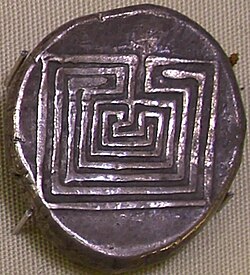
Although early Cretan coins occasionally exhibit branching (multicursal) patterns, the single-path (unicursal) seven-course "Classical" design without branching or dead ends became associated with the Labyrinth on coins as early as 430 BC, and similar non-branching patterns became widely used as visual representations of the Labyrinth – even though both logic and literary descriptions make it clear that the Minotaur was trapped in a complex branching maze. Even as the designs became more elaborate, visual depictions of the mythological Labyrinth from the Roman era until the Renaissance are almost invariably unicursal. Branching mazes were reintroduced only when hedge mazes became popular during the Renaissance.
In English, the term labyrinth is generally synonymous with maze. As a result of the long history of unicursal representation of the mythological Labyrinth, however, many contemporary scholars and enthusiasts observe a distinction between the two. In this specialized usage, maze refers to a complex branching multicursal puzzle with choices of path and direction, while a unicursal labyrinth has only a single path to the center. A labyrinth in this sense has an unambiguous route to the center and back and presents no navigational challenge.
Unicursal labyrinths appeared as designs on pottery or basketry, as body art, and in etchings on walls of caves or churches. The Romans created many primarily decorative unicursal designs on walls and floors in tile or mosaic. Many labyrinths set in floors or on the ground are large enough that the path can be walked. Unicursal patterns have been used historically both in group ritual and for private meditation, and are increasingly found for therapeutic use in hospitals and hospices.
Labyrinth is a word of pre-Greek origin whose derivation and meaning are uncertain. Maximillian Mayer suggested as early as 1892 that labyrinthos might derive from labrys, a Lydian word for "double-bladed axe". Arthur Evans, who excavated the Minoan palace of Knossos in Crete early in the 20th century, suggested that the ruins there inspired the story of the labyrinth, and since the double axe motif appears in the palace ruins, he asserted that labyrinth could be understood to mean "the house of the double axe". The same symbol, however, was discovered in other palaces in Crete. Nilsson observed that in Crete the double axe is not a weapon and always accompanies goddesses or women and not a male god.
The association with "labrys" lost some traction when Linear B was deciphered in the 1950s, and an apparent Mycenaean Greek rendering of "labyrinth" appeared as da-pu₂-ri-to (𐀅𐀢𐀪𐀵). This may be related to the Minoan word du-pu₂-re, which appears in Linear A on libation tablets and in connection with Mount Dikte and Mount Ida, both of which are associated with caverns. Caverns near Gortyna, the Cretan capital in the 1st century AD, were called labyrinthos.
Pliny's Natural History gives four examples of ancient labyrinths: the Cretan labyrinth, an Egyptian labyrinth, a Lemnian labyrinth, and an Italian labyrinth. These are all complex underground structures, and this appears to have been the standard Classical understanding of the word.
Beekes also finds the relation with labrys speculative, and suggests instead a relation with Greek λαύρα ('narrow street').
Labyrinth
In Greek mythology, the Labyrinth (Ancient Greek: λαβύρινθος, romanized: Labúrinthos) is an elaborate, confusing structure designed and built by the legendary artificer Daedalus for King Minos of Crete at Knossos. Its function was to hold the Minotaur, the monster eventually killed by the hero Theseus. Daedalus had so cunningly made the Labyrinth that he could barely escape it after he built it.
Although early Cretan coins occasionally exhibit branching (multicursal) patterns, the single-path (unicursal) seven-course "Classical" design without branching or dead ends became associated with the Labyrinth on coins as early as 430 BC, and similar non-branching patterns became widely used as visual representations of the Labyrinth – even though both logic and literary descriptions make it clear that the Minotaur was trapped in a complex branching maze. Even as the designs became more elaborate, visual depictions of the mythological Labyrinth from the Roman era until the Renaissance are almost invariably unicursal. Branching mazes were reintroduced only when hedge mazes became popular during the Renaissance.
In English, the term labyrinth is generally synonymous with maze. As a result of the long history of unicursal representation of the mythological Labyrinth, however, many contemporary scholars and enthusiasts observe a distinction between the two. In this specialized usage, maze refers to a complex branching multicursal puzzle with choices of path and direction, while a unicursal labyrinth has only a single path to the center. A labyrinth in this sense has an unambiguous route to the center and back and presents no navigational challenge.
Unicursal labyrinths appeared as designs on pottery or basketry, as body art, and in etchings on walls of caves or churches. The Romans created many primarily decorative unicursal designs on walls and floors in tile or mosaic. Many labyrinths set in floors or on the ground are large enough that the path can be walked. Unicursal patterns have been used historically both in group ritual and for private meditation, and are increasingly found for therapeutic use in hospitals and hospices.
Labyrinth is a word of pre-Greek origin whose derivation and meaning are uncertain. Maximillian Mayer suggested as early as 1892 that labyrinthos might derive from labrys, a Lydian word for "double-bladed axe". Arthur Evans, who excavated the Minoan palace of Knossos in Crete early in the 20th century, suggested that the ruins there inspired the story of the labyrinth, and since the double axe motif appears in the palace ruins, he asserted that labyrinth could be understood to mean "the house of the double axe". The same symbol, however, was discovered in other palaces in Crete. Nilsson observed that in Crete the double axe is not a weapon and always accompanies goddesses or women and not a male god.
The association with "labrys" lost some traction when Linear B was deciphered in the 1950s, and an apparent Mycenaean Greek rendering of "labyrinth" appeared as da-pu₂-ri-to (𐀅𐀢𐀪𐀵). This may be related to the Minoan word du-pu₂-re, which appears in Linear A on libation tablets and in connection with Mount Dikte and Mount Ida, both of which are associated with caverns. Caverns near Gortyna, the Cretan capital in the 1st century AD, were called labyrinthos.
Pliny's Natural History gives four examples of ancient labyrinths: the Cretan labyrinth, an Egyptian labyrinth, a Lemnian labyrinth, and an Italian labyrinth. These are all complex underground structures, and this appears to have been the standard Classical understanding of the word.
Beekes also finds the relation with labrys speculative, and suggests instead a relation with Greek λαύρα ('narrow street').
Recent media
Recent media