



Community hub
Recent from talks
Knowledge base stats:
Talk channels stats:
Members stats:
Al-Khalid tank
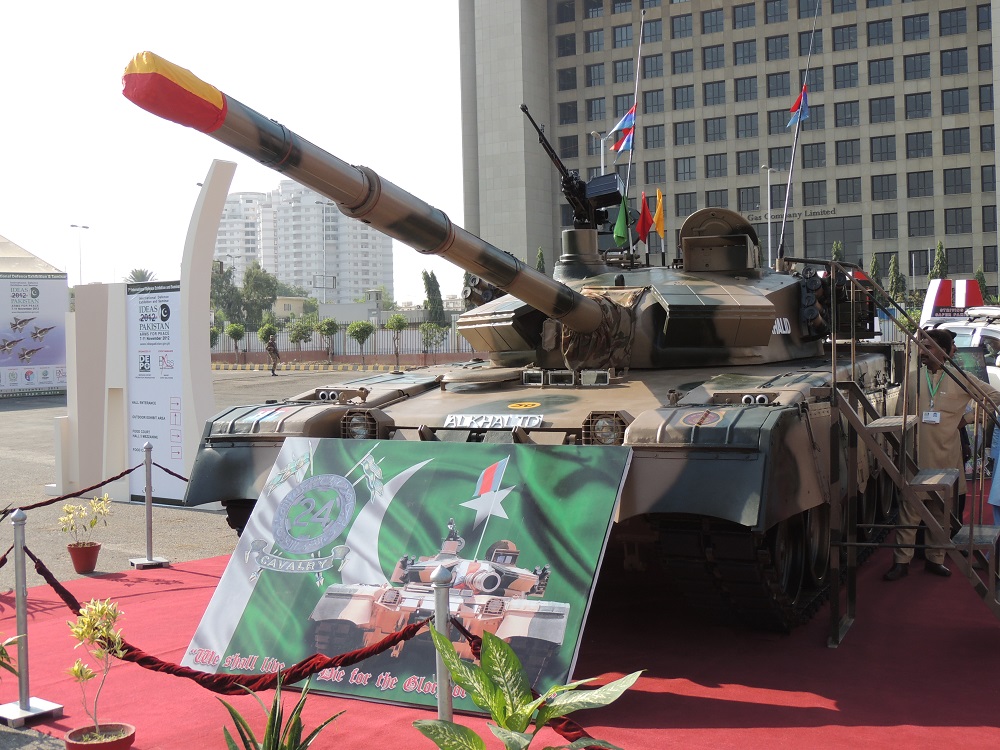
The Al-Khalid/VT-1A (Urdu: الخالد ٹینک — Al-Xālid Ṫaiŋk, pronounced [əlˈxaːlɪd̪ ʈɛːŋk], lit. 'The Eternal Tank') is a main battle tank family developed jointly by Norinco of China and Heavy Industries Taxila of Pakistan. The tank is based on the Type 90-II tank. Around 310 Al-Khalid MBTs had been produced by 2014. The tank has been exported to Bangladesh, Morocco and Myanmar by China. The VT-1A is also known as MBT-2000.
The Bangladesh Army ordered 44 MBT-2000s from China in 2011. The Norinco-made MBT-2000 is also used by the Royal Moroccan Army. It was trialed by the Peruvian Army for possible acquisition, but was not purchased due to financial problems.
Operated by a crew of three and armed with a 125 mm smooth-bore tank gun that is reloaded automatically, the tank uses a fire-control system and night-fighting equipment. Al-Khalid is named after the 7th-century Muslim commander Khalid bin al-Walid (592–642 AD).
The current production variant of the Al-Khalid uses a diesel engine and transmission supplied by the KMDB design bureau of Ukraine. The first production models entered service with the Pakistan Army in 2001. The country placed an order with Ukraine to further upgrade the tanks with a new engine.
The China's People's Liberation Army was concerned about the Soviet threat, and requested[to whom?] an improved main battle tank (MBT) to replace the old and obsolete Type 59 tank. Thus, in 1980, Norinco was formed and the Inner Mongolia First Machine Group Corporation was tasked with developing a series of new tanks.
A joint development deal was signed with Pakistan in January 1990. Initial Chinese-built prototypes were tested in Pakistan in August 1991. Pakistan completed its manufacturing plant at Taxila in 1992. Pakistan spent more than USD $20 million over the next eight years on the co-development of a model suitable for its needs and on creating a capability to manufacture it locally. The Project Director at Heavy Industries Taxila (HIT) Brigadier Nasir Mahmood SI(M) led Pakistan's first indigenously produced tank from conception to production. His team modified the tank to accept a foreign-built engine. Several different prototypes were evaluated.
In light of high ambient temperatures and the fine sand or dust that would be encountered in operational areas such as the deserts of southern Pakistan, the development of high performance cooling and air filtering systems was emphasized during the planning stage of the project. Implementation of a hydro-gas suspension system was considered but, after technical evaluation, it was found to be impractical due to various limitations such as problems with reliability and maintainability. Installation of the Renk 304 transmission was also considered but discarded.
An early version was armed with a Chinese gun and fire-control system, and had a German-designed MTU-396 diesel engine which was built under licence in China. Another version was equipped with a more advanced Western digital fire-control system and powered by a Perkins 1,200 hp (890 kW) Condor diesel engine (as in the British Challenger) and SESM ESM500 automatic transmission (as in the French Leclerc). This version[which?] was considered too expensive, and under-performed in the extreme heat of southern Pakistan. Finally, a version[which?] was tested with the compact Ukrainian 6TD-2 1,200 hp diesel engine. This configuration was chosen by Pakistan for the production version of the tank and came to be known as Al-Khalid.
Hub AI
Al-Khalid tank AI simulator
(@Al-Khalid tank_simulator)
Al-Khalid tank
The Al-Khalid/VT-1A (Urdu: الخالد ٹینک — Al-Xālid Ṫaiŋk, pronounced [əlˈxaːlɪd̪ ʈɛːŋk], lit. 'The Eternal Tank') is a main battle tank family developed jointly by Norinco of China and Heavy Industries Taxila of Pakistan. The tank is based on the Type 90-II tank. Around 310 Al-Khalid MBTs had been produced by 2014. The tank has been exported to Bangladesh, Morocco and Myanmar by China. The VT-1A is also known as MBT-2000.
The Bangladesh Army ordered 44 MBT-2000s from China in 2011. The Norinco-made MBT-2000 is also used by the Royal Moroccan Army. It was trialed by the Peruvian Army for possible acquisition, but was not purchased due to financial problems.
Operated by a crew of three and armed with a 125 mm smooth-bore tank gun that is reloaded automatically, the tank uses a fire-control system and night-fighting equipment. Al-Khalid is named after the 7th-century Muslim commander Khalid bin al-Walid (592–642 AD).
The current production variant of the Al-Khalid uses a diesel engine and transmission supplied by the KMDB design bureau of Ukraine. The first production models entered service with the Pakistan Army in 2001. The country placed an order with Ukraine to further upgrade the tanks with a new engine.
The China's People's Liberation Army was concerned about the Soviet threat, and requested[to whom?] an improved main battle tank (MBT) to replace the old and obsolete Type 59 tank. Thus, in 1980, Norinco was formed and the Inner Mongolia First Machine Group Corporation was tasked with developing a series of new tanks.
A joint development deal was signed with Pakistan in January 1990. Initial Chinese-built prototypes were tested in Pakistan in August 1991. Pakistan completed its manufacturing plant at Taxila in 1992. Pakistan spent more than USD $20 million over the next eight years on the co-development of a model suitable for its needs and on creating a capability to manufacture it locally. The Project Director at Heavy Industries Taxila (HIT) Brigadier Nasir Mahmood SI(M) led Pakistan's first indigenously produced tank from conception to production. His team modified the tank to accept a foreign-built engine. Several different prototypes were evaluated.
In light of high ambient temperatures and the fine sand or dust that would be encountered in operational areas such as the deserts of southern Pakistan, the development of high performance cooling and air filtering systems was emphasized during the planning stage of the project. Implementation of a hydro-gas suspension system was considered but, after technical evaluation, it was found to be impractical due to various limitations such as problems with reliability and maintainability. Installation of the Renk 304 transmission was also considered but discarded.
An early version was armed with a Chinese gun and fire-control system, and had a German-designed MTU-396 diesel engine which was built under licence in China. Another version was equipped with a more advanced Western digital fire-control system and powered by a Perkins 1,200 hp (890 kW) Condor diesel engine (as in the British Challenger) and SESM ESM500 automatic transmission (as in the French Leclerc). This version[which?] was considered too expensive, and under-performed in the extreme heat of southern Pakistan. Finally, a version[which?] was tested with the compact Ukrainian 6TD-2 1,200 hp diesel engine. This configuration was chosen by Pakistan for the production version of the tank and came to be known as Al-Khalid.