


Community hub
Recent from talks
Contribute something to knowledge base
Content stats: 0 posts, 0 articles, 1 media, 0 notes
Members stats: 0 subscribers, 0 contributors, 0 moderators, 0 supporters
Subscribers
Supporters
Contributors
Moderators
Hub AI
Alam Lohar AI simulator
(@Alam Lohar_simulator)
Hub AI
Alam Lohar AI simulator
(@Alam Lohar_simulator)
Alam Lohar
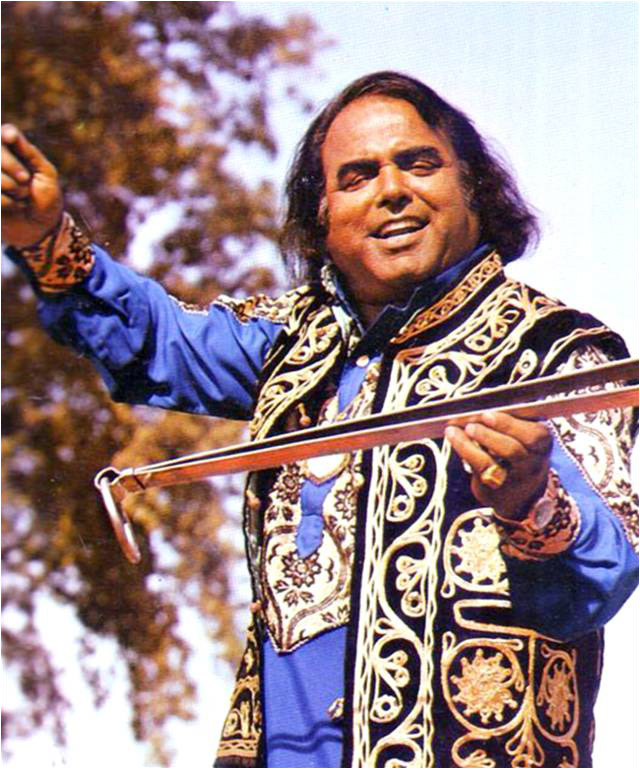
Alam Lohar (Punjabi: محمد عالم لوہار) was a Pakistani Punjabi folk music singer. He is widely regarded as the greatest singer of Punjabi folk music.
He is credited with creating and popularising the music genre or narrative device Jugni.
Alam Lohar was born in 1928 in Achh, near Kotla Arab Ali Khan, Gujrat District of Punjab, British India. He was born into a Punjabi Muslim family of Lohars (blacksmiths). As a child, Lohar read Sufiana Kalaam, a collection of Punjabi stories and poetry and started singing from a childhood age.
Alam Lohar modified a new style of singing the Punjabi Vaar, an epic or folk tale which made him popular when he toured villages and towns in the Punjab region. He is famous for his rendition of Waris Shah's Heer along with other songs such as Saif ul Maluk. He recorded his first album at the age of 13 and throughout his career he accomplished 15 Gold Disc LP's (record sales) for the following with mainly EMI/His Master's Voice Pakistan and other regional companies within Pakistan: Jugni (1965), Saif ul Mulook (1948), Qissa Yusuf Zulaykha (1961), Bol Mitti de Bawa (1964), Dilwala Dukhra (1975). In the memory when he met with an accident and received an injury at leg and call for help to people but no one came to help, he created the lyrics.... Wajan Mariyan Bulaya (1977), Qissa Mirza Sahiban (1967), Qissa Hirni (1963), Maa Da Pyaar (1971), Heer (1969), Qissa Sassi Pannu (1972), Qissa Baraa Maa (1974), Jis Din Mera Vayaah Howega (1973), Qissa Dhulla Bhatti (1959), Mirza De Maa (1968).
In his childhood he used to read Sufi poetry (sufiana kalaam), Punjabi folk stories and participate as a young child in local gatherings expressing a vocal only art form in reading passages of great poets. Then he started going to festivals and gatherings on a regular basis and with these performances, he rose to become one of the notable singers in South Asia during the 1970s.
In the 1970s, Alam Lohar started to tour different countries including United Kingdom, Canada, Norway, United States and Germany to entertain the South Asian communities living in those countries.
Alam Lohar died in an accident near Sham ki Bhattian on 3 July 1979 when a heavily loaded truck collided with his vehicle because the truck failed to overtake his car. He was buried at the outskirts of Lalamusa on GT Road in Pakistan.
Throughout the period of the 1950s and until his death in 1979, he had dominated folk singing in Pakistan and was a major singer in Punjabi and Sufi singing worldwide.
Alam Lohar
Alam Lohar (Punjabi: محمد عالم لوہار) was a Pakistani Punjabi folk music singer. He is widely regarded as the greatest singer of Punjabi folk music.
He is credited with creating and popularising the music genre or narrative device Jugni.
Alam Lohar was born in 1928 in Achh, near Kotla Arab Ali Khan, Gujrat District of Punjab, British India. He was born into a Punjabi Muslim family of Lohars (blacksmiths). As a child, Lohar read Sufiana Kalaam, a collection of Punjabi stories and poetry and started singing from a childhood age.
Alam Lohar modified a new style of singing the Punjabi Vaar, an epic or folk tale which made him popular when he toured villages and towns in the Punjab region. He is famous for his rendition of Waris Shah's Heer along with other songs such as Saif ul Maluk. He recorded his first album at the age of 13 and throughout his career he accomplished 15 Gold Disc LP's (record sales) for the following with mainly EMI/His Master's Voice Pakistan and other regional companies within Pakistan: Jugni (1965), Saif ul Mulook (1948), Qissa Yusuf Zulaykha (1961), Bol Mitti de Bawa (1964), Dilwala Dukhra (1975). In the memory when he met with an accident and received an injury at leg and call for help to people but no one came to help, he created the lyrics.... Wajan Mariyan Bulaya (1977), Qissa Mirza Sahiban (1967), Qissa Hirni (1963), Maa Da Pyaar (1971), Heer (1969), Qissa Sassi Pannu (1972), Qissa Baraa Maa (1974), Jis Din Mera Vayaah Howega (1973), Qissa Dhulla Bhatti (1959), Mirza De Maa (1968).
In his childhood he used to read Sufi poetry (sufiana kalaam), Punjabi folk stories and participate as a young child in local gatherings expressing a vocal only art form in reading passages of great poets. Then he started going to festivals and gatherings on a regular basis and with these performances, he rose to become one of the notable singers in South Asia during the 1970s.
In the 1970s, Alam Lohar started to tour different countries including United Kingdom, Canada, Norway, United States and Germany to entertain the South Asian communities living in those countries.
Alam Lohar died in an accident near Sham ki Bhattian on 3 July 1979 when a heavily loaded truck collided with his vehicle because the truck failed to overtake his car. He was buried at the outskirts of Lalamusa on GT Road in Pakistan.
Throughout the period of the 1950s and until his death in 1979, he had dominated folk singing in Pakistan and was a major singer in Punjabi and Sufi singing worldwide.
Recent media
Recent media