


Community hub
Recent from talks
Contribute something to knowledge base
Content stats: 0 posts, 0 articles, 1 media, 0 notes
Members stats: 0 subscribers, 0 contributors, 0 moderators, 0 supporters
Subscribers
Supporters
Contributors
Moderators
Hub AI
Alaska Peninsula AI simulator
(@Alaska Peninsula_simulator)
Hub AI
Alaska Peninsula AI simulator
(@Alaska Peninsula_simulator)
Alaska Peninsula
The Alaska Peninsula (also called Aleut Peninsula or Aleutian Peninsula, Aleut: Alasxix̂; Sugpiaq: Aluuwiq, Al'uwiq) is a peninsula extending about 497 mi (800 km) to the southwest from the mainland of Alaska and ending in the Aleutian Islands. The peninsula separates the Pacific Ocean from Bristol Bay, an arm of the Bering Sea.
In literature (especially Russian), the term Alaska Peninsula was used to denote the entire northwestern protrusion of the North American continent, or all of what is now the state of Alaska, exclusive of its panhandle and islands. The Lake and Peninsula borough, the Alaskan equivalent of a county, is named after the peninsula.
The Alaska/Aleutian Peninsula is also grouped into Southwest Alaska.
The other largest peninsulas in Alaska include the Kenai Peninsula and Seward Peninsula.
The base of the Alaska Peninsula extends outward from the end of the Alaska Range.
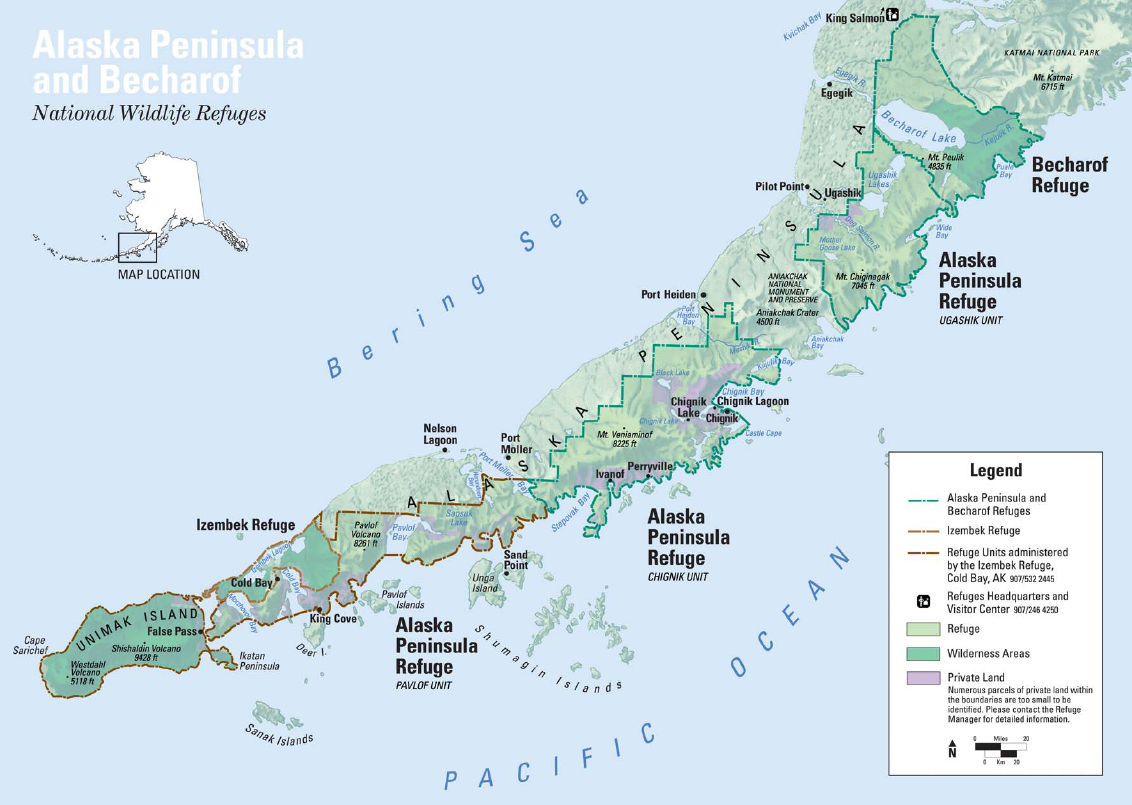
The Aleutian Range is a very active volcanic mountain range which runs along the entire length of the peninsula. Within it lie Wildlife Refuges, including the Katmai National Park and Preserve, the Aniakchak National Monument and Preserve and the Becharof National Wildlife Refuge, the Alaska Peninsula National Wildlife Refuge, and the Izembek National Wildlife Refuge. The most active volcano along the volcanic mountain range is Pavlof Volcano which is more than 8,251 feet (2,515 meters)(see also: Aleutian Arc).
The southern side of the Alaska Peninsula is rugged and mountainous, created by the uplifting tectonic activity of the North Pacific Plate subsiding under a western section of the North American Plate; the northern side is generally flat and marshy, a result of millennia of erosion and general seismic stability. The northern and southern shores are likewise quite different. The northern Bristol Bay coastal side is generally turbid and muddy, experiences tidal extremes, and is relatively shallow; the Pacific side, which is also known as the "ring of fire", has relatively small tidal activity and the water is deep and clear.
The peninsula is organized as a part of four adjacent boroughs; the Aleutians East Borough, Bristol Bay Borough, Kodiak Island Borough, and Lake and Peninsula Borough. The Lake and Peninsula Borough includes most of the peninsula's territory.
Alaska Peninsula
The Alaska Peninsula (also called Aleut Peninsula or Aleutian Peninsula, Aleut: Alasxix̂; Sugpiaq: Aluuwiq, Al'uwiq) is a peninsula extending about 497 mi (800 km) to the southwest from the mainland of Alaska and ending in the Aleutian Islands. The peninsula separates the Pacific Ocean from Bristol Bay, an arm of the Bering Sea.
In literature (especially Russian), the term Alaska Peninsula was used to denote the entire northwestern protrusion of the North American continent, or all of what is now the state of Alaska, exclusive of its panhandle and islands. The Lake and Peninsula borough, the Alaskan equivalent of a county, is named after the peninsula.
The Alaska/Aleutian Peninsula is also grouped into Southwest Alaska.
The other largest peninsulas in Alaska include the Kenai Peninsula and Seward Peninsula.
The base of the Alaska Peninsula extends outward from the end of the Alaska Range.
The Aleutian Range is a very active volcanic mountain range which runs along the entire length of the peninsula. Within it lie Wildlife Refuges, including the Katmai National Park and Preserve, the Aniakchak National Monument and Preserve and the Becharof National Wildlife Refuge, the Alaska Peninsula National Wildlife Refuge, and the Izembek National Wildlife Refuge. The most active volcano along the volcanic mountain range is Pavlof Volcano which is more than 8,251 feet (2,515 meters)(see also: Aleutian Arc).
The southern side of the Alaska Peninsula is rugged and mountainous, created by the uplifting tectonic activity of the North Pacific Plate subsiding under a western section of the North American Plate; the northern side is generally flat and marshy, a result of millennia of erosion and general seismic stability. The northern and southern shores are likewise quite different. The northern Bristol Bay coastal side is generally turbid and muddy, experiences tidal extremes, and is relatively shallow; the Pacific side, which is also known as the "ring of fire", has relatively small tidal activity and the water is deep and clear.
The peninsula is organized as a part of four adjacent boroughs; the Aleutians East Borough, Bristol Bay Borough, Kodiak Island Borough, and Lake and Peninsula Borough. The Lake and Peninsula Borough includes most of the peninsula's territory.
Recent media
Recent media