Hubbry Logo
Alberto DinesAlberto DinesMain
Open search
Alberto Dines
Community hub
Alberto Dines
logo
8 pages, 0 posts
0 subscribers
Be the first to start a discussion here.
Alberto Dines
Alberto Dines
from Wikipedia

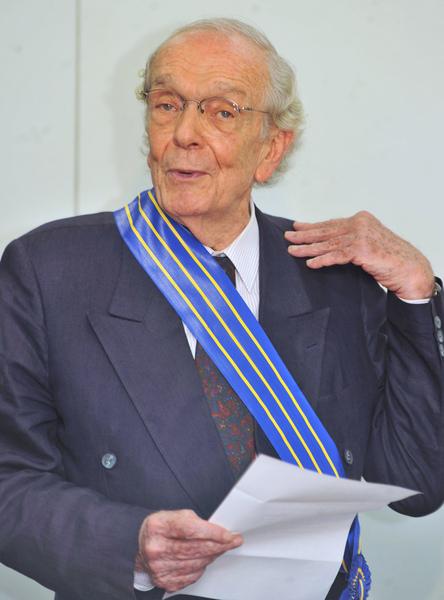
Alberto Dines (Portuguese pronunciation: [awˈbɛʁ.tu ˈd͡ʒĩ.nis]; February 19, 1932 – May 22, 2018[1]) was a Brazilian journalist and writer.

Key Information

Biography

[edit]

With a career spanning over five decades, Dines directed and launched several magazines and newspapers in Brazil and Portugal. He has taught journalism since 1963, and was a visiting professor at the Columbia University School of Journalism in 1974.

Dines was the editor in chief of Jornal do Brasil for twelve years, in addition to coordinating the Rio de Janeiro branch of Folha de S.Paulo. He was also the director of Grupo Abril in Portugal, where he launched the Exame magazine.

After years of dodging the military dictatorship censorship as the editor in chief of Jornal do Brazil, Dines was fired in June 1974 for publishing an article criticizing the overtly amicable relationship between the owners of the newspaper and the state government of Rio de Janeiro.

In addition to working as a journalist, Dines has written over 15 books, including Death in Paradise, the Tragedy of Stefan Zweig (1981) and Fire Links – Antônio José da Silva, the Jew and other stories of the Inquisition in Portugal and Brazil (1992). His book about Stefan Zweig was adapted into the film Lost Zweig (2002), directed by Sylvio Back. Dines also discussed Zweig in a documentary by the same director.

In April 1996, Dines launched the groundbreaking Observatório da Imprensa website. The media analysis website was later adapted into a weekly TV show, currently aired by TV Brasil, and a daily radio show, aired on public stations.

Awards

[edit]

Works

[edit]
  • Morte no paraíso, a tragédia de Stefan Zweig, Editora Nova Fronteira (1981), Editora Rocco (2004)
  • Tod im Paradies. Die Tragödie des Stefan Zweig, Edition Büchergilde (2006)

References

[edit]
[edit]
Revisions and contributorsEdit on WikipediaRead on Wikipedia
from Grokipedia
Alberto Dines was a Brazilian journalist, writer, and biographer known for his profound impact on Brazilian media, his resistance to censorship during the military dictatorship, and his acclaimed biographical works, particularly Morte no Paraíso: A Tragédia de Stefan Zweig. Born on February 19, 1932, in Rio de Janeiro to parents of Jewish origin, Dines began his career in 1952 as a film critic and quickly advanced through key roles in Brazilian journalism, including positions at Visão, Manchete, and Última Hora. He served as editor-in-chief of Jornal do Brasil from 1962 to 1973, where he led a major modernization of the newspaper by establishing new departments and innovative practices that elevated its national prominence. During this period, he became renowned for his defiance of the military regime, exemplified by the newspaper's ironic front page on December 13, 1968, following the promulgation of Institutional Act Number Five, which used metaphorical weather language to denounce repression and censorship. Following his departure from Jornal do Brasil, Dines worked with Folha de S.Paulo, contributed to alternative publications, and spent time in Portugal as director for Grupo Abril, where he helped launch magazines. In 1996, he founded the Observatório da Imprensa, initially an online platform for media analysis and criticism that expanded into television and radio programs, cementing his legacy as a leading voice in press ethics and accountability. He also maintained a long academic career, teaching journalism since 1963—including at PUC-Rio—and serving as a visiting professor at Columbia University's Graduate School of Journalism in 1974. Dines authored several influential books, including Morte no Paraíso: A Tragédia de Stefan Zweig (1981), O Baú de Abravanel (1990), and Vínculos de Fogo (1992), which explored historical, cultural, and Jewish themes. His contributions earned him awards such as the Maria Moors Cabot Prize in 1971. He died on May 22, 2018, in São Paulo due to respiratory failure following pneumonia.

Early Life

Childhood and Family Background

Alberto Dines was born on February 19, 1932, in Rio de Janeiro, Brazil, at the Beneficência Portuguesa hospital in the Glória neighborhood. He was the son of Israel Dines and Raquel Dines, Jewish immigrants from a region of Ukraine that shifted between Russian and Polish control after World War I. His father, Israel Dines, arrived in Brazil in the late 1920s as a professional activist in the Jewish community, having previously worked in Poland with organizations supporting refugees and social aid. In Brazil, he initially tried commerce in Curitiba before moving to Rio de Janeiro, where he devoted his entire career to Jewish organizations focused on assisting immigrants with placement and integration, as well as overseeing Jewish education and schools. His mother, Raquel Dines, came from the same region with a stronger academic background, having completed gymnasium studies in Russia and becoming proficient in Russian, Hebrew, Yiddish, and eventually Portuguese with notable fluency. Dines grew up in Rio de Janeiro neighborhoods such as Vila Isabel, Andaraí, and Tijuca, attending Jewish schools throughout his childhood and early education. He completed primary studies at a progressive, left-leaning Jewish school and secondary education at the Ginásio Hebreu Brasileiro, an advanced institution with many left-wing teachers affiliated with the Brazilian Communist Party and drawn from prestigious public schools like Pedro II. In this environment, he learned Yiddish and gained exposure to German literature. At the age of eight, his school received a visit from the renowned Austrian writer Stefan Zweig, who was then in exile in Brazil; the encounter, captured in a class photograph with the celebrated author, left a deep impression on Dines and ignited a lifelong fascination with Zweig's life and his tragic exile in Brazil. These formative years in Rio's Jewish community, shaped by his parents' immigrant experiences and dedication to communal causes, fostered an early interest in media and writing that would lead to his first professional roles in the early 1950s.

Entry into Journalism and Early Media Work

Alberto Dines began his professional journalism career in 1952 as a film critic for the magazine A Cena Muda. The following year, he joined the recently founded magazine Manchete as a reporter, marking his transition into broader reporting roles. During the 1950s, he contributed to several prominent publications, including the magazines Visão, Manchete, and Fatos & Fotos, while also working in morning and evening newspapers, radio, and early television outlets. His early media involvement overlapped with contributions to Brazilian cinema between 1949 and 1954. Later in the decade, Dines worked at the newspaper Diário da Noite, where his tenure was notably marked by coverage of the hijacking of the Portuguese transatlantic ship Santa Maria in early 1961. He faced his first major dismissal around 1960–1961 after publishing unauthorized photographs related to the incident, which drew repercussions from his editors. This event highlighted the risks he took early in his career while pursuing impactful reporting.

Film and Television Work

Early Contributions to Brazilian Cinema (1949–1954)

Alberto Dines made early contributions to Brazilian cinema between 1949 and 1954, working in various capacities on several feature films during a period when he was also beginning his journalism career. His first credit came in 1949 as dialogue writer for Sol e Toiros, a film directed by José Buchs that drew on bullfighting themes. In 1952, he served as assistant director on Está com Tudo, expanding his involvement in film production. The next year, he worked as writer on O Craque, a sports-themed production. In 1954, Dines provided the story and also appeared as an actor in A Sogra. These roles reflected his initial hands-on engagement with the Brazilian film industry before he focused more prominently on journalism and criticism.

Later Involvement and Adaptations (2002–2009)

In 2002, Alberto Dines' 1981 book Morte no Paraíso: a tragédia de Stefan Zweig served as the basis for the feature film Lost Zweig, directed by Sylvio Back. Dines received a writing credit on the project alongside Back and Nicholas O'Neill. The film dramatizes the final days of Austrian writer Stefan Zweig and his wife in exile in Petrópolis, Brazil, culminating in their suicide during Carnival in 1942. Dines also appeared as himself in a documentary by Sylvio Back where he discussed aspects of Zweig's life and work. Later in the period, Dines contributed as a writer to the 2009 TV series Preto no branco, directed by Silvio Tendler. The production explored themes of censorship in the Brazilian press prior to broader media freedoms. During 2002–2009, Dines made several appearances as himself across various productions, resulting in approximately five credits in documentaries and related media.

Journalism Career

Early Positions and Magazine Work

Alberto Dines began his professional journalism career in 1952 as a film critic for the magazine A Cena Muda. The following year, he joined the newly founded Visão magazine at the invitation of Nahum Sirotsky, initially covering artistic life, theater, and cinema before shifting to political reporting, including Jânio Quadros' campaigns for mayor of São Paulo in 1953 and governor of São Paulo state in 1954. He remained at Visão until 1957. In 1957, Dines transferred to Manchete magazine as assistant director and editorial secretary, though he left after disagreements with owner Adolpho Bloch. In 1959, he assumed direction of the second caderno at Última Hora newspaper, later overseeing both its morning and evening editions. During 1960, Dines served as editor-in-chief of the newly launched Fatos & Fotos magazine while also directing Diário da Noite, where he restructured it as a tabloid but was dismissed after refusing to suppress coverage of the Santa Maria hijacking. Throughout this formative period, he worked across prominent magazines such as Visão, Manchete, and Fatos & Fotos, various newspapers including morning and evening editions, and gained additional experience in radio and a little television. In early 1962, he transitioned to Jornal do Brasil as editor-in-chief.

Leadership and Innovations at Jornal do Brasil (1962–1974)

Alberto Dines joined Jornal do Brasil on January 8, 1962, initially without a formal title, though he soon assumed responsibilities as managing editor and effectively served as editor-in-chief for the next twelve years. He reorganized the newsroom by introducing clearly defined sections—including the newspaper's first dedicated economics section, which moved beyond mere reproduction of stock and commodities reports—and implemented two daily editorial meetings to improve planning and commentary. Dines also established a research department that began by building a basic library, organizing photograph and negative files, and creating a pre-digital database; by 1965, he transformed it into a content-producing unit that generated background reports and analytical support, hiring notable journalists such as Fernando Gabeira, Murilo Felisberto, Moacyr Japiassu, and later Raul Ryff. In 1965, inspired by a three-month course at Columbia University in 1964 under the World Press Institute program, Dines launched the Cadernos de Jornalismo e Comunicação supplements, which offered in-house critical reflections, notes, and texts on journalism practices; initially circulated internally and to select audiences, they later reached wider distribution through a bookstore chain, appearing roughly four to five times per year. He further transformed Caderno B—originally a repository for leftover material created in the 1950s—into an autonomous cultural section published more regularly, featuring in-depth interviews, strong critical writing, literary contributions especially on Saturdays, and a collective critics' ranking system that positioned Jornal do Brasil as a leading reference for theater, art, and literature coverage. Dines developed the Agência Jornal do Brasil (AJB), a domestic news agency that distributed journalistic material to other newspapers under a cooperative revenue-sharing model in which republication income was divided equally among the reporter, the agency, and the newspaper. His tenure ended in 1974 when he was dismissed amid the military dictatorship's intensified censorship following the 1968 Institutional Act No. 5, a period marked by increasing pressure on independent journalism.

Later Roles, Columns, and International Work

After leaving the Jornal do Brasil in 1974, Alberto Dines contributed to Folha de S. Paulo with the column "Jornal dos jornais" from 1976 to 1980, where he practiced media criticism by analyzing press practices and ethics in Brazil. His pointed critiques led to his dismissal following articles addressing Paulo Maluf, including one accusing the politician of responsibility in repressing the ABC strikes that was censored and unpublished, prompting his departure. From 1982 to 1988, Dines served as editorial vice-director at Editora Abril in São Paulo, a period he later described as productive yet challenging due to internal dynamics within the publishing group. He subsequently became director of Grupo Abril in Portugal, where he launched the magazine Exame and oversaw operations from Lisbon between 1988 and 1995. During his extended periods in Lisbon, Dines conducted archival and field research essential to his biographical projects, drawing on the city's resources for in-depth historical investigation. These international experiences preceded his establishment of Observatório da Imprensa in 1996.

Teaching and Academic Contributions

Pioneering Journalism Education in Brazil

Alberto Dines began teaching journalism in Brazil in 1963, when he joined the faculty of the newly established journalism course at the Pontifícia Universidade Católica do Rio de Janeiro (PUC-Rio). At PUC-Rio, he created and taught the discipline of Jornalismo Comparado (Comparative Journalism), which he invented by adapting the methodologies of comparative law to systematically examine and contrast different journalistic practices, traditions, and systems across countries and cultures. This marked one of the earliest introductions of a rigorous comparative framework into Brazilian journalism education, helping to shift the field toward more analytical and theoretical foundations at a time when university-level journalism training was still emerging in the country. In the 1990s, Dines co-founded the Laboratório de Estudos Avançados em Jornalismo (Labjor) at the Universidade Estadual de Campinas (Unicamp) in 1994, together with professors Carlos Vogt and José Marques de Melo. Labjor established itself as a reference center for advanced research, training, and critical reflection on journalism, with a focus on media dissemination of science and culture in national and Latin American contexts. These initiatives in journalism education laid groundwork that later informed Dines' work in media criticism and press observation.

Visiting Professorships and Comparative Journalism

Alberto Dines attended a three-month complementary course at Columbia University in New York beginning in September 1964, organized in partnership with the World Press Institute, an organization that has since ceased to exist. The program assembled newspaper editors from different continents, with Dines participating as a representative of Latin American newspapers, and included interactions with distinguished professors and professionals. Dines described the experience as "marvelous" and transformative, marking his first formal university course, and noted that he retained all the books and notes from the period, having taken them with his work at Jornal do Brasil in mind. This exposure to U.S. journalistic practices influenced his subsequent modernization efforts at the newspaper. In 1974, following his departure from Jornal do Brasil, Dines accepted an invitation to Columbia University through the Tinker Institute, serving as the Edward Larocque Tinker Visiting Professor at the Graduate School of Journalism and remaining affiliated through 1975. He resided in university accommodations near the campus and emphasized that his primary role was to learn from the environment rather than to teach, though he delivered two conferences—one per academic term—on the relations between government and the press in Brazil to graduate students and journalists. These international engagements at Columbia enriched Dines' approach to comparative journalism by immersing him in cross-national perspectives on press systems, particularly through direct observation of U.S. media practices and post-Watergate discussions of journalistic ethics and media accountability.

Literary Career

Major Books and Biographies

Alberto Dines authored more than 15 books across his career, covering journalism, history, biography, and related fields. Among his major works is O papel do jornal e a profissão de jornalista, first published in 1974, which examines the evolving role of newspapers amid growing competition from television while addressing journalistic ethics, public interest, and professional standards. The book became a reference in media studies and underwent several revisions, including a commemorative ninth edition in 2009 that incorporated updates on the defense of journalism credentials. Dines' best-known biographical work is Morte no paraíso: a tragédia de Stefan Zweig, published in 1981, detailing the Austrian writer's exile in Brazil during World War II and his suicide in Petrópolis in 1942. This biography was reissued in a revised edition in 2004 and appeared in a German translation in 2006. Another significant contribution is Vínculos de fogo – Antônio José da Silva, o Judeu e outras histórias da Inquisição em Portugal e no Brasil, published in 1992, which investigates the life of the 18th-century Jewish playwright Antônio José da Silva and broader Inquisition histories in Portugal and colonial Brazil. The book received the Jabuti Prize in 1993 in the Literary Studies/Essays category.

Media Criticism and Observatório da Imprensa

Founding and Focus of Observatório da Imprensa

Alberto Dines founded the Observatório da Imprensa website in April 1996 as a platform dedicated to media analysis, criticism, and monitoring of the Brazilian press. The initiative originated under the responsibility of the Laboratório de Estudos Avançados em Jornalismo (Labjor) at Unicamp and was initially linked to the Uniemp Institute. It later became a project of the Projor – Instituto para o Desenvolvimento do Jornalismo, formally established in April 2001, and was hosted by UOL for a period. The Observatório drew inspiration from earlier models in Portugal and France, with the first organization named Observatório da Imprensa created in Lisbon three months before the French Observatoire de la Presse, founded in September 1995. Dines positioned it as a civil, non-governmental, non-corporate, and non-partisan entity aimed at accompanying the performance of Brazilian media alongside other civil society organizations. It sought to function as a permanent forum for media users—readers, listeners, viewers, and internet users—organized independently from journalistic institutions, enabling active participation and expression. The project emphasized its role as an attentive mediator between the media and the public, addressing a previously vacant social space in Brazil to promote higher standards of press quality and accountability. The focus remained on fostering critical reflection and public engagement with media practices through ongoing analysis and commentary. The project later expanded into broadcast formats.

Broadcast Programs and Ongoing Impact

The Observatório da Imprensa expanded beyond its digital origins into broadcast media, most notably through a weekly television program that brought its media criticism to a broader audience. The program, also titled Observatório da Imprensa and presented by Alberto Dines, launched in 1998 on TV Educativa do Rio de Janeiro and subsequently aired on TV Brasil until 2016. It featured discussions and analyses of journalistic practices, the role of the press in society, and critiques of media coverage on significant topics, serving as a consistent platform for ethical reflection and debate. The initiative further adapted into a daily radio program transmitted on public and educational stations, extending the same critical approach to audio formats and reaching listeners through routine commentary on media issues. These broadcast adaptations reinforced the Observatório da Imprensa's position as a key forum for questioning and improving Brazilian journalism. The programs' sustained presence over nearly two decades contributed significantly to fostering higher standards in media practice and public awareness of press responsibility. Their legacy endures in the continued emphasis on media accountability and the maturation of journalistic discourse in Brazil.

Personal Life and Death

Marriages and Family

Alberto Dines was married twice. His first marriage was to Ester Rosali. From this marriage, he had four children. He later married Norma Couri, a journalist. The couple remained together during Dines' later career and years. In 2012, he marked his 80th birthday with a quiet lunch celebration alongside his wife Norma Couri.

Final Years and Death

In his later years, Dines continued to engage in journalism education and reflection on the field. Between 2011 and 2013, he taught the course on History of Journalism in a postgraduate specialization program at the Escola Superior de Propaganda e Marketing (ESPM) in São Paulo. In 2012, marking his 80th birthday and 60 years in the profession, the Fundação de Amparo à Pesquisa do Estado de São Paulo (FAPESP) organized a full-day seminar titled "Conhecimento científico do jornalismo no Brasil: a contribuição de Alberto Dines" on March 22 at its auditorium in São Paulo, where Dines participated as one of the speakers to discuss his innovations in comparative media analysis, media criticism, and online journalism practices. Alberto Dines died on May 22, 2018, at the age of 86, in São Paulo, Brazil. He was hospitalized at the Hospital Albert Einstein for approximately ten days due to a flu that worsened into pneumonia, leading to fatal respiratory complications.

Awards and Honors

Journalism and Cultural Recognitions

Alberto Dines received several prestigious recognitions for his distinguished career in journalism and his contributions to cultural and media discourse. In 1970, he was awarded the Maria Moors Cabot Prize by Columbia University, one of the oldest international journalism awards, for his outstanding coverage of Latin America and his advocacy for press freedom. As editor-in-chief of Jornal do Brasil since 1962, he was honored for his vocal defense of journalistic independence amid Brazil's military regime and widespread censorship. In 2005, Dines received the Prêmio Imprensa Estrangeira, acknowledging his enduring influence on journalistic standards and international media perspectives. On March 29, 2010, he was presented with the Roberto Marinho Prize for Communication, a major Brazilian honor recognizing his sustained efforts to promote ethical journalism, media accountability, and public discourse. These awards collectively underscore Dines' impact on strengthening journalistic integrity and cultural criticism in Brazil and beyond. In October 2007, Alberto Dines received the Austrian Holocaust Memorial Award from the Austrian Memorial Service for his contributions to preserving the memory of the Holocaust, particularly through his acclaimed biography of Stefan Zweig—a Jewish writer driven to suicide in exile by Nazi persecution—and his presidency of the Casa Stefan Zweig cultural center in Petrópolis, Brazil. In 2009, Dines was honored with the Austrian Cross of Honour for Science and Art, bestowed by the Austrian government in recognition of his biographical and literary work dedicated to Stefan Zweig and broader cultural remembrance.

References

Add your contribution
Related Hubs
User Avatar
No comments yet.