Hubbry Logo
Alberto SempriniAlberto SempriniMain
Open search
Alberto Semprini
Community hub
Alberto Semprini
logo
8 pages, 0 posts
0 subscribers
Be the first to start a discussion here.
Alberto Semprini
Alberto Semprini
from Wikipedia

Key Information

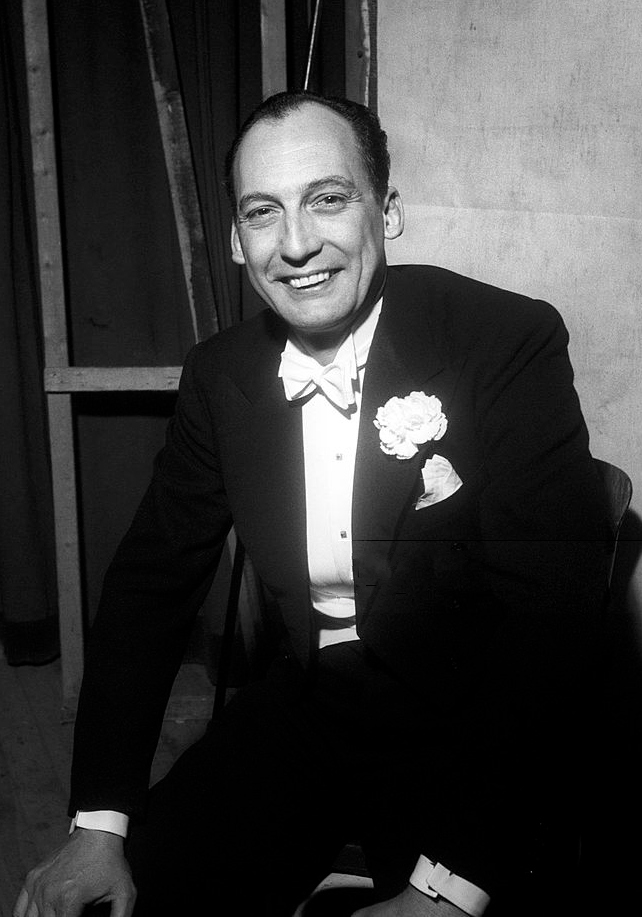
Alberto Fernando Riccardo Semprini OStJ OBE (27 March 1908 – 19 January 1990), known as Alberto Semprini (Italian pronunciation: [alˈbɛrto semˈpriːni]), or by his stage name Semprini, was an English pianist, composer and conductor, known for his appearances on the BBC, mainly on radio.[1]

Early life

[edit]

Born in Bath, Somerset, England, of Italian ancestry, Semprini showed early talent for both the piano and cello. The second of three sons, his parents were Arturo Riccardo Fernando Semprini, a musician from Rimini, Italy, and his wife, Elizabeth Tilley, an opera singer from Dudley, Worcestershire. Alberto graduated from the Verdi Conservatory in Milan in 1929, having studied composition and conducting, as well as honing his skills at the piano.[1]

Career

[edit]

In Italy, he performed a broad range of music, from pop to jazz and classical, and in 1938 led his first radio orchestra there. In the late 1950s he also featured regularly at the Sanremo Music Festival.

Semprini recorded for Telefunken in the early 1940s, with a dance orchestra. During the Second World War, despite having a British passport, he was called up for military service in Italy. He was rejected as being unfit, but his passport was taken, and Semprini was suspected of being pro-British (which was true). Life in Fascist Italy became difficult for him, and he moved to Sanremo to compose. He returned to Rome in 1944 to await the arrival of the Allied Army. When they came, he volunteered his services with the Entertainments National Service Association. While working with ENSA, he met the actor Michael Brennan, who helped Semprini get his passport back. Brennan brought Semprini back to London in 1949. He was signed to His Master's Voice in 1950, for whom he recorded until 1963.[2]

Back in the UK, he hosted a light music programme, Semprini Serenade, which he introduced with the words: "Old ones, new ones, loved ones, neglected ones". The program first aired on BBC Radio in 1957 and continued for around 25 years.[3] Although his 'house band' was the New Abbey Light Symphony Orchestra on his commercial records, on radio he was always accompanied by one of the BBC's own staff orchestras, initially the BBC Revue Orchestra.

Semprini also wrote a number of original light music compositions, including Concerto Appassionato and Mediterranean Concerto, which he used as the theme tune for his radio show.

In 1977, following a performance in York, Semprini chose to leave the stage, citing a lack of confidence.

Honours

[edit]

In 1973 he was made an Officer of the Order of St John, and on 30 November 1983 he was appointed an Officer of the Order of the British Empire, in recognition of his considerable charity work.[4]

Personal life and death

[edit]

In 1931, Semprini married Brunilde Regarbagnati in Italy, and the couple had three sons. However, the marriage was not to last. After the war, he worked and studied in Spain, where he fell in love with a young Spanish dancer, María de la Concepción Consuelo García Cardoso, the daughter of Generoso José García Inglesias, a house painter. Semprini took Consuelo to England in 1949, and following his divorce in 1952, married her that year. They had two sons.[1]

He lived on a houseboat in West Mersea, Essex, and in Brixham, Devon. Semprini suffered from Alzheimer's disease, and died in Brixham on 19 January 1990, aged 81.[1]

Recordings

[edit]

Semprini was a prolific recording artist. His work was first released on the Italian label Fonit Cetra, then EMI Records, where he remained for the rest of his professional career. Although strongly associated with light music, his recordings were principally of well-known classical music, including the Grieg Piano Concerto and solo pieces by Beethoven, Chopin, Liszt, Tchaikovsky and Debussy.[5]

In 2015 Vocalion Records released a CD of his late 1950s broadcasts with the BBC Revue Orchestra, most of which had not been heard since their first broadcast.

Cultural references

[edit]

References

[edit]
[edit]
Revisions and contributorsEdit on WikipediaRead on Wikipedia
from Grokipedia
Alberto Semprini (1908–1990) was an English , , and conductor of Italian descent, best known for hosting the long-running (later Radio 2) show Semprini Serenade from 1957 to 1982, which featured arrangements of popular songs, film themes, and classics, often introduced with his signature phrase "Old ones, new ones, loved ones, neglected ones." Over its 25-year run, the program aired more than 700 episodes, establishing Semprini as a beloved figure in British and . He also composed and arranged numerous works for and , including the Mediterranean Concerto, which served as the theme for his radio show. Born Alberto Fernando Riccardo Semprini on 27 March 1908 in , , to Italian parents Arturo Semprini and , he demonstrated early talent for , particularly and . At age 11, he moved to , , to study at the Conservatory, where he graduated in 1928 with diplomas in , composition, and . Semprini began his professional career in the late and early , making his first recordings in around 1932–1935 for labels like Columbia and Gramophone, including jazz-influenced pieces such as "Rumba da concerto" and "Blues del 900," and performing as a semi-jazz and conductor in theaters and on radio across . Returning to after , Semprini built a successful career in , performing concerts, composing for films and theater, and becoming a staple on and television in the . His popularity led to the creation of Semprini Serenade, where he led his own orchestra in medleys and arrangements, amassing a wide audience through broadcasts five days a week. Semprini also appeared in films such as La scuola dei timidi (1941) and Dove sta Zazà (1947) during his time in Italy, and later recorded extensively for , including popular albums of solos and orchestral works. For his contributions to music and charity fundraising, he was appointed Officer of the (OBE) in 1983. Semprini died on 19 January 1990 in , , , leaving a legacy as one of Britain's most enduring personalities.

Early life and education

Birth and family background

Alberto Semprini was born on 27 March 1908 in , , to Arturo Riccardo Fernando Semprini, an Italian originally from , and , an English singer. As the second of three sons, Semprini grew up in a household deeply immersed in music, with his father's professional work as a and his mother's on the operatic stage providing constant exposure to performances and instruments from an early age. This musical environment nurtured Semprini's innate talent, as he began exploring and informally within the family setting, surrounded by the sounds of his parents' artistic pursuits. The Semprini home served as a vibrant space for musical experimentation, where familial performances and access to instruments shaped his foundational understanding of music before any structured learning. In 1919, at around the age of 11, the entire Semprini family—including the three sons—relocated from to , , driven by familial connections to the father's homeland. This move allowed Semprini to continue his early informal musical development at home amid Italy's rich cultural backdrop, laying the groundwork for his later formal training.

Musical training and influences

Semprini moved to in 1919 at the age of eleven to pursue formal musical studies, enrolling at the Conservatorio Giuseppe Verdi where he demonstrated early talent on the piano and . His education emphasized classical foundations, with coursework in piano performance, composition, and conducting that built a strong technical base in European musical traditions. During his student years at the conservatory, Semprini graduated in 1928, having honed his skills alongside theoretical and orchestral training that exposed him to the works of Italian composers such as and Puccini, reflecting the institution's emphasis on national operatic heritage. This classical grounding was complemented by his family's musical background—his father a professional and his mother an singer—which provided an initial spark for his passion, briefly referenced as a supportive influence without overshadowing his institutional learning. In the vibrant cultural scene of , particularly in , Semprini encountered emerging imports from America, which began to shape his versatile approach by introducing rhythmic and popular harmonies into his classical repertoire. As one of Italy's pioneering jazz pianists during this period, he experimented with blending these genres, laying the groundwork for his signature style that fused technical precision with accessible, melodic appeal—evident in early arrangements that bridged concert hall elegance and energy. This synthesis emerged organically through his conservatory experiences, where exposure to diverse musical forms encouraged innovative interpretations without formal jazz instruction.

Professional career

Early performances in

Following his graduation from the Conservatorio Giuseppe Verdi in in 1928, where he had honed his skills in , composition, and conducting, Alberto Semprini established his professional presence in . He quickly gained recognition for performances that fused classical techniques with emerging popular and influences, reflecting the vibrant scene of the era. In 1934, Semprini initiated his concert career with jazz-oriented programs, soon forming a acclaimed piano duo with Enrico Bormioli dedicated to interpreting modern rhythms. The duo embarked on an extensive tour of theaters in and select European venues, solidifying Semprini's reputation as a versatile capable of bridging traditional and contemporary styles. By 1938, Semprini's growing prominence led to his appointment as conductor of a rhythm-symphony for Italian radio, where he launched the influential "Concerts Cora" series. These broadcasts showcased his ability to lead ensembles in a wide repertoire, from light orchestral pieces to jazz-infused arrangements, further elevating his status in the European music landscape prior to the disruptions of .

BBC broadcasting and radio work

After returning to the United Kingdom in 1948 following his wartime service entertaining troops with ENSA across , including performances in , Alberto Semprini began establishing his broadcasting presence with the , initially through variety and cabaret-style radio performances that showcased his skills and arrangements. These early appearances in the late and early helped build his reputation among British audiences, blending classical influences with popular tunes, before culminating in his breakthrough program. Semprini's most iconic contribution to BBC radio was the launch of Semprini Serenade in 1957 on the BBC Light Programme, which later transitioned to Radio 2. The Sunday program, initially broadcast in the evening and later in the afternoon, featured Semprini at the piano, leading the Serenade Orchestra in medleys of old and new popular songs, light classics, and themes from films and shows, often introduced with his signature phrase: "Old ones, new ones, loved ones, neglected ones." Running for over 25 years until 1982, it broadcast more than 700 episodes and became a staple of Sunday afternoons, fostering a loyal following for its warm, nostalgic style that popularized light music across generations. He also made occasional guest appearances on , including variety shows and specials that highlighted his and playing. Throughout his tenure, Semprini's style evolved to emphasize live improvisations and tight coordination, maintaining a consistent appeal through high production quality and engaging arrangements that bridged classical and contemporary .

Other musical engagements

Throughout his career, Semprini engaged in various live performances and collaborations beyond his BBC broadcasting commitments, including notable appearances at international music festivals. He served as musical director at the in in 1954, leading his Sestetto Azzurro ensemble and accompanying performers such as Katyna Ranieri and Flo Sandon's. He returned to the festival in 1955 and 1958, where in the latter year he orchestrated and conducted Domenico Modugno's winning entry, "Nel blu dipinto di blu" (Volare), which also represented at the . These engagements allowed Semprini to adapt his style for diverse audiences, blending orchestral arrangements with popular Italian songs. Semprini also participated in live concert tours across the , collaborating with orchestras for theater and hall performances. In the 1960s, he appeared as piano soloist with the at venues such as the Assembly Hall in Tunbridge Wells (15 October 1960) and Leas Cliff Hall in (7 July 1967), often alongside vocalists like Cherry Lind, Leslie Fyson, and Stephanie Voss. These concerts featured his arrangements of light classics and medleys, performed in a format that echoed his radio style but emphasized theatrical presentation for live crowds. A similar collaboration occurred on 14 July 1967 at the in , highlighting his versatility in orchestral settings outside studio broadcasts. After retiring from performances in 1977, Semprini continued his work until 1982. He made occasional post-retirement appearances, primarily for charitable causes. In March 1982, at age 74, he gave his final public concert at the in , , to raise funds for , an organization supporting women's causes; this performance helped him amass thousands of pounds for various charities over his later years.

Recordings and discography

Early recordings and labels

Semprini's recording career began in during the early 1930s, where he made his debut sessions for , known in Italy as (HMV). These initial efforts, dating from 1932 to 1933, were as conductor with Rodolfo De Angelis, focusing on light classical pieces. Semprini also made early recordings for the Italian label Fonit Cetra around 1932–1940s, including jazz-influenced pieces such as arrangements of popular songs. By 1935, he recorded piano duets in collaboration with fellow pianist Bormioli for Columbia (U.K.), focusing on light classical and emerging jazz-influenced pieces such as "Rumba da concerto" and "Blues del 900," alongside more traditional fare like arrangements of "Cordova" from Spanish dances, often on 10-inch discs. In the early , Semprini signed with in , where he led a dance orchestra for sessions that produced popular medleys and piano solos suited to the era's swing and trends. These recordings, typically in mono format with orchestral arrangements emphasizing rhythmic vitality, marked his growing international profile amid wartime constraints. The output included versatile repertoire that bridged and accessible classical interpretations. By the mid-1950s, Semprini transitioned to in the , aligning with his relocation and commitments; this shift around 1955 facilitated a series of singles and early long-playing (LP) releases under and imprints. These sessions retained mono recording techniques but incorporated fuller orchestral backings for medleys and solos, capturing his signature style in polished studio environments with arrangements that highlighted piano prominence amid strings and rhythm sections. Representative examples include LPs like those compiling hit medleys, establishing his discographic foundation in the British market. A notable early recording was the 1952 single featuring themes from the Grieg (first movement) and Tchaikovsky No. 1, performed by Semprini with the Melachrino Orchestra in a , salon-style arrangement.

Notable works and releases

Semprini's recordings with in the 1960s included several popular hits that showcased his style, such as the album Semprini Plays Favourite Melodies (1966), which incorporated pop covers alongside original compositions in a piano-orchestra setting. This release exemplified his ability to blend classical influences with accessible, rhythmic interpretations, contributing to his commercial success during the decade. These albums often drew from contemporary hits, reimagined through Semprini's signature elegant phrasing and orchestral accompaniment, appealing to listeners of light classical and easy-listening genres. His adaptations of classical repertoire, such as works by Chopin and Beethoven rendered in salon style, appeared on various releases during this period, transforming complex pieces like Chopin's nocturnes or Beethoven's sonata themes into lighter, more intimate piano-focused arrangements. Following Semprini's death in 1990, posthumous releases have preserved and revived his catalog, including the 2015 Vocalion CD Semprini Serenades - Transcription Recordings (1959-60), which compiled rare broadcasts featuring his piano performances with the BBC Revue Orchestra. Into the 2020s, digital reissues on platforms like and have made selections from his catalog, such as tracks from classical adaptations, widely available, introducing his work to new generations through streaming services.

Honours and recognition

Awards and titles

In 1972, Semprini was appointed an Officer of the Order of St John (OStJ) in recognition of his contributions to music and charitable causes associated with the order. Semprini received the Officer of the Order of the British Empire (OBE) in the 1983 Queen's Birthday Honours, awarded for his services to charity and broadcasting. The honour was presented to him at Buckingham Palace on 30 November 1983. Semprini's long association with the BBC culminated in a lifetime recognition during his final broadcast in 1982 at the Royal Festival Hall, marking the corporation's 60th anniversary, where he conducted the in a performance of his .

Charity contributions

Throughout his career, Alberto Semprini engaged in philanthropic efforts by using his musical talents to support charitable causes, particularly by entertaining patients in hospitals and sanatoriums, which provided solace and upliftment during difficult times, including the post-war recovery period in the and 1950s. These performances were part of broader initiatives to aid health-related relief efforts, reflecting his commitment to community welfare through accessible and classical recitals. Semprini organized and participated in benefit concerts that contributed to fundraising for various organizations. In 1953, he gave a recital at Bath's Palace Theatre, which helped support local charitable endeavors tied to cultural and community health initiatives. Additionally, in the late 1960s, he performed at a special charity concert at , an event recalled by local residents as a significant gathering aimed at raising funds for educational and welfare programs. Semprini's overall charitable impact was acknowledged in 1983 when he received the OBE for services including considerable charity work.

Personal life

Marriages and family

Semprini married Brunilde Regarbagnati, an Italian woman, in the 1930s during his early career in . The couple had three sons, born in the late 1930s and 1940s, though specific names and dates for these children are not widely documented. His extensive touring and peripatetic lifestyle as a strained the marriage, ultimately leading to proceedings that were finalized in 1952. In 1952, following his , Semprini married Maria de la Concepcion Consuelo Garcia Cardoso, known as Consuelo, whom he had met earlier and brought to in 1949. This second marriage endured until his death, providing a stable family foundation amid his professional demands. Together, they had two sons in the 1950s, resulting in a total of five sons across both marriages, including Kikko, Leylo, , Chevi, and Giorgio. The family made their home on a houseboat named L'Esperance in , , during the mid-20th century, reflecting Semprini's affinity for a nautical lifestyle. In 1979, they relocated to , , settling in a house that allowed for a quieter phase while accommodating visits from , such as Semprini's brother Tino and grandchildren. Semprini's international tours continued to influence family dynamics, particularly in the earlier years, but the second marriage fostered resilience and close-knit gatherings, as evidenced by family appearances on his 1977 This Is Your Life episode.

Later years and death

Semprini retired from his regular BBC radio broadcasts in early 1982 at the age of 74, concluding 25 years of hosting Semprini Serenade, which had aired from 1957 to 1982. His final professional engagement came later that year on 7 November 1982, when he conducted the at the Royal Festival Hall during the BBC's 60th anniversary concert, with pianist Philip Martin performing Semprini's Mediterranean Concerto; this marked a poignant farewell, as health issues prevented him from playing the piano himself. In his later years, Semprini battled , diagnosed in the 1980s, which progressively impaired his cognitive and physical abilities, including his capacity to perform on the piano. He had also developed in his hands, further limiting his musical activities. Semprini died at his home in , , , on 19 January 1990, at the age of 81, as a result of . His service was held privately, followed by cremation at Crematorium, after which his ashes were scattered at sea off , . In the immediate aftermath, the aired a special tribute edition of Semprini hosted by Ian Wallace, featuring archival performances to celebrate his legacy.

Legacy and cultural impact

Influence on light music

Alberto Semprini's long-running program Semprini Serenade, broadcast from 1957 to 1982, played a pivotal role in popularizing among British audiences during the mid-20th century. Through medleys of , light classics, and film themes, Semprini offered accessible arrangements that blended his classical training with contemporary popular elements, drawing an estimated large and loyal listenership over more than 700 episodes on the and later Radio 2. This format, introduced with his signature phrase "Old ones, new ones, loved ones, neglected ones," made a staple of Sunday afternoon programming, influencing radio habits from the through the by providing a soothing alternative to emerging rock and pop genres. Semprini's work helped preserve the traditions of salon piano music, rooted in his studies at the , at a time when heavier rock influences were overshadowing lighter orchestral and piano-based styles. By performing and arranging pieces that echoed 19th-century while incorporating modern tunes, he maintained a bridge between classical heritage and everyday entertainment, ensuring the genre's relevance for post-war listeners seeking escapist fare. His broadcasts, starting with his BBC debut in 1949, contributed significantly to the 's light music department, where he became a central figure for over three decades, helping shape program formats that emphasized melodic, orchestral arrangements still reflected in contemporary broadcasts. Critical reception highlighted his charming and gentle persona, with millions adoring his ability to make sophisticated music approachable, though some scholars note his style as emblematic of light music's transitional role between and mass entertainment in mid-century Britain. For instance, his original composition Mediterranean Concerto, used as the program's theme, exemplified this fusion and influenced subsequent works. Alberto Semprini's name gained a humorous foothold in through . In the 1970 "Chemist Sketch" from series 2, episode 17, the word "Semprini" is portrayed as one of several taboo terms that patients must avoid uttering in a chemist's shop, leading to absurd expulsions and escalating confusion for comedic effect. Later retrospectives included the 2015 release of Semprini Serenades: BBC Radio Transcription Recordings (1959-60), a compilation of archival broadcasts that evoked the era's style. His recordings have been featured in various music compilations nostalgic for British , often alongside similar orchestral works to recapture the period's radio and ambiance.

References

Add your contribution
Related Hubs
User Avatar
No comments yet.