



Community hub
Recent from talks
Knowledge base stats:
Talk channels stats:
Members stats:
Alcohol proof
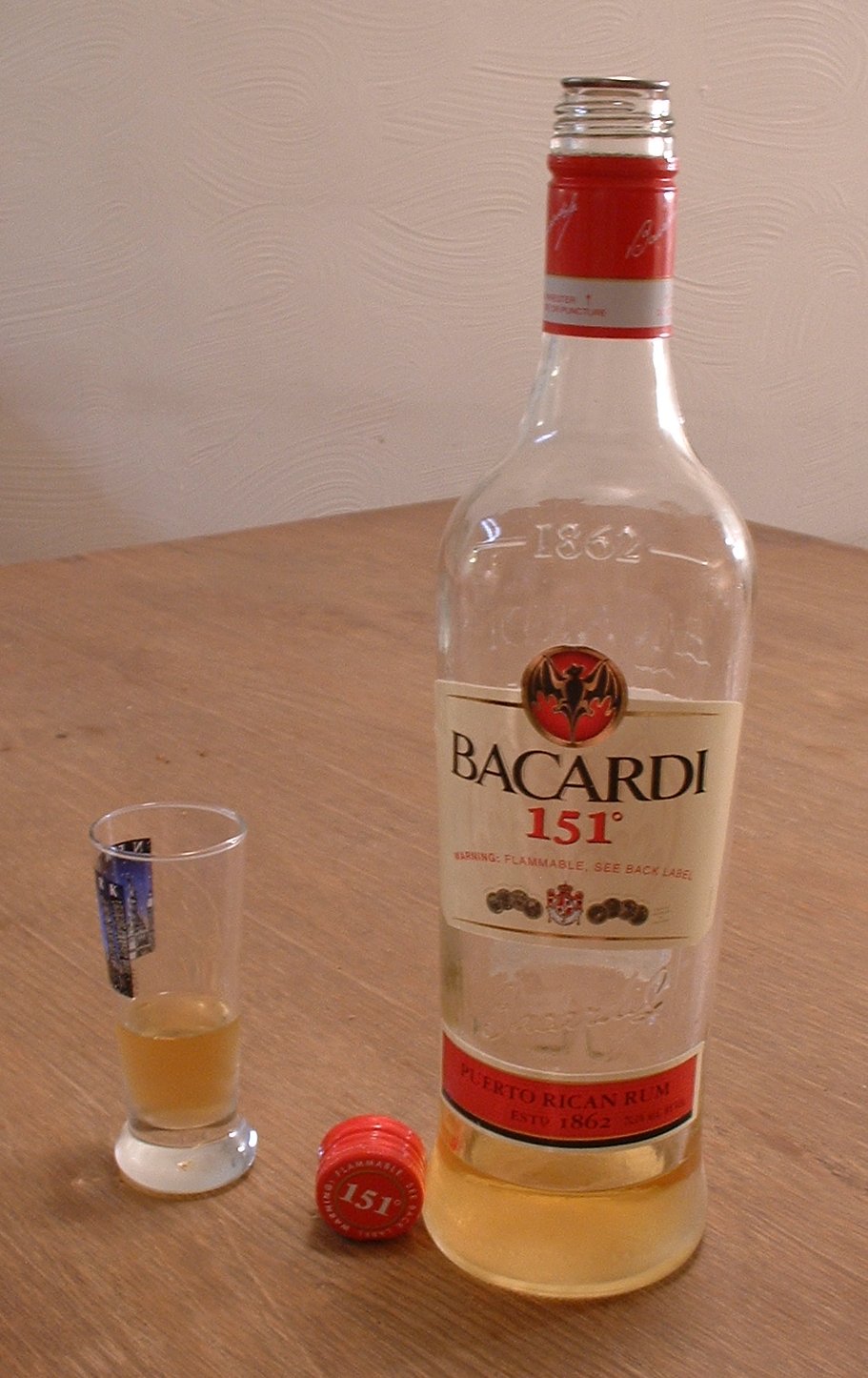
Alcohol proof (usually termed simply "proof" in relation to a beverage) is a measure of the content of ethanol (alcohol) in an alcoholic beverage. The term was originally used in England and from 1816 was equal to about 1.75 times the percentage of alcohol by volume (ABV). The United Kingdom today uses ABV instead of proof. The definition of proof in terms of ABV varies from country to country, for example in the United States, alcohol proof is defined as twice the percentage of ABV.
The measurement of alcohol content and the statement of content on bottles of alcoholic beverages is regulated by law in many countries. In 1972, Canada phased out the use of "proof"; in 1973, the European Union followed suit; and the United Kingdom, where the concept originated, started using ABV instead in 1980. The United States Code mandates the use of ABV, but permits proof to be used also.
The degree symbol (°) is sometimes used to indicate alcohol proof, either alone (e.g. 10°) or after a space and joined to the letter P as a unit name (e.g. 13 °P).
The term proof dates back to 16th century England, when spirits were taxed at different rates depending on their alcohol content. Similar terminology and methodology spread to other nations as spirit distillation, and taxation, became common. In England, spirits were originally tested with a basic "burn-or-no-burn" test, in which an alcohol-containing liquid that would ignite was said to be "above proof", and one which would not was said to be "under proof". A liquid just alcoholic enough to maintain combustion was defined as 100 proof and was the basis for taxation. Because the flash point of alcohol is highly dependent on temperature, 100 proof defined this way ranges from 20% at 36 °C (97 °F) to 96% at 13 °C (55 °F) alcohol by weight (ABW); at 24 °C (75 °F) 100 proof would be 50% ABW.
Another early method for testing liquor's alcohol content was the "gunpowder method". Gunpowder was soaked in a spirit, and if the gunpowder could still burn, the spirit was rated above proof. This test relies on the fact that potassium nitrate (a chemical in gunpowder) is significantly more soluble in water than in alcohol. While less influenced by temperature than the simpler burn-or-no-burn test, gunpowder tests also lacked true reproducibility. Factors including the grain size of gunpowder and the time it sat in the spirit impact the dissolution of potassium nitrate and therefore what would be defined as 100 proof. However, the gunpowder method is significantly less variable than the burn-or-no-burn method, and 100 proof defined by it is traditionally defined as 57.15% ABV.
By the end of the 17th century, England had introduced tests based on specific gravity for defining proof. However, it was not until 1816 that a legal standard based on specific density was defined in England. 100 proof was defined as a spirit with 12⁄13 the specific gravity of pure water at the same temperature. From the 19th century until 1 January 1980, the UK officially measured alcohol content by proof spirit, defined as spirit with a gravity of 12⁄13 that of water, or 923 kg/m3 (1,556 lb/cu yd), and equivalent to 57.15% ABV.
The value 57.15% is very close to the fraction 4⁄7 ≈ 0.5714. This led to the approximation that 100-proof spirit has an ABV of 4⁄7. From this, it follows that to convert the ABV expressed as a percentage to degrees proof, it is only necessary to multiply the ABV by 7⁄4. Thus pure 100% alcohol will have 100×(7⁄4) = 175 proof, and a spirit containing 40% ABV will have 40×(7⁄4) = 70 proof.
The proof system in the United States was established around 1848 and was based on percent alcohol rather than specific gravity. Fifty percent alcohol by volume was defined as 100 proof. This is different from 50% volume fraction (expressed as a percentage); the latter does not take into account change in volume on mixing, whereas the former does. To make 50% ABV from pure alcohol, one would take 50 parts of alcohol and dilute to 100 parts of solution with water, all the while mixing the solution. To make 50% alcohol by volume fraction, one would take 50 parts alcohol and 50 parts water, measured separately, and then mix them together. The resulting volume will not be 100 parts but between 96 and 97 parts, since the smaller water molecules can take up some of the space between the larger alcohol molecules (see volume change).
Hub AI
Alcohol proof AI simulator
(@Alcohol proof_simulator)
Alcohol proof
Alcohol proof (usually termed simply "proof" in relation to a beverage) is a measure of the content of ethanol (alcohol) in an alcoholic beverage. The term was originally used in England and from 1816 was equal to about 1.75 times the percentage of alcohol by volume (ABV). The United Kingdom today uses ABV instead of proof. The definition of proof in terms of ABV varies from country to country, for example in the United States, alcohol proof is defined as twice the percentage of ABV.
The measurement of alcohol content and the statement of content on bottles of alcoholic beverages is regulated by law in many countries. In 1972, Canada phased out the use of "proof"; in 1973, the European Union followed suit; and the United Kingdom, where the concept originated, started using ABV instead in 1980. The United States Code mandates the use of ABV, but permits proof to be used also.
The degree symbol (°) is sometimes used to indicate alcohol proof, either alone (e.g. 10°) or after a space and joined to the letter P as a unit name (e.g. 13 °P).
The term proof dates back to 16th century England, when spirits were taxed at different rates depending on their alcohol content. Similar terminology and methodology spread to other nations as spirit distillation, and taxation, became common. In England, spirits were originally tested with a basic "burn-or-no-burn" test, in which an alcohol-containing liquid that would ignite was said to be "above proof", and one which would not was said to be "under proof". A liquid just alcoholic enough to maintain combustion was defined as 100 proof and was the basis for taxation. Because the flash point of alcohol is highly dependent on temperature, 100 proof defined this way ranges from 20% at 36 °C (97 °F) to 96% at 13 °C (55 °F) alcohol by weight (ABW); at 24 °C (75 °F) 100 proof would be 50% ABW.
Another early method for testing liquor's alcohol content was the "gunpowder method". Gunpowder was soaked in a spirit, and if the gunpowder could still burn, the spirit was rated above proof. This test relies on the fact that potassium nitrate (a chemical in gunpowder) is significantly more soluble in water than in alcohol. While less influenced by temperature than the simpler burn-or-no-burn test, gunpowder tests also lacked true reproducibility. Factors including the grain size of gunpowder and the time it sat in the spirit impact the dissolution of potassium nitrate and therefore what would be defined as 100 proof. However, the gunpowder method is significantly less variable than the burn-or-no-burn method, and 100 proof defined by it is traditionally defined as 57.15% ABV.
By the end of the 17th century, England had introduced tests based on specific gravity for defining proof. However, it was not until 1816 that a legal standard based on specific density was defined in England. 100 proof was defined as a spirit with 12⁄13 the specific gravity of pure water at the same temperature. From the 19th century until 1 January 1980, the UK officially measured alcohol content by proof spirit, defined as spirit with a gravity of 12⁄13 that of water, or 923 kg/m3 (1,556 lb/cu yd), and equivalent to 57.15% ABV.
The value 57.15% is very close to the fraction 4⁄7 ≈ 0.5714. This led to the approximation that 100-proof spirit has an ABV of 4⁄7. From this, it follows that to convert the ABV expressed as a percentage to degrees proof, it is only necessary to multiply the ABV by 7⁄4. Thus pure 100% alcohol will have 100×(7⁄4) = 175 proof, and a spirit containing 40% ABV will have 40×(7⁄4) = 70 proof.
The proof system in the United States was established around 1848 and was based on percent alcohol rather than specific gravity. Fifty percent alcohol by volume was defined as 100 proof. This is different from 50% volume fraction (expressed as a percentage); the latter does not take into account change in volume on mixing, whereas the former does. To make 50% ABV from pure alcohol, one would take 50 parts of alcohol and dilute to 100 parts of solution with water, all the while mixing the solution. To make 50% alcohol by volume fraction, one would take 50 parts alcohol and 50 parts water, measured separately, and then mix them together. The resulting volume will not be 100 parts but between 96 and 97 parts, since the smaller water molecules can take up some of the space between the larger alcohol molecules (see volume change).