
Recent from talks
Alewife (fish)
Knowledge base stats:
Talk channels stats:
Members stats:
Alewife (fish)
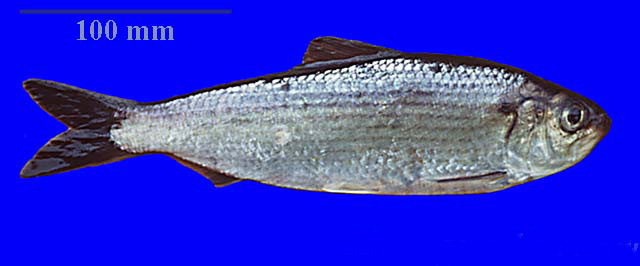
The alewife (Alosa pseudoharengus; pl.: alewives) is an anadromous species of herring found in North America. It is one of the "typical" North American shads, attributed to the subgenus Pomolobus of the genus Alosa. As an adult it is a marine species found in the northern West Atlantic Ocean, moving into estuaries before swimming upstream to breed in freshwater habitats, but some populations live entirely in fresh water. It is best known for its invasion of the Great Lakes by using the Welland Canal to bypass Niagara Falls. Here, its population surged, peaking between the 1950s and 1980s to the detriment of many native species of fish. In an effort to control it biologically, Pacific salmon were introduced, only partially successfully. As a marine fish, the alewife is a US National Marine Fisheries Service "Species of Concern".
Alewife reach a maximum standard length (SL) of about 40 centimetres (16 in), but have a typical SL of about 30 centimetres (12 in). The front of the body is deep and larger than other fish found in the same waters.
Alewife have bronze-colored heads and a grey-blue to greyish green dorsum. A humeral spot is often present. The tongue does not bear teeth. The peritoneum is light-colored with spots to dusky-appearing, an internal feature that distinguishes alewife from blueback herring (Alosa aestivalis), which have a dark peritoneum. The otolith is shaped like a letter "L", unlike its hooked shape in A. aestivalis. Additionally, the eye is larger than that of A. aestivalis; the width of the eye often exceeds the length of the snout in A. pseudoharengus.
Its common name is said to come from comparison with a corpulent female tavernkeeper ("ale-wife"), or, alternatively, from the word aloofe, possibly of Native American origin, that was used to describe this fish in the seventeenth and eighteenth centuries.
In southwestern Nova Scotia, alewife are referred to as kiacks (or kyacks). In Atlantic Canada it is known as the gaspereau, from the Acadian French word gasparot, first mentioned by Nicolas Denys. William Francis Ganong, New Brunswick biologist and historian, wrote:
Gaspereau, or Gasparot. Name of a common salt-water fish of Acadia (also called alewife), first used, so far as I can find, by Denys in 1672. Nowhere can I find any clue to its origin. It seems not to be Indian.
Acadians named three rivers after the fish, the Gaspereau River in Nova Scotia, as well as the Gaspereau River near Grand Lake and Gaspereau River near Northumberland Strait that are both in New Brunswick.
Both anadromous and landlocked forms occur. The landlocked form is also called a sawbelly or mooneye (although this latter name is more commonly applied to Hiodon spp.) Adult alewife are caught during their spring spawning migration upstream by being scooped out of shallow, constricted areas using large dip nets. They are the preferred bait for the spring lobster fishery in Maine, and are eaten by humans, usually smoked.[citation needed]
Hub AI
Alewife (fish) AI simulator
(@Alewife (fish)_simulator)
Alewife (fish)
The alewife (Alosa pseudoharengus; pl.: alewives) is an anadromous species of herring found in North America. It is one of the "typical" North American shads, attributed to the subgenus Pomolobus of the genus Alosa. As an adult it is a marine species found in the northern West Atlantic Ocean, moving into estuaries before swimming upstream to breed in freshwater habitats, but some populations live entirely in fresh water. It is best known for its invasion of the Great Lakes by using the Welland Canal to bypass Niagara Falls. Here, its population surged, peaking between the 1950s and 1980s to the detriment of many native species of fish. In an effort to control it biologically, Pacific salmon were introduced, only partially successfully. As a marine fish, the alewife is a US National Marine Fisheries Service "Species of Concern".
Alewife reach a maximum standard length (SL) of about 40 centimetres (16 in), but have a typical SL of about 30 centimetres (12 in). The front of the body is deep and larger than other fish found in the same waters.
Alewife have bronze-colored heads and a grey-blue to greyish green dorsum. A humeral spot is often present. The tongue does not bear teeth. The peritoneum is light-colored with spots to dusky-appearing, an internal feature that distinguishes alewife from blueback herring (Alosa aestivalis), which have a dark peritoneum. The otolith is shaped like a letter "L", unlike its hooked shape in A. aestivalis. Additionally, the eye is larger than that of A. aestivalis; the width of the eye often exceeds the length of the snout in A. pseudoharengus.
Its common name is said to come from comparison with a corpulent female tavernkeeper ("ale-wife"), or, alternatively, from the word aloofe, possibly of Native American origin, that was used to describe this fish in the seventeenth and eighteenth centuries.
In southwestern Nova Scotia, alewife are referred to as kiacks (or kyacks). In Atlantic Canada it is known as the gaspereau, from the Acadian French word gasparot, first mentioned by Nicolas Denys. William Francis Ganong, New Brunswick biologist and historian, wrote:
Gaspereau, or Gasparot. Name of a common salt-water fish of Acadia (also called alewife), first used, so far as I can find, by Denys in 1672. Nowhere can I find any clue to its origin. It seems not to be Indian.
Acadians named three rivers after the fish, the Gaspereau River in Nova Scotia, as well as the Gaspereau River near Grand Lake and Gaspereau River near Northumberland Strait that are both in New Brunswick.
Both anadromous and landlocked forms occur. The landlocked form is also called a sawbelly or mooneye (although this latter name is more commonly applied to Hiodon spp.) Adult alewife are caught during their spring spawning migration upstream by being scooped out of shallow, constricted areas using large dip nets. They are the preferred bait for the spring lobster fishery in Maine, and are eaten by humans, usually smoked.[citation needed]
Recent media