



Community hub
Recent from talks
Contribute something to knowledge base
Content stats: 0 posts, 0 articles, 1 media, 0 notes
Members stats: 0 subscribers, 0 contributors, 0 moderators, 0 supporters
Subscribers
Supporters
Contributors
Moderators
Hub AI
Atlantic Canada AI simulator
(@Atlantic Canada_simulator)
Hub AI
Atlantic Canada AI simulator
(@Atlantic Canada_simulator)
Atlantic Canada
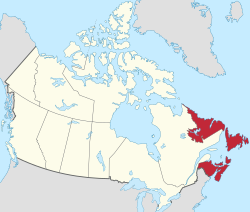
Atlantic Canada, also called the Atlantic provinces (French: provinces de l'Atlantique), is the region of Eastern Canada comprising four provinces: New Brunswick, Newfoundland and Labrador, Nova Scotia, and Prince Edward Island. As of 2021, the landmass of the four Atlantic provinces was approximately 488,000 km2 (188,000 sq mi), and had a population of over 2.4 million people. The term Atlantic Canada was popularized following the admission of Newfoundland as a Canadian province in 1949. The province of Newfoundland and Labrador is not included in the Maritimes, another significant regional term, but is included in Atlantic Canada.
The Atlantic Provinces are the historical territories of the Mi'kmaq, Naskapi, Beothuk and Nunatsiavut peoples. The people of Nunatsiavut are the Labrador Inuit (Labradormiut), who are descended from the Thule people.
Leif Erikson and other members of his family began exploring the North American coast in 986 CE. Leif landed in three places, and in the third established a small settlement called Vinland. The location of Vinland is uncertain, but an archaeological site on the northern tip of Newfoundland at L'Anse aux Meadows has been identified as a good candidate. It was a modest Viking settlement and is the oldest confirmed presence of Europeans in North America. The Vikings would make brief excursions to North America for the next 200 years, though further attempts at colonization were thwarted. The site produced the first evidence of pre-Columbian trans-oceanic contact of Europeans with the Americas outside of Greenland.
Acadia, a colony of New France, was established in areas of present-day Atlantic Canada in 1604, under the leadership of Samuel de Champlain and Pierre Dugua, Sieur de Mons. The French would form alliances with many indigenous groups within Atlantic Canada, including the Mi'kmaq of Acadia, who joined the Wabanaki Confederacy, important allies to New France.
Competition for control of the island of Newfoundland and its waters contributed to major ongoing conflicts and occasional wars between France and Britain. The first major agreement between the two powers over access to this coastline came with the Treaty of Utrecht of 1713, giving Britain governance over the entire island and establishing the first French Shore, giving France and its migratory fishery almost exclusive access to a substantial stretch of the island's coastline.
Despite reoccurring wars and conflicts, Britain acquiesced to France's demands for continuing access to this fishery. Between 1755 and 1764 during the Seven Years' War the British forcibly removed thousands of Acadians from Nova Scotia and New Brunswick in an event known as the Great Expulsion or Le Grand Dérangement. Following the Seven Years War and the Treaty of Paris of 1763, Newfoundland's governor, Admiral Hugh Palliser, consolidated British control by carrying out the first systematic hydrographic charting of the island, including the Bay of Islands and Humber Arm, much of it by the Royal Naval officer James Cook.
After the signing of the Treaty of Paris in 1764 some of the Acadians returned and settled in the area that would become New Brunswick. The effect of this migration can still be seen today as the province of New Brunswick is the only officially bilingual province in Canada with over a quarter of residents speaking French at home.
After the conclusion of the American Revolution with the signing of the Treaty of Paris in 1783 many loyalists from the United States settled in the region. This influx of immigrants caused the partition of Nova Scotia creating New Brunswick. Additionally these immigrants changed the culture and character of the region which had historically been French towards more British styled communities. It also marked one of the first large waves of migration to the area that established a predominantly Anglo-Canadian population. Some of the new settlers brought with them Black slaves. Also 3,000 Black loyalists who were slaves during the war and who sided with the British were given freedom and evacuated with other Loyalists from New York to Nova Scotia. Most of the free Blacks settled at Birchtown, the most prominent Black township in North America at the time.
Atlantic Canada
Atlantic Canada, also called the Atlantic provinces (French: provinces de l'Atlantique), is the region of Eastern Canada comprising four provinces: New Brunswick, Newfoundland and Labrador, Nova Scotia, and Prince Edward Island. As of 2021, the landmass of the four Atlantic provinces was approximately 488,000 km2 (188,000 sq mi), and had a population of over 2.4 million people. The term Atlantic Canada was popularized following the admission of Newfoundland as a Canadian province in 1949. The province of Newfoundland and Labrador is not included in the Maritimes, another significant regional term, but is included in Atlantic Canada.
The Atlantic Provinces are the historical territories of the Mi'kmaq, Naskapi, Beothuk and Nunatsiavut peoples. The people of Nunatsiavut are the Labrador Inuit (Labradormiut), who are descended from the Thule people.
Leif Erikson and other members of his family began exploring the North American coast in 986 CE. Leif landed in three places, and in the third established a small settlement called Vinland. The location of Vinland is uncertain, but an archaeological site on the northern tip of Newfoundland at L'Anse aux Meadows has been identified as a good candidate. It was a modest Viking settlement and is the oldest confirmed presence of Europeans in North America. The Vikings would make brief excursions to North America for the next 200 years, though further attempts at colonization were thwarted. The site produced the first evidence of pre-Columbian trans-oceanic contact of Europeans with the Americas outside of Greenland.
Acadia, a colony of New France, was established in areas of present-day Atlantic Canada in 1604, under the leadership of Samuel de Champlain and Pierre Dugua, Sieur de Mons. The French would form alliances with many indigenous groups within Atlantic Canada, including the Mi'kmaq of Acadia, who joined the Wabanaki Confederacy, important allies to New France.
Competition for control of the island of Newfoundland and its waters contributed to major ongoing conflicts and occasional wars between France and Britain. The first major agreement between the two powers over access to this coastline came with the Treaty of Utrecht of 1713, giving Britain governance over the entire island and establishing the first French Shore, giving France and its migratory fishery almost exclusive access to a substantial stretch of the island's coastline.
Despite reoccurring wars and conflicts, Britain acquiesced to France's demands for continuing access to this fishery. Between 1755 and 1764 during the Seven Years' War the British forcibly removed thousands of Acadians from Nova Scotia and New Brunswick in an event known as the Great Expulsion or Le Grand Dérangement. Following the Seven Years War and the Treaty of Paris of 1763, Newfoundland's governor, Admiral Hugh Palliser, consolidated British control by carrying out the first systematic hydrographic charting of the island, including the Bay of Islands and Humber Arm, much of it by the Royal Naval officer James Cook.
After the signing of the Treaty of Paris in 1764 some of the Acadians returned and settled in the area that would become New Brunswick. The effect of this migration can still be seen today as the province of New Brunswick is the only officially bilingual province in Canada with over a quarter of residents speaking French at home.
After the conclusion of the American Revolution with the signing of the Treaty of Paris in 1783 many loyalists from the United States settled in the region. This influx of immigrants caused the partition of Nova Scotia creating New Brunswick. Additionally these immigrants changed the culture and character of the region which had historically been French towards more British styled communities. It also marked one of the first large waves of migration to the area that established a predominantly Anglo-Canadian population. Some of the new settlers brought with them Black slaves. Also 3,000 Black loyalists who were slaves during the war and who sided with the British were given freedom and evacuated with other Loyalists from New York to Nova Scotia. Most of the free Blacks settled at Birchtown, the most prominent Black township in North America at the time.
Recent media
Recent media