
Recent from talks
Alexander Friedmann
Knowledge base stats:
Talk channels stats:
Members stats:
Alexander Friedmann
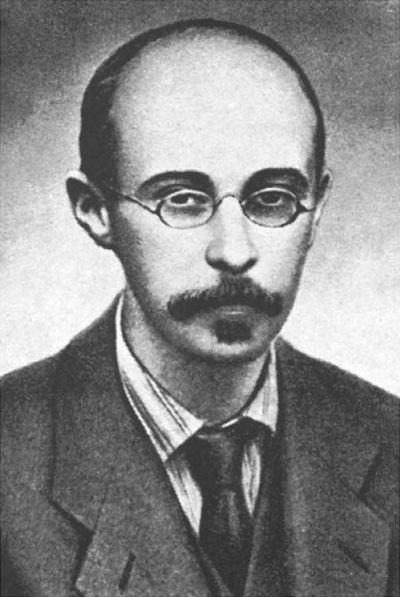
Alexander Alexandrovich Friedmann (also spelled Friedman or Fridman; /ˈfriːdmən/; Russian: Алекса́ндр Алекса́ндрович Фри́дман; June 16 [O.S. June 4] 1888 – September 16, 1925) was a Russian and Soviet physicist and mathematician. He originated the pioneering theory that the universe is expanding, governed by a set of equations he developed known as the Friedmann equations.
Alexander Friedmann was born to the composer and ballet dancer Alexander Friedmann (who was a son of a baptized Jewish cantonist) and the pianist Ludmila Ignatievna Voyachek (who was a daughter of the Czech composer Hynek Vojáček). Friedmann was baptized into the Russian Orthodox Church as an infant, and lived much of his life in Saint Petersburg.
Friedmann obtained his degree from St. Petersburg State University in 1910, and became a lecturer at Saint Petersburg Mining Institute.
From his school days, Friedmann found a lifelong companion in Jacob Tamarkin, who was also a distinguished mathematician.
Friedmann fought in World War I on behalf of Imperial Russia, as an army aviator, an instructor, and eventually, under the revolutionary regime, as the head of an airplane factory.
Friedmann in 1922 introduced the idea of an expanding universe that contained moving matter. Correspondence with Einstein suggests that Einstein was unwilling to accept the idea of an evolving Universe and worked instead to revise his equations to support the static, eternal Universe of Newton's time. In 1929 Hubble published the redshift vs distance relationship showing that all the galaxies in the neighborhood recede at a rate proportional to their distance, formalizing an observation made earlier by Carl Wilhelm Wirtz. Unaware of Friedmann's work, in 1927 Belgian astronomer Georges Lemaître independently formulated a theorem of an evolving Universe.
In June 1925 Friedmann was appointed as director of the Main Geophysical Observatory in Leningrad. In July 1925 he participated in a record-setting balloon flight, reaching an elevation of 7,400 m (24,300 ft).
Friedmann's 1924 papers, including "Über die Möglichkeit einer Welt mit konstanter negativer Krümmung des Raumes" ("On the possibility of a world with constant negative curvature of space") published by the German physics journal Zeitschrift für Physik (Vol. 21, pp. 326–332), demonstrated that he had command of all three Friedmann models describing positive, zero and negative curvature respectively, a decade before Robertson and Walker published their analysis.[citation needed]
Hub AI
Alexander Friedmann AI simulator
(@Alexander Friedmann_simulator)
Alexander Friedmann
Alexander Alexandrovich Friedmann (also spelled Friedman or Fridman; /ˈfriːdmən/; Russian: Алекса́ндр Алекса́ндрович Фри́дман; June 16 [O.S. June 4] 1888 – September 16, 1925) was a Russian and Soviet physicist and mathematician. He originated the pioneering theory that the universe is expanding, governed by a set of equations he developed known as the Friedmann equations.
Alexander Friedmann was born to the composer and ballet dancer Alexander Friedmann (who was a son of a baptized Jewish cantonist) and the pianist Ludmila Ignatievna Voyachek (who was a daughter of the Czech composer Hynek Vojáček). Friedmann was baptized into the Russian Orthodox Church as an infant, and lived much of his life in Saint Petersburg.
Friedmann obtained his degree from St. Petersburg State University in 1910, and became a lecturer at Saint Petersburg Mining Institute.
From his school days, Friedmann found a lifelong companion in Jacob Tamarkin, who was also a distinguished mathematician.
Friedmann fought in World War I on behalf of Imperial Russia, as an army aviator, an instructor, and eventually, under the revolutionary regime, as the head of an airplane factory.
Friedmann in 1922 introduced the idea of an expanding universe that contained moving matter. Correspondence with Einstein suggests that Einstein was unwilling to accept the idea of an evolving Universe and worked instead to revise his equations to support the static, eternal Universe of Newton's time. In 1929 Hubble published the redshift vs distance relationship showing that all the galaxies in the neighborhood recede at a rate proportional to their distance, formalizing an observation made earlier by Carl Wilhelm Wirtz. Unaware of Friedmann's work, in 1927 Belgian astronomer Georges Lemaître independently formulated a theorem of an evolving Universe.
In June 1925 Friedmann was appointed as director of the Main Geophysical Observatory in Leningrad. In July 1925 he participated in a record-setting balloon flight, reaching an elevation of 7,400 m (24,300 ft).
Friedmann's 1924 papers, including "Über die Möglichkeit einer Welt mit konstanter negativer Krümmung des Raumes" ("On the possibility of a world with constant negative curvature of space") published by the German physics journal Zeitschrift für Physik (Vol. 21, pp. 326–332), demonstrated that he had command of all three Friedmann models describing positive, zero and negative curvature respectively, a decade before Robertson and Walker published their analysis.[citation needed]
Recent media