
Hubbry Logo
MathematicianMathematicianMain
Open search
Mathematician
Community hub
Mathematician
logo
8 pages, 0 posts
0 subscribers
Be the first to start a discussion here.
Contribute something
Mathematician
Mathematician
from Wikipedia
Mathematician
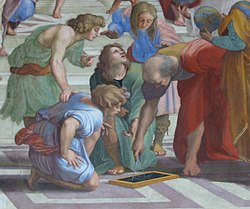
Euclid (holding calipers), Greek mathematician, known as the "Father of Geometry"
Occupation
Occupation type
Academic
Description
CompetenciesMathematics, analytical skills and critical thinking skills
Education required
Doctoral degree, occasionally master's degree
Fields of
employment
universities,
private corporations,
financial industry,
government
Related jobs
statistician, actuary

A mathematician is someone who uses an extensive knowledge of mathematics in their work, typically to solve mathematical problems. Mathematicians are concerned with numbers, data, quantity, structure, space, models, and change.

History

[edit]

One of the earliest known mathematicians was Thales of Miletus (c. 624 – c. 546 BC); he has been hailed as the first true mathematician and the first known individual to whom a mathematical discovery has been attributed.[1] He is credited with the first use of deductive reasoning applied to geometry, by deriving four corollaries to Thales's theorem.

The number of known mathematicians grew when Pythagoras of Samos (c. 582 – c. 507 BC) established the Pythagorean school, whose doctrine it was that mathematics ruled the universe and whose motto was "All is number".[2] It was the Pythagoreans who coined the term "mathematics", and with whom the study of mathematics for its own sake begins.

The first woman mathematician recorded by history was Hypatia of Alexandria (c. AD 350 – 415). She succeeded her father as librarian at the Great Library and wrote many works on applied mathematics. Because of a political dispute, the Christian community in Alexandria punished her, presuming she was involved, by stripping her naked and scraping off her skin with clamshells (some say roofing tiles).[3]

Science and mathematics in the Islamic world during the Middle Ages followed various models and modes of funding varied based primarily on scholars. It was extensive patronage and strong intellectual policies implemented by specific rulers that allowed scientific knowledge to develop in many areas. Funding for translation of scientific texts in other languages was ongoing throughout the reign of certain caliphs,[4] and it turned out that certain scholars became experts in the works they translated, and in turn received further support for continuing to develop certain sciences. As these sciences received wider attention from the elite, more scholars were invited and funded to study particular sciences. An example of a translator and mathematician who benefited from this type of support was Al-Khawarizmi. A notable feature of many scholars working under Muslim rule in medieval times is that they were often polymaths. Examples include the work on optics, maths and astronomy of Ibn al-Haytham.

The Renaissance brought an increased emphasis on mathematics and science to Europe. During this period of transition from a mainly feudal and ecclesiastical culture to a predominantly secular one, many notable mathematicians had other occupations: Luca Pacioli (founder of accounting); Niccolò Fontana Tartaglia (notable engineer and bookkeeper); Gerolamo Cardano (earliest founder of probability and binomial expansion); Robert Recorde (physician) and François Viète (lawyer).

As time passed, many mathematicians gravitated towards universities. An emphasis on free thinking and experimentation had begun in Britain's oldest universities beginning in the seventeenth century at Oxford with the scientists Robert Hooke and Robert Boyle, and at Cambridge where Isaac Newton was Lucasian Professor of Mathematics & Physics. Moving into the 19th century, the objective of universities all across Europe evolved from teaching the "regurgitation of knowledge" to "encourag[ing] productive thinking."[5] In 1810, Alexander von Humboldt convinced the king of Prussia, Fredrick William III, to build a university in Berlin based on Friedrich Schleiermacher's liberal ideas; the goal was to demonstrate the process of the discovery of knowledge and to teach students to "take account of fundamental laws of science in all their thinking." Thus, seminars and laboratories started to evolve.[6]

British universities of this period adopted some approaches familiar to the Italian and German universities, but as they already enjoyed substantial freedoms and autonomy the changes there had begun with the Age of Enlightenment, the same influences that inspired Humboldt. The Universities of Oxford and Cambridge emphasized the importance of research, arguably more authentically implementing Humboldt's idea of a university than even German universities, which were subject to state authority.[7] Overall, science (including mathematics) became the focus of universities in the 19th and 20th centuries. Students could conduct research in seminars or laboratories and began to produce doctoral theses with more scientific content.[8] According to Humboldt, the mission of the University of Berlin was to pursue scientific knowledge.[9] The German university system fostered professional, bureaucratically regulated scientific research performed in well-equipped laboratories, instead of the kind of research done by private and individual scholars in Great Britain and France.[10] In fact, Rüegg asserts that the German system is responsible for the development of the modern research university because it focused on the idea of "freedom of scientific research, teaching and study."[11]

Required education

[edit]

Mathematicians usually cover a breadth of topics within mathematics in their undergraduate education, and then proceed to specialize in topics of their own choice at the graduate level. In some universities, a qualifying exam serves to test both the breadth and depth of a student's understanding of mathematics; the students who pass are permitted to work on a doctoral dissertation.

Activities

[edit]
Emmy Noether, mathematical theorist and teacher

Applied mathematics

[edit]

Mathematicians involved with solving problems with applications in real life are called applied mathematicians. Applied mathematicians are mathematical scientists who, with their specialized knowledge and professional methodology, approach many of the imposing problems presented in related scientific fields. With professional focus on a wide variety of problems, theoretical systems, and localized constructs, applied mathematicians work regularly in the study and formulation of mathematical models. Mathematicians and applied mathematicians are considered to be two of the STEM (science, technology, engineering, and mathematics) careers.[12]

The discipline of applied mathematics concerns itself with mathematical methods that are typically used in science, engineering, business, and industry; thus, "applied mathematics" is a mathematical science with specialized knowledge. The term "applied mathematics" also describes the professional specialty in which mathematicians work on problems, often concrete but sometimes abstract. As professionals focused on problem solving, applied mathematicians look into the formulation, study, and use of mathematical models in science, engineering, business, and other areas of mathematical practice.

Pure mathematics

[edit]

Pure mathematics is mathematics that studies entirely abstract concepts. From the eighteenth century onwards, this was a recognized category of mathematical activity, sometimes characterized as speculative mathematics,[13] and at variance with the trend towards meeting the needs of navigation, astronomy, physics, economics, engineering, and other applications.

Another insightful view put forth is that pure mathematics is not necessarily applied mathematics: it is possible to study abstract entities with respect to their intrinsic nature, and not be concerned with how they manifest in the real world.[14] Even though the pure and applied viewpoints are distinct philosophical positions, in practice there is much overlap in the activity of pure and applied mathematicians.

To develop accurate models for describing the real world, many applied mathematicians draw on tools and techniques that are often considered to be "pure" mathematics. On the other hand, many pure mathematicians draw on natural and social phenomena as inspiration for their abstract research.

Mathematics teaching

[edit]

Many professional mathematicians also engage in the teaching of mathematics. Duties may include:

  • teaching university mathematics courses;
  • supervising undergraduate and graduate research; and
  • serving on academic committees.

Consulting

[edit]

Many careers in mathematics outside of universities involve consulting. For instance, actuaries assemble and analyze data to estimate the probability and likely cost of the occurrence of an event such as death, sickness, injury, disability, or loss of property. Actuaries also address financial questions, including those involving the level of pension contributions required to produce a certain retirement income and the way in which a company should invest resources to maximize its return on investments in light of potential risk. Using their broad knowledge, actuaries help design and price insurance policies, pension plans, and other financial strategies in a manner which will help ensure that the plans are maintained on a sound financial basis.

As another example, mathematical finance will derive and extend the mathematical or numerical models without necessarily establishing a link to financial theory, taking observed market prices as input. Mathematical consistency is required, not compatibility with economic theory. Thus, for example, while a financial economist might study the structural reasons why a company may have a certain share price, a financial mathematician may take the share price as a given, and attempt to use stochastic calculus to obtain the corresponding value of derivatives of the stock (see: Valuation of options; Financial modeling).

Occupations

[edit]
In 1938 in the United States, mathematicians were desired as teachers, calculating machine operators, mechanical engineers, accounting auditor bookkeepers, and actuary statisticians.

According to the Dictionary of Occupational Titles occupations in mathematics include the following.[15]

Prizes in mathematics

[edit]

There is no Nobel Prize in mathematics, though sometimes mathematicians have won the Nobel Prize in a different field, such as economics or physics. Prominent prizes in mathematics include the Abel Prize, the Chern Medal, the Fields Medal, the Gauss Prize, the Nemmers Prize, the Balzan Prize, the Crafoord Prize, the Shaw Prize, the Steele Prize, the Wolf Prize, the Schock Prize, and the Nevanlinna Prize.

The American Mathematical Society, Association for Women in Mathematics, and other mathematical societies offer several prizes aimed at increasing the representation of women and minorities in the future of mathematics.[16][17]

Mathematical autobiographies

[edit]

Several well known mathematicians have written autobiographies in part to explain to a general audience what it is about mathematics that has made them want to devote their lives to its study. These provide some of the best glimpses into what it means to be a mathematician. The following list contains some works that are not autobiographies, but rather essays on mathematics and mathematicians with strong autobiographical elements.

See also

[edit]

Notes

[edit]

Bibliography

[edit]

Further reading

[edit]
[edit]
Revisions and contributorsEdit on WikipediaRead on Wikipedia
from Grokipedia
A mathematician is a specialist or expert in , someone who studies, teaches, or applies advanced knowledge of the discipline to explore patterns, formulate conjectures, prove theorems, and solve complex problems across diverse fields. These professionals engage in , focusing on abstract concepts like , , and , or , where they develop models for real-world phenomena in areas such as physics, engineering, economics, and . The role of mathematicians traces back to ancient civilizations, where early practitioners in , , , , and laid foundational work in arithmetic, , and astronomy around 1700 B.C.E., with figures like documenting practical calculations and introducing deductive reasoning in the 6th century B.C.E. In , mathematicians such as , , and advanced and , establishing principles like the and the axiomatic method that remain central to the field. During the medieval period, scholars in the Islamic world, including —who contributed to and algorithms—and , preserved and expanded Greek knowledge while introducing innovations in and . The and Enlightenment eras saw European mathematicians like René Descartes, , and Leonhard Euler integrate mathematics with physics, developing and that revolutionized science. In the modern era, mathematicians have profoundly influenced technology and society, with contributions spanning cryptography, computing, and space exploration. Alan Turing's work on computability and algorithms in the 1930s and 1940s laid the groundwork for modern computers and artificial intelligence. Emmy Noether's theorems in the early 20th century connected symmetries in physics to conservation laws, impacting fields from quantum mechanics to general relativity. Katherine Johnson's precise trajectory calculations enabled key NASA missions, including the Apollo program, demonstrating mathematics' role in aerospace engineering. Today, mathematicians drive innovations in data science, cybersecurity, and machine learning, underscoring mathematics as the conceptual foundation for scientific and technological progress.

Overview

Definition

A is a who studies, creates, and applies mathematical knowledge, with a primary focus on , logic, and rigorous proof to explore patterns, structures, and relationships. This involves formulating conjectures, establishing theorems through from axioms, and developing tools that underpin diverse fields, emphasizing conceptual depth over empirical . The term "mathematician" derives from the ancient Greek mathēmatikos, an adjective meaning "fond of learning" or "relating to learning," stemming from mathēma ("knowledge" or "science") and evolving through Latin mathematicus to denote specialists in the study of quantity, structure, space, and change. Estimates suggest there are around 80,000 professional mathematicians worldwide. In contrast to scientists, who rely on empirical testing, observation, and falsifiability to validate hypotheses about the natural world, mathematicians prioritize self-consistent theoretical frameworks built on logical deduction, making mathematics a foundational yet distinct discipline. Similarly, while engineers apply mathematical models to practical design, construction, and optimization of systems, mathematicians concentrate on the formulation, analysis, and generalization of those models themselves, often exploring their abstract properties independent of real-world constraints. Central attributes of mathematicians include exceptional proficiency in mathematical reasoning, , and the ability to handle high levels of , enabling them to uncover profound insights such as the proof of , which states that no three positive integers aa, bb, and cc satisfy an+bn=cna^n + b^n = c^n for any value of n>2n > 2. These skills foster a oriented toward precision, persistence in tackling complex puzzles, and the synthesis of ideas into elegant, generalizable solutions.

Societal Role

Mathematicians play a pivotal in by developing foundational tools that underpin technological advancements, economic , and scientific , extending their influence far beyond academic settings. Their work enables secure digital communications, efficient , and predictive modeling of complex systems, fostering and problem-solving across industries. In technology, mathematicians have profoundly shaped and through algorithms and cryptographic methods. For instance, foundational algorithms like those for shortest-path in networks stem from , optimizing data transmission in modern infrastructure. In cryptography, mathematical constructs such as elliptic curves and lattice-based problems form the basis for post-quantum encryption standards, protecting sensitive data against emerging quantum threats; the National Institute of Standards and Technology selected four such algorithms in 2022 and published three as final standards (FIPS 203, 204, and 205) in August 2024, with the fourth (FIPS 206 based on ) finalized in 2025, ensuring robust cybersecurity. These contributions safeguard global digital economies, where underpins secure transactions and privacy in everyday applications like . Mathematicians also drive economic and policy frameworks by providing statistical models for and optimization techniques for . Econometric models, rooted in probability and linear algebra, enable precise predictions of market trends and , informing policies and fiscal strategies worldwide. In , and algorithms minimize costs in supply chains, as seen in scheduling and management, enhancing efficiency and reducing environmental impacts through better resource use. These tools support evidence-based policymaking, such as in trade agreements, by quantifying uncertainties and optimizing outcomes. Contributions to science are exemplified by the use of differential equations in modeling natural phenomena, bridging abstract mathematics with empirical observation. These equations describe dynamic systems, such as population growth in ecology or fluid dynamics in weather patterns, allowing scientists to simulate and predict real-world behaviors with high fidelity. In physics, partial differential equations underpin models of heat transfer and wave propagation, essential for engineering designs like earthquake-resistant structures. This mathematical framework has revolutionized scientific discovery by providing quantitative rigor to qualitative insights. As of 2025, mathematicians' influence is increasingly evident in , , and climate modeling, addressing pressing global challenges. In AI, linear algebra and optimization algorithms power neural networks, enabling breakthroughs in for autonomous systems and medical diagnostics. relies on and probabilistic models developed by mathematicians to extract insights from vast datasets, informing and . For climate modeling, AI-enhanced differential equations improve simulations of ocean currents and , as demonstrated by initiatives like the NSF's Community Research Digital Intelligence Twin, which democratizes access to predictive tools for mitigating disasters. These advancements underscore ' ongoing role in and technological resilience.

Historical Development

Ancient Origins

The origins of mathematics trace back to prehistoric times, where early humans developed rudimentary methods to manage resources and trade. In ancient , around 3000 BCE, the Sumerians introduced one of the earliest known numerical systems using clay and impressed marks on tablets, forming the basis of a (base-60) that facilitated accounting and astronomical calculations. This system evolved from simple tallies into inscriptions, enabling the recording of quantities for goods and land measurements. In parallel, ancient Egyptian mathematics emphasized practical for monumental , particularly the of around 2600 BCE. Egyptian scribes used empirical methods to calculate areas and volumes, such as approximating the slope () of pyramid faces to ensure stability and alignment, as documented in papyri like the (c. 1650 BCE). These techniques involved ratios and basic without formal proofs, focusing on proportions to achieve precise alignments with the cardinal directions. The classical era in Greece marked a shift toward deductive reasoning and axiomatic systems, beginning with figures like (c. 624–546 BCE), who is credited with introducing geometric proofs to the West. Thales demonstrated theorems such as the bisection of a circle by its diameter and the equality of base angles in isosceles triangles, using similarity and interception to measure distances, including the height of pyramids via shadows. The Pythagorean school (c. 530 BCE) advanced this by proving the geometrically: in a right triangle with legs aa and bb and hypotenuse cc, a2+b2=c2a^2 + b^2 = c^2, often via rearrangement of areas in squares. Euclid synthesized these developments in Elements (c. 300 BCE), establishing a rigorous axiomatic framework with definitions, postulates, and proofs for plane and solid geometry. Archimedes (c. 287–212 BCE) extended these ideas to advanced theorems on circles and volumes, proving that a circle's area equals πr2\pi r^2 (where π\pi is approximated between 310713\frac{10}{71} and 3173\frac{1}{7}) and a sphere's volume is 43πr3\frac{4}{3}\pi r^3, using methods of exhaustion and mechanical balances. Meanwhile, in Asia, independent advancements flourished. In China, the Nine Chapters on the Mathematical Art (c. 200 BCE) included methods for solving quadratic equations through geometric constructions and algebraic manipulations, such as completing the square for problems involving areas and right triangles. In India, the concept of zero emerged as both a placeholder and an independent number by the 7th century CE, formalized by Brahmagupta in Brahmasphutasiddhanta (628 CE), who defined arithmetic operations like aa=0a - a = 0 and rules for zero in equations, enabling the decimal positional system. These innovations laid foundational principles for later mathematical abstraction.

Medieval Developments

The medieval period (c. 5th–15th centuries) featured significant mathematical progress, particularly during the Islamic Golden Age (8th–13th centuries), where scholars in the Abbasid Caliphate synthesized and advanced ancient Greek, Indian, and Persian knowledge. In Baghdad's House of Wisdom, Muhammad ibn Musa al-Khwarizmi (c. 780–850) authored Al-Kitab al-Mukhtasar fi Hisab al-Jabr wal-Muqabala (c. 820), establishing algebra as a systematic discipline for solving linear and quadratic equations, with "al-jabr" referring to restoration of balances. His works also introduced algorithms, named after his Latinized name Algoritmi. Omar Khayyam (1048–1131) developed geometric solutions for cubic equations and refined the Persian calendar using intersection of conic sections. Islamic mathematicians like al-Biruni (973–1048) advanced trigonometry with accurate sine tables and spherical astronomy, while preserving Euclid's Elements through commentaries. These translations into Latin in 12th-century Europe, via Toledo and Sicily, transmitted knowledge that fueled the Renaissance. In , mathematics emphasized practical applications for , , and astronomy. Italian mathematician Leonardo (c. 1170–1250) promoted Hindu-Arabic numerals in (1202), including the for modeling population growth, revolutionizing calculation from . In , Bhāskara II (1114–1185) contributed to algebra and trigonometry in Lilavati (1150), with early approximations of pi using infinite series. Chinese mathematics during the (960–1279) advanced algebraic methods, such as the "Horner method" precursor for root extraction in Mathematical Treatise in Nine Sections (1247).

Modern Evolution

The Renaissance marked a revival in mathematical thought, building on classical foundations with renewed emphasis on algebraic methods and geometric innovation. In 1545, Italian mathematician published Ars Magna, which introduced systematic solutions to cubic and quartic equations, including the use of complex numbers despite their counterintuitive nature, thereby advancing beyond quadratic forms. This work formalized techniques for handling irreducible cases in cubics, influencing subsequent algebraic developments. Complementing these advances, ' La Géométrie (1637) established by linking algebraic equations to geometric curves through coordinate systems, enabling the representation of loci as equations and transforming into an algebraic discipline. The 19th century brought a push toward rigor in , addressing foundational ambiguities in inherited from the . , in his Cours d'analyse (1821), introduced the modern definition of the limit using epsilon-delta arguments, providing a precise basis for derivatives and integrals without relying on infinitesimals. further refined this framework in his Berlin lectures during the 1850s–1870s, emphasizing and to solidify the epsilon-delta approach across . Concurrently, emerged as mathematicians like and explored group structures and solvability by radicals, shifting focus from specific equations to general algebraic systems and laying groundwork for ring and field theories. The 20th century expanded mathematics into foundational crises and new interdisciplinary fields. Kurt Gödel's incompleteness theorems, published in 1931, demonstrated that any consistent capable of basic arithmetic contains unprovable truths, profoundly impacting the by undermining for complete axiomatization. This revelation spurred developments in and . Simultaneously, gained prominence through Henri Poincaré's work in the late 19th and early 20th centuries, evolving into with tools like homology for classifying spaces, while emerged as a mathematical subfield, driven by Alan Turing's 1936 and post-war applications in algorithms and . Institutional growth paralleled these intellectual shifts, professionalizing mathematics as a discipline. Reforms at the in the early , influenced by the Analytical Society (founded ), modernized mathematical education by adopting continental methods and notation, enhancing the prestige of the . The Lucasian Chair of , established in 1663 and held by from 1669 to 1701, exemplified early institutional support. The Faculty of Mathematics was organized into dedicated departments around 1960. Post-World War II, boomed as a applied mathematical field, originating from wartime Allied efforts in optimization and logistics, leading to techniques like formalized by in 1947 and widespread adoption in industry and government. This era saw exponential growth in mathematical societies, journals, and funding, cementing mathematics' role in science and technology.

Education and Training

Academic Requirements

To become a professional mathematician, the foundational educational pathway starts at the undergraduate level with a in mathematics or a related field such as physics or . This degree typically requires completion of core courses including single- and , linear algebra, and , which build essential analytical foundations. In the United States, such programs generally span four years and emphasize a broad to prepare students for advanced study or entry-level positions. Graduate education is often necessary for research-oriented or advanced roles, progressing from a to a PhD in . The , usually lasting one to two years, involves advanced coursework and may include a , while the PhD requires original , comprehensive examinations, and a dissertation demonstrating novel contributions to the field. PhD programs typically take 4 to 7 years after the , with candidates often serving as teaching assistants and passing qualifying exams in areas like and . For applied mathematics positions in industry, alternative certifications or degrees may suffice, such as a bachelor's or master's in statistics, , or with a substantial mathematics component, focusing on practical applications like modeling and computation. These paths prioritize quantitative skills over pure theoretical and are common in sectors like and . Educational structures vary globally, with European programs often more rigorous and specialized compared to the flexible, generalist approach in the U.S. For instance, institutions like the in offer highly selective three-year undergraduate programs leading to a equivalent to a master's, emphasizing intensive training from entry. In contrast, U.S. curricula allow greater breadth and elective choices during the four-year bachelor's, while European PhDs are typically shorter at three years, focusing directly on research without a separate master's phase in some countries.

Essential Skills

Mathematicians rely on a suite of core cognitive and analytical abilities to advance knowledge and solve complex problems. These skills enable the rigorous construction of arguments, manipulation of intangible concepts, and integration of computational methods, forming the foundation of mathematical practice across disciplines. Proficiency in these areas distinguishes mathematicians and supports their contributions to both theoretical and applied domains. stands as a cornerstone skill, involving the construction and verification of deductive proofs to establish mathematical truths. Key techniques include proof by contrapositive, which demonstrates an implication P    QP \implies Q by showing ¬Q    ¬P\neg Q \implies \neg P, and , which proves statements for all natural numbers by verifying a base case and inductive step. These methods ensure arguments are airtight and universally applicable, as emphasized in foundational curricula. Abstract thinking allows mathematicians to engage with concepts lacking direct physical counterparts, such as or vector spaces, by focusing on structural properties and relationships rather than concrete instances. This ability fosters generalization and insight into higher-level structures, essential for fields like and , where visualization alone is insufficient. University-level training highlights abstract thinking as critical for transitioning from computational exercises to theoretical innovation. Proficiency with computational tools enhances efficiency in exploring and validating mathematical ideas, particularly through programming languages like Python for simulations and , and software such as for numerical computations and visualization. These tools enable mathematicians to handle large-scale problems, prototype algorithms, and verify conjectures computationally, bridging theoretical work with practical implementation. Academic programs increasingly integrate such skills to prepare students for modern research demands. Problem-solving frameworks equip mathematicians with heuristics to navigate uncertainty, including pattern recognition to identify recurring structures in data or proofs, and the use of counterexamples to disprove conjectures by providing a single instance where a universal claim fails. These strategies promote systematic exploration and critical evaluation, accelerating discovery while avoiding unfounded assumptions. Educational resources underscore their role in developing robust analytical approaches.

Fields of Mathematics

Pure Mathematics

Pure mathematics focuses on the exploration of abstract structures and their intrinsic properties, driven by the quest for theoretical depth and logical consistency rather than immediate applications. This branch encompasses foundational areas such as , , , , and , where mathematicians develop rigorous proofs and uncover universal truths about mathematical objects. In , a core area of , researchers investigate the properties of integers and their distributions, often using analytic tools to reveal patterns in prime numbers. A seminal example is the , defined for complex numbers ss with real part greater than 1 as ζ(s)=n=11ns,\zeta(s) = \sum_{n=1}^\infty \frac{1}{n^s}, which extends to the broader via and plays a pivotal role in understanding the distribution of primes through connections to the . The non-trivial zeros of this function, conjectured to lie on the critical line (s)=1/2\Re(s) = 1/2 by the , would refine estimates on prime gaps and densities, highlighting the profound interplay between arithmetic and in . Algebra, another foundational pillar, studies algebraic structures through axiomatic systems that abstract symmetries and operations. Group theory exemplifies this, defining a group as a set GG equipped with a binary operation * satisfying four axioms: closure (for all a,bGa, b \in G, abGa * b \in G), associativity (for all a,b,cGa, b, c \in G, (ab)c=a(bc)(a * b) * c = a * (b * c)), identity existence (there exists eGe \in G such that ae=ea=aa * e = e * a = a for all aGa \in G), and invertibility (for each aGa \in G, there exists bGb \in G such that ab=ba=ea * b = b * a = e). These axioms underpin the , a monumental achievement completed in the late , demonstrating how abstract definitions lead to concrete enumerations and classifications in pure algebraic research. Geometry and topology in pure mathematics extend beyond classical Euclidean spaces to explore curved and abstract configurations. Non-Euclidean geometries, such as hyperbolic and elliptic types, arise by altering Euclid's , yielding spaces where the sum of angles in a deviates from 180 degrees and multiple or no parallels exist through a point./01:_Preliminaries/1.02:_Non-Euclidean_Geometry) further generalizes these ideas through manifolds, which are topological spaces locally homeomorphic to , allowing the study of global properties invariant under continuous deformations, such as connectivity and . A key result bridging algebra and these fields is the , which asserts that every non-constant with complex coefficients has at least one complex root, ensuring the complex numbers form an and facilitating the analysis of factorizations in higher dimensions. Analysis provides the rigorous framework for limits, continuity, and infinite processes in pure mathematics, emphasizing real and complex functions. Central to real analysis is the Bolzano-Weierstrass Theorem, which states that every bounded sequence in Rn\mathbb{R}^n possesses a convergent subsequence, underpinning the completeness of the real numbers and enabling proofs of existence for maxima, minima, and fixed points in continuous mappings. In complex analysis, this theorem extends to support and , tools essential for evaluating integrals and solving differential equations abstractly./02:_Sequences/2.04:_The_Bolazno-Weierstrass_theorem) The philosophical underpinnings of lie in its pursuit of beauty, truth, and elegance, often independent of utility, as articulated by , who likened significant theorems to works of art for their aesthetic harmony and depth. Unsolved conjectures like the —positing that the iterative map nn/2n \to n/2 if even, 3n+13n+1 if odd, always reaches 1 for positive integers—exemplify this drive, captivating mathematicians with their deceptive simplicity and resistance to proof despite extensive verification for vast ranges. Such problems underscore the intrinsic value of pure mathematics in probing of logic and structure.

Applied Mathematics

Applied mathematics involves the application of mathematical techniques to solve practical problems in science, , and other disciplines, distinguishing it from by its emphasis on empirical validation and computational implementation. Mathematicians in this field develop models that bridge abstract theory with real-world phenomena, often requiring interdisciplinary collaboration to interpret results and refine predictions. A core subfield is the use of differential equations to model physical systems, particularly in physics, where they describe how quantities like velocity and pressure evolve over time and space. For instance, the Navier-Stokes equations govern by expressing Newton's second law for viscous fluids, capturing phenomena such as airflow over aircraft wings or ocean currents. Derived independently by and George Gabriel Stokes in the 1840s, these partial differential equations are fundamental for simulating turbulent flows and remain unsolved in three dimensions for smooth solutions, as highlighted in the Clay Mathematics Institute's . Probability and statistics provide essential tools for , enabling mathematicians to quantify and infer patterns from observational in fields like and . These methods underpin testing and regression models, where probabilistic frameworks assess the reliability of conclusions drawn from noisy datasets. For example, updates beliefs based on new evidence, a technique widely applied in modern to handle complex datasets from sensors or surveys. Optimization techniques, such as , address resource allocation problems by finding the best outcome under constraints, formalized as maximizing cTx\mathbf{c}^T \mathbf{x} subject to AxbA \mathbf{x} \leq \mathbf{b} and x0\mathbf{x} \geq \mathbf{0}. The simplex method, invented by in 1947, efficiently solves these by traversing vertices of the feasible , revolutionizing during for logistics planning. This remains a cornerstone for industrial scheduling and , with variants handling billions of variables in contemporary software. Numerical methods like finite element analysis approximate solutions to partial differential equations by dividing complex domains into simpler elements, facilitating simulations in and . Originating in the 1940s with foundational work by and further developed by Ray Clough in the 1950s, this technique discretizes continuous problems into algebraic systems solvable by computers, enabling accurate predictions of stress in bridges or electromagnetic fields in devices. In , stochastic processes model random fluctuations, with the Black-Scholes equation providing a for option pricing under assumptions: Vt+12σ2S22VS2+rSVSrV=0\frac{\partial V}{\partial t} + \frac{1}{2} \sigma^2 S^2 \frac{\partial^2 V}{\partial S^2} + r S \frac{\partial V}{\partial S} - r V = 0 where VV is the option value, SS the underlying asset price, tt time, σ\sigma volatility, and rr the . Introduced by and in their 1973 paper, this model transformed derivatives trading by enabling fair pricing and hedging strategies, earning a in 1997. Emerging areas include algorithms, which rely on optimization and to train models on data, as formalized in Vapnik-Chervonenkis theory for bounding generalization errors. Seminal contributions, such as those in Shalev-Shwartz and Ben-David's framework, emphasize over structural risk, powering applications from image recognition to . Additionally, applies nonlinear dynamics to weather prediction, where Edward Lorenz's 1963 model demonstrated sensitive dependence on initial conditions, limiting long-term forecasts to about two weeks despite deterministic equations.

Professional Activities

Research Practices

Mathematical research typically begins with the formulation of , which are educated hypotheses derived from observed patterns or empirical within a mathematical domain. Researchers identify potential relationships or generalizations through exploration of examples, often building on existing theorems or unresolved problems. Once a conjecture is proposed, proof development proceeds iteratively, involving the construction of auxiliary statements such as lemmas—smaller, verifiable results that support the main claim—and their rigorous deduction from established axioms and prior results. This process emphasizes logical deduction to ensure the conjecture holds universally, with verification often requiring multiple layers of intermediate proofs to bridge gaps in reasoning. Collaboration plays a crucial role in proof development, particularly through workshops and research communities where mathematicians exchange ideas, critique partial proofs, and co-develop arguments. For instance, programs like the American Mathematical Society's Mathematics Research Communities facilitate intensive group work among early-career researchers, leading to joint publications and refined conjectures. These collaborative settings allow for diverse perspectives to challenge assumptions and accelerate verification, often resulting in breakthroughs that solitary efforts might overlook. Mathematicians rely on specialized tools to document and disseminate their work, with serving as the standard for typesetting complex mathematical expressions and proofs due to its precision in rendering formulas and symbols. Preprints are commonly uploaded to , an that enables rapid sharing of unfinished work for community feedback before formal submission. The process, overseen by journals such as those published by the , involves anonymous expert evaluation to assess originality, correctness, and significance, typically taking several months and requiring revisions based on referees' reports. Funding for mathematical research is predominantly secured through competitive grants, such as those from the National Science Foundation's Division of in the United States, which support individual investigators, collaborative projects, and computational resources essential for proof exploration. Ethical practices are paramount, with strict avoidance of through meticulous citation of sources; for example, the American Mathematical Society's policy mandates full attribution of ideas and prohibits presenting others' work as one's own, including in collaborative authorship. An iterative approach often incorporates computational methods to test hypotheses and verify conjectures numerically before pursuing formal proofs, providing evidence of plausibility or counterexamples. For instance, the has been computationally checked for all starting values up to extremely large numbers, such as 2712^{71}, supporting its apparent truth despite lacking a general proof. This hypothesis-testing loop—alternating between computation, conjecture refinement, and deductive proof attempts—allows researchers to build confidence in results and guide theoretical development efficiently.

Teaching and Outreach

Mathematicians engage in classroom instruction across educational levels, from K-12 to , where they design curricula to build foundational skills and advanced reasoning. Effective focuses on coherence, aligning materials with learning standards to support conceptual depth rather than rote memorization, as outlined in guidelines from the National Research Council. In K-12 settings, this often involves interactive methods, such as dynamic explorations of geometric proofs, allowing students to manipulate shapes and observe relationships in real time. At the level, mathematicians adapt curricula to integrate rigorous proofs and applications, drawing on their research expertise to illustrate complex ideas like or differential equations. Mentorship forms a core part of mathematicians' pedagogical roles, involving the supervision of student theses and guidance of projects to nurture emerging talent. Junior faculty mathematicians frequently lead undergraduate initiatives, structuring projects to encourage interdisciplinary approaches while providing feedback on problem formulation and . These efforts help students transition from coursework to independent inquiry, often resulting in co-authored publications or presentations that build confidence and skills. Public outreach efforts by mathematicians aim to popularize the discipline and counter misconceptions about its accessibility. Books like Simon Singh's Fermat's Enigma, which narrates the centuries-long pursuit of , have reached wide audiences by blending historical drama with mathematical insight, becoming international bestsellers. Events such as Mathematics and Statistics Awareness Month, coordinated by SIAM, feature workshops, talks, and resources to highlight mathematics' role in everyday life and society, fostering broader public appreciation. Teaching also presents challenges, notably math anxiety, which impairs and perpetuates negative attitudes among learners. To address this, educators emphasize conceptual explanations, real-world connections, and group activities that normalize errors as part of learning, thereby reducing pressure and building resilience. Technology integration, such as software, further mitigates these issues by offering interactive visualizations of abstract concepts like , enabling students to experiment dynamically and achieve measurable gains in understanding and problem-solving.

Career Opportunities

Academic Positions

In universities worldwide, mathematicians hold academic positions that emphasize , , and institutional service, with hierarchies varying by country and institution type. In the United States, the standard tenure-track progression begins with the rank of , a position typically held for five to seven years during which the individual builds a record of scholarly achievement. Successful candidates are then promoted to with tenure, granting , and may later advance to full professor based on continued contributions. The tenure decision hinges on evaluations of output—primarily peer-reviewed publications and securing external grants—alongside effective and departmental service, as outlined in departmental guidelines at institutions like the . Beyond university faculty roles, mathematicians pursue positions at dedicated research institutes, where the focus shifts toward uninterrupted scholarly work. At the Institute for Advanced Study in , permanent faculty appointments, such as the IBM von Neumann Professorship, enable long-term projects in without teaching or administrative duties, supporting up to eight such positions across all mathematical fields. Similarly, the Institute for Mathematics in the Sciences in offers postdoctoral and positions lasting one to three years, emphasizing collaborative, grant-funded investigations in areas like applied analysis and , with no formal teaching requirements. Responsibilities in these academic roles require balancing multiple duties, often with a teaching load of two to four courses per at research-oriented universities, allowing time for productivity. Faculty also contribute to committee service, such as or hiring panels, which supports departmental . For instance, at the , research-active tenure-stream mathematicians maintain a equivalent to three courses annually, adjustable for grant activities. Global variations in academic structures reflect differing emphases on job security and progression. In the , the career ladder starts at —comparable to a U.S. —followed by , reader, and , but lacks a formal tenure ; instead, follows a probationary period of two to three years, prioritizing research impact over fixed timelines. This contrasts with the U.S. postdoc-to-tenure-track model, where early-career instability is more pronounced before achieving tenure.

Industry and Consulting Roles

Mathematicians play pivotal roles in industry and consulting, leveraging their expertise in modeling, optimization, and to solve complex, real-world problems in profit-driven environments. Unlike academic positions that balance and , these careers emphasize project-based applications, often requiring with interdisciplinary teams to deliver measurable outcomes. Skills from , such as algorithmic design and , prepare mathematicians for these dynamic settings, where they contribute to innovation in , , and beyond. In the tech sector, mathematicians frequently work as data scientists, developing and refining algorithms that power core functionalities like search optimization. At companies such as , they apply mathematical techniques to enhance performance, for instance, by modeling user queries and relevance through and frameworks. This role involves analyzing vast datasets to improve algorithmic efficiency, directly impacting and platform scalability. In finance, quantitative analysts, commonly known as quants, utilize to model market risks and derivatives, enabling firms to against volatility and make informed decisions. This involves constructing probabilistic models that simulate asset movements under , a cornerstone of strategies at institutions like investment banks and funds. Seminal works, such as Steven Shreve's Stochastic Calculus for Finance II, underpin these practices by providing the theoretical foundation for continuous-time . Government agencies offer mathematicians opportunities in specialized areas like and statistical analysis. At the (NSA), they contribute to cryptographic systems, designing algorithms and analyzing signals to protect interests. Similarly, the U.S. Census Bureau employs mathematical statisticians to develop sampling methodologies for surveys, ensuring accurate population estimates through techniques like probability sampling and . These roles apply rigorous mathematical frameworks to challenges, such as data privacy and demographic forecasting. Consulting firms engage mathematicians in operations research projects, focusing on optimization problems in and . For example, they model networks to minimize costs and improve efficiency for clients in transportation and manufacturing, using and to balance inventory, routing, and demand. Firms like exemplify this by integrating operations research with analytics to drive client profitability through customized optimization solutions.

Recognition and Legacy

Prestigious Awards

The , often regarded as the highest honor for young mathematicians, is awarded every four years by the (IMU) during its to up to four individuals under the age of 40 whose work demonstrates outstanding achievement and promise in . The criteria emphasize groundbreaking contributions across pure or applied fields, with recipients selected for their potential to shape future developments; for example, the 2022 laureates— for phase transitions in statistical physics, for connections between and , James Maynard for distribution, and for in —highlighted advances in both theoretical and geometric problems. Each winner receives a and a cash prize of 15,000 Canadian dollars. The , established in 2003 by the Norwegian government and administered by the Norwegian Academy of Science and Letters, recognizes lifetime achievements in and serves as the field's equivalent to the , honoring profound and lasting impact without age restrictions. It is awarded annually for exceptional contributions, such as the 2004 prize to and for their index theorem unifying , , and . The prize includes a monetary award of 7.5 million Norwegian kroner (approximately 750,000 euros) and a ceremony presided over by the King of . Other notable international honors include the , awarded annually since 1978 by the Wolf Foundation to recognize outstanding achievements in mathematical research, often for mid- to late-career contributions, with a shared cash prize of 100,000 U.S. dollars. The ACM A.M. Turing Award, presented yearly by the Association for Computing Machinery since 1966, honors seminal contributions to with significant mathematical foundations, such as theoretical or algorithms, and carries a 1 million U.S. dollar prize; it frequently recognizes mathematicians for work in , like Avi Wigderson's 2023 award for probabilistic methods in complexity theory and Andrew Barto and Richard Sutton's 2024 award for foundational work in . Nomination processes for these awards typically involve submissions from academic institutions, professional societies, and IMU or academy members to dedicated committees, which review candidates based on peer recommendations and impact assessments, ensuring confidentiality and broad international input. As of November 2025, trends in these prestigious awards reflect growing recognition of women and , evidenced by milestones such as the first female winner, in 2019 for , and Maryna Viazovska's 2022 for applied , alongside increasing selections for applied fields like partial differential equations in Luis Caffarelli's 2023 , in Michel Talagrand's 2024 , algebraic analysis in Masaki Kashiwara's 2025 , and in the 2024 to Barto and Sutton.

Notable Contributions

Leonhard Euler's formula, eix=cosx+isinxe^{ix} = \cos x + i \sin x, with its special case eiπ+1=0e^{i\pi} + 1 = 0, elegantly connects exponential functions from mathematical analysis to trigonometric functions rooted in geometry, revealing deep structural unity in complex numbers. This identity, first derived in Euler's 1748 treatise Introductio in analysin infinitorum, underpins applications in signal processing and physics by providing a bridge between algebraic and geometric interpretations of periodic phenomena. Alan Turing's , introduced in his 1936 paper "On Computable Numbers, with an Application to the ," demonstrates that no general exists to determine whether a given program will terminate on a specific input, establishing fundamental limits in . This undecidability result, proven via a diagonalization argument akin to Cantor's, forms the cornerstone of and informs modern discussions on design and . Isaac Newton's development of in the 1660s, during his amid the Great Plague, introduced fluxions as a method for handling rates of change and infinite sums, revolutionizing the study of motion and variation. Detailed in his unpublished manuscript De Analysi per Aequationes Numero Terminorum Infinitas (1669) and later applied geometrically in (1687), Newton's framework enabled precise modeling of planetary orbits and laid the groundwork for . David Hilbert's 23 problems, presented at the 1900 in , outlined foundational challenges in , from the to the rigorization of , profoundly directing 20th-century research agendas. His address, published as "Mathematische Probleme," inspired solutions to over half the problems and influenced fields like and , with unsolved ones like the remaining central to contemporary . Srinivasa Ramanujan's partition formulas, particularly the Hardy-Ramanujan asymptotic p(n)14n3exp(π2n3)p(n) \sim \frac{1}{4n\sqrt{3}} \exp\left(\pi \sqrt{\frac{2n}{3}}\right)
Add your contribution
Related Hubs
Contribute something
User Avatar
No comments yet.