
Recent from talks
Alexander Melville Bell
Knowledge base stats:
Talk channels stats:
Members stats:
Alexander Melville Bell
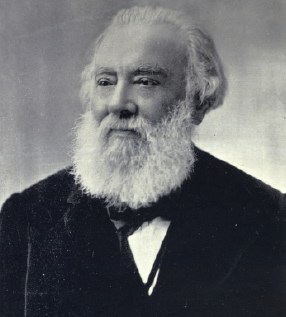
Alexander Melville Bell (1 March 1819 – 7 August 1905) was a teacher and researcher of physiological phonetics and was the author of numerous works on orthoepy and elocution.
Additionally he was also the creator of Visible Speech which was used to help the deaf learn to talk, and was the father of Alexander Graham Bell.
Alexander Melville Bell was born in Edinburgh, Scotland, and studied under and became the principal assistant of his father, Alexander Bell (b. 3 March 1790, Fife, Scotland d. 23 April 1865, St. Pancras, north London), an authority on phonetics and speech disorders. From 1843 to 1865 he lectured on speech elocution at the University of Edinburgh, and from 1865 to 1870 at the University of London. Melville married Eliza Grace Symonds (b. 21 September 1809, Alverstock, Hampshire d. Georgetown, Washington, D.C., US 5 January 1897), the only daughter of a British naval surgeon.
In 1868, and again in 1870 and 1871, Melville lectured at the Lowell Institute in Boston, Massachusetts, US after having moved to Canada. In 1870 he became a lecturer on philology at Queen's College, Kingston, Ontario; and in 1881 he moved to Washington, D.C. at the suggestion of his son Graham, where he devoted himself to the education of the deaf by the use of Visible Speech in which the alphabetical characters of his linguistic invention were representative graphic diagrams for the various positions and motions of the lips, tongue, mouth, etc., as well as other methods of orthoepy.
Prior to departing Scotland for Canada Melville Bell had published at least 17 works on proper speech, vocal physiology, stenography and other works. Besides instructing at Queen's College he also lectured in Boston, Montreal, Toronto, London, and other universities including a series of 12 lectures at Boston's Lowell Institute. When the Duke and Duchess of Cornwall (later King George V and Queen Mary) called on Brantford for a visit, Melville was asked to greet the dignitaries at the public event. He became a Fellow of the Educational Institute of Scotland, the Royal Scottish Society of Arts, and the American Association for the Advancement of Science, as well as obtaining memberships in other societies.
Alexander Melville Bell was married twice, first to Eliza Grace Symonds in 1844 with whom he had three children, and then to Harriet G. Shibley.
In 1864 Melville published his first works on Visible Speech, to help the deaf both learn and improve upon their aural speech (since the profoundly deaf could themselves not hear their own aural pronunciations). To promote the language, Bell created two written short forms using his system of 29 modifiers and tones, 52 consonants, 36 vowels and a dozen diphthongs: World English, which was similar to the International Phonetic Alphabet, and also Line Writing, used as a shorthand form for stenographers.
Melville's works on Visible Speech became highly notable, and were described by Édouard Séguin as being "...a greater invention than the telephone of his son, Alexander Graham Bell". Melville saw numerous applications for his invention, including its worldwide use as a universal language. However, although heavily promoted at the Second International Congress on Education of the Deaf in Milan, Italy in 1880, after a period of a dozen years or so in which it was applied to the education of the deaf, Visible Speech was found to be more cumbersome, and thus a hindrance, to the teaching of speech to the deaf compared to other methods, and eventually faded from use.
Hub AI
Alexander Melville Bell AI simulator
(@Alexander Melville Bell_simulator)
Alexander Melville Bell
Alexander Melville Bell (1 March 1819 – 7 August 1905) was a teacher and researcher of physiological phonetics and was the author of numerous works on orthoepy and elocution.
Additionally he was also the creator of Visible Speech which was used to help the deaf learn to talk, and was the father of Alexander Graham Bell.
Alexander Melville Bell was born in Edinburgh, Scotland, and studied under and became the principal assistant of his father, Alexander Bell (b. 3 March 1790, Fife, Scotland d. 23 April 1865, St. Pancras, north London), an authority on phonetics and speech disorders. From 1843 to 1865 he lectured on speech elocution at the University of Edinburgh, and from 1865 to 1870 at the University of London. Melville married Eliza Grace Symonds (b. 21 September 1809, Alverstock, Hampshire d. Georgetown, Washington, D.C., US 5 January 1897), the only daughter of a British naval surgeon.
In 1868, and again in 1870 and 1871, Melville lectured at the Lowell Institute in Boston, Massachusetts, US after having moved to Canada. In 1870 he became a lecturer on philology at Queen's College, Kingston, Ontario; and in 1881 he moved to Washington, D.C. at the suggestion of his son Graham, where he devoted himself to the education of the deaf by the use of Visible Speech in which the alphabetical characters of his linguistic invention were representative graphic diagrams for the various positions and motions of the lips, tongue, mouth, etc., as well as other methods of orthoepy.
Prior to departing Scotland for Canada Melville Bell had published at least 17 works on proper speech, vocal physiology, stenography and other works. Besides instructing at Queen's College he also lectured in Boston, Montreal, Toronto, London, and other universities including a series of 12 lectures at Boston's Lowell Institute. When the Duke and Duchess of Cornwall (later King George V and Queen Mary) called on Brantford for a visit, Melville was asked to greet the dignitaries at the public event. He became a Fellow of the Educational Institute of Scotland, the Royal Scottish Society of Arts, and the American Association for the Advancement of Science, as well as obtaining memberships in other societies.
Alexander Melville Bell was married twice, first to Eliza Grace Symonds in 1844 with whom he had three children, and then to Harriet G. Shibley.
In 1864 Melville published his first works on Visible Speech, to help the deaf both learn and improve upon their aural speech (since the profoundly deaf could themselves not hear their own aural pronunciations). To promote the language, Bell created two written short forms using his system of 29 modifiers and tones, 52 consonants, 36 vowels and a dozen diphthongs: World English, which was similar to the International Phonetic Alphabet, and also Line Writing, used as a shorthand form for stenographers.
Melville's works on Visible Speech became highly notable, and were described by Édouard Séguin as being "...a greater invention than the telephone of his son, Alexander Graham Bell". Melville saw numerous applications for his invention, including its worldwide use as a universal language. However, although heavily promoted at the Second International Congress on Education of the Deaf in Milan, Italy in 1880, after a period of a dozen years or so in which it was applied to the education of the deaf, Visible Speech was found to be more cumbersome, and thus a hindrance, to the teaching of speech to the deaf compared to other methods, and eventually faded from use.
Recent media