
Recent from talks
Alexander Pantages
Knowledge base stats:
Talk channels stats:
Members stats:
Alexander Pantages
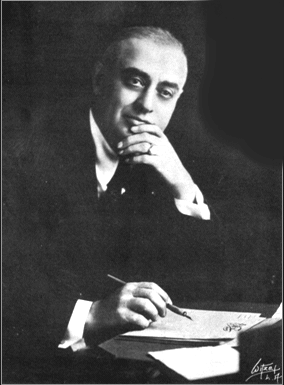
Alexander Pantages (Greek: Περικλῆς Ἀλέξανδρος Πανταζῆς, Periklis Alexandros Pandazis; 1867 – February 17, 1936) was a Greek American vaudeville impresario and early motion picture producer. He created a large and powerful circuit of theatres across the Western United States and Canada.
At the height of his empire, Pantages owned or operated 84 theatres across the United States and Canada. In 1929, he was accused of raping a 17-year-old dancer named Eunice Alice Pringle. He was found guilty but acquitted on appeal. The negative publicity led to the selling of his operations and he permanently ceased being a force in exhibition or vaudeville. He is largely forgotten today in historical accounts of the early development of motion pictures. He died in February 1936.
There is dispute about his year of birth, but it is likely that he was born in 1867 on the island of Andros, Greece. It is suggested that he was born "Pericles" Pantages but changed it to "Alexander" when he heard about Alexander the Great. In a personal correspondence between Rodney Pantages, son of Alexander, and Arthur Dean Tarrach, Pantages's biographer, this claim is denied. At the age of nine he ran away while with his father on a business trip in Cairo, Egypt. He then went to sea and spent the next two years working as a deck hand. He arrived in the United States in the early 1880s. His ties to his homeland seem mercurial; he never set foot in Greece again although he did assist his relatives financially and even brought his brother, Nicholas, to live in the United States. He used to call himself "King Greek", perhaps in emulation of Louis B. Mayer's "Super Jew".
After having been at sea for two years, Pantages disembarked in Panama and spent some time there helping the French to dig the Panama Canal, but after contracting malaria he was warned by a doctor to move to cooler climates. He headed north, stopping briefly in Seattle but eventually settling in San Francisco where he worked as a waiter and also, briefly and unsuccessfully, as a boxer. He left San Francisco in 1897, and made his way to Canada's Yukon Territory during the Klondike Gold Rush, ending up in the mining boom-town of Dawson City.
During his time in the bitter cold of Dawson City, Pantages worked as a waiter and as a porter at the Dawson City Opera House, saving his money to invest in local show business. Subsequently, he managed the venue, presenting shows with a stock company. The venture ended when the Opera House was destroyed in a fire, on January 9, 1900. However, Pantages and the company arranged to build a new venue, with electrical lighting and brick chimneys. Originally scheduled to open less than two weeks after the fire, on February 26, 1900, the Orpheum Theatre had its first "typical night of 'wine, women and song,'" closing at 2:30 the next morning, and taking in over $3,000 ($116,100 in 2025) for "wine and other 'concoctions.'" In June, Pantages acquired a projector and made motion pictures a regular part of the Orpheum bill of fare.
In autumn 1900, Pantages and performer Kathleen 'Kate' Rockwell started working and living together, after she left the troupe that had brought her north from Victoria, BC, just the previous August and joined Pantages's Orpheum company. In November 1902 she returned to Victoria, leasing the Orpheum Theatre there, by February 1903, to present vaudeville and moving pictures. Although details of his departure from the Yukon are unknown, Pantages was proprietor and manager of the theatre by April 1903.
Pantages moved to Seattle, Washington, where he opened the Crystal Theater, a short-form vaudeville and motion picture house of his own. He ran the operation almost entirely by himself, and charged 10 cents admission. This took place a few months after Rockwell had opened up a small storefront movie theater in Vancouver, and later built a theater there in 1907 that stood until 2011, and another in 1914. That same year, he married a musician named Lois Mendenhall (1884–1941). Rockwell filed a breach-of-promise-to-marry lawsuit against him as 'Klondike Kate' that was settled out of court; she later wrote that he had stolen from her the money with which he purchased the Crystal. It would be more than two decades before they saw each other again.[citation needed]
In 1904, Pantages opened a second Seattle theatre, the Pantages; in 1906 he added a stock theater, the Lois, named after his wife. By 1920, he owned more than 30 vaudeville theatres and controlled, through management contracts, perhaps 60 more[citation needed] in both the United States and Canada. These theatres formed the "Pantages Circuit", a chain of theatres into which he could book and rotate touring acts on long-term contracts.
Hub AI
Alexander Pantages AI simulator
(@Alexander Pantages_simulator)
Alexander Pantages
Alexander Pantages (Greek: Περικλῆς Ἀλέξανδρος Πανταζῆς, Periklis Alexandros Pandazis; 1867 – February 17, 1936) was a Greek American vaudeville impresario and early motion picture producer. He created a large and powerful circuit of theatres across the Western United States and Canada.
At the height of his empire, Pantages owned or operated 84 theatres across the United States and Canada. In 1929, he was accused of raping a 17-year-old dancer named Eunice Alice Pringle. He was found guilty but acquitted on appeal. The negative publicity led to the selling of his operations and he permanently ceased being a force in exhibition or vaudeville. He is largely forgotten today in historical accounts of the early development of motion pictures. He died in February 1936.
There is dispute about his year of birth, but it is likely that he was born in 1867 on the island of Andros, Greece. It is suggested that he was born "Pericles" Pantages but changed it to "Alexander" when he heard about Alexander the Great. In a personal correspondence between Rodney Pantages, son of Alexander, and Arthur Dean Tarrach, Pantages's biographer, this claim is denied. At the age of nine he ran away while with his father on a business trip in Cairo, Egypt. He then went to sea and spent the next two years working as a deck hand. He arrived in the United States in the early 1880s. His ties to his homeland seem mercurial; he never set foot in Greece again although he did assist his relatives financially and even brought his brother, Nicholas, to live in the United States. He used to call himself "King Greek", perhaps in emulation of Louis B. Mayer's "Super Jew".
After having been at sea for two years, Pantages disembarked in Panama and spent some time there helping the French to dig the Panama Canal, but after contracting malaria he was warned by a doctor to move to cooler climates. He headed north, stopping briefly in Seattle but eventually settling in San Francisco where he worked as a waiter and also, briefly and unsuccessfully, as a boxer. He left San Francisco in 1897, and made his way to Canada's Yukon Territory during the Klondike Gold Rush, ending up in the mining boom-town of Dawson City.
During his time in the bitter cold of Dawson City, Pantages worked as a waiter and as a porter at the Dawson City Opera House, saving his money to invest in local show business. Subsequently, he managed the venue, presenting shows with a stock company. The venture ended when the Opera House was destroyed in a fire, on January 9, 1900. However, Pantages and the company arranged to build a new venue, with electrical lighting and brick chimneys. Originally scheduled to open less than two weeks after the fire, on February 26, 1900, the Orpheum Theatre had its first "typical night of 'wine, women and song,'" closing at 2:30 the next morning, and taking in over $3,000 ($116,100 in 2025) for "wine and other 'concoctions.'" In June, Pantages acquired a projector and made motion pictures a regular part of the Orpheum bill of fare.
In autumn 1900, Pantages and performer Kathleen 'Kate' Rockwell started working and living together, after she left the troupe that had brought her north from Victoria, BC, just the previous August and joined Pantages's Orpheum company. In November 1902 she returned to Victoria, leasing the Orpheum Theatre there, by February 1903, to present vaudeville and moving pictures. Although details of his departure from the Yukon are unknown, Pantages was proprietor and manager of the theatre by April 1903.
Pantages moved to Seattle, Washington, where he opened the Crystal Theater, a short-form vaudeville and motion picture house of his own. He ran the operation almost entirely by himself, and charged 10 cents admission. This took place a few months after Rockwell had opened up a small storefront movie theater in Vancouver, and later built a theater there in 1907 that stood until 2011, and another in 1914. That same year, he married a musician named Lois Mendenhall (1884–1941). Rockwell filed a breach-of-promise-to-marry lawsuit against him as 'Klondike Kate' that was settled out of court; she later wrote that he had stolen from her the money with which he purchased the Crystal. It would be more than two decades before they saw each other again.[citation needed]
In 1904, Pantages opened a second Seattle theatre, the Pantages; in 1906 he added a stock theater, the Lois, named after his wife. By 1920, he owned more than 30 vaudeville theatres and controlled, through management contracts, perhaps 60 more[citation needed] in both the United States and Canada. These theatres formed the "Pantages Circuit", a chain of theatres into which he could book and rotate touring acts on long-term contracts.
Recent media