
Recent from talks
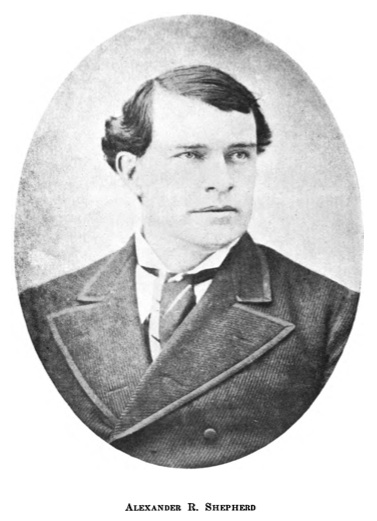
Alexander Robey Shepherd
Knowledge base stats:
Talk channels stats:
Members stats:
Alexander Robey Shepherd
Alexander Robey Shepherd (January 30, 1835 – September 12, 1902), also known as Boss Shepherd, was an American politician and businessman who was the 2nd Governor of the District of Columbia from 1873 to 1874. He was one of the most controversial and influential civic leaders in the history of Washington, D.C., and one of the most powerful big-city political bosses of the Gilded Age. He was also head of the District of Columbia Department of Public Works from 1871 to 1873. He is known, particularly in Washington, as "The Father of Modern Washington."
Shepherd was born in Southwest Washington, D.C., on January 30, 1835. He dropped out of school at age 13.
After dropping out of school, Shepherd took a job as a plumber's assistant, eventually working his way up to becoming the owner of the plumbing firm. He then invested the profits from that firm in real estate development, which made him a wealthy socialite and influential citizen of the city. One of his luxurious properties was Shepherd's Row, a set of rowhouses on Connecticut Avenue designed by Adolf Cluss; Cluss was later the star witness at Shepherd's congressional investigation hearings.
Two days after the Battle of Fort Sumter that initiated the American Civil War, Shepherd and his brother each enlisted in the 3rd Battalion of the District of Columbia volunteers. The term of enlistment at that time was only three months, after which Shepherd was honorably discharged. On January 30, 1861, he was married to Mary Grice Young, with whom he raised seven children. Her niece, Marie Grice Young, was the piano teacher of Theodore Roosevelt's children and a Titanic survivor.
He was an early member of the Republican Party and a member of the Washington City Councils from 1861 to 1871, during which time he was an important voice for D.C. emancipation, then for suffrage for the freed slaves. Frederick Douglass later said, "I want to thank Governor Shepherd for the fair way in which he treated the colored race when he was in a position to help them."
By 1870, war and mismanagement had caused the finances and infrastructure of the city to deteriorate so badly that the Mayor of Washington, Sayles J. Bowen, had his furniture seized in an attempt to pay the city's debts. Democrats and Republicans were in a rare agreement that a drastic change was needed from Bowen's regime. As a solution, Shepherd and his allies began agitation for the abolition of the elected governments of Washington City and Georgetown, as well as the appointed justices of the peace for Washington County, to be replaced with a unified territorial government to administer the entire District of Columbia. The Shepherd machine was easily able to sway popular support in favor of that notion.
In 1871, Shepherd was able to convince Congress to pass a bill that established the territorial government that he desired. The Organic Act of 1871 merged the various governments in the District of Columbia into a single eleven-member legislature, including two representatives for Georgetown and two for the County of Washington, to be presided over by a territorial governor. The legislature and governor would all be appointed by the President. Both frontrunners for the governorship were initially Shepherd, from Washington, and Colonel Jason A. Magruder, from Georgetown; although popular support was behind Shepherd, US President Ulysses S. Grant feared that either appointment would cause a sectional divide that might make governorship of the full district impossible. Thus, Grant's inaugural appointment to the governorship was his friend, the financier Henry D. Cooke, "a gentleman of unimpeachable integrity" and secretly a close political ally of Shepherd.
Shepherd was appointed vice-chair of the city's five-man Board of Public Works. The most powerful public entity in the District of Columbia, the Board of Public Works was actually an independent entity from the territorial government, reporting directly to Congress, but kept within the territory's sphere of influence by making the governor its chairman. Cooke, however, rarely attended the Board's meetings (probably at Shepherd's urging), allowing Vice-Chair Shepherd to preside. He asserted himself as a leader to such an extent that he often did not bother to consult the other members of the Board before he made decisions and took sweeping action. His abilities as a political operator, according to D.C. journalist Sam Smith, were formidable:
Hub AI
Alexander Robey Shepherd AI simulator
(@Alexander Robey Shepherd_simulator)
Alexander Robey Shepherd
Alexander Robey Shepherd (January 30, 1835 – September 12, 1902), also known as Boss Shepherd, was an American politician and businessman who was the 2nd Governor of the District of Columbia from 1873 to 1874. He was one of the most controversial and influential civic leaders in the history of Washington, D.C., and one of the most powerful big-city political bosses of the Gilded Age. He was also head of the District of Columbia Department of Public Works from 1871 to 1873. He is known, particularly in Washington, as "The Father of Modern Washington."
Shepherd was born in Southwest Washington, D.C., on January 30, 1835. He dropped out of school at age 13.
After dropping out of school, Shepherd took a job as a plumber's assistant, eventually working his way up to becoming the owner of the plumbing firm. He then invested the profits from that firm in real estate development, which made him a wealthy socialite and influential citizen of the city. One of his luxurious properties was Shepherd's Row, a set of rowhouses on Connecticut Avenue designed by Adolf Cluss; Cluss was later the star witness at Shepherd's congressional investigation hearings.
Two days after the Battle of Fort Sumter that initiated the American Civil War, Shepherd and his brother each enlisted in the 3rd Battalion of the District of Columbia volunteers. The term of enlistment at that time was only three months, after which Shepherd was honorably discharged. On January 30, 1861, he was married to Mary Grice Young, with whom he raised seven children. Her niece, Marie Grice Young, was the piano teacher of Theodore Roosevelt's children and a Titanic survivor.
He was an early member of the Republican Party and a member of the Washington City Councils from 1861 to 1871, during which time he was an important voice for D.C. emancipation, then for suffrage for the freed slaves. Frederick Douglass later said, "I want to thank Governor Shepherd for the fair way in which he treated the colored race when he was in a position to help them."
By 1870, war and mismanagement had caused the finances and infrastructure of the city to deteriorate so badly that the Mayor of Washington, Sayles J. Bowen, had his furniture seized in an attempt to pay the city's debts. Democrats and Republicans were in a rare agreement that a drastic change was needed from Bowen's regime. As a solution, Shepherd and his allies began agitation for the abolition of the elected governments of Washington City and Georgetown, as well as the appointed justices of the peace for Washington County, to be replaced with a unified territorial government to administer the entire District of Columbia. The Shepherd machine was easily able to sway popular support in favor of that notion.
In 1871, Shepherd was able to convince Congress to pass a bill that established the territorial government that he desired. The Organic Act of 1871 merged the various governments in the District of Columbia into a single eleven-member legislature, including two representatives for Georgetown and two for the County of Washington, to be presided over by a territorial governor. The legislature and governor would all be appointed by the President. Both frontrunners for the governorship were initially Shepherd, from Washington, and Colonel Jason A. Magruder, from Georgetown; although popular support was behind Shepherd, US President Ulysses S. Grant feared that either appointment would cause a sectional divide that might make governorship of the full district impossible. Thus, Grant's inaugural appointment to the governorship was his friend, the financier Henry D. Cooke, "a gentleman of unimpeachable integrity" and secretly a close political ally of Shepherd.
Shepherd was appointed vice-chair of the city's five-man Board of Public Works. The most powerful public entity in the District of Columbia, the Board of Public Works was actually an independent entity from the territorial government, reporting directly to Congress, but kept within the territory's sphere of influence by making the governor its chairman. Cooke, however, rarely attended the Board's meetings (probably at Shepherd's urging), allowing Vice-Chair Shepherd to preside. He asserted himself as a leader to such an extent that he often did not bother to consult the other members of the Board before he made decisions and took sweeping action. His abilities as a political operator, according to D.C. journalist Sam Smith, were formidable:
Recent media