


Community hub
Recent from talks
Contribute something
Nothing was collected or created yet.
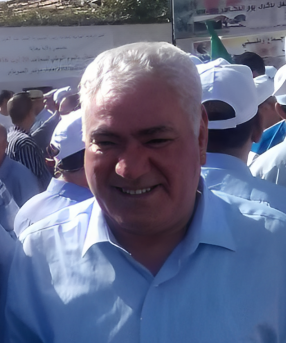
Ali Laskri
View on Wikipedia | You can help expand this article with text translated from the corresponding article in French. (March 2021) Click [show] for important translation instructions.
|
Ali Laskri (born in Chabet el Ameur on 20 August 1955) is an Algerian politician. He is the leader of the political opposition Socialist Forces Front party in Algeria.[citation needed]
Key Information


Biography
[edit]Ali Laskri was born in 1955 in the commune of Chabet el Ameur in the current Boumerdès Province within the lower Kabylia.[1][2][3]
After elementary studies in his native, he obtained a post-graduation diploma specializing in management and administration sciences at the University of Algiers.[4][5][6]
He then began a professional career as a consulting administrator at the University of Boumerdès.[7][8][9]
Political career
[edit]Laskri joined the opposition Socialist Forces Front (FFS) party in January 1990, and was then elected chairman of the People's Municipal Assembly (APC) of the commune of Boumerdès during the 1990 Algerian local elections on 12 June 1990 and then a member of the FFS national council at the party's first congress in 1991.[10][11]
He was elected in 1993 as political coordinator of the FFS in the Boumerdès Province, when he already held the post of organics officer at the level of this body.[12][13]
He was then appointed in 1997 as national secretary of the party in charge of monitoring the world of work, then left this post at the end of 1998.[14][15]
On the occasion of the 1999 Algerian presidential election of 15 April 1999, Laskri held the post of campaign director for party president Hocine Aït Ahmed in the province of Boumerdès.[16][17]
During the third FFS congress in 2000, he was elected chairman of the organizing committee, and in the meantime was the party's first federal secretary in the wilaya of Boumerdès.[18][19]
During the 2002 Algerian local elections, he led the list of the People's Provincial Assembly (APW) of the FFS in the wilaya of Boumerdès, then was appointed in 2003 as national secretary in charge of solidarity, before being appointed to the position of first secretary of the party in 2004 where he will assume this responsibility until April 2007.[20][21][22]
He was again appointed as the first secretary of the FFS from 2011 to 2013, and was in the meantime elected during the 2012 Algerian legislative election on 10 May 2012 as a deputy of the FFS in the People's National Assembly (APN) representing the wilaya of Boumerdès.[23][24][25]
He was partisanly appointed as chairman of the political strategy commission of the national council and member of the FFS ethics committee until 2013, and was re-elected in his mandate as national deputy in the 2017 Algerian legislative election on 4 May 2017.[26][27][28]
On 17 March 2019, following the 2019 protests in Algeria, he resigned from his post as deputy with other elected members of the APN.[29][30][31]
See also
[edit]References
[edit]- ^ "Algérie Politique · Algérie-Politique". Algérie-Politique. Retrieved 31 March 2021.
- ^ "FFS : Ali Laskri perd la main: Toute l'actualité sur liberte-algerie.com". Liberte-algerie.com/. Retrieved 31 March 2021.
- ^ "Ali Laskri met en garde contre un passage en force". Djazairess.com. Retrieved 31 March 2021.
- ^ "Ali Laskri. Membre de l'instance présidentielle : "Nous nous opposons à la démarche non statutaire" | El Watan". Elwatan.com. Retrieved 31 March 2021.
- ^ "Ali Laskri: Mise en place d'un "Budget social" pour consacrer le caractère social de l'Etat". Archived from the original on 2021-01-27. Retrieved 2021-03-24.
- ^ "Ali Laskri réunit son conseil national". Djazairess.com. Retrieved 31 March 2021.
- ^ "FFS : Laskri démissionne du présidium: Toute l'actualité sur liberte-algerie.com". Liberte-algerie.com/. Retrieved 31 March 2021.
- ^ "Ali Laskri dévoile la feuille de route du nouveau présidium, aucune nomination pour le moment". DMA. 24 April 2018. Retrieved 31 March 2021.
- ^ "Laskri sort de sa réserve". Djazairess.com. Retrieved 31 March 2021.
- ^ Rédaction, La (29 October 2017). "Boumerdès". Retrieved 31 March 2021.
- ^ "Chassé du présidium, Ali Laskri dépose plainte". Elwatan.com. Retrieved 31 March 2021.
- ^ "Hocine Aït Ahmed démissionne après 50 ans passés à la tête du FFS". France 24. 25 May 2013. Retrieved 31 March 2021.
- ^ "Ait Ahmed relève Karim Tabbou et désigne Ali Laskri premier secrétaire national du FFS - Algerie360". Algerie360.com. 18 November 2011. Retrieved 31 March 2021.
- ^ "Aït Ahmed désigne Ali Laskri nouveau premier secrétaire du FFS". Le Matin d'Algérie. Retrieved 31 March 2021.
- ^ "Ali Laskri jette l'éponge". Djazairess.com. Retrieved 31 March 2021.
- ^ "Ait Ahmed désigne Ali Laskri au poste de premier secrétaire du FFS | TAMURT". tamurt.info. Retrieved 31 March 2021.
- ^ "Ali Laskri ne participe pas au congrès extraordinaire du FFS". Djazairess.com. Retrieved 31 March 2021.
- ^ "La primauté de "l'utile" sur le politique: Toute l'actualité sur liberte-algerie.com". Liberte-algerie.com/. Retrieved 31 March 2021.
- ^ "Ali Laskri refuse de céder". Djazairess.com. Retrieved 31 March 2021.
- ^ ""Le droit d'avoir des droits"". Djazairess.com. Retrieved 31 March 2021.
- ^ "Laskri serait désigné premier secrétaire". Djazairess.com. Retrieved 31 March 2021.
- ^ "Laskri n'y croit pas". Djazairess.com. Retrieved 31 March 2021.
- ^ ""Catastrophe et désordre"". Djazairess.com. Retrieved 31 March 2021.
- ^ "Larbi Ould Khelifa nouveau président de l'APN". Djazairess.com. Retrieved 31 March 2021.
- ^ "Ali Laskri à Bordj Ménaïel". Djazairess.com. Retrieved 31 March 2021.
- ^ "LASKRI ALI". Apn.dz. Retrieved 31 March 2021.
- ^ "Campagne électorale à Boumerdès: La proximité pour convaincre". Djazairess.com. Retrieved 31 March 2021.
- ^ "Le FFS veut faire mieux qu'en 2007". Djazairess.com. Retrieved 31 March 2021.
- ^ Administration, A. P. N. "LASKRI Ali". Apn.dz. Retrieved 31 March 2021.
- ^ Benali, Arezki (17 March 2019). "Le député du FFS Ali Laskri démissionne de l'APN". Retrieved 31 March 2021.
- ^ "Ali Laskri montre la voie". Djazairess.com. Retrieved 31 March 2021.
External links
[edit]- Socialist Forces Front (FFS) on Facebook
- Ali Laskri on Berbère Television (2019) on YouTube
- Intervention by Ali Laskri Coordinator of the FFS presidential body (2018) on YouTube
- FFS: Ali Laskri guest of DzairTV (2018) on YouTube
- FFS: Intervention of Ali Laskri in Draa El Mizan (2018) on YouTube
- Intervention by Ali Laskri at the celebration of the 53rd anniversary of the FFS in Médéa (2016) on YouTube
Ali Laskri
View on GrokipediaAs a prominent figure in Algeria's pro-democracy movement, Laskri has denounced irregularities in parliamentary elections and called for peaceful mobilization against the status quo, positioning the FFS as a secular alternative amid widespread repression of dissent.[3][1] His leadership has drawn government scrutiny, including arrests of party members and himself during periods of heightened crackdowns on opposition activities.[2][4]