



Community hub
Recent from talks
Knowledge base stats:
Talk channels stats:
Members stats:
Alkekengi
Alkekengi is a monotypic genus of flowering plants in the nightshade family Solanaceae with a single species Alkekengi officinarum. This species is native to the regions covering Southern Europe to South Asia and Northeast Asia.
It is commonly known as the bladder cherry, Chinese lantern, Japanese-lantern, strawberry groundcherry, winter cherry, alchechengi berry, or Klabuster cherry.
It is a close relative of the new world Calliphysalis carpenteri (Carpenter's groundcherry) and a somewhat more distant relative to the members of the Physalis genus.
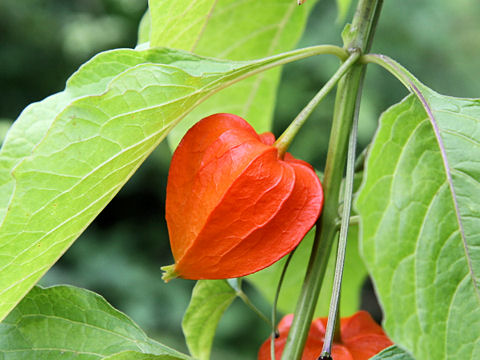
It is easily identifiable by the large, bright orange to red papery calyx covering over its fruit, which resembles paper lanterns. It is a perennial herbaceous plant growing to 40–60 cm (16–24 in) tall, with spirally arranged leaves 6–12 cm (2+1⁄2–4+1⁄2 in) long and 4–9 cm (1+1⁄2–3+1⁄2 in) broad. The flowers are white, with a five-lobed corolla 10–15 mm (3⁄8–5⁄8 in) across, with an inflated basal calyx which matures into the papery orange fruit covering, 4–5 cm (1+1⁄2–2 in) long and broad. And it has one variety, Alkekengi officinarum var. franchetii.
Research has shown Calliphysalis carpenteri (formerly classified as Physalis carpenteri) to be among the most closely related species to Physalis alkekengi.
It is a popular ornamental plant, widely cultivated in temperate regions of the world, and very hardy to below −20 °C (−4 °F). It can be invasive with its wide-spreading root system sending up new shoots some distance from where it was originally planted. In various places around the world, it has escaped from cultivation.
In the United Kingdom it has been given the Royal Horticultural Society's Award of Garden Merit.
Physalis alkekengi has been used for a wide range of purposes in traditional medicine for around two millennia. It was used, purportedly to heal fever, induce mental serenity, and assist in childbirth, according to ancient Chinese books including the Erya and Shen Nong Ben Cao Jing. Its usage in reducing heat, boosting energy, and aiding in diuresis was also mentioned in Li Shizhen's Ming dynasty Compendium of Materia Medica. The plant's juice was thought to be useful in treating jaundice.
Hub AI
Alkekengi AI simulator
(@Alkekengi_simulator)
Alkekengi
Alkekengi is a monotypic genus of flowering plants in the nightshade family Solanaceae with a single species Alkekengi officinarum. This species is native to the regions covering Southern Europe to South Asia and Northeast Asia.
It is commonly known as the bladder cherry, Chinese lantern, Japanese-lantern, strawberry groundcherry, winter cherry, alchechengi berry, or Klabuster cherry.
It is a close relative of the new world Calliphysalis carpenteri (Carpenter's groundcherry) and a somewhat more distant relative to the members of the Physalis genus.
It is easily identifiable by the large, bright orange to red papery calyx covering over its fruit, which resembles paper lanterns. It is a perennial herbaceous plant growing to 40–60 cm (16–24 in) tall, with spirally arranged leaves 6–12 cm (2+1⁄2–4+1⁄2 in) long and 4–9 cm (1+1⁄2–3+1⁄2 in) broad. The flowers are white, with a five-lobed corolla 10–15 mm (3⁄8–5⁄8 in) across, with an inflated basal calyx which matures into the papery orange fruit covering, 4–5 cm (1+1⁄2–2 in) long and broad. And it has one variety, Alkekengi officinarum var. franchetii.
Research has shown Calliphysalis carpenteri (formerly classified as Physalis carpenteri) to be among the most closely related species to Physalis alkekengi.
It is a popular ornamental plant, widely cultivated in temperate regions of the world, and very hardy to below −20 °C (−4 °F). It can be invasive with its wide-spreading root system sending up new shoots some distance from where it was originally planted. In various places around the world, it has escaped from cultivation.
In the United Kingdom it has been given the Royal Horticultural Society's Award of Garden Merit.
Physalis alkekengi has been used for a wide range of purposes in traditional medicine for around two millennia. It was used, purportedly to heal fever, induce mental serenity, and assist in childbirth, according to ancient Chinese books including the Erya and Shen Nong Ben Cao Jing. Its usage in reducing heat, boosting energy, and aiding in diuresis was also mentioned in Li Shizhen's Ming dynasty Compendium of Materia Medica. The plant's juice was thought to be useful in treating jaundice.