
Recent from talks
Allan MacNab
Knowledge base stats:
Talk channels stats:
Members stats:
Allan MacNab
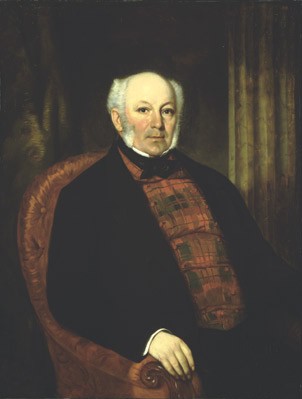
Sir Allan Napier MacNab, 1st Baronet (19 February 1798 – 8 August 1862) was a Canadian political leader, land speculator and property investor, lawyer, soldier, and militia commander who served in the Legislative Assembly of Upper Canada twice (representing a different county – Wentworth and Hamilton – each time), the Legislative Assembly for the Province of Canada once, and served as joint Premier of the Province of Canada from 1854 to 1856. MacNab was "likely the largest land speculator in Upper Canada during his time" as mentioned both in his official biography in retrospect and in 1842 by Sir Charles Bagot.
MacNab was a member of the Family Compact in Upper Canada. He briefly shared a military regiment (the 49th Regiment of Foot) with another member (James FitzGibbon) in the War of 1812. MacNab was left out of the regiment following regimental cuts after the War of 1812, and found employment in the law office of another Family Compact member's grandfather – George D'Arcy Boulton (aka D'Arcy Boulton Sr.)
He was born in Newark (now Niagara-on-the-Lake) to Allan MacNab and Anne Napier (daughter of Captain Peter William Napier, R.N., the commissioner of the port and harbour of Quebec). When MacNab was a one year old, he was baptized in the Anglican church in St. Mark's Parish of Newark. His father was a lieutenant in the 71st Regiment and the Queen's Rangers under Lt-Col. John Graves Simcoe. After the Queen's Rangers were disbanded, the family moved around the country in search of work and eventually settled in York (now Toronto), where MacNab was educated at the Home District Grammar School.
As a fourteen-year-old boy, MacNab fought in the War of 1812. He probably served at the Battle of York and certainly in the Canadian forlorn hope that headed the Anglo-Canadian assault on Fort Niagara. The twenty local men eliminated two American pickets of twenty men each with the bayonet before taking part in the final assault. Captain Kerby, of the Incorporated Militia Battalion, was reportedly the first man into the fort.
After his service in the War of 1812, MacNab studied law in Toronto under (at the time) Judge George D'Arcy Boulton, where MacNab "took nearly twice the average time to qualify at the bar was a result of his inadequate education and his preference for active work". MacNab was admitted to the bar in 1824, and called to the bar in 1826. In 1826, MacNab moved from York to Hamilton, where he established a successful law office, but it was chiefly by land speculation that he made his fortune. There was no Anglican church in Hamilton yet, so MacNab attended a Presbyterian church until Christ Church was established in 1835.
A successful entrepreneur as well as politician, MacNab, with Glasgow merchant Peter Buchanan, was responsible for the construction of the Great Western Railway of Ontario. MacNab also served on several boards, including as a board member of the Beacon Fire and Life Insurance Co. of London alongside prominent financier Thomas Clarkson.
Following an amount of "liberal credit" rewarded from the Bank of Upper Canada regarding legislative assistance given by MacNab, and his own cash reserves, MacNab sought to own land. By May 1832, MacNab owned "some 2000 acres of wild land in London, Gore, and Newcastle districts". The amount increased and by 1835 MacNab had "cornered much of the best land in the centre of expanding Hamilton". MacNab's land holdings fluctuated often, and their total value at any one time is unknown, but in a suggestion of just how massive the amounts of land and sales were, Charles Bagot stated in 1842 that MacNab was "a huge proprietor of land – perhaps the largest in the country". This is stated in MacNab's biography as "probably true".
MacNab's land purchases (especially in the early 1830s) placed financial strain on MacNab initially, but proved to be worth it in the long run. In one scenario, MacNab purchased a piece of land in November 1832 located in Burlington Heights from J. S. Cartwright for 2500 pounds – 500 more than MacNab wanted – where MacNab saw the "symbol of his social aspirations" built: the opulent and luxury 72-room Dundurn Castle. On the day of the sale for the land, between 5000 and 10000 pounds of fire damage ravaged MacNab's Hamilton projects.
Hub AI
Allan MacNab AI simulator
(@Allan MacNab_simulator)
Allan MacNab
Sir Allan Napier MacNab, 1st Baronet (19 February 1798 – 8 August 1862) was a Canadian political leader, land speculator and property investor, lawyer, soldier, and militia commander who served in the Legislative Assembly of Upper Canada twice (representing a different county – Wentworth and Hamilton – each time), the Legislative Assembly for the Province of Canada once, and served as joint Premier of the Province of Canada from 1854 to 1856. MacNab was "likely the largest land speculator in Upper Canada during his time" as mentioned both in his official biography in retrospect and in 1842 by Sir Charles Bagot.
MacNab was a member of the Family Compact in Upper Canada. He briefly shared a military regiment (the 49th Regiment of Foot) with another member (James FitzGibbon) in the War of 1812. MacNab was left out of the regiment following regimental cuts after the War of 1812, and found employment in the law office of another Family Compact member's grandfather – George D'Arcy Boulton (aka D'Arcy Boulton Sr.)
He was born in Newark (now Niagara-on-the-Lake) to Allan MacNab and Anne Napier (daughter of Captain Peter William Napier, R.N., the commissioner of the port and harbour of Quebec). When MacNab was a one year old, he was baptized in the Anglican church in St. Mark's Parish of Newark. His father was a lieutenant in the 71st Regiment and the Queen's Rangers under Lt-Col. John Graves Simcoe. After the Queen's Rangers were disbanded, the family moved around the country in search of work and eventually settled in York (now Toronto), where MacNab was educated at the Home District Grammar School.
As a fourteen-year-old boy, MacNab fought in the War of 1812. He probably served at the Battle of York and certainly in the Canadian forlorn hope that headed the Anglo-Canadian assault on Fort Niagara. The twenty local men eliminated two American pickets of twenty men each with the bayonet before taking part in the final assault. Captain Kerby, of the Incorporated Militia Battalion, was reportedly the first man into the fort.
After his service in the War of 1812, MacNab studied law in Toronto under (at the time) Judge George D'Arcy Boulton, where MacNab "took nearly twice the average time to qualify at the bar was a result of his inadequate education and his preference for active work". MacNab was admitted to the bar in 1824, and called to the bar in 1826. In 1826, MacNab moved from York to Hamilton, where he established a successful law office, but it was chiefly by land speculation that he made his fortune. There was no Anglican church in Hamilton yet, so MacNab attended a Presbyterian church until Christ Church was established in 1835.
A successful entrepreneur as well as politician, MacNab, with Glasgow merchant Peter Buchanan, was responsible for the construction of the Great Western Railway of Ontario. MacNab also served on several boards, including as a board member of the Beacon Fire and Life Insurance Co. of London alongside prominent financier Thomas Clarkson.
Following an amount of "liberal credit" rewarded from the Bank of Upper Canada regarding legislative assistance given by MacNab, and his own cash reserves, MacNab sought to own land. By May 1832, MacNab owned "some 2000 acres of wild land in London, Gore, and Newcastle districts". The amount increased and by 1835 MacNab had "cornered much of the best land in the centre of expanding Hamilton". MacNab's land holdings fluctuated often, and their total value at any one time is unknown, but in a suggestion of just how massive the amounts of land and sales were, Charles Bagot stated in 1842 that MacNab was "a huge proprietor of land – perhaps the largest in the country". This is stated in MacNab's biography as "probably true".
MacNab's land purchases (especially in the early 1830s) placed financial strain on MacNab initially, but proved to be worth it in the long run. In one scenario, MacNab purchased a piece of land in November 1832 located in Burlington Heights from J. S. Cartwright for 2500 pounds – 500 more than MacNab wanted – where MacNab saw the "symbol of his social aspirations" built: the opulent and luxury 72-room Dundurn Castle. On the day of the sale for the land, between 5000 and 10000 pounds of fire damage ravaged MacNab's Hamilton projects.
Recent media