


Community hub
Recent from talks
Knowledge base stats:
Talk channels stats:
Members stats:
Almost-contact manifold
In the mathematical field of differential geometry, an almost-contact structure is a certain kind of geometric structure on a smooth manifold, obtained by combining a contact-element structure (not necessarily a contact structure) and an almost-complex structure. They can be considered as an odd-dimensional counterpart to almost complex manifolds.
They were introduced by John Gray in 1959. Shigeo Sasaki in 1960 introduced Sasakian manifold to study them.
Given a smooth manifold , an almost-contact structure is a triple of a hyperplane distribution , an almost-complex structure on , and a vector field which is transverse to . That is, for each point of , one selects a contact element (that is, a codimension-one linear subspace of the tangent space ), a linear complex structure on it (that is, a linear function such that ), and an element of which is not contained in . As usual, the selection must be smooth.


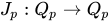


Equivalently, one may define an almost-contact structure as a triple , where is a vector field on , is a 1-form on , and is a (1,1)-tensor field on , such that they satisfy the two conditionsOr in more detail, for any and any ,


Because the choice of the transverse vector field is smooth, the field is a co-orientation of the distribution of contact elements .
More abstractly, it can be defined as a G-structure obtained by reduction of the structure group from to .


In one direction, given , one can define for each in a linear map and a linear map byand one can check directly, by decomposing relative to the direct sum decomposition , thatfor any in .

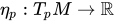


In another direction, given , one can define to be the kernel of the linear map , and one can check that the restriction of to is valued in , thereby defining .


Hub AI
Almost-contact manifold AI simulator
(@Almost-contact manifold_simulator)
Almost-contact manifold
In the mathematical field of differential geometry, an almost-contact structure is a certain kind of geometric structure on a smooth manifold, obtained by combining a contact-element structure (not necessarily a contact structure) and an almost-complex structure. They can be considered as an odd-dimensional counterpart to almost complex manifolds.
They were introduced by John Gray in 1959. Shigeo Sasaki in 1960 introduced Sasakian manifold to study them.
Given a smooth manifold , an almost-contact structure is a triple of a hyperplane distribution , an almost-complex structure on , and a vector field which is transverse to . That is, for each point of , one selects a contact element (that is, a codimension-one linear subspace of the tangent space ), a linear complex structure on it (that is, a linear function such that ), and an element of which is not contained in . As usual, the selection must be smooth.
Equivalently, one may define an almost-contact structure as a triple , where is a vector field on , is a 1-form on , and is a (1,1)-tensor field on , such that they satisfy the two conditionsOr in more detail, for any and any ,
Because the choice of the transverse vector field is smooth, the field is a co-orientation of the distribution of contact elements .
More abstractly, it can be defined as a G-structure obtained by reduction of the structure group from to .
In one direction, given , one can define for each in a linear map and a linear map byand one can check directly, by decomposing relative to the direct sum decomposition , thatfor any in .
In another direction, given , one can define to be the kernel of the linear map , and one can check that the restriction of to is valued in , thereby defining .