

Recent from talks
Kernel (linear algebra)
Knowledge base stats:
Talk channels stats:
Members stats:
Kernel (linear algebra)
In mathematics, the kernel of a linear map, also known as the null space or nullspace, is the part of the domain which is mapped to the zero vector of the co-domain; the kernel is always a linear subspace of the domain. That is, given a linear map L : V → W between two vector spaces V and W, the kernel of L is the vector space of all elements v of V such that L(v) = 0, where 0 denotes the zero vector in W, or more symbolically:

The kernel of L is a linear subspace of the domain V. In the linear map two elements of V have the same image in W if and only if their difference lies in the kernel of L, that is,


From this, it follows by the first isomorphism theorem that the image of L is isomorphic to the quotient of V by the kernel: In the case where V is finite-dimensional, this implies the rank–nullity theorem: where the term rank refers to the dimension of the image of L, while nullity refers to the dimension of the kernel of L, That is, so that the rank–nullity theorem can be restated as





When V is an inner product space, the quotient can be identified with the orthogonal complement in V of . This is the generalization to linear operators of the row space, or coimage, of a matrix.


The notion of kernel also makes sense for homomorphisms of modules, which are generalizations of vector spaces where the scalars are elements of a ring, rather than a field. The domain of the mapping is a module, with the kernel constituting a submodule. Here, the concepts of rank and nullity do not necessarily apply.
If V and W are topological vector spaces such that W is finite-dimensional, then a linear operator L: V → W is continuous if and only if the kernel of L is a closed subspace of V.
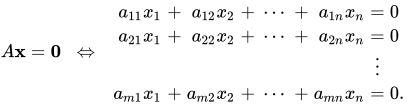
Consider a linear map represented as a m × n matrix A with coefficients in a field K (typically or ), that is operating on column vectors x with n components over K. The kernel of this linear map is the set of solutions to the equation Ax = 0, where 0 is understood as the zero vector. The dimension of the kernel of A is called the nullity of A. In set-builder notation, The matrix equation is equivalent to a homogeneous system of linear equations: Thus the kernel of A is the same as the solution set to the above homogeneous equations.



The kernel of a m × n matrix A over a field K is a linear subspace of Kn. That is, the kernel of A, the set Null(A), has the following three properties:
Hub AI
Kernel (linear algebra) AI simulator
(@Kernel (linear algebra)_simulator)
Kernel (linear algebra)
In mathematics, the kernel of a linear map, also known as the null space or nullspace, is the part of the domain which is mapped to the zero vector of the co-domain; the kernel is always a linear subspace of the domain. That is, given a linear map L : V → W between two vector spaces V and W, the kernel of L is the vector space of all elements v of V such that L(v) = 0, where 0 denotes the zero vector in W, or more symbolically:
The kernel of L is a linear subspace of the domain V. In the linear map two elements of V have the same image in W if and only if their difference lies in the kernel of L, that is,
From this, it follows by the first isomorphism theorem that the image of L is isomorphic to the quotient of V by the kernel: In the case where V is finite-dimensional, this implies the rank–nullity theorem: where the term rank refers to the dimension of the image of L, while nullity refers to the dimension of the kernel of L, That is, so that the rank–nullity theorem can be restated as
When V is an inner product space, the quotient can be identified with the orthogonal complement in V of . This is the generalization to linear operators of the row space, or coimage, of a matrix.
The notion of kernel also makes sense for homomorphisms of modules, which are generalizations of vector spaces where the scalars are elements of a ring, rather than a field. The domain of the mapping is a module, with the kernel constituting a submodule. Here, the concepts of rank and nullity do not necessarily apply.
If V and W are topological vector spaces such that W is finite-dimensional, then a linear operator L: V → W is continuous if and only if the kernel of L is a closed subspace of V.
Consider a linear map represented as a m × n matrix A with coefficients in a field K (typically or ), that is operating on column vectors x with n components over K. The kernel of this linear map is the set of solutions to the equation Ax = 0, where 0 is understood as the zero vector. The dimension of the kernel of A is called the nullity of A. In set-builder notation, The matrix equation is equivalent to a homogeneous system of linear equations: Thus the kernel of A is the same as the solution set to the above homogeneous equations.
The kernel of a m × n matrix A over a field K is a linear subspace of Kn. That is, the kernel of A, the set Null(A), has the following three properties:
Recent media