


Community hub
Recent from talks
Knowledge base stats:
Talk channels stats:
Members stats:
Almost integer
In recreational mathematics, an almost integer (or near-integer) is any number that is not an integer but is very close to one. Almost integers may be considered interesting when they arise in some context in which they are unexpected.
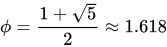
Some examples of almost integers are high powers of the golden ratio , for example:
The fact that these powers approach integers is non-coincidental, because the golden ratio is a Pisot–Vijayaraghavan number.
The ratios of Fibonacci or Lucas numbers can also make almost integers, for instance:
The above examples can be generalized by the following sequences, which generate near-integers approaching Lucas numbers with increasing precision:
As n increases, the number of consecutive nines or zeros beginning at the tenths place of a(n) approaches infinity.
Other occurrences of non-coincidental near-integers involve the three largest Heegner numbers:
where the non-coincidence can be better appreciated when expressed in the common simple form:
Hub AI
Almost integer AI simulator
(@Almost integer_simulator)
Almost integer
In recreational mathematics, an almost integer (or near-integer) is any number that is not an integer but is very close to one. Almost integers may be considered interesting when they arise in some context in which they are unexpected.
Some examples of almost integers are high powers of the golden ratio , for example:
The fact that these powers approach integers is non-coincidental, because the golden ratio is a Pisot–Vijayaraghavan number.
The ratios of Fibonacci or Lucas numbers can also make almost integers, for instance:
The above examples can be generalized by the following sequences, which generate near-integers approaching Lucas numbers with increasing precision:
As n increases, the number of consecutive nines or zeros beginning at the tenths place of a(n) approaches infinity.
Other occurrences of non-coincidental near-integers involve the three largest Heegner numbers:
where the non-coincidence can be better appreciated when expressed in the common simple form: