Hubbry Logo
search
logo
1411706

Almost integer

logo
Community Hub0 Subscribers
Read side by side
from Wikipedia
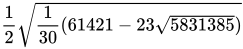
Ed Pegg Jr. noted that the length d equals , which is very close to 7 (approximately 7.0000000857)[1]

In recreational mathematics, an almost integer (or near-integer) is any number that is not an integer but is very close to one. Almost integers may be considered interesting when they arise in some context in which they are unexpected.

Almost integers relating to the golden ratio and Fibonacci numbers

[edit]

Some examples of almost integers are high powers of the golden ratio , for example:
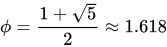
The fact that these powers approach integers is non-coincidental, because the golden ratio is a Pisot–Vijayaraghavan number.

The ratios of Fibonacci or Lucas numbers can also make almost integers, for instance:

The above examples can be generalized by the following sequences, which generate near-integers approaching Lucas numbers with increasing precision:

As n increases, the number of consecutive nines or zeros beginning at the tenths place of a(n) approaches infinity.

Almost integers relating to e and π

[edit]

Other occurrences of non-coincidental near-integers involve the three largest Heegner numbers:

where the non-coincidence can be better appreciated when expressed in the common simple form:[2]


where

and the reason for the squares is due to certain Eisenstein series. The constant is sometimes referred to as Ramanujan's constant.

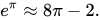
Almost integers that involve the mathematical constants π and e have often puzzled mathematicians. An example is: The explanation for this seemingly remarkable coincidence was given by A. Doman in September 2023, and is a result of a sum related to Jacobi theta functions as follows: The first term dominates since the sum of the terms for total The sum can therefore be truncated to where solving for gives Rewriting the approximation for and using the approximation for gives Thus, rearranging terms gives Ironically, the crude approximation for yields an additional order of magnitude of precision. [1]

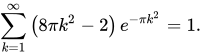
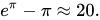
Another example involving these constants is:


See also

[edit]

References

[edit]
[edit]
Revisions and contributorsEdit on WikipediaRead on Wikipedia
from Grokipedia
An almost integer is a real number that is not an integer but differs from one by an extremely small amount, typically less than 10910^{-9} or even much smaller, often arising from evaluations of transcendental or algebraic expressions in mathematics.[1] These near-integers captivate mathematicians due to their unexpected proximity, which can result from deep properties in number theory, such as modular forms or class numbers of quadratic fields, and they frequently involve fundamental constants like π\pi and ee.[2] One of the most renowned examples is Ramanujan's constant, eπ163e^{\pi \sqrt{163}}, which approximates the integer 262537412640768744 with a fractional part of approximately 7.499×10¹³-7.499 \times 10^{-13}, making it indistinguishable from the integer in the first 12 decimal places.[3] This phenomenon stems from the fact that 163 is a Heegner number, the largest integer dd for which the imaginary quadratic field Q(d)\mathbb{Q}(\sqrt{-d}) has class number 1, leading to the j-invariant being an algebraic integer and yielding near-integrality via the modular function.[1] Similar near-integers occur for smaller Heegner numbers like 19, 43, 67, and 163, where eπde^{\pi \sqrt{d}} approaches integers with increasing precision as dd grows.[3] Other notable almost integers include approximations from trigonometric functions, such as sin(11)0.9999902065504253\sin(11) \approx -0.9999902065504253, which is within 10510^{-5} of -1, and expressions like eππ19.9990999791894758e^\pi - \pi \approx 19.9990999791894758, close to 20 by about 9×1049 \times 10^{-4}.[1] High-profile examples also emerge from near-solutions to Fermat's Last Theorem, such as 275+845[30](/page/30)51.999982\frac{27^5 + 84^5}{[30](/page/-30-)^5} \approx 1.999982, accurate to six decimal places, and more precise 12th-power counterexamples like 398712+4365124472121.0000000000189\frac{3987^{12} + 4365^{12}}{4472^{12}} \approx 1.0000000000189, matching 10 digits.[1] These instances underscore the topic's role in recreational mathematics, illustrating how subtle structural features in equations can produce astonishing numerical coincidences.[2]

Fundamentals

Definition

In recreational mathematics, an almost integer is defined as a real number that is not an integer but lies very close to one, meaning the distance to the nearest integer is exceptionally small.[1] This closeness is typically quantified by the condition |x - n| < ε for some integer n and a small positive ε, depending on the context of the approximation.[1] Unlike ordinary rational approximations to irrational numbers, almost integers frequently emerge from evaluations of irrational algebraic or transcendental expressions that produce unexpectedly tiny fractional parts, revealing intriguing numerical coincidences rather than deliberate rational estimates.[1] The quality of such approximations is commonly assessed on a logarithmic scale, for instance through measures like |x - n| < 10^{-k} where k is a large positive integer representing the number of matching decimal digits.[4] To understand almost integers, it is helpful to recall prerequisite concepts from number theory. Irrational numbers are real numbers that cannot be expressed as the ratio of two integers and thus have non-terminating, non-repeating decimal expansions. Diophantine approximation, a branch of number theory, examines how well irrational numbers can be approximated by rational numbers, with almost integers exemplifying particularly strong approximations where the approximating rational has denominator 1 (i.e., an integer).[4]

Historical Development

The historical roots of almost integers trace back to the 13th century with the work of Leonardo of Pisa, known as Fibonacci, who introduced the Fibonacci sequence in his 1202 treatise Liber Abaci. The ratios of consecutive terms in this sequence converge to the golden ratio ϕ=1+52\phi = \frac{1 + \sqrt{5}}{2}, an irrational algebraic number whose powers ϕn\phi^n for integer nn are remarkably close to integers, a property later explained by Binet's formula in 1843, which expresses Fibonacci numbers in terms of ϕ\phi and demonstrates the minimal distance to the nearest integer.[5] This early observation highlighted how certain irrational expressions could yield values with near-integer characteristics, laying foundational groundwork for later explorations in Diophantine approximation. In the 19th century, significant advancements came through studies of transcendental numbers and modular functions. Charles Hermite, in 1859, investigated the j-invariant of elliptic modular functions for imaginary quadratic fields with large discriminants, computing that eπ163e^{\pi \sqrt{163}} is extraordinarily close to the integer 262537412640768744, differing by only about 7.5×10¹³-7.5 \times 10^{-13}, an observation made without modern computing.[1] Ferdinand von Lindemann's 1882 proof of the transcendence of π\pi, building on Hermite's 1873 demonstration that ee is transcendental, indirectly facilitated the analysis of expressions involving ee and π\pi that produce near-integers by confirming their irrational and transcendental nature, thus excluding exact integrality. Srinivasa Ramanujan advanced this area profoundly in 1913–1914 through entries in his notebooks and his published paper "Modular equations and approximations to π\pi," where he independently rediscovered and generalized Hermite's observations, noting that eπde^{\pi \sqrt{d}} for specific discriminants dd (such as 163) yields values extremely close to integers, with the case for d=163d=163 differing from an integer by less than 101210^{-12}. These insights, rooted in Ramanujan's profound intuition for modular forms, were initially recorded in his private notebooks and published during his lifetime in 1914, though full expositions from the notebooks appeared posthumously in edited volumes starting in the 1950s. The modern recognition and popularization of almost integers occurred in the late 20th century, particularly from the 1980s onward, as computational tools enabled precise verifications. In 1988, N. J. A. Sloane, John H. Conway, and Simon Plouffe nearly simultaneously observed that eππ19.999099979e^\pi - \pi \approx 19.999099979, close to 20 within 10310^{-3}, sparking interest in such curiosities.[1] This phenomenon gained traction in recreational mathematics literature, including Martin Gardner's 1975 April Fool's article in Scientific American jesting that Ramanujan's constant was exactly integral, and was further disseminated through resources like Wolfram MathWorld in the 1990s, where high-precision computations confirmed the fractional deviations for various examples.

Algebraic Almost Integers

Golden Ratio and Fibonacci Numbers

The golden ratio, denoted by ϕ=1+521.6180339887\phi = \frac{1 + \sqrt{5}}{2} \approx 1.6180339887, is the positive root of the quadratic equation x2x1=0x^2 - x - 1 = 0.[6] Binet's formula expresses the nnth Fibonacci number FnF_n as
Fn=ϕn(ϕ)n5, F_n = \frac{\phi^n - (-\phi)^{-n}}{\sqrt{5}},
where the second term (ϕ)n=ψn(-\phi)^{-n} = \psi^n and ψ=1520.6180339887\psi = \frac{1 - \sqrt{5}}{2} \approx -0.6180339887 is the other root.[6] Since ψ<1|\psi| < 1, the term ψn/5\psi^n / \sqrt{5} is small for positive integers nn, making ϕn/5\phi^n / \sqrt{5} a near-integer approximation to the exact integer FnF_n, with the difference bounded by 1/(25)0.2236<0.51/(2\sqrt{5}) \approx 0.2236 < 0.5.[6] Thus, FnF_n is the integer closest to ϕn/5\phi^n / \sqrt{5}, and rounding ϕn/5\phi^n / \sqrt{5} to the nearest integer yields FnF_n exactly.[6] A parallel relation holds for the Lucas numbers LnL_n, defined by the same recurrence as the Fibonacci numbers but with initial conditions L0=2L_0 = 2 and L1=1L_1 = 1. The Binet-like formula for Lucas numbers is
Ln=ϕn+ψn, L_n = \phi^n + \psi^n,
which is exactly an integer for each nn.[7] Consequently, ϕn=Lnψn\phi^n = L_n - \psi^n, so ϕn\phi^n approximates the integer LnL_n with an error of ψn-\psi^n, whose absolute value ψn|\psi|^n diminishes rapidly.[7] For n>2n > 2, rounding ϕn\phi^n to the nearest integer gives LnL_n.[7] Representative examples illustrate this near-integer behavior. For n=5n=5, ϕ511.0901699437\phi^5 \approx 11.0901699437, which is close to the Lucas number L5=11L_5 = 11 with an error of approximately 0.09020.0902; meanwhile, ϕ5/54.9595084972\phi^5 / \sqrt{5} \approx 4.9595084972, close to the Fibonacci number F5=5F_5 = 5 with an error of approximately 0.04050.0405.[6][7] For n=10n=10, ϕ10122.9918693816\phi^{10} \approx 122.9918693816, close to L10=123L_{10} = 123 with an error of approximately 0.00810.0081; and ϕ10/555.0036199104\phi^{10} / \sqrt{5} \approx 55.0036199104, close to F10=55F_{10} = 55 with an error less than 10210^{-2}.[6][7] The fractional parts in these approximations converge to zero exponentially fast because ψ=(ϕ)10.618<1|\psi| = |(-\phi)^{-1}| \approx 0.618 < 1, so the error terms ψn/5|\psi^n| / \sqrt{5} and ψn|\psi^n| decay as O(ψn)O(|\psi|^n).[6][7] This property highlights how powers of the golden ratio generate almost integers through their intimate connection to the Fibonacci and Lucas sequences.[6][7]

Units in Real Quadratic Fields

In real quadratic number fields Q(d)\mathbb{Q}(\sqrt{d}), where d>0d > 0 is a square-free integer, the ring of integers possesses a group of units that includes a fundamental unit ε>1\varepsilon > 1 of the form ε=x+yd\varepsilon = x + y \sqrt{d} with x,yx, y positive integers.[8] The conjugate ε=xyd\varepsilon' = x - y \sqrt{d} satisfies 0<ε<10 < |\varepsilon'| < 1, ensuring that powers of ε\varepsilon generate approximations to integers. Specifically, εn+(ε)n=tn\varepsilon^n + (\varepsilon')^n = t_n, where tnt_n is an integer for each positive integer nn, and since (ε)n|(\varepsilon')^n| becomes arbitrarily small as nn increases, εntn(ε)n\varepsilon^n \approx t_n - (\varepsilon')^n, making εn\varepsilon^n an almost integer close to tnt_n.[9] This phenomenon arises because the fundamental unit ε\varepsilon is a Pisot number, a real algebraic integer greater than 1 whose other Galois conjugates (here, just ε\varepsilon') have absolute value less than 1; such numbers systematically produce almost integers via their powers.[9] The error term εntn=(ε)n| \varepsilon^n - t_n | = |(\varepsilon')^n| decreases exponentially with base ε<1|\varepsilon'| < 1, providing quantitative bounds on the approximation quality—for instance, the distance to the nearest integer is at most εn|\varepsilon'|^n. For even nn, particularly when the norm of ε\varepsilon is 1-1, the approximation aligns directly with integer values without additional sign adjustments.[9] A representative example occurs in Q(3)\mathbb{Q}(\sqrt{3}), where the fundamental unit is ε=2+33.732\varepsilon = 2 + \sqrt{3} \approx 3.732 with norm 1 and conjugate ε0.268\varepsilon' \approx 0.268. The powers satisfy the relation εn=xn+yn3\varepsilon^n = x_n + y_n \sqrt{3}, where xn,ynx_n, y_n are positive integers obeying the recurrence from the minimal polynomial t24t+1=0t^2 - 4t + 1 = 0, and tn=2xnt_n = 2 x_n. For n=10n=10, ε10=262087+1513163524173.999998092\varepsilon^{10} = 262087 + 151316 \sqrt{3} \approx 524173.999998092, which is within 1.908×1061.908 \times 10^{-6} of the integer 524174, illustrating the rapid convergence.[9] Generalizing, higher even powers of ε\varepsilon yield even closer approximations, with errors on the order of 10k10^{-k} for sufficiently large even nn proportional to the exponent. In other real quadratic fields, similar behavior holds. For Q(2)\mathbb{Q}(\sqrt{2}), the fundamental unit is 1+22.4141 + \sqrt{2} \approx 2.414 with norm 1-1 and conjugate 120.4141 - \sqrt{2} \approx -0.414, and its square η=(1+2)2=3+225.828\eta = (1 + \sqrt{2})^2 = 3 + 2\sqrt{2} \approx 5.828 has norm 1. Powers of η\eta produce almost integers; for example, (1+2)15551614.0000018128(1 + \sqrt{2})^{15} \approx 551614.0000018128, deviating from 551614 by about 1.81×1061.81 \times 10^{-6}, bounded by 12151.81×106|1 - \sqrt{2}|^{15} \approx 1.81 \times 10^{-6}.[9] The error in these cases depends crucially on the magnitude of the conjugate, with smaller ε|\varepsilon'| yielding tighter approximations for comparable nn. This connection to almost integers stems from the units solving Pell equations x2dy2=±1x^2 - d y^2 = \pm 1, where solutions (xk,yk)(x_k, y_k) generate the powers εk=xk+ykd\varepsilon^k = x_k + y_k \sqrt{d}, and the integer traces tk=2xkt_k = 2 x_k (for norm 1 units) or adjusted for norm 1-1 ensure the near-integer property.[10] Seminal work by Pisot established that such quadratic units are prototypical examples of numbers whose powers approximate integers exceptionally well, influencing broader studies in Diophantine approximation.[9]

Transcendental Almost Integers

Expressions Involving e and π

One notable example of an almost integer arises from the expression eππe^\pi - \pi, which evaluates to approximately 19.999099979 and is within 0.000900021 of the integer 20.[1] This near-equality can also be expressed in complex form as $ (\pi + 20)^i \approx -0.9999999992 - 0.0000388927i $, close to -1.[1] The discovery and analysis of this relation are detailed in a study by Maze and Minder, who explored its implications in the context of complex exponentiation. Another striking near-identity involves higher powers: e6π4π50.000017673e^6 - \pi^4 - \pi^5 \approx 0.000017673, which is remarkably close to the integer 0, with an absolute error on the order of 10510^{-5}.[1] This approximation underscores coincidental alignments between powers of the transcendental constants ee and π\pi, though no deep theoretical connection is established beyond numerical observation.[1] Similarly, the ratio π9/e89.9998387\pi^9 / e^8 \approx 9.9998387 approaches the integer 10 with an error of about 0.0001613, providing another instance where exponential and polynomial expressions in π\pi and ee yield near-integers.[1] A linear combination also produces a close approximation: 163(πe)68.999664163(\pi - e) \approx 68.999664, deviating from the integer 69 by roughly 0.000336.[1] This example illustrates how scaling the difference between π\pi and ee can amplify small discrepancies to reveal almost integer behavior, though the specific coefficient 163 arises from numerical exploration rather than a priori derivation.[1] Such expressions emphasize the intriguing numerical proximity of ee and π\pi in simple algebraic forms, contributing to their study in recreational and computational number theory.

Ramanujan's Near-Integers from Heegner Numbers

The expression $ e^{\pi \sqrt{163}} $ approximates 262537412640768743.99999999999925007, with an error of approximately $ -7.5 \times 10^{-13} $ from the integer 262537412640768744.[11] This near-integrality was first noted by Charles Hermite in 1859 and is sometimes referred to as "Ramanujan's constant" due to a 1975 April Fool's hoax by Martin Gardner, who falsely claimed it was an exact integer conjectured by Ramanujan; it highlights a profound near-integer property tied to advanced number theory. The value can be expressed as $ e^{\pi \sqrt{163}} \approx (640320)^3 + 744 $, where the deviation arises from higher-order terms in the expansion of the modular j-invariant function.[12] This phenomenon generalizes to specific positive square-free integers $ d $, known as Heegner numbers: 1, 2, 3, 7, 11, 19, 43, 67, and 163. These are the discriminants for which the imaginary quadratic field $ \mathbb{Q}(\sqrt{-d}) $ has class number 1, meaning the ideal class group is trivial.[13] The class number 1 property ensures that the j-invariant $ j(\tau) $, evaluated at $ \tau = \frac{1 + \sqrt{-d}}{2} $, is an algebraic integer. For these fields, $ j(\tau) $ takes integer values, and the near-integer behavior of $ e^{\pi \sqrt{d}} $ stems from the q-expansion of the j-function:
j(τ)=q1+744+196884q+n=2cnqn, j(\tau) = q^{-1} + 744 + 196884 q + \sum_{n=2}^{\infty} c_n q^n,
where $ q = e^{2\pi i \tau} = -e^{-\pi \sqrt{d}} $, so $ q^{-1} = -e^{\pi \sqrt{d}} $, and all coefficients $ c_n $ are non-negative integers. Rearranging gives
eπd744j(τ), e^{\pi \sqrt{d}} \approx 744 - j(\tau),
with the approximation improving as $ d $ increases because the higher terms $ \sum c_n q^n $ become negligibly small due to the tiny $ |q| \approx e^{-\pi \sqrt{d}} $. The trivial class group implies a unique ideal class, making $ j(\tau) $ an integer and positioning it close to a rational (in this case, -744 plus a large cubic integer), which drives the exceptional proximity.[12] For smaller Heegner numbers, the approximations are less precise but still notable. For $ d = 67 $, $ e^{\pi \sqrt{67}} \approx 147197952743.99999866 $, or equivalently $ (5280)^3 + 744 $, with an error of about $ 1.3 \times 10^{-6} $.[1] Similarly, for $ d = 43 $, $ e^{\pi \sqrt{43}} \approx 884736743.999777 $, error roughly $ 2.2 \times 10^{-4} $. These cases illustrate how the class number 1 condition yields algebraic integers whose modular expansion aligns $ e^{\pi \sqrt{d}} $ remarkably near rationals, with the closeness scaling with the size of $ d $ among the finite list of Heegner numbers.[13]

Significance

Connections to Number Theory

Almost integers exemplify exceptional cases in Diophantine approximation, where irrational numbers can be approximated by rationals to an extraordinarily high degree of precision. In number theory, Diophantine approximation studies how well real numbers, particularly irrationals, can be approximated by rational fractions $ p/q $, quantified by inequalities of the form $ |\alpha - p/q| < 1/(c q^2) $ for some constant $ c $. Almost integers arise when such approximations yield values extremely close to integers, often surpassing typical bounds for most irrationals. A foundational result in this area is Hurwitz's theorem, which states that for any irrational $ \alpha $, there are infinitely many rationals $ p/q $ satisfying $ |\alpha - p/q| < 1/(\sqrt{5} q^2) $, and $ \sqrt{5} $ is the optimal constant, achieved precisely for the golden ratio and its quadratic conjugates.[14][9] The phenomenon of almost integers is further illuminated through the lens of continued fractions, which generate the best rational approximations to irrationals and reveal the quality of these approximations via the growth of partial quotients. For quadratic irrationals, continued fractions are periodic, leading to bounded partial quotients and thus the sharp constant in Hurwitz's theorem; however, certain transcendental almost integers exhibit even better approximations, akin to those from unbounded continued fractions but with finite, exceptional closeness. This connection underscores why almost integers, while not algebraic in many cases, mimic the approximation properties of quadratic irrationals.[9] To quantify the "almost" nature of these integers, number theorists employ the irrationality measure $ \mu(\alpha) $, defined as the supremum of $ \lambda $ such that $ |\alpha - p/q| < 1/q^\lambda $ holds for infinitely many integers $ p, q > 0 $. For rational $ \alpha $, $ \mu(\alpha) = 1 $; for algebraic irrationals, Roth's theorem establishes $ \mu(\alpha) = 2 $; and for almost all reals, $ \mu(\alpha) = 2 $ almost everywhere. Transcendental almost integers often have finite but greater than 2 measures, indicating superior rational approximations compared to typical transcendentals, though bounded above by theorems like those of Mahler or Ridout.[15][16] In the context of modular forms, almost integers emerge prominently through the j-invariant of elliptic curves over imaginary quadratic fields. For discriminants corresponding to Heegner numbers—square-free positive integers $ d $ where $ \mathbb{Q}(\sqrt{-d}) $ has class number 1—the j-invariant $ j(\tau) $ for $ \tau = (1 + \sqrt{-d})/2 $ is an algebraic integer, and in fact an integer itself. The Baker–Stark–Heegner theorem resolves the class number one problem by proving there are exactly nine such fields, with Heegner numbers 1, 2, 3, 7, 11, 19, 43, 67, 163, thereby explaining why expressions like $ e^{\pi \sqrt{163}} $ yield near-integers via the modular equation relating j-values. This theorem, combining analytic and algebraic methods, highlights how class field theory and modular forms produce these approximations, linking almost integers to deep structures in algebraic number theory.[17][18] Finally, almost integers bridge number theory and transcendence theory, as exemplified by expressions like $ e^{\pi \sqrt{d}} $ for integer $ d $. These numbers are transcendental, as established by results in transcendental number theory beyond the Lindemann–Weierstrass theorem (which applies to algebraic exponents). Despite this transcendence, these numbers are remarkably close to algebraic integers, such as when $ d = 163 $, where the fractional part is on the order of $ 10^{-12} $, illustrating a tension between algebraic-like behavior and proven transcendence.

Role in Recreational Mathematics

Almost integers have captivated enthusiasts in recreational mathematics since Martin Gardner highlighted them in his April 1975 "Mathematical Games" column in Scientific American, presenting the near-integer $ e^{\pi \sqrt{163}} $ as part of an April Fools' prank that nonetheless sparked widespread amateur interest and computations.[19] Gardner's engaging style in such columns, later collected in books like Mathematical Circus (1979), encouraged readers to explore these numerical curiosities, turning abstract approximations into accessible wonders that blend computation and surprise.[20] In puzzles and challenges, almost integers often appear as exercises in approximation and verification, such as determining values of $ n $ where $ \phi^n / \sqrt{5} $ (with $ \phi $ the golden ratio) yields the closest approximations to integers, revealing the deep ties between irrationals and integer sequences like the Fibonacci numbers.[1] Another classic challenge involves using calculators or basic programs to compute $ e^{\pi \sqrt{163}} $ and observe its deviation from the integer 262537412640768744 by a mere fraction like $ -7.499 \times 10^{-13} $, testing the limits of precision and inspiring hands-on experimentation.[11] These phenomena played a key role in early computer mathematics demonstrations during the 1970s, where programs on mainframes and emerging personal calculators extended the decimal expansions of expressions like $ e^{\pi \sqrt{163}} $ to reveal strings of up to 2 million nines, showcasing computational power and fueling hobbyist programming efforts.[19] In modern contexts, almost integers continue as "numerical coincidences" in educational media, such as the 2012 Numberphile video on the Ramanujan constant, which has drawn millions of views and broadened public fascination with transcendental numbers.[21]
User Avatar
No comments yet.