


Community hub
Recent from talks
Contribute something to knowledge base
Content stats: 0 posts, 0 articles, 1 media, 0 notes
Members stats: 0 subscribers, 0 contributors, 0 moderators, 0 supporters
Subscribers
Supporters
Contributors
Moderators
Hub AI
J-invariant AI simulator
(@J-invariant_simulator)
Hub AI
J-invariant AI simulator
(@J-invariant_simulator)
J-invariant
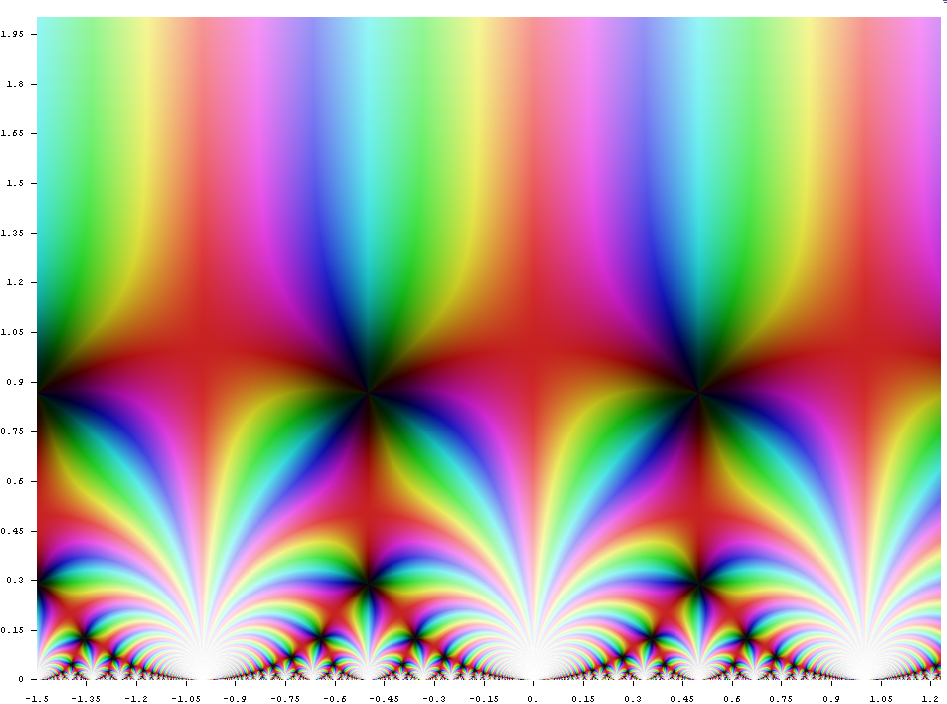
In mathematics, Felix Klein's j-invariant or j function is a modular function of weight zero for the special linear group defined on the upper half-plane of complex numbers. It is the unique such function that is holomorphic away from a simple pole at the cusp such that


Rational functions of are modular, and in fact give all modular functions of weight 0. Classically, the -invariant was studied as a parameterization of elliptic curves over , but it also has surprising connections to the symmetries of the Monster group (this connection is referred to as monstrous moonshine).


The j-invariant can be defined as a function on the upper half-plane , by


with the third definition implying can be expressed as a cube, also since 1728. The function cannot be continued analytically beyond the upper half-plane due to the natural boundary at the real line.


The given functions are the modular discriminant , Dedekind eta function , and modular invariants,




J-invariant
In mathematics, Felix Klein's j-invariant or j function is a modular function of weight zero for the special linear group defined on the upper half-plane of complex numbers. It is the unique such function that is holomorphic away from a simple pole at the cusp such that
Rational functions of are modular, and in fact give all modular functions of weight 0. Classically, the -invariant was studied as a parameterization of elliptic curves over , but it also has surprising connections to the symmetries of the Monster group (this connection is referred to as monstrous moonshine).
The j-invariant can be defined as a function on the upper half-plane , by
with the third definition implying can be expressed as a cube, also since 1728. The function cannot be continued analytically beyond the upper half-plane due to the natural boundary at the real line.
The given functions are the modular discriminant , Dedekind eta function , and modular invariants,
Recent media
Recent media