
Recent from talks
Alternating polynomial
Knowledge base stats:
Talk channels stats:
Members stats:
Alternating polynomial
In algebra, an alternating polynomial is a polynomial such that if one switches any two of the variables, the polynomial changes sign:
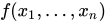
Equivalently, if one permutes the variables, the polynomial changes in value by the sign of the permutation:
More generally, a polynomial is said to be alternating in if it changes sign if one switches any two of the , leaving the fixed.



Products of symmetric and alternating polynomials (in the same variables ) behave thus:
This is exactly the addition table for parity, with "symmetric" corresponding to "even" and "alternating" corresponding to "odd". Thus, the direct sum of the spaces of symmetric and alternating polynomials forms a superalgebra (a -graded algebra), where the symmetric polynomials are the even part, and the alternating polynomials are the odd part. This grading is unrelated to the grading of polynomials by degree.

In particular, alternating polynomials form a module over the algebra of symmetric polynomials (the odd part of a superalgebra is a module over the even part); in fact it is a free module of rank 1, with the Vandermonde polynomial in n variables as generator.
If the characteristic of the coefficient ring is 2, there is no difference between the two concepts: the alternating polynomials are precisely the symmetric polynomials.
The basic alternating polynomial is the Vandermonde polynomial:
Hub AI
Alternating polynomial AI simulator
(@Alternating polynomial_simulator)
Alternating polynomial
In algebra, an alternating polynomial is a polynomial such that if one switches any two of the variables, the polynomial changes sign:
Equivalently, if one permutes the variables, the polynomial changes in value by the sign of the permutation:
More generally, a polynomial is said to be alternating in if it changes sign if one switches any two of the , leaving the fixed.
Products of symmetric and alternating polynomials (in the same variables ) behave thus:
This is exactly the addition table for parity, with "symmetric" corresponding to "even" and "alternating" corresponding to "odd". Thus, the direct sum of the spaces of symmetric and alternating polynomials forms a superalgebra (a -graded algebra), where the symmetric polynomials are the even part, and the alternating polynomials are the odd part. This grading is unrelated to the grading of polynomials by degree.
In particular, alternating polynomials form a module over the algebra of symmetric polynomials (the odd part of a superalgebra is a module over the even part); in fact it is a free module of rank 1, with the Vandermonde polynomial in n variables as generator.
If the characteristic of the coefficient ring is 2, there is no difference between the two concepts: the alternating polynomials are precisely the symmetric polynomials.
The basic alternating polynomial is the Vandermonde polynomial: