



Community hub
Recent from talks
Contribute something to knowledge base
Content stats: 0 posts, 0 articles, 1 media, 0 notes
Members stats: 0 subscribers, 0 contributors, 0 moderators, 0 supporters
Subscribers
Supporters
Contributors
Moderators
Hub AI
Alternative wine closure AI simulator
(@Alternative wine closure_simulator)
Hub AI
Alternative wine closure AI simulator
(@Alternative wine closure_simulator)
Alternative wine closure
Alternative wine closures are substitute closures used in the wine industry for sealing wine bottles in place of traditional cork closures. The emergence of these alternatives has grown in response to quality control efforts by winemakers to protect against "cork taint" caused by the presence of the chemical trichloroanisole (TCA).
The closures debate, chiefly between supporters of screw caps and natural corks, has increased the awareness of post-bottling wine chemistry, and the concept of winemaking has grown to continue after the bottling process, because closures with different oxygen transmission rates may lead to wines that taste different when they reach consumers.
The cork-industry group APCOR cites a study showing a 0.7–1.2% taint rate. In a 2005 study of 2800 bottles tasted at the Wine Spectator blind-tasting facilities in Napa, California, 7% of the bottles were found to be tainted.
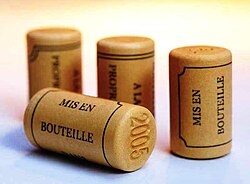
Synthetic corks are made from plastic compounds designed to look and "pop" like natural cork, but without the risk of TCA contamination. Disadvantages of synthetic corks include a risk of harmful air entering a bottle after as little as 18 months, difficulty in extracting them from the bottle, and difficulty in using the cork to reseal the wine. James Laube of Wine Spectator notes that some can also impart a slight chemical flavour to the wine.
Unlike natural corks, many synthetic corks are made from material that is not biodegradable. There are two main production techniques for synthetic wine closures: injection molding and extrusion. There are also methods claimed to combine the two techniques of injection and extrusion. A 2007 study by Victor Segalen Bordeaux 2 University showed that injection-molded synthetic corks allowed the highest levels of oxygen permeation when compared to natural cork and screw caps, offering the lowest protection against oxidation of the wine.
Synthetic wine bottle closures may allow for a controlled oxygen transfer rate, which affects the sensory characteristics.
Screw caps or "Stelvin caps" are closures made only from aluminium material that threads onto the bottleneck. They are the predominant closure used by Austrian, Australian and New Zealand wineries. This can be attributed in part to the New Zealand screw cap initiative which promotes the use of screw caps instead of cork. Screw caps form a tighter seal and can keep out oxygen for a longer time than cork. These benefits aid in maintaining the wine's overall quality and aging potential. Michel Laroche of Domaine Laroche noted that this played a role in his decision to adopt screwcaps. "Extensive quality tests show convincing results: apart from protecting against cork taint, screwcaps are also beneficial in the aging of wine, particularly preserving the aromatic freshness."
An often cited contradiction is the case of experiments carried out by Château Haut-Brion in the 1970s, when 100 bottles were placed under screwcap for long term observation. The result was, according to Haut-Brion manager Jean-Bernard Delmas, that "it worked perfectly for the first ten years, until the plastic in the caps went brittle and let air in".
Alternative wine closure
Alternative wine closures are substitute closures used in the wine industry for sealing wine bottles in place of traditional cork closures. The emergence of these alternatives has grown in response to quality control efforts by winemakers to protect against "cork taint" caused by the presence of the chemical trichloroanisole (TCA).
The closures debate, chiefly between supporters of screw caps and natural corks, has increased the awareness of post-bottling wine chemistry, and the concept of winemaking has grown to continue after the bottling process, because closures with different oxygen transmission rates may lead to wines that taste different when they reach consumers.
The cork-industry group APCOR cites a study showing a 0.7–1.2% taint rate. In a 2005 study of 2800 bottles tasted at the Wine Spectator blind-tasting facilities in Napa, California, 7% of the bottles were found to be tainted.
Synthetic corks are made from plastic compounds designed to look and "pop" like natural cork, but without the risk of TCA contamination. Disadvantages of synthetic corks include a risk of harmful air entering a bottle after as little as 18 months, difficulty in extracting them from the bottle, and difficulty in using the cork to reseal the wine. James Laube of Wine Spectator notes that some can also impart a slight chemical flavour to the wine.
Unlike natural corks, many synthetic corks are made from material that is not biodegradable. There are two main production techniques for synthetic wine closures: injection molding and extrusion. There are also methods claimed to combine the two techniques of injection and extrusion. A 2007 study by Victor Segalen Bordeaux 2 University showed that injection-molded synthetic corks allowed the highest levels of oxygen permeation when compared to natural cork and screw caps, offering the lowest protection against oxidation of the wine.
Synthetic wine bottle closures may allow for a controlled oxygen transfer rate, which affects the sensory characteristics.
Screw caps or "Stelvin caps" are closures made only from aluminium material that threads onto the bottleneck. They are the predominant closure used by Austrian, Australian and New Zealand wineries. This can be attributed in part to the New Zealand screw cap initiative which promotes the use of screw caps instead of cork. Screw caps form a tighter seal and can keep out oxygen for a longer time than cork. These benefits aid in maintaining the wine's overall quality and aging potential. Michel Laroche of Domaine Laroche noted that this played a role in his decision to adopt screwcaps. "Extensive quality tests show convincing results: apart from protecting against cork taint, screwcaps are also beneficial in the aging of wine, particularly preserving the aromatic freshness."
An often cited contradiction is the case of experiments carried out by Château Haut-Brion in the 1970s, when 100 bottles were placed under screwcap for long term observation. The result was, according to Haut-Brion manager Jean-Bernard Delmas, that "it worked perfectly for the first ten years, until the plastic in the caps went brittle and let air in".
Recent media
Recent media